Sunday, April 22, 2012

Spotlight on Nurse Thorne

By Tracy Adams
(pseud. Sofi O’Bryan), ©1962

Inspired by her medical student fiancé, Cindy Thorne abandoned her acting career to become a nurse. But the details of medical training and the strain of awaiting his return made her question her decision. Was her dedication to helping humanity strong enough to counter the excitement of a new appearance behind the footlights and the charm of an intriguing leading man?

GRADE: C+

BEST QUOTES:
“With a love scene like that you’ll give all the doctors high blood pressure and they’ll kick you out of nursing, baby.”

“My heart is in real bad shape, suffering from a stenosis there’s no name for.”

REVIEW:
Cindy Thorne is a former child star with a haranguing stage mother who has lost her chance at glory by association when the child in question opted for a more pedestrian career: While researching a role at a hospital, Cindy met this intern, Bruce, and soon decided to chuck Hollywood for nursing school so she could help him when he goes into practice. (But it’s also apparent that Hollywood had dropped Cindy as well, as she had become too old to play a child, and roles for older girls weren’t forthcoming.)

When the book opens, Cindy is a few months from graduating from nursing school, and her class has decided to stage a production of My Fair Lady. Cindy, of course, lands the lead. There’s this intern, Ted Morrow, who qualifies for the part of Henry Higgins basically by being cute, but he comes with the extra advantage that he’s already pining for his leading lady. As play rehearsals progress, Cindy spends a lot of time thinking about how much she loves being on the stage and asking herself if nursing is really the right career for her. Oh, and dating – and kissing – Ted, despite her being all but engaged to Bruce. As graduation and opening night approach, her internal struggles increase in frequency and amplitude, until both are over and Cindy is heading out for a celebratory night on the town with Bruce, planning to tell him that she’s going to quit nursing before her shiny new RN pin has even cooled. Then their cab is brought to a halt in a traffic jam caused by a fire in the subway near the Times building on 42nd Street – and she and Bruce are simultaneously tumbling out onto the street to go help the injured. Somehow this instinctive reaction completely negates all those pages of internal turmoil, and “she belonged in this white uniform, in these white oxfords and white stockings. She wouldn’t exchange places with any other girl in the world.”

I’ve spent the morning wondering what to say about this book. As you can see from the pair of paragraphs above, there’s not really much to say. It’s mildly pleasant, but it has next to no camp or humor, and it’s a bit earnest for my taste, with too much fretting over how emotionally demanding nursing is. The cast of characters is overly large; we whiz past 12 other nursing students, getting to know just one, who is unfortunately a bit irritating. Our brief exposure to Bruce – he doesn’t even have a last name – is not enough to make for a satisfying ending when she chooses him over Ted. I was also somewhat taken aback, given Cindy’s previously strong conviction that she needed to be an actress, that she could reverse herself for apparently no more of reason than that she reached for a car door handle in a moment of crisis. In the end, the spotlight is focused on a fickle nurse engaged to a stranger, and I’m more than ready to leave the theater.

Monday, April 16, 2012

Nurse Kitty’s Secret

By Fern Shepard
(pseud. Florence Stonebraker), ©1963
Cover illustration by Rudy Nappi


At times, Kitty McCarthy thought she had buried her unhappy past. She was young, beautiful, raven-haired—and now all she wanted was to make good as an R.N. at Miner’s Hospital in the Kentucky hills—and to marry rugged Dr. Gary Harding—whose dream it was to see his little hospital properly equipped and endowed. Then, one day, Kitty’s brave new world fell apart—when Hollywood film queen Sherri Shannon was brought in—an accident victim. Sherri soon decided she wanted young Dr. Harding and would win him—if she had to destroy Kitty by ruthless trickery and by divulging the dark secret that involved both their pasts …

GRADE: C

BEST QUOTES:
“Being born my child was the most important thing that could have happened to you.”

“Nurses don’t weep!”

“Jeff would be a good catch for any girl. One of these days he was going to be an excellent gynecologist. He had all the necessary qualities.”

“I’ll be twenty-four. That’s pretty ancient, so maybe by then I’ll have more sense and a clearer head.”

“No wonder it had been so easy to lose Gary who, for all of his serious side, was a very human man. Such men were attracted to women who never forgot to be intensely feminine, who understood the importance of small vanities, of working hard to look beautiful even if they were not beautiful.”

“When you want something with all your heart, you must expect to pay a price for it.”

REVIEW:

You can usually count on Florence Stonebraker for a lively romp, with sparkling writing, characters that hold nothing back, and a wry wit. Nurse Kitty’s Secret could have been all that. It has the necessary ingredients: a femme fatale, a sassy sidekick, and even a tiny revolver pulled from a sequined clutch. Just add vodka and a twist of lemon, and enjoy responsibly! But despite these individual gems, they’re just not substantial enough to produce something to sigh over. In the end, Nurse Kitty’s Secret is your longtime fiancé finally pulling out a ring—and it’s microscopic diamonds set in silver.

I was hopeful with the very first sentence: “At exactly what moment Sherri was going to let the cat out of the bag concerning their relationship, Kitty McCarthy did not know.” All right! Enter Sherri Shannon who, at 42, is one of Hollywood’s most beautiful women, but you know as well as I do how keeping your chins and crow’s feet in check at such an advanced age can make a gal utterly neurotic. She’s been in a car accident in the boonies of Kentucky and has been transported to Miners’ Hospital, where Kitty is a nurse. No coincidence, this: Sherri had hired detectives to track down her long-lost daughter when she found herself alone and bored after the death of her fourth husband. In no time flat she is fluffing her platinum blonde hair and pressing her sculptured moue on Dr. Gary Harding, the medico who runs the hospital, in spite (or—could it be?—because) of the fact that he is currently all but engaged to Kitty. (As usual, the man in question cannot bring himself to marry, “as long as I am not earning enough to provide the kind of life I would want to provide for a wife and family.” These sorts of dopes unfailingly find themselves at the altar within 100 pages of such idiotic declarations.)

Kitty wants nothing to do with her glamorous mother because seven years ago the woman tried to have her committed to an insane asylum. It’s not clear why Sherri is so eager to persecute her daughter after a such a long hiatus, and she gets off to a weak start, haranguing Kitty to find her favorite tweezers—“I simply couldn’t get along without them!”—in amongst the creams and oils and lipstick papers littering the bathroom of Sherri’s hospital room. Indeed, after this weak attack she barely has the chance to sharpen her claws any further, immediately striking a deal with Kitty: She will organize a huge fund-raiser to build a new wing for the hospital if Kitty will quit her job and leave town. Kitty realizes that “it was Gary’s lifetime dream. To take it from him would be to take everything that was important to him”—or, in Sherri’s words, Kitty is “a foolish little sentimentalist […] just the type to give up your man in order to give him his heart’s desire”—and promptly tenders her resignation.

Kitty plans to leave town, but something always stands in her way. There’s that 16-year-old bride carrying an ectopic pregnancy, who begs Kitty to help her: She’s been advised by Kitty’s uncle, who plays the role of the wise, aged family doctor, to “guard against over-exertion and fatigue, be careful of her diet,” but I just can’t see how either of these precautions is going to keep her fallopian tube from rupturing and causing serious hemorrhage, even death.


So Kitty’s always hearing rumors from her pals at the hospital about the romance that Sherri is foisting on the dopey Dr. Gary. He wants his new hospital so much that he plays along—only to realize too late that “that fiendish woman—and she must be a fiend, treating you as she did—expects me to marry her! […] Think what it will mean to me to be married to that screwy woman!” But the pragmatic Kitty reminds him that his precious hospital hangs in the balance. And besides, “Marrying Sherri won’t mean a life sentence, honey. Her marriages never last very long.” Oh. Well, in that case …

The benefit goes off, but without the doctor—whose engagement to Sherri was to be announced at its conclusion—because he’s in surgery saving the kid whose ectopic pregnancy has indeed nearly killed her. Never saw that one coming. The money is raised, and Sherri turns up in a gold lame sheath dress, sporting a small shiny revolver to collect her vengeance. But it’s too little, too late. This scene plays out like a mangy stray with heatstroke compared to the fiery tiger it could have been.

Another sign that this book was doomed to disappoint was the fate of the liveliest character, hospital receptionist Liz Tracey. Liz is the sassy, wry sidekick who flings off lines like, “What’s with our Love Goddess this bright spring morning?” and “Miss Shannon is holding her own: Her temperature is normal, her blood pressure is normal, her appetite is normal, she wanted champagne for breakfast. We think she will live.” And she decamps for California halfway through the book, after Sherri told her that she ought to “strive to project a sweet, cheery personality. Me!” Frankly, I wish we could have gone with her. It would have made for a spicier book.

Saturday, April 14, 2012

University Nurse

By Arlene Hale, ©1967
Cover illustration by Lou Marchetti

Sara Arnold, the nurse at Heights University, knew what it was to go beyond the call of duty, to help sick or troubled students. But she needed love, too, and she couldn’t share Noel with so many of his devoted—and beautiful students. Sara loved the dedicated young professor, but how could she accept just a small corner of his life when someone like Hal offered her his whole world? For Hal was the kind of man who would give up all for the woman he loved. As a responsible nurse, Sara could understand Noel’s dedication to his career, but sometimes even a girl like Sara, usually so full of common sense, had trouble choosing between what reason dictated and her heart demanded.

GRADE: C

BEST QUOTES:
“It’s a living. I’d swap it any time for a home, kids and a husband.”

“ ‘Hmm, your hair smells so good.’
“ ‘Shampooed it last night, just for you.’ ”

“ ‘You look right in a kitchen. I thought professional women were never much for homemaking.’
“ ‘You’re wrong,’ Sara answered. ‘We’re women first and then professionals.’ ”

REVIEW:
Arlene Hale was a very prolific writer, penning more than one hundred books under this name, and she had at least six other pseudonyms as well. Quantity, however, seldom has anything to with quality in a best-selling author; I have found Arlene Hale’s books to be mostly mediocre (this is the eighth I’ve read). And so we have University Nurse.

Sara Arnold, the RN for Heights University, is dating sociology prof Noel Tyler. Their dates consist of her laying her head on his tweedy shoulder as he smokes a pipe in his book-lined study. Oh, and fighting about how he spends too much of his free time with his students, the co-eds especially, and this one girl in particular. Anne Marie Parker, a 22-year-old senior, is perennially turning up on Noel’s doorstep. Noel won’t tell Sara what he and Anne Marie talk about, because it’s confidential, but Sara has a few unflattering ideas.

Despite Sara’s objections, the visits to Noel’s house don’t stop, and now Professor Garth, the old chem prof, is dropping by as well. He has a troubled marriage, and rumors are flying that he is involved with one of the undergrads. Soon the Dean hears that it’s Anne Marie who is getting extra help in chemistry, and Prof. Garth is fired. Anne Marie is about to be expelled herself when she turns up at Noel’s house again. Noel sees no problem in “tightening his arms around her for a moment. In a way, Anne Marie was much as he had been as an orphaned boy, needing help, needing love, needing someone’s shoulder to lean on. He would and could help this girl. He lifted her tear-smudged face in his hands. Even like this, she was a fragile, beautiful thing and his heart ached to help her.” Clearly he has learned nothing from the cautionary tale of Prof. Garth.

Anne Marie tells Noel that nothing happened between her and Prof. Garth, and he insists that she go to the Dean and tell him this, or he will. Of course, when Sara learns of this latest tête à tête, she argues with Noel; she feels that if she had really wanted to, Anne Marie would have gone to the Dean long ago and prevented Prof. Garth from being fired in the first place, and Sara wonders if Anne Marie needs some therapy. Noel is hotly defending Anne Marie’s psychiatric integrity and about to break up with Sara when the phone rings: rather than go to the Dean, Anne Marie went to the medicine cabinet and attempted suicide with its contents.

When Sara and Noel get to Anne Marie’s hospital room, she asks them if anyone has cabled her father, an elusive businessman who has never had time for his daughter. “They must! They must!” she tells them. “Otherwise, it was all for—” Sara and Noel immediately deduce that Anne Marie had set up the whole “affair” with Prof. Garth as well as the suicide attempt to get her father’s attention. Noel takes the whole thing very hard, feeling that it’s entirely his fault that Anne Marie attempted suicide, because his rescue of Prof. Garth’s reputation and Anne Marie’s enrollment in the university meant that Anne Marie felt compelled to take some other drastic action to force her father to notice her.

I’m sure I don’t have to explain any more for you to see where this story is going. It’s a simple story, simply told, without much camp or fun or humor. It’s a quick read, but the best thing about this book is the cover—the illustration by Lou Marchetti as well as the cover line, “The professor understood everything but love.”

Saturday, March 31, 2012

Nurse Betrayed

By Jeanne J. Bowman
(pseud. Peggy O’More Blocklinger), ©1966


Nurse Trudy Holmes left Dane Memorial Hospital to care for the post-operative wife of wealthy Dr. Malcolm Morse. Dr. Morse painted a glowing picture of Medicine Mountain as a quiet retreat which would be more of a “paid vacation” than a nursing assignment for Trudy. Although she hesitated leaving the hospital the two doctors she loved, Trudy accepted the assignment eagerly, for she had worked so hard for several years putting herself through nursing school and training at the hospital. But Trudy didn’t count on a pampered young debutante and an old country witch doctor complicating her life. Could Trudy come down from Medicine Mountain with her reputation and her love unscarred? Trudy didn’t know …

GRADE: C-

BEST QUOTES:
“When she smiled Trudy knew she had never sat in a dentist’s chair.”

“Neither knew she was more than a pair of hands protruding from a uniform.”

“Doctors are human. That is why they need wives of intelligence.”

REVIEW:
Picking up another Jeanne Bowman is a sign of my depression over my long string of disappointing VNRNs: With Bowman, there is no expectation that the book will be any good, so your hopes are never dashed. The question is only how bad the book will be. Nurse Betrayed is bad, no question about that, but it’s not completely horrible. I’m just not sure this assuages my depression at all.

Right out of the first paragraph, Bowman hits the ground running with a hailstorm of her patented staccato diction in a discussion between two doctors about improving nurses’ shoes with balloon soles: “ ‘Wouldn’t work. Consider the patients. Nurse steps on pin. Blowout. Patient jerks; rips stitches.’ ‘Or a slow puncture. Hiss. Patient unable to identify source, and an anxiety neurosis is triggered.’ ” Then they pass our heroine. “ ‘One of you, who is she?’ ‘Holmes, special. Gertrude, called Trudy. Not bad-looking, but neither this nor that. Hair.’ ” Had enough? Well, I certainly had, but since it is my self-appointed mission to read these things, I seized my courage with a firm hand and turned to page two.

I found a bizarre but fortunately short-lived obsession with the mousy color of Trudy’s hair, which dies away after Trudy accepts a job taking care of Dr. Morse’s wife, Malda, who is recovering from surgery for a benign tumor. Upon her arrival in the mountain chalet designated for Mrs. Morse’s recovery, the back-country housekeeper, Mrs. Alpin, sets Trudy up with a steeped tea rinse the minute she takes off her hat. Mrs. Alpin lives and dies by an 1856 book called Inquire Within for Anything You Want to Know, a real-life book of wisdom that informs her that Dr. Whalen is in love with Trudy because he handed her something with his left hand, that rubbing onion juice into your head will cause hair to grow, that you can stave off hysterics by avoiding excitement and tight lacing of the corsets. All this, of course, makes Mrs. Alpin ineffably charming, as does her folksy way of speechifyin’.

Taking care of Mrs. Morse isn’t all that tough, since the patient is barely allowed to move. Weeks after her surgery, it’s still taking her several minutes to climb the stairs. This is quite a comedown for Mrs. Morse; previously she had been very busy with charity work, to such an extent that her husband feels she “should have been a man with a dozen companies under her supervision.” But she isn’t a man, so she should spend more time at home. Dr. Morse tells Trudy that “what his wife really needed was major surgery on philanthropic projects, time to recover from excess activity, to build up reserve strength and possibly have ‘some sense drummed into her.’ ”


Not to worry, Bowman’s heroines have a habit of curing everyone with the lightest touch (see Shoreline Nurse for a particularly egregious example), and Trudy is no exception. “Lightly then Trudy tossed her dart, with laughter. ‘I am thinking of a patient who wondered if she would ever be asked to do anything worth-while. She had been a business girl, married into the upper echelons and was unable to explain to her husband why she was never invited to head anything and served only in the lowliest groups—she with her executive experience.’ ” How this anecdote manages to rouse Mrs. Morse I’ll never understand, but just two pages later, Mrs. Morse comes to her senses: “I want to thank you for awakening me to how selfish I was about duty,” she tells Trudy. “I have taken on projects, chairmanships, committee work that I loathed, through a mistaken sense of duty. I have neglected my own life and family, and have deprived younger women of work they need.”

Trudy’s endeavors here are all the more perplexing because she has previously decided that for a woman of Mrs. Morse’s active disposition, “isolation with nothing to occupy an active mind could pop her right back into Memorial Hospital with the nervous breakdown the enforced rest had delayed.” But it doesn’t really pay to get too hung up on the unexplained peculiarities in a Bowman book; there are far too many of them, and you’ll just make yourself sick. Like when Trudy goes to town for the afternoon to run some errands and then becomes convinced the sheriff is coming for her for abandoning her patient. Oh, wait, there I go again.

The “romance” of the book is fulfilled by a passel of doctors who also have homes nearby, and they drop in a lot. Trudy thinks they’re cute, but displays no especial affection toward any one of them. This being a VNRN, however, when her assignment is over she accepts a ride to town with one of them—who has never heretofore given her a second glance—and he pulls the car over. A helicopter is passing overhead just then, and the pilot notices “a man and a nurse, judging from her cap and cape, though the cap did get knocked off.” It’s a little creepy for her to be pairing off with a virtual stranger, all the more so because we are witnessing the ending in this voyeuristic manner, but there it is.

In Nurse Betrayed, Bowman actually has a few occasional enjoyable turns of phrase. But her usual bag of tricks is on full display, such as the careful laying out of a particular character’s psychological weaknesses: “She sought desperately for a goal, such as a man and marriage, then headed for that goal, destroying anything that impeded her journey, only to find goals could fall before an onslaught.” And why is this book called Nurse Betrayed? So while this may not be as bad as some of her novels, it’s not worth picking up.

Sunday, March 25, 2012

Nurses Marry Doctors

By Maud McCurdy Welch, ©1956
Cover illustration by Edrien King


Besides being young and attractive, Julian Paige was a brilliant surgeon. He also believed that no doctor should ever marry. To Nurse Linda Stephens, already in love with him, this was not only an exasperating obstacle. It was a challenge. Though Phil Manley, also on the staff at Bennett Memorial, was ready to slip a ring on Linda’s finger, the pretty nurse could see herself saying “I do” only standing next to the handsome Julian. What made Julian change his mind was a triangle—a most unusual kind of triangle.

GRADE: C+

BEST QUOTES:
“You know, it’s really ridiculous the way I like looking at you.”

“She’d baked some pies that morning before going on duty. Apple, the kind most men prefer.”

“If Madelon King had four or five children, she’d have something to occupy that empty mind of hers. … Lots of women with money try to fill their lives with bridge and canasta and cocktail parties; then they’re always running to analysts or hypnotists to find out why they’re nervous. A little responsibility would work wonders with them.”

“You use so many big words, how do you expect me to follow you? Remember I’m just a little country girl.”

“Sometimes Linda wondered if between the three of them, they weren’t lavishing too much love on Betsy. This could be overdone, she supposed. But how could a child ever have too much love? Statistics gathered by the Recreation Program for Hospitalized and Orphaned children easily proved that the child who was much loved in infancy was normal in every way and grew both in strength and beauty.”

“A doctor doesn’t have much time for love. Even sometimes when he seems to have an obsession about a girl, he tries to write it off as a mere chemical reaction.”


REVIEW:
I have not had great luck recently with VNRNs. The last time I read a book that earned an A was just before Thanksgiving. Nurses Marry Doctors isn’t that great, either. Part of its problem is that from the opening page, you know who the heroine, Linda Stephens, is supposed to end up with—Dr. Julian Page. It’s just a question of how long it takes him to come around. But we know the answer to that, too—126 pages.

Of course, as I explain to everyone when I tell them I read VNRNs, it’s not about the romance, it’s entirely what happens between the beginning and the end that makes or breaks a VNRN. Here we have some of that sort of charming life of the 1950s-era novel: The heroine has a good friend or roommate—the latter, in this case, Karen Winslow—with boy troubles of her own. They hang out in their apartment, do stuff together, and go on dates with men they’re not really interested in, for the most part untroubled by a linear plot. But in this book, Linda and Karen’s lives just aren’t that riveting to make for a great book.

Playing the role of the possible rivals are Evelyn Bryson, a 17-year-old jailbait socialite, and Dr. Phil Manley, who relentlessly pursued Linda and drives too fast. Under Julian’s guiding hand, Evelyn has rounded up her socialite pals to start a program that sends the young debutantes to an orphanage to play with the cuter babies. Though Julian has asked Linda and Karen to get involved in the program, Evelyn continually rebuffs them, even as time passes and Evie’s pals decide they have more important things to do at the country club. But Linda and Karen show up anyway, and Linda bonds with an infant whose widowed mother had been run over by a bus the day before. The baby has been crying non-stop for the last 24 hours, but she smiles and reaches out her thin little arms to Linda—it turns out that Linda is the spitting image of the baby’s dead mother! This story just rips Linda’s heart to shreds, because she herself lost her parents when she was very young. So she and Karen agree to take Baby Betsy home with them.

Between them and a retired nurse who still lives on the hospital grounds, they improve the baby’s health and spirits enormously, not to mention their own: Karen, who had been left at the altar two years ago and is still moping about it, acquires a new zest for life while stitching up tiny rompers and bonnets. But then three women “with severe hairdos, grim expressions and outlandish hats” show up on the doorstep. They’re from the Prairie County Children’s Welfare Board, and they’ve come to take Betsy to her only known relative, a toothless yokel named Sam Davis with six children of his own, who can barely manage to keep his family acquainted with dinner and soap. Karen and Linda go out to Sam’s tumble-down house and find Betsy unkempt and feverish and starving—Sam can’t afford the formula Betsy needs—and the Davis family about to climb into their flivver to head for Californy. Sam would be relieved if Linda took Betsy—and do any of the other young-uns look appealing to her?—but, he tells them, “We ain’t goin’ agin the law,” which feels that blood relatives are more important than love, food, and shelter.

When Linda and Karen get home again, Julian is there. Linda can barely tell him what happened through her sobs, and he asks her why she didn’t tell Sam that the law would allow her to keep Betsy, since she will soon be marrying Dr. Phil Manley, which is what Phil told Julian just this morning. But Linda replies that even if it meant she could keep Betsy, she can’t marry Phil because she doesn’t love him. Julian’s head lifts up, a new gleam comes to his eye, and he tears off like a shot for some reason that he won’t tell Linda.

I couldn’t possibly ruin the ending by telling you what happens next. Suffice to say, everything is wrapped up in a few more pages. The problem is, you don’t really care much about these characters or what happens to them, so the ending falls flat. The book has a light sweetness about it, like a spoonful of whipped cream, but it’s no more substantial—or satisfying—than that. Leave this book on the shelf and treat yourself instead to a slice of apple pie.

Saturday, March 10, 2012

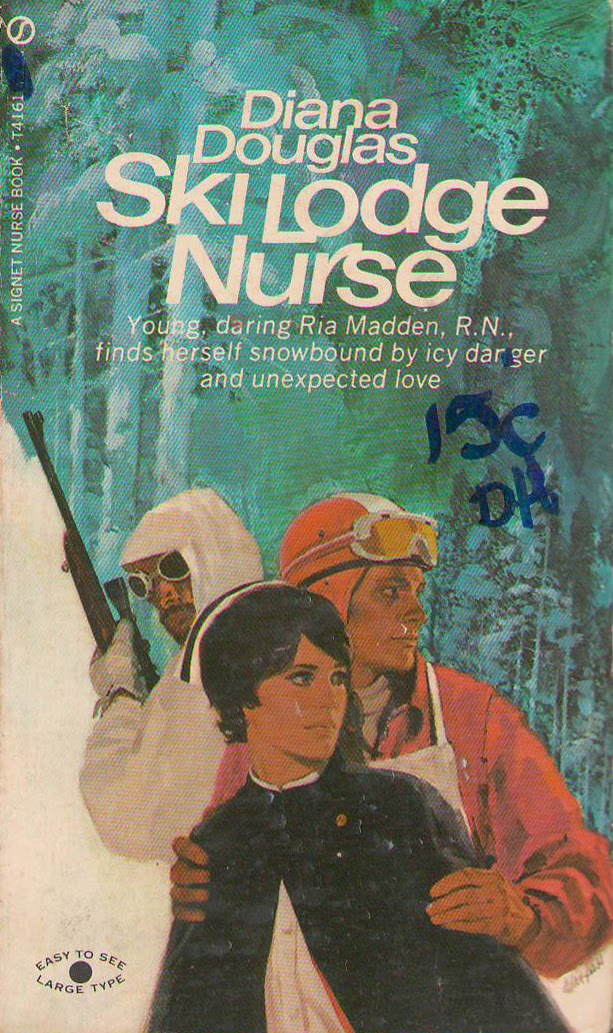
Ski Lodge Nurse

By Diana Douglas
(pseud. Richard Wilkes-Hunter), ©1970
Cover illustration by Allan Kass


For raven-haired, sports-loving Ria Madden, being a nurse at Hurricane Valley Ski Lodge had been, for the past three seasons, the perfect job—glamorous, exciting, fun. But this year was different. This year was trouble, and Ria knew it. It began with the strangely persistent romantic attentions of Thor Carlsen, the handsome Nordic skiing champion. It increased in intensity with Dr. Leon Marshall’s inordinate concern with Ria’s every after-hours activity. And then, without warning, it exploded into an avalanche of danger which forced her to face the ultimate challenge of her nursing career—and to make the most crucial decision of her life…

GRADE: C+

BEST QUOTES:
“Some of the women who come to Hurricane Valley would melt a glacier.”

“Thor appreciated her not only as a woman and a nurse, but as a skier.”

“The hunter on the mountain was insane.”

REVIEWS:
More than any other author I’ve encountered, Richard Wilkes-Hunter’s novels—Casino Nurse, Surfing Nurse, Beauty Contest Nurse, Sea Nurse—read like justifications for writing off that expensive vacation. Ski Lodge Nurse may be one of his better books, but in the end it’s really just more of the same. It has a lot more action than some of his other books, but action doesn’t make up for stupidity.

Ria Madden has worked at the Hurricane Valley (curious name for a ski resort—wouldn’t Blizzard Valley have been more appropriate?) in Colorado for the last three winters with Dr. Leon Marshall. She likes him, and “it was something more than admiration of his six feet of sturdy male strength and his gray eyes that could so easily mask his feelings.” But while they got along great for the first two years, last season she found him possessive, jealous, and “like a bear with a sore head. […] She had almost grown to hate him.” And so far, as this season opens, he’s not much better, snapping at the nurses and stomping off in a huff.

Competing for Ria’s affections is the lead ski instructor, Thor Carlsen, a Norwegian who won some skiing competition long ago. He invites Ria out for the first run of the season, and there’s a blow-by-blow description of every trail and move made by the pair that recalls the surfing passages from Surfing Nurse: too much jargon and an assumption that you care about every bump and turn they make on the way down. The layout of the mountain is also poorly described, so though a lot of action occurs up on the mountain, it’s largely confusing when you can’t picture what is happening.

There’s a lodge up on the mountain for people who get stuck, and while he is out with Ria, Thor notices smoke is coming from the chimney, so he sends up his number two, Niki Casello, to check it out. Niki is engaged to the other nurse, Brigid. Niki is competing in an international ski comptetition, which this year will be held in Hurricane Valley. He is deathly afraid of the ski jump but enters the event anyway because he thinks that if he does well the ensuing fame will earn him a top post at another ski resort and a salary large enough to support him and his bride, who of course he cannot allow to work.

Curiously, Niki loses the first aid pack he takes up the mountain and is as snappish as Dr. Marshall about it when he gets back, saying he did not find anyone in the cabin. The next day, he’s up at 6 a.m., climbing the mountain on foot. No one thinks twice about this until Ria and Dr. Marshall, out skiing that afternoon, hear gunshots. Then Niki falls off a cliff that a ski jumper could have taken easily—he tries to abort the jump at the last minute but his momentum carries him over—and is saved from death by a mysterious skier in white carrying a rifle who digs him out of the snow before Thor, who has seen the accident through his binoculars from a neighboring mountain peak, can get there.

That night, someone breaks into Ria’s room in the hospital. Before she has even clapped eyes on the fellow, Ria has a diagnosis: “The man out there was sick, her training reminded her. Dangerous, but sick. People like that were frightened of light, because their sickness was a thing of darkness and secrecy.” She turns on the light and runs to the window, intending to beat the intruder with her shoe, and discovers it’s the white-garbed hunter. He is muttering in Italian, but guess what! Ria’s mother was Italian, so she’s able to chat the guy up. He’s just looking for food, and he tells her he’s afraid of the men who have been chasing him. She explains they just want to ask him to stop popping off his rifle, because the skiing season has opened and they don’t want any tourists to get shot, which would be bad for business. He doesn’t believe her, though. “They plan to kill me. I have often heard them speak of it. They are clever, often they come upon me at night, unseen, whispering of cruel things …” She rushes off to fill a pack full of food for him, musing that this guy looks a lot like Niki.

The next day, when the men hear about this, they decide to posse up. They chase the poor guy for two days until he jumps off a cliff and is injured, but he gets away. The men are camping on the mountain that night, and at 5 a.m. Ria hears noises outside her window again. The crazy skier is back, passed out in the snow. Ria gets some ski instructors to carry him in, calls a doctor in town for a recipe for a chemical straitjacket, sets his fractured humerus, and arranges for his transport to the nearest hospital. One of the ski instructors heads into the mountains to bring in the posse, and when Dr. Marshall gets back, is he impressed? Heck, no! He snaps at her for giving the man sedatives and because she gave the man food earlier, telling her that her “thoughtless generosity probably contributed to the accident he had.” That pack of guys relentlessly chasing him had nothing to do with it; it most certainly was the pack of food on his back destabilizing his landing, the stupid girl!

Only after the skier—revealed as Lorenzo, Niki’s long-lost older brother—has been safely packed into an ambulance does Thor tells the stupid doctor that he is going back to Norway—alone—and that Ria is in love with the doctor. “All men are jealous of their sweethearts before they marry. But afterward never, for it is an insult to be jealous of your wife,” says deluded Thor. So Dr. Marshall goes back to the hospital and kisses away Ria’s tears, and then it’s all over but for the skiing competition, which Lorenzo attends. He’s now living with his parents in Denver, and “if Lorenzo heard voices now, they had become subdued, part of a familiar pattern that now he understood better and no longer heeded.” Dr. Leon is cured as well—“He wasn’t jealous of [Ria] anymore,” we are told—so that’s two miracle cures in one chapter! All we need now is a top-three finish for Niki in an event that doesn’t give him the willies, the slalom, and we can close the book with a sigh of relief. Check and check.

Saturday, March 3, 2012

Special Nurse

By Margaret Howe, ©1955

Nan Warner was proud of her first job at modern Donovan Memorial Hospital. Her devotion to her calling and her radiant youth soon attracted the attention of the doctors. The handsome, arrogant Chief of Staff tried to win Nan for himself alone, while Dr. Matt Ferguson watched jealously. And then one day Nan was assigned as special nurse to old Hannah Donovan, whose millions ruled the destinies of Donovan Hospital and its staff. Established at the Donovan mansion, the slim, red-haired nurse found that the autocratic old woman was using her as a pawn in an evil plan which not only involved the two young doctors but also threatened Nan’s happiness as a woman.

GRADE: B-

BEST QUOTES:“A girl’s heart was unpredictable at best.”

“I like you better when you smile, Nan.”

“Every silly nurse falls in love with a doctor.”

“There was a wonderful future for which to plan with a man who held her heart in his big firm hands.”


REVIEW:
I noticed with my 2011 VNRN Awards that eight of the ten best authors won based on reviews of three or fewer reviews (the top four awards were based on just two reviews each). So this year I’m reading more of these authors—and so far, I have to say, the first few I read did not live up to their reputation. Now, with Special Nurse, Margaret Howe has done no better. This book is not so special: The writing is a perfunctory, there are almost no great quotes, and Nan Warner is a shallow, uninteresting heroine whose opinions about other people swing wildly, leaving you think she is either very fickle or slightly demented.

Nan is a nurse at the Donovan Memorial Hospital in Illinois, which is funded by aging dowager Hannah Donovan. Her protégé, the handsome Dr. Richard Harden, has been dating Nan, who goes weak in the knees whenever Dick is around. Then there’s this other doctor, Matthew Ferguson, who is a “diagnostician” in the hospital. Dr. Ferguson is a dedicated physician, one who goes to bat for poor patients, so naturally he butts heads with Dick, who cares only for wealthy patients like Hannah Donovan.

At the book’s opening, Nan does not think much of Matthew. When Matthew discharges Hannah, admitted for a minor cold, so that a “blue baby” can have her room, Nan agrees to go home with Hannah for a week to be her private nurse even though the hospital is “shockingly short of nurses,” as VNRN hospitals usually are. Matthew is angry about that, and tells Nan to get her patient discharged by 4 p.m., in a tone that suggests that “Nan might have been the most stupid and unattractive nurse at Memorial,” because it’s perfectly acceptable to be rude to unattractive nurses.

But during her week with Hannah (which merits only a few pages of the book, despite the impression given by the back cover blurb), she goes for a swim in Lake Michigan and nearly drowns, rescued just as she is going down for the last time by Matthew. So now she can’t exactly hate him. And when she returns to the hospital as the special nurse for the blue baby, she witnesses first-hand both his devoted fight for the best medical care for the boy and Dick’s obvious disregard for the same. Also, she finds that Dick is no longer calling her for dates and that he’s been going out with his secretary. Then Matthew tells her that he loves her. He proves the point by ignoring her in the halls or, when he is forced to talk to her, by being brusque. Nan still yearns for Dick, who was so complimentary of her red curls and bestowed fond glances but never said those three little words. So she decides that Dick only wants a beautiful wife to ornament his career, while Matthew has picked her out because he wants “a helpful mate. A flat-footed, capable woman, thought Nan scornfully,” though I’m not sure why she should be scornful of the idea of marrying a helpful, capable woman, unless the implication is that such women can’t possibly be attractive.

It’s not too tough to see where this is going. Nan slowly turns her affections toward Matthew, and Dick slowly turns his affections back to Nan. In the end, Hannah is admitted to the hospital—really sick this time, with gallbladder disease—and Dick, afraid for his reputation lest Hannah not make it, refuses to operate. Eventually Matthew is forced to do the surgery, Hannah survives, Matthew is lionized (and offered a key job at the hospital by Hannah), and Dick’s reputation drops into the bedpan.

In the final chapters, we are treated to even more of the standard VNRN conventions. Dick becomes increasingly desperate and forces himself on Nan just as Matthew walks into the room. Nan, natch, can’t possibly “humble herself” and tell Matthew what really happened: “How could she make it clear to Matthew that she loved him without sacrificing her pride?” (I’m not quite clear what pride has to do with it, unless it’s that women should never appear to be chasing a man.) Then Dick meets Nan, who is wandering around in the rain in an attempt to find Matthew’s house, forces her into his car, and proposes marriage, insisting that she tell him yes or no. Curiously, Nan’s reaction is that “it was so like Harden to take advantage of a situation like this to force an answer.” Why does she resent the fact that he wants a reply? How is he taking advantage of her? Is the handle on the car door not working? Nan’s somewhat bizarre reactions make me feel like I am observing a foreign culture.

The clinching cliché is that Dick and Nan are involved in a car accident, and the previously distant Matthew rushes to her bedside. She is able to rouse herself from her delirium to fling her arms around him and kiss him, so everything is going to be all right in the end. Maybe. In the most ambiguous final page I’ve ever encountered, she tells Matthew that “if I can…” she will always try to love him and understand that “his work came first. And she must not annoy him by foolish fears.” He answers, “If you can, my darling, we’ll have a good marriage.” Mighty big if, I say.