Showing posts with label skiing. Show all posts

Saturday, April 16, 2022

The Nurse from Hawaii

By Ethel Hamill
(pseud. Jean Francis Webb III), ©1964
Cover illustration by Edrien 

Gail Ingersoll, born and raised in Hawaii, had longed for months to return to the beauty and warmth of the Islands. But a sense of duty had kept her in Vermont, where she had gone to nurse old Miss Abigail Ingersoll, the last of the family on the Mainland. Now Miss Abigail was dead, and as soon as Gail had recuperated from a recent bout with pneumonia, she could begin making plans to go home. Vermont was covered with snow the day Dean Mathias and the small child in a red snowsuit came to seek shelter in the old carriage house—not even asking permission, if you please. Dean Mathias, with his sultry good looks, his pantherlike grace, could leave at any time, Gail decided, but it would break her heart if he took the small blonde Clancy away with him. There was some mystery about the pair, Gail was sure—something that had brought them from California to Vermont. Until that mystery was cleared up, and Clancy was quite safe—Dean was threatening to leave and take Clancy with him—Hawaii must wait. Only by giving up her dream could Gail realize her full potentialities as a nurse and find a love—or rather, two loves—that would make her renunciation an easy choice.

GRADE: B+

BEST QUOTES:
“The expensive, ugly wallpaper showed lighter rectangles where other pictures had hung; past Ingersolls had bought themselves the best, but with no eye for beauty. And now, indestructible, their mistakes survived them.” 

REVIEW:
It was with great pleasure that I realized that Jean Francis Webb, one of my favorite VNRN authors, had written a nurse novel that I hadn’t read yet. This is the youngest of the six, written three years after the delightful Aloha Nurse, and it almost seems like it might have been the child of a second mother, as it has none of the camp or wit of its older sisters. But it is a smooth, gentle story that feels written, with a small (if not altogether obvious) mystery at the end, and worth reading, if for different reasons. 

Gail Ingersoll was born and raised in Hawaii, but for unclear reasons came to New York to work as a nurse. There she met Old Dr. Hawkstrom, who hails from the tiny town of Cutler, Vermont. She happened to have the same name as an elderly, wealthy woman desperately in need of a nurse, and as fate would have it, the two are second cousins twice removed, and this familial bond (though Gail had not been aware of the existence of old Abigail) compelled her to move to Cutler and nurse the old bat for four years, through what sounds like Alzheimer’s, until the woman had run out into the winter night and drowned herself in the pond. Gail has inherited the entire fairly large estate, and is casting about for something to do with it—she’s considering starting a hospital in town—when a tanned Californian surfer with “almost a dangerous face” is discovered in the carriage house with an ill five-year-old child named Clancy.

Gail immediately takes over the little girl, moving her into the house and falling unreasonably in love: “She hadn’t known a day ago that Clancy existed. Today, the tiny creature on the sofa bed seemed the most important person in the world.” She has Old Doc out to inject some penicillin, and the doctor seems strangely taken by the little girl, as well. It’s not too hard for us to see the writing on the wall: Dr. Hawkstrom’s daughter Beth had run away to California and hadn’t been heard of since. The little girl calls the man by his first name, but everyone assumes he is her father. He’s a cool, suave snake, and Gail warily puts up with him because she wants to keep Clancy—and of course the girl shouldn’t be moved for weeks after this little cold that she’s suffered.

Eventually Gail proposes to give Dean a stipend that would allow him to spend his life surfing in Hawaii if he will let her adopt Clancy. He comes back with a counter-proposal: That she come with him and Clancy to Hawaii, and, he tells her, “I’m perfectly willing to marry you first,” sealing the offer with a “hard and virile and questing” kiss. Another catch is that she can only have Clancy if she keeps her inheritance—but mercifully, she does not consider this for a moment.

Then Old Doc’s son, Dr. Jon Hawkstrom Jr., arrives in town, and Gail finds the air a bit thin and electric when he’s around. She’s sure he’s going to help her with her plan to convert the old mansion into a cottage hospital, but he insists he has some research projects he can’t abandon, and off he goes. Then Dean is on the brink of pulling out with Clancy, and stops to say goodbye to Gail—just as Doc Junior returns to town, and a lively conversation ensues in which all is revealed!

If the plot, in the retelling, seems a little dull, the story is assuredly not. The depiction of this snow-bound Vermont village evokes the Lucy Agnes Hancock books of the 1940s, calm and sweet; the tone is even, dare I say, a little Robert Frosted. Lovely sentences abound: “Spring seemed to be stirring in its sleep, under white blankets.” And: “I’d hate to see you crack your heart on the impossible.” Peripheral characters are well-drawn and charming, and there’s a compelling if tiny story of a woman who the town thinks has run off with the owner of the feed store. Gail is shown on several occasions to be a smart, competent, dedicated nurse with no idea of quitting her job, even when she’s a wealthy woman: “I’m a nurse and I always will be,” she insists. Completely devoid of the delicious camp of his past books, in this book Mr. Webb has instead created a lovely, simple story that, if of a different style than his earlier efforts, still demonstrates that he was a gifted writer. And one whose works I have now, sadly, exhausted.


Shop this title, reprinted under the title 
Green Mountain Nurse, offered by
Nurse Novels Publishing!


Saturday, January 16, 2016

Resort Nurse

By Nell Marr Dean, ©1960
Cover illustration by Lou Marchetti

Young Lynn Ryan was thrilled by her new assignment—hotel nurse at the glamorous Tamarac Lodge. Her duties would be informal, and she’d have a chance to meet fascinating people—at a salary that would enable her to help the family she loved. Lynn didn’t reckon with the three exciting men who appeared, each offering his own brand of romance. Nor was she prepared for the sudden challenge to her professional vows—a challenge to which at first she could find no answer …

GRADE: B

BEST QUOTES:
“This climate has wrecked my hair.”

“She was unaccustomed to foreigners and their continental manners.”

“Spanish people have very colorful names.”

“Today almost every girl at some time or another thinks she wants to go into nursing. She feels it’s a way to do something constructive—something within her reach.”

Lynn developed a wild curiosity to see the inside of a gaming house. Woman-like, she planned a campaign to get Steve to take her.”

“Girls who are going to have babies simply don’t engage in strenuous sports. Probably the reason you got hurt today is because you were nervous.”

Pearl had just given her a shampoo and set, and she had the fresh feeling that always comes with a new hairdo.”

“Being a very chic little redhead, Audrey was indeed someone to be very proud of.”

“Kay, stop crying! You’re going to get married in ten minutes. You can’t do it with red eyes.”

“ ‘Missy Ryan, come quick! I take you with me.’
“ ‘With you where?’ she asked, trying to cut through his devious Oriental ways.”

“Any woman might as well face it. The responsibility for creating a happy courtship is mostly up to her—just like creating a happy marriage is. In fact, it’s about ninety per cent up to her. If nine out of ten women weren’t such fools, they could get—and keep—the man they want.”

REVIEW:
Lynn Ryan, wearing a cashmere coat and a warm sparkle in her blue-green eyes, is awash in excitement about her new job at Taramac Lodge at Squaw Valley. She’s a little bit nervous about the job because she’s never set foot on skis, but is going to have to be ready to dash out to the slopes at any minute to minister to a hapless skier with a sprained ankle or a broken rib. But she’s going to overcome her fears for her stepmother, Carmen Marie, who’s lived in poverty her entire life: She’s spending her exorbitant salary—$250 per month—on a lot in the Los Angeles suburb of Fernando Acres, where Carmen and Lynn’s father will finally have a house of their own.

En route to the resort on the bus, she meets Steve Matson, an engineer working to widen the roads to four-laners before the upcoming Olympics. Later Steve drops by to visit and takes her out snowshoeing—and they come across a wealthy hotel guest, whom Lynn had previously treated for intoxication with lemon and honey and a cold bath, lying in the snow. As Steve races back to the hotel to get help, Todd Gilmore tells Lynn that he came out into the woods to commit suicide by freezing to death. When Todd is safely packed back, she whispers to Steve what Todd told her, but Steve completely laughs her off, as does the doctor who is treating Todd for frostbite. After the amputation of a few fingers and toes, Todd is back at the hotel recovering, and Lynn is dropping by daily to manage his care, and slowly becoming his friend.

Her interest in Todd takes her to the new casino he’s built nearby, and soon she’s won $3 on the nickel slots. You can see the writing on the walls. Before long, Lynn gets word that her father has been injured and can’t work, so he will have to live off the money that he and Carmen were saving to make the next payment on the Fernando Acres house. Lynn doesn’t have quite enough money to cover the whole payment herself, so she hustles back to the Pair-O-Dice with Wong Duck, the Chinese cook, and loses $195, all but $5 of the money she’d saved. If that weren’t enough, she returns and loses her entire $250 paycheck, just to put the icing on the cake.

Then, out on a date, Steve tells Lynn he loves her because “you’re soft and sweet.” This might be a nice turn for Lynn, but no: Steve very peculiarly becomes nasty and jealous of Todd after Lynn tells him of her gambling losses, though his biggest accusation is that Lynn, on her routine nursing visits to Todd, is being instructed on gambling techniques while she’s there, the scandalous tramp.

After a week in which Steve doesn’t call, Todd asks Lynn to drive him to a meeting, as he’s still sore from his toe amputations and can’t operate the gas pedal very well. En route, he tells Lynn that he’s in love with her. He’s a lot nicer than Steve’s been lately, especially when Lynn returns to the hotel and finds a ridiculous letter from Steve, telling her he won’t bother her again because he can’t compete with Todd’s money. Todd, desolate over Lynn’s kind refusals, gets drunk and flings himself off a cliff, and Lynn is forced to rescue him again. Safe back at the lodge, Lynn is tending to him in the lobby when Steve walks in and naturally transforms into a raging ass, making snarky remarks and jealous assumptions without pausing to listen to Lynn’s reasonable explanations. Fortunately, she has her friend Pearl to give her sound advice: “What do you expect me to do? Keep fawning over Steve?” she asks Pearl. “If you love him, you’d better,” Pearl answers. “Lynn, a woman has to make the fellow she adores think he’s the only guy in the universe.” Ah. Thanks for the tip. Though it does beg the question whether Steve is worth adoring.

This being a VNRN, however, that vital question goes unexamined. Instead, Lynn calls Steve and makes up a dumb story about needing medical supplies and then pretends she doesn’t know how to get to Carson City. She’s exulted when Steve falls into her trap and offers to drive her. She dresses for the drive—“for once he wouldn’t find her in a starchy white uniform, looking like a pillar of salt. Pearl’s words rang in her mind: Men like to be with women who are beautiful and feminine. Women who intrigue them.” On their drive, Lynn remembers more of Pearl’s pearls: “Men are like little boys. They love praise.” So she compliments the job on the roads he’s been doing, and sure enough, Steve melts long enough to hear Lynn tell him that Todd’s been committed to an insane asylum for a year because of his suicidal tendencies. He’s so pleased that he offers Lynn some advice for making the $700 payment she and her family need for the second installment on the house: Just ask for an extension on the option. He’s so smart! Before long, he’s calling her a bonehead and ordering her around: “ ‘Move over closer to me,’ he ordered brusquely.” She swoons: “It was the old Steve talking again, Steve with the same bossy sweetness in his voice, the same strong hard arms that could hold you so tight you hurt.” You know it’s real love when he hurts you. It’s enough to make you want to stop at the nearest quickie wedding chapel, which, unfortunately, they may well be about to do at book’s end. Run, Lynn! Run!

There’s a lot of campy writing and situations to be found in this story. Its deep flaws—the insidious racism (see Best Quotes) and the horrific attitudes about relationships—are pretty dreadful, but at the same time they make the book more interesting, they give you something to think about and cluck over, and be grateful that times have changed. I feel quite certain that Steve is not going to make Lynn happy, but I also feel quite certain, after Pearl’s advice, that happiness is not really the point of being married; being married is the point of being married, and Lynn is about to score on that point, so it counts as a success. Sometimes a book that makes you irritated is not necessarily a bad book, and in this instance, that is definitely the case.

Thursday, November 28, 2013

New England Nurse

By Adelaide Humphries, ©1956
 
Nurse Judy Andrews found life rewarding in her lovely, quiet, snowbound Vermont village. Engaged to Neal Bentley, whom she had known all her life, she was happily planning to be married in the spring. Overnight, her comfortable world changed. Curt Wiley, a handsome Texas engineer, came to town to build a ski resort on the mountain that Judy loved. By the first snowfall, the sleepy little town would be seething with activity. Judy hated Curt the moment she met him, hated this Texan who was charming all the women in town and was now turning that charm on her! Then, unaccustomed to the New England climate, Curt came down with pneumonia. As she nursed him back to health, Judy discovered that Curt was not the playboy he appeared to be, not just a fast-talking promoter, but a decent, sensitive human being who had a difficult job to do, and who seemed to be falling in love with her. Suddenly Neal Bentley seemed dull and uninteresting to Judy. By spring she had to make a decision. She had to choose between the rootlessness of a life as a construction man’s wife, or the steady, homespun love of her childhood sweetheart … a decision that was as much of a surprise to Judy as it will be to you.
 
GRADE: B-
 
BEST QUOTES:
“Judy was the kind of nurse one usually encountered only on the covers of a magazine. The majority of nurses turned out to be middle-aged specimens, often with a superior demeanor.”
 
“Meeting you, Miss Andrews—and knowing I’ll be seeing you again soon—has practically cured me!”
 
“Marriage is a woman’s goal—she wants to be a wife and mother. Yet she knows that, once she has taken this step, nothing will ever be the same again. With a man, it’s different. I guess that’s how it should be. It’s a woman who bears the children, my dear. And that’s what I meant when I said that marriage—children—makes a woman settle down, put others before herself, give up her own identity—to a certain degree, anyway.”
 
“Once they were married, all these anxieties would melt away as though they had never existed. There would never be any regrets.”
 
“A woman can handle a situation better if she knows she looks her best.”
 
REVIEW:
Vermont nurse Judy Andrews has a problem common to VNRN heroines at book’s open: Her boyfriend is a dud. “Neal was so good looking that the sight of him ought to quicken any girl’s heart,” we learn in the second chapter. “Only of course she was so used to looking at him, that her blood pressure remained normal.” She’s not wild about kissing him, either; “Judy had taken Neal’s good-night kisses so much for granted that she had never thought much about them afterwards.” So needless to say, we are not optimistic about their future. When wealthy Neal Bentley proposes, she gives him a resounding, “I—I suppose so—”
 
Judy is partly disappointed because “romance seldom came as one dreamed of it. For Judy, like every other young girl, dreamed of an unknown prince who would one day sweep her off her feet and carry her away, if not on a white charger, at least to places she had never seen before.” But hold on to your hat, chicken, because look who’s coming down the road: Curt Wiley, in a “two-toned hard-topped job” with white-walled tires. He’s in town to build a ski resort on the town’s mountain, though Judy feels this will ruin both the town and the mountain she loves so much. But her initial bias against Curt soon turns, as Curt also seems to share her sentimental feelings toward the environment, telling her that “it seems a shame to spoil all this.” Now Curt is looking more attractive: “Curt seemed to have the same feeling about the mountain as she did. Neal would not understand it—for now that she faced it, all Neal thought of now was how he could personally profit by the changes that had come to their community.” When Curt tells her he is never going to be rich, she thinks “money was far too important to some people—for instance, to Neal.” And when Curt is invited for Christmas at her house, “Curt fitted in exceptionally well. Better, Judy found herself thinking, than Neal would have.”
 
And so it is not surprising that, when Curt kisses Judy under the mistletoe, it’s a kiss that Judy isn’t likely to forget, like one of Neal’s: “It left Judy weak and limp as a rag doll. It had been the kind of kiss she had dreamed about in those dreams concerning a prince who would come from out of nowhere to carry her away. She felt like the princess who had been awakened after a long sleep.” Though Curt has heretofore been set up as something of a flirt, he seems to be developing a certain fondness for Judy. At one point, when they are out on the mountain together, he says, “I want you to know that—I’m crazy about you.” In response, she kisses him. “It was not like the kiss beneath the mistletoe. But her whole heart was in it.”
 
Suddenly, though, the town Curt once found so charming is “this godforsaken place,” and he can’t wait to get out. He’s talking about going to South America to build bridges, and he tells her that he cares for her but can only offer her a vagabond life without much money. In the end, though, he asks her to consider going with him when he leaves Vermont in a few weeks. She thinks about what a dud Neal is, and all but tells Curt she doesn’t love Neal. In the pages in which she ponders her decision, the biggest sticking point seems to be that “there would be talk, lots of talk. The blame would all fall on Judy Andrews, a farmer’s daughter who had run away with a stranger.”
 
A few days later, Neal picks up Judy at work, and she is just on the brink of telling Neal that she won’t marry him after all, “that it was Curt she loved. That when he asked her, as she knew he would, she would have to go away with him.” At this point, Curt’s character undergoes a startling about-face. Up until now, we’ve believed that “Curt is a gentleman,” as Judy’s mother, who has struck up a good friendship with the young man, says. But now, ten pages from the end, Neal tells Judy that Curt run off with Cynthia. And now, as they pull up in front of Judy’s house, she’s changed her mind: “How could she ever have thought she could leave all this?” Neal, too, has become someone else; “there were depths within him that she had not recognized before. And they belonged together—they had been born and reared in the mountains, among folks of their own kind. How could she ever have thought she wanted anyone except Neal?” And even better, suddenly his kisses are “somewhat exciting!” How convenient.
 
The book has some curious attitudes about marriage, mainly that once married, a woman must no longer have any opinions or ideas that her husband didn’t come up with first. Shortly after Neal proposes, he tells her that they have to cut short their drive so he can have a chat with her father. “ ‘Whatever you say,’ Judy agreed. She wondered if this was how it would be for the rest of her life—whatever Neal decided would be all right with her. Or at least she would pretend that it was.” Later, when she contemplates the upcoming Christmas holiday, she realizes that this will be her last Christmas with her own family; “as Neal’s wife, it would be her duty to spend the Christmas holidays with his people, not hers. To Judy, not to be with her own family at Christmastime would be heartbreaking. Yet she supposed it was a sacrifice she must learn to be willing, even glad, to make.” She also thinks, “Marriage would mean the end of one’s personal freedom. Until then, you were not obligated to try to be what the other person wanted, or thought, you to be.” It sounds pretty grim to me. And not much like the heroine we come to know, “a young woman with a mind of her own.”
 
In the end, though Judy has maintained that she is in love with Curt, all that is brushed off for what is now painted as a deeper and enduring love for Neal. All we have heard throughout the book is what a self-centered, shallow bore he is, but abruptly we find that he is exactly what Judy wanted all along. If he doesn’t make her heart pound, we’re supposed to take a page from Judy’s mother, who at one point tells Judy that she’d considered running away the morning of her own wedding, but is now very content with her life. And so Judy too is suddenly happy to abandon her career (it is taken for granted that she will stop working after she is married), her opinions and identity, passion, and even true love—if we can believe what we have been told about her feelings for Curt—for an ordinary life with a man she seems to look on as a not very interesting companion. I was annoyed at Judy’s change of heart, and I was annoyed that with Curt’s conversion at the last minute into a felonious Lothario (it’s a crime to transport a minor across state lines), she never even made a choice of her own; removing Curt from the picture took even that away from her. Though we are left with the impression that Judy is going to live happily ever after with her true prince, Neal, it sounds more like a prison sentence to me.

Saturday, March 10, 2012

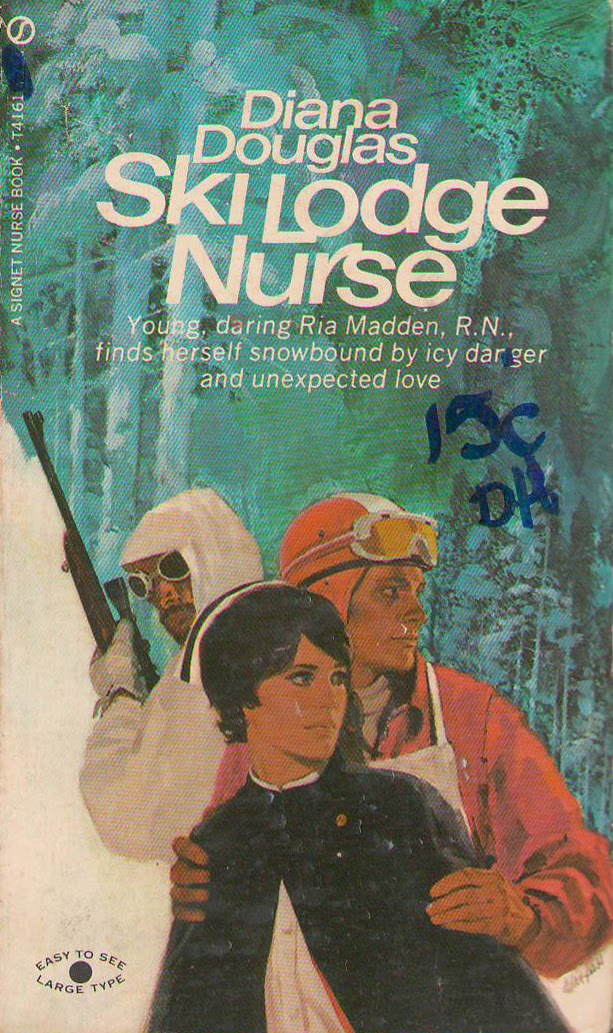
Ski Lodge Nurse

By Diana Douglas
(pseud. Richard Wilkes-Hunter), ©1970
Cover illustration by Allan Kass


For raven-haired, sports-loving Ria Madden, being a nurse at Hurricane Valley Ski Lodge had been, for the past three seasons, the perfect job—glamorous, exciting, fun. But this year was different. This year was trouble, and Ria knew it. It began with the strangely persistent romantic attentions of Thor Carlsen, the handsome Nordic skiing champion. It increased in intensity with Dr. Leon Marshall’s inordinate concern with Ria’s every after-hours activity. And then, without warning, it exploded into an avalanche of danger which forced her to face the ultimate challenge of her nursing career—and to make the most crucial decision of her life…

GRADE: C+

BEST QUOTES:
“Some of the women who come to Hurricane Valley would melt a glacier.”

“Thor appreciated her not only as a woman and a nurse, but as a skier.”

“The hunter on the mountain was insane.”

REVIEWS:
More than any other author I’ve encountered, Richard Wilkes-Hunter’s novels—Casino Nurse, Surfing Nurse, Beauty Contest Nurse, Sea Nurse—read like justifications for writing off that expensive vacation. Ski Lodge Nurse may be one of his better books, but in the end it’s really just more of the same. It has a lot more action than some of his other books, but action doesn’t make up for stupidity.

Ria Madden has worked at the Hurricane Valley (curious name for a ski resort—wouldn’t Blizzard Valley have been more appropriate?) in Colorado for the last three winters with Dr. Leon Marshall. She likes him, and “it was something more than admiration of his six feet of sturdy male strength and his gray eyes that could so easily mask his feelings.” But while they got along great for the first two years, last season she found him possessive, jealous, and “like a bear with a sore head. […] She had almost grown to hate him.” And so far, as this season opens, he’s not much better, snapping at the nurses and stomping off in a huff.

Competing for Ria’s affections is the lead ski instructor, Thor Carlsen, a Norwegian who won some skiing competition long ago. He invites Ria out for the first run of the season, and there’s a blow-by-blow description of every trail and move made by the pair that recalls the surfing passages from Surfing Nurse: too much jargon and an assumption that you care about every bump and turn they make on the way down. The layout of the mountain is also poorly described, so though a lot of action occurs up on the mountain, it’s largely confusing when you can’t picture what is happening.

There’s a lodge up on the mountain for people who get stuck, and while he is out with Ria, Thor notices smoke is coming from the chimney, so he sends up his number two, Niki Casello, to check it out. Niki is engaged to the other nurse, Brigid. Niki is competing in an international ski comptetition, which this year will be held in Hurricane Valley. He is deathly afraid of the ski jump but enters the event anyway because he thinks that if he does well the ensuing fame will earn him a top post at another ski resort and a salary large enough to support him and his bride, who of course he cannot allow to work.

Curiously, Niki loses the first aid pack he takes up the mountain and is as snappish as Dr. Marshall about it when he gets back, saying he did not find anyone in the cabin. The next day, he’s up at 6 a.m., climbing the mountain on foot. No one thinks twice about this until Ria and Dr. Marshall, out skiing that afternoon, hear gunshots. Then Niki falls off a cliff that a ski jumper could have taken easily—he tries to abort the jump at the last minute but his momentum carries him over—and is saved from death by a mysterious skier in white carrying a rifle who digs him out of the snow before Thor, who has seen the accident through his binoculars from a neighboring mountain peak, can get there.

That night, someone breaks into Ria’s room in the hospital. Before she has even clapped eyes on the fellow, Ria has a diagnosis: “The man out there was sick, her training reminded her. Dangerous, but sick. People like that were frightened of light, because their sickness was a thing of darkness and secrecy.” She turns on the light and runs to the window, intending to beat the intruder with her shoe, and discovers it’s the white-garbed hunter. He is muttering in Italian, but guess what! Ria’s mother was Italian, so she’s able to chat the guy up. He’s just looking for food, and he tells her he’s afraid of the men who have been chasing him. She explains they just want to ask him to stop popping off his rifle, because the skiing season has opened and they don’t want any tourists to get shot, which would be bad for business. He doesn’t believe her, though. “They plan to kill me. I have often heard them speak of it. They are clever, often they come upon me at night, unseen, whispering of cruel things …” She rushes off to fill a pack full of food for him, musing that this guy looks a lot like Niki.

The next day, when the men hear about this, they decide to posse up. They chase the poor guy for two days until he jumps off a cliff and is injured, but he gets away. The men are camping on the mountain that night, and at 5 a.m. Ria hears noises outside her window again. The crazy skier is back, passed out in the snow. Ria gets some ski instructors to carry him in, calls a doctor in town for a recipe for a chemical straitjacket, sets his fractured humerus, and arranges for his transport to the nearest hospital. One of the ski instructors heads into the mountains to bring in the posse, and when Dr. Marshall gets back, is he impressed? Heck, no! He snaps at her for giving the man sedatives and because she gave the man food earlier, telling her that her “thoughtless generosity probably contributed to the accident he had.” That pack of guys relentlessly chasing him had nothing to do with it; it most certainly was the pack of food on his back destabilizing his landing, the stupid girl!

Only after the skier—revealed as Lorenzo, Niki’s long-lost older brother—has been safely packed into an ambulance does Thor tells the stupid doctor that he is going back to Norway—alone—and that Ria is in love with the doctor. “All men are jealous of their sweethearts before they marry. But afterward never, for it is an insult to be jealous of your wife,” says deluded Thor. So Dr. Marshall goes back to the hospital and kisses away Ria’s tears, and then it’s all over but for the skiing competition, which Lorenzo attends. He’s now living with his parents in Denver, and “if Lorenzo heard voices now, they had become subdued, part of a familiar pattern that now he understood better and no longer heeded.” Dr. Leon is cured as well—“He wasn’t jealous of [Ria] anymore,” we are told—so that’s two miracle cures in one chapter! All we need now is a top-three finish for Niki in an event that doesn’t give him the willies, the slalom, and we can close the book with a sigh of relief. Check and check.

Sunday, January 30, 2011

Ski Resort Nurse

By Jane L. Sears, ©1962

Nurse Quentin McCall had two great loves—skiing and nursing, and the Crystal Valley hospital seemed the ideal place to combine them. But lovely Quentin soon found herself tangled in a snowdrift of conflicting emotions. For two men occupied her thoughts and neither would believe Quentin to be what she was. To the wealthy widower Alex Kriloff, she was the past refound, the dead come alive. To Dr. Ken Johnson, who turned a cold shoulder to romance, Quentin was a disturbingly beautiful reality. Quentin asked herself, “If a mask was a necessity for love, was she willing to wear one?”

GRADE: A-

BEST QUOTES:
“I got TB bundling with a doll in Smitty’s sleigh!”

“I’m meant for greater things than emptying sputum cups all day long!”

“Quentin couldn’t seem to stop Tillie from jamming those needles into her.”

“She wondered where he was and if he was still tortured.”

REVIEW:
Quentin is a fresh nursing school graduate who has decided to take a job at a hospital at a ski resort in the Sierra Nevadas. She’s been skiing her entire life, having grown up in New Hampshire, and this job will allow her to combine her two passions. Of course, she finds some new ones just minutes after walking through the hospital door. Dr. Ken Johnson instantly reveals himself as “a complete grump, disliking youth and fun.” He hates skiing and young nurses, who he believes come to his hospital to meet unattached millionaires who have broken a leg on the slopes. And he’s rude, sarcastic, and constantly angry, shouting at nurses and patients alike. So Quentin is instantly infatuated, “glad she had on the black knit stretch pants that flattered her long-legged, narrow-waisted figure.” She can’t stop thinking about the big jerk, though he gives her little encouragement—just one fleeting moment when, for once, he apologizes for his rudeness and says, “I wish…” before being called away to attend to a patient. Love does not take a great deal of fuel to start a bonfire in a vintage nurse romance novel.

There is, of course, another man. Alexander Kriloff is an insanely wealthy recluse who spots her schussing down the slopes one evening from his mountaintop aerie through binoculars and spends weeks uncharacteristically searching the pubs for her. His is a tragic story: He and his new bride had come to his house in the mountains for a skiing honeymoon, but she came down with appendicitis just as a blizzard set in, and there was no way to get to the hospital on the other side of the Donner Pass—and she died of a ruptured appendix in her husband’s arms two days after their wedding. He responded by building the hospital, where Quentin now works, in her honor. It’s quite a hospital, too, where waiters serve the patients bloody Marys, the cafeteria offers filet mignon, every window has a million-dollar view of the slopes, and the patients don’t have to leave until they want to. It costs plenty, of course, but most of the patients are wealthy jet-setters who don’t mind the bill.

Alexander meets her eventually—and then it’s a whirlwind romance. He has her over for dinner, fetched in the Rolls by his chauffeur, and gives her a tour of every room in the house—except one; gosh, I wonder what’s in there? He flies her to San Francisco for an evening of cocktails at the Top of the Mark and then dinner at Ernie’s. He sends her five dozen roses. But she has limits: When he tries to give her a gold clock with the alarm set for 8:00, the time of their date that night, she gently returns it. She quickly comes to feel a motherly affection for him that she calls love. “Only one thing disturbed her and that was his increasing possessiveness … demanding she spend every spare moment with him until at times she felt very nearly suffocated.” However, as soon as he proposes to her, “his complete need for her marked by a possessiveness that had troubled her previously, made her own heart respond and want to give.”

I could tell you more about the plot, but why bother? That’s not why you should read this book. The writing is entertaining, descriptive, and campy, everything I look for in a VNRN. The romance is amusingly over the top: “Her hands still caught firmly in his, Quentin slowly lifted her eyes, felt herself drowning in the depth of his brooding gaze.” The luxe settings help with both the appeal and the camp: “With a small sigh she turned in the seat, gazed at the back of Charles [sic] neat neck beneath his chauffeur’s cap, and let her fingers idly trail along the leopard skin upholstery. ‘My gosh!’ she whispered to herself. ‘Wait until Olive hears about this!’ ”

The biggest flaw this book has, apart from Quentin’s inexplicable attraction to Dr. Johnson, is the copy editing. Now, I know the people out there who care deeply about commas can be counted on one hand, but I am one of those very curmudgeons. Typos such as “grizzly detail” (they mean grisly) and “her body felt like it was being seered” (it should have been seared) can be shrugged off with a laugh, but the constant confusing of it’s with its was absolutely maddening. (The former means it is, as in it’s mine, while the second refers to something belonging to it, as in its color.) However, with such fabulous writing, a great cover, and another of Ace’s magnificent cover lines—“adventure and romance in two white worlds”—I can heartily recommend this book, it’s disrespect for punctuation notwithstanding.

Saturday, December 25, 2010

Hospital in Kashmir

By Belinda Dell, ©1959

“Andrews the adding-machine—is that how you think of me? Put the right instrument in his hand and he’ll perform an operation: save his patient from choking and he’ll take it for granted. All coolness and efficiency but without human qualities!” Doctor Gil Andrews said to Nurse Clare Edmonds, soon after her arrival at Kahldi Hospital in Kashmir. Nurse Clare’s feelings for Doctor Gil were, in fact, very different from her feelings for an adding-machine—but how could she tell him so?

GRADE: B+

BEST QUOTES:
“This little town is absolutely dominated by these medical types, and unless you put your foot down you’ll get cold compresses with your lunch, and vaccination statistics with your dinner.”

“Any man has moments in his life that won’t bear looking into.”

REVIEW:
I have to say that when I pick up a VNRN with more than 120 pages—and this one has 191—a certain feeling of dread comes over me. Almost 200 pages for a nurse romance novel? Does the author really have that much that needs to be said, or does she just think she does? Yes, I have been burned in the past. And so the page count, in addition to the cover, which must be acknowledged as not one of the genre’s finest, made me less that confident when I picked up Hospital in Kashmir.

And how wrong I was. This is a very cute book, with a pretty ending (an extremely rare find in the VNRN) and picturesque scenes, absolutely worth reading.

Clare Edmonds is following her best friend from nursing school when she takes a job in Kashmir. She’s desperately needed, as they have 300 patients but only six nurses and two doctors. There’s a snafu with her transportation, however; the car and driver who will take her the last leg of the trip have fallen through. Walton Parker, an engineer who does a lot of work near her hospital, takes her on the 12-hour drive, and en route, they strike up a relationship—not long after her arrival in the village of Srinagar, everyone is convinced they are to be engaged. But Dr. Gil Andrews, Walton’s best friend, warns Clare that Walton’s fancies are fleeting. Sure enough, after a month-long trip to London, Walton returns with a cooler heart. The village is disgusted with Walton, and pities Clare. For her part, Clare resents the community’s investment in her love life. “Why must everyone without exception assign her to Walton? Why mightn’t she be allowed to have opinions and feelings of her own on the subject?”

In the hospital, she quickly establishes herself as a dream nurse. During a surgery early on, she proves her worth when she saves a patient who stops breathing. Later, Dr. Gil tells her breathlessly that he now has “the feeling of having somebody at my side who would know what to put into my hand without a word from me.” They get to chatting, and it turns out that the reason Gil is so dispassionate is that he was in love once, long ago … with a woman who let him down, utterly and completely … Alma was a rich woman, but she couldn’t bring herself to marry a poor man. That’s why Gil now feels that cowardice, “to be afraid and not overcome your fear,” is “moral degradation,” the worst possible human failing.

Not long after that, Gil and Clare take a day off and go skiing, and on their walk back to their car, he takes her to a bridge made of a single untrimmed pine tree trunk, 40 feet above a ravine, with just a single rope for a handrail. Clare distinguishes herself by screaming, throwing herself to the ground, and absolutely refusing to cross. That does cool things somewhat between the two. Then, who should show up on the step of the nurse’s bungalow, but Alma herself! She’s strong, beautiful, tall, rich, a mountain climber, an excellent horsewoman, pretty much everything you could want to be. Except that she’s not very nice. She toys with Gil, who does not want his past with her known. And she works hard to win over Walton, even though she is clearly out of his league, and besides, he bores her. So to better do both at the same time, she convinces Walton to bring her with him and Gil on their planned three-week trip to climb the 14,000-foot Mt. Keung. They require a chaperone, so Clare, who clearly cannot tolerate heights and has never climbed anything more than the stairs to the next floor, is enlisted to go along. To give her credit, she is aware how ludicrous the whole situation is. But she’s a good sport, though she is buffeted emotionally, watching Alma heartlessly cast Walton aside and make passes at Gil, who despite their past seems to be taking her back, hand over fist.

A very nice couple of chapters detail the trip up the mountain, with base camps, Sherpas, and altitude sickness. It brought back memories of
Into Thin Air (Jon Krakauer, ©1997), down to the calamity that leaves several members of their party injured. You won’t be surprised to hear that Clare is called on to save the day, but she does so in a way that is true: She is still quivering with fear and too dizzy to move at the prospect of the ridge dropping away next to her, and her trek up the mountain is only a partial success, but it’s enough to get the job done. (A helicopter neatly gets her back down the mountain, which was just not going to happen under her own steam.)

Back in Srinagar, there are the usual tangled relationships and misunderstandings to clear away, but this is nicely managed, without inducing dry heaves in the reader. I do enjoy the bit of armchair travel these books sometimes provide, and though the general feeling of life in Clare’s hospital community, though mostly Caucasian, was well-drawn, I didn’t get as good a view of the Kashmiri countryside as I had hoped for. There is really not one racist remark in the entire book, and even the sexism was pretty low-key. While Alma, who is in almost all ways superlative, is not a woman anyone ends up marrying, the more subdued Clare is not exactly a mouse, either; she tosses off her share of snappy remarks, and her nursing skills are obviously outstanding. And when one man threatens to beat his wife “within an inch of her life” if she wears a red sari to please Dr. Gil, the wife—an MD on the hospital staff—sarcastically responds, “Isn’t he wonderful?” So all in all, this book (hideous as its cover may be) deserves a spot on the bookshelf.