Showing posts with label theme - protecting the patient. Show all posts

Saturday, December 6, 2025

Society Nurse

By Jane Converse
(pseud. Adela Maritano), ©1975
Cover illustration by Allan Kass 

Love sick. That’s what pretty Nurse Nina Bateman was, though she knew handsome, wealthy, dedicated Doctor Mark Danover was way out of her league. Then Mark asked her to take a private case, caring for a beautiful young heiress, Cindy Calvert, who happened to be Mark’s next-door neighbor. Was he looking for a competent nurse, or, as his manner suggested, was there something more behind Mark’s request? Everything seemed wonderful, until Nina met Cindy and her domineering mother. Nina realized before introductions were over that she couldn’t stand the haughty Mrs. Calvert. And what was worse, Mrs. Calvert made it obvious she thought Mark would make the perfect husband for Cindy! How could Nina compete for her heart’s desire against the ambitious scheming of her lovely young patient’s overpowering mother?

GRADE: A-

BEST QUOTES:
“I’m surprised at you. I thought that line went out with starched collars and the five-cent cup of coffee.” 

“A man who told you that he loved you should also believe in you.”

“I was furious. Hurt and furious about you letting that creep make a pass at you.”

REVIEW:
Some authors inspire certain feelings the minute you pull one of their books off the shelf. Jeanne Judson inspires a contented smile, Peggy Gaddis an exasperated sigh, and Jane Converse an anticipatory giggle. And when we have her Society Nurse open before us, we will giggle aplenty. Nurse Nina Bateman lives with her unloving mother in a rundown section of Chicago’s North Side, where she works at a clinic for the downtrodden.  There, two glorious afternoons a week, the godlike Dr. Mark Danover, who lives in a different sort of North Shore suburb, comes to work for free at the clinic, but he is not the sort to brag; “He was doing something he wanted to do and saw no reason to be praised for doing it.” So yes, Nina is in love with Dr. Mark, but “there was no encouragement to be found in his warm smiles, his thoughtful gestures, or even from his complimentary remark,” because “he was uniformly pleasant to everyone.” A rare find in a VNRN, a love interest who is genuinely a good man. Sigh … 

One day, though, Nina and Mark get to talking after a long, hard day, when she reveals she is one of the kids from the ’hood, and that she spends most of her evenings home alone with a book. “Nina thrust her chin up in the air. ‘I happen to like good books.’” And I happen to like Nina! Naturally Mark seems to, too, and asks her out to dinner—and then ruins it by saying he wanted to talk to her about a private case he’s hoping she’ll take on because the patient is a 17-year-old girl with diabetes, and Nina is so well-versed in endocrinology. Also, the patient is a very special friend of Mark’s, and his next-door neighbor. Of course she agrees, thinking she’s likely to see him more often—but the case turns out to be more than she expected.

Poor little rich girl Cindy Calvert is the sweetest little naif with a penchant for saying things like, “Oh, wow, Miss Bateman!” Cindy also has a penchant for Dave Tolson, another poor kid who is putting himself through medical school by mowing Dr. Mark’s lawn—how quaint! But Cindy’s mother Faye is one of those classic divas with “dark eyelashes that were too long and too upswept to belong to their present owner,” who “surveyed Nina as though she were examining a somewhat questionable pot roast.” The only reason Nina gets the job is that she is recommended by Dr. Mark, and Faye has her eye on Dr. Mark as the future Mr. Cindy Calvert, though he clearly has nothing but avuncular feelings for the young girl almost half his age.

So in moves Nina, where she has front row seats to witness Faye’s attempts to “keep Cindy in a state of perpetual childhood,” forbidding her to leave the house, exercise, see friends or especially that Dave Tolson, all because of her disease. “Yet, if anyone who lived here was sick, it was the woman who had made a bright, aesthetically lovely, completely lovable girl see herself as a burden—someone to be ashamed of.” Nina spends her days counting the calories in Cindy’s diet, measuring out and delivering insulin shots, testing blood sugar, and trying to instill a spine into sad, brainwashed Cindy, who is gushingly grateful to the mother who is trying to convince her that she’s “a burden, she should be grateful that people cared about her at all. It had taken years of conditioning to make the girl accept this self-effacing state; the results would not be undone in a few short conversations with a newly engaged R.N.” But liberate Cindy is what Nina cannot help but try to do, and spends afternoons giving her pep talks about her rights.

Needless to say, Nina soon tangles with the imperious Faye, who has told the household staff to tell Cindy’s beau Dave that she’s not available when he calls, but Nina has answered the phone and passed it to Cindy. Summoned to Faye’s lair for a scolding, Nina tries to explain that relationships are good for Cindy, but Faye calls out Nina (somewhat rightly) for overstepping what she knows to be the rules in a house where she is only an employee. Nina, bless her, stands up for herself, saying, “I don’t consider myself a member of your household staff, Mrs. Calvert. I have a degree in nursing. I’d like to be respected as a professional.” Unfortunately, the conversation goes south from there, as Faye calls Nina “common, cheap, conniving” and Nina shouts, “You’re the coldest, the cruelest, the most selfish excuse for a human being I’ve ever met!” And guess who is walking through the door at that moment?

Mark is appropriately shocked. “Frankly, I’m astonished. Name calling! It seems so beneath you,” he tells Nina, but to keep Cindy from falling to pieces at losing one person in her life who cares about her, he convinces the shouting women to give it another try. “If I make any radical changes now, Cindy is liable to run off with that absurd thing with the freckles,” acquiesces the gracious Faye. But it isn’t long before the ladies are back at it, as Faye starts preaching the gospel that her young, gold-digging boyfriend, Reverend Ronald Perry, espouses—that you can cure disease with your mind. (The ever-sassy Nina remarks, when he attempts to sell her his snake-oil theories, “You don’t mind if they keep the surgical wards at County open? A ruptured appendix can be such a nuisance to someone who doesn’t know all you do.”) Faye follows this up by insisting that Nina reveal her true colors—that she’s angling to win Mark for herself. Nina has just admitted that she’s in love with Mark when the man himself walks in—what a knack he has for showing up at awkward moments! He asks Nina if it’s true, and good for her, she replies, “That I love you? I’m not ashamed of that. What if I do?”

Of course it turns out that he loves her too, and there’s a lot of smooching then. But true love never sails smooth in a vintage nurse romance novel, and soon the boyfriend Ronald is assaulting Nina just as Faye walks in—obviously taking lessons from Mark about when to make an entrance. Ron, unphased, tries to salvage what woman he can by insisting, “You must have enjoyed that as much as I did,” to which Nina replies, “I haven’t been so thrilled since my dentist told me I’d have to have root canal work.” But Faye runs straight to Mark, who refuses to hear what Nina has to say about what happened, and she is promptly fired by the cold-faced pair.

Then she’s back working at the old clinic when a stricken Dave Tolson turns up, telling Nina that Mark is out of town at a conference and he is sure that Faye has fired the new nurse and embarked Cindy on a faith-healing treatment plan prescribed by Ronald, and he’s certain that Cindy has lapsed into a diabetic coma. Off sprints Nina to the rescue—will she get there in time? And if she manages to save Cindy, can she cure Mark of his stupidity as well?

Of course she can—she’s a smart, strong, spicy Jane Converse heroine. The writing is sprinkled with Jane Converse’s excellent bon mots, and the characters are enjoyable. If Faye Calvert is too easily dismissed as “whacked out” and insane—it would have been less simplistic and condescending to deal with her as what she is, a deeply troubled, insecure woman who would imperil her daughter to try to keep her man, and there are plenty of people like that in the world—that’s the biggest flaw of an otherwise thoroughly enjoyable book.

Sunday, May 28, 2023

New Orleans Nurse

By Diana Douglas 
(pseud. Richard Wilkes-Hunter), ©1974
Cover illustration by Allan Kass

When beautiful Melinda Fontane Excepted a new assignment during Mardi Gras time in New Orleans, she found her patient to be a charming, if enigmatic, man. She could not understand the veil of secrecy which surrounded his case. But when the doctor in attendance turned out to be handsome Garth Woodward, an old friend of Melinda’s, she was warned that her patient was a target for murder, and that she, too, could be in danger. That was all Garth would tell her, but he kept a close watch on his lovely young assistant—close enough to rekindle Melinda’s deep feeling for him. Then, suddenly, midst the swelling frenzy of the Mardi Gras, all disguise is dropped, and Melinda learned to the real identity of her mysterious patient—and discovered to the true face of love …


GRADE: C+


BEST QUOTES:

“First time I have ever had an attractive nurse to sit up with me, and I’m put to sleep.”


“I’m used to wounds. Remind me to show you my scars sometime.”


REVIEW:

I am generally not a fan of nurse novels written in the 1970s, nor am I fan of author Richard Wilkes-Hunter. So this novel, which falls into both categories, was not likely to impress. It lived up to my expectations. Melinda Fontane is a nurse from New Orleans who once had a crush on Dr. Garth Woodward. They had dated briefly, but then he had gone off to start his private practice, and she had quit the hospital in favor of private nursing, leaving no forwarding address. They meet completely by accident when she is hired to care for the same patient he is watching over, a mysterious Mr. Wallace who has multiple sclerosis. Garth immediately tells her that he had tried to track her down but had been unable to find her—and she is strangely angry when he says that he thought she might work for him in his office. “So that was the only way he thought of her—as a nurse. Wasn’t that typical!” So she is particularly chilly to him every time they meet, which is guaranteed to win him back.


She—and also the readers—are given little information about the patient, apart from the fact that he has MS and therefore should not be driving and apparently needs constant vigilance lest he actually try to do something for himself, which will apparently set off a relapse. This is another one of those instances of VNRN “medicine” where the treatment may be worse than the disease. We also find out that Mr. Wallace has quite the coterie of government agents guarding him from an assassination attempt. But Mr. Wallace is a terrible patient—and an even worse person to try to guard—as he is constantly ducking out for adventures like lunch in New Orleans with his nurse in tow. On the luncheon escapade, Melinda drops by Garth’s office only to meet his very pretty office nurse Lisa, and immediately becomes enraged by the fact that Garth has been known to lunch at the intimate little bistro nearby. “His receptionist had been with him, Melinda decided jealously. She was sure of it.” That bastard!


So she subjects him to more unjustified needling, but the man bravely takes her aside and asks her what he has done to annoy her. She makes a number of snippy remarks that paint a clear picture of her jealousy, and he explains that though he has been out with Lisa, he does not care for her the way he does for Melinda. Unfortunately, she still cannot bring herself to be anything but horrible, and he is on the verge of giving up and walking off when at the very last minute she pulls herself together and begs him to come on the deep-sea fishing trip that Mr. Wallace is planning—though it is sure to cause a relapse!—and he accepts.

This is actually one of the more enjoyable parts of the book, as it appears that from author Wilkes-Hunter’s descriptions that he actually knew something about and greatly enjoyed the sport. Melinda herself is quite the expert and teaches Garth to fish, and he lands a 250-pound marlin. But he still doesn’t have much in the way of sea legs and nearly falls overboard, snagged at the last minute by Melinda. “But she finished up in his arms against the cabin wall. There did not seem to be anywhere either of them wanted to go from there, and someone had to take the initiative, so she did,” we are told in a cute turn of phrase. She gives him a “victor’s kiss” that quickly threatens to get out of hand until a speedboat sweeps in from out of nowhere and begins shooting at the party, wounding one of Mr. Wallace’s security guards.

Then it’s back to the mansion, where Melinda is attending Mr. Wallace, who swears this time, “I would not endanger you or any of the others again,” as he folds away the day’s newspaper headlined “1973 Mardi Gras Best Ever.” No one in this entire organization has the brains of a gnat, including Mr. Wallace, who continually falls for the stupidest ploys by the bad guys to capture him. Off to Mardi Gras he sneaks, with the car of security guards and Melinda in hot pursuit. Naturally she is the one who finds him—and he is easily lured into a trap and captured by the evil villains. Honestly, they could have pulled up in a white van and asked him if he wanted to see a phone booth full of candy around the corner and he would have climbed right in.


Everything turns out exactly as you know it will, with little excitement, clever writing, humor, or intelligence. Melinda has the unfortunate tendency to get pissy about inconsequential incidents, and is barely redeemed by her real strength of character—she always stands up for herself and her patient, and her extreme competence at boating and deep-sea fishing is the cherry on top. The “secret” of the ending is telegraphed on the first page, and it’s a long 157 pages to finally wind it up. Only four of the 14 VNRNs by Richard Wilkes-Hunter that I’ve reviewed have earned better grades than this one, but with a C+, it’s still, unfortunately, not a book you’ll likely want to bother with—and not even the Best Ever Mardi Gras is going to change that.


Saturday, September 24, 2022

Tread Softly, Nurse Scott!

By Marilyn Ross
(pseud. William E. Daniel Ross), ©1966
Cover illustration by Mort Engel 

Nurse Judy Scott alone knows that Dr. Graham Holland, chief surgeon of the hospital where she works, has made a terrible mistake. Because of his error, a patient may die. Only one person believes Judy—Dr. John Randall, her fiancĂ©. But for reasons of his own, Dr. Randall refuses to do anything. He even threatens to end their romance if Judy exposes Dr. Holland’s mistake. With her future and her patient’s life at stake, Judy faces her most crucial decision as a nurse—and as a woman.

GRADE: B+

BEST QUOTES:
“How do you measure husband material? By the yard? Do you take the quality and width into consideration along with the texture of the hair?”

REVIEW:
Nurse Judy Scott is the sort of heroine I can get behind. More than a little feisty, we are told that “she was just a jolly, good-natured young woman until some error caught her attention. Then her temper flamed to match her hair!” Right out of the gate, she’s telling a demanding, rude patient who has attempted to smuggle whiskey into the hospital—the bottle having been seized and stored in the nurses’ station—that “having it around too much has helped put you where you are now. We do not have time to bottle-nurse you,” and walking out. Amazingly, she never gets into trouble for her comments. 

She works on the surgical floor but also gets pulled into occasional surgeries as scrub—because apparently the existing pool of scrub nurses is not as talented as Judy is—which means she is on hand to witness the slow deterioration of Dr. Graham Holland, 65-year-old hospital chief who is moving slowly in gallbladder surgeries, stumbling in the halls, and complaining that the x-rays are too fuzzy these days. She discusses the problem frequently with her boyfriend, Dr. Miles Small, who has proposed multiple times but in whom she is not deeply interested. But Judy doesn’t always have the courage of her convictions, and tells Miles, who shares her concern, “Perhaps, if you ignore it, the trouble will pass and he’ll be all right.”

But the mistakes keep piling up, and soon Judy learns that there are two cases of patients whose gallbadders Dr. Holland had removed who had serious complications and were referred to major Boston hospitals for corrective surgery. Then the nasty alcoholic woman is not recovering from her surgery, and in a trip back to the OR that Judy and Dr. Small are assisting in, it is learned that Dr. Holland tied off the wrong duct (the common bile duct rather than the cystic duct, in case you are wondering).  Dr. Holland walks out of the surgery before it is completed, flies to Boston, and returns a few days later wearing glasses. Could this be the answer?

Well, Dr. Small is not convinced, because when his own father lands in the hospital with pancreatic cancer and Dr. Holland is planning to operate, he transfers his father to the Brigham in Boston for the surgery. “We have agreed that Dr. Holland shouldn’t operate on your father,” Judy says to Dr. Small. “But what about the others, the average patients who are still coming to him and depending on his skill? If Graham Holland isn’t in a fit physical condition to operate on your father, he isn’t well enough to be trusted with anyone else.” Dr. Small is shocked at this suggestion and defers any confrontation with Dr. Holland, because “we owe him our loyalty, Judy.” Judy adroitly replies, “Don’t we owe some basic allegiance to our patients?” Dr. Small answers, “There’s no harm in allowing him to continue as he is,” though it’s been proven that Dr. Holland is in fact harming patients, but Judy agrees to give Dr. Holland more time. Then she catches another mistake that Dr. Holland has made on the eve of major surgery for a prominent lawyer. Does she turn in her beloved colleague or allow the patients to undergo unnecessary risk? It’s an interesting and not uncommon dilemma in hospitals—and one I have personally witnessed—when a leading surgeon is no longer at the top of their game, and the debate around this question makes the book more interesting—the problem being that the answer is obvious to the casual observer.

Another unusual aspect of this book is how it dissects Judy’s relationship with another surgeon, Dr. John Randall. He is a serious, somber man and brilliant surgeon who Dr. Holland brings only reluctantly onto the hospital staff. Some say Dr. Holland is deliberately sabotaging Dr. Randall’s career, though Dr. Holland says his intention is to keep Dr. Randall humble and from acquiring an arrogance that undercuts his skill. It’s not an unwarranted concern; Dr. Randall laments that Dr. Small gets the important patients while his clinic consists of “a sewerage worker, and insurance agent and an elderly retired schoolteacher,” but Judy answers, “It seems to me that patients are all people and as individuals, important, regardless of their social position.”

Judy finds herself caring more and more for Dr. Randall, but she is concerned that if she marries him, his seriousness will eventually undermine their relationship. “There is a barrier between you and other people,” she tells him. “What worries me is that after we’re married and I’m trying to help you in the way I think right, you’ll shut down that barrier on me.” Later, she wonders if “the deep fondness she felt for him would not offset the pain his difficult disposition caused her. Many times she had seen divorce cases in which mental cruelty was listed as the reason for the breaking of a marriage and she saw that this could happen if she and John married.” When most VNRN heroines are grimly determined to marry the first man who presents themselves, not infrequently accepting a fellow who has previously shown himself to be an ass, it is refreshing to see our heroine consider marriage with the seriousness that it deserves.

Between these two weighty story lines, this novel has more gravitas than most, but it is not wholly satisfying. Judy has more gumption than many, but still has the stereotypical faults of VNRN heroines, such as when she needlessly frets about Dr. Randall’s involvement with a drippy woman no one—much less Dr. Randall—likes. A non-mystery is revealed in the final pages and leads to the overly neat solution to a number of problems. The writing is fine but not great, not campy or amusing, with little humor or joy, and the final pages are a series of declarative sentences that tell you rapid-fire how everything turns out, such as, “Patrick Lockary was operated on the next morning and his operation was successful. Miles returned from Boston with good news about his father.” It’s one of the better books (along with Arctic Nurse and Night Club Nurse) written by the extraordinarily prolific William E. Daniel Ross, but unfortunately that’s still not high praise.

Saturday, April 16, 2022

The Nurse from Hawaii

By Ethel Hamill
(pseud. Jean Francis Webb III), ©1964
Cover illustration by Edrien 

Gail Ingersoll, born and raised in Hawaii, had longed for months to return to the beauty and warmth of the Islands. But a sense of duty had kept her in Vermont, where she had gone to nurse old Miss Abigail Ingersoll, the last of the family on the Mainland. Now Miss Abigail was dead, and as soon as Gail had recuperated from a recent bout with pneumonia, she could begin making plans to go home. Vermont was covered with snow the day Dean Mathias and the small child in a red snowsuit came to seek shelter in the old carriage house—not even asking permission, if you please. Dean Mathias, with his sultry good looks, his pantherlike grace, could leave at any time, Gail decided, but it would break her heart if he took the small blonde Clancy away with him. There was some mystery about the pair, Gail was sure—something that had brought them from California to Vermont. Until that mystery was cleared up, and Clancy was quite safe—Dean was threatening to leave and take Clancy with him—Hawaii must wait. Only by giving up her dream could Gail realize her full potentialities as a nurse and find a love—or rather, two loves—that would make her renunciation an easy choice.

GRADE: B+

BEST QUOTES:
“The expensive, ugly wallpaper showed lighter rectangles where other pictures had hung; past Ingersolls had bought themselves the best, but with no eye for beauty. And now, indestructible, their mistakes survived them.” 

REVIEW:
It was with great pleasure that I realized that Jean Francis Webb, one of my favorite VNRN authors, had written a nurse novel that I hadn’t read yet. This is the youngest of the six, written three years after the delightful Aloha Nurse, and it almost seems like it might have been the child of a second mother, as it has none of the camp or wit of its older sisters. But it is a smooth, gentle story that feels written, with a small (if not altogether obvious) mystery at the end, and worth reading, if for different reasons. 

Gail Ingersoll was born and raised in Hawaii, but for unclear reasons came to New York to work as a nurse. There she met Old Dr. Hawkstrom, who hails from the tiny town of Cutler, Vermont. She happened to have the same name as an elderly, wealthy woman desperately in need of a nurse, and as fate would have it, the two are second cousins twice removed, and this familial bond (though Gail had not been aware of the existence of old Abigail) compelled her to move to Cutler and nurse the old bat for four years, through what sounds like Alzheimer’s, until the woman had run out into the winter night and drowned herself in the pond. Gail has inherited the entire fairly large estate, and is casting about for something to do with it—she’s considering starting a hospital in town—when a tanned Californian surfer with “almost a dangerous face” is discovered in the carriage house with an ill five-year-old child named Clancy.

Gail immediately takes over the little girl, moving her into the house and falling unreasonably in love: “She hadn’t known a day ago that Clancy existed. Today, the tiny creature on the sofa bed seemed the most important person in the world.” She has Old Doc out to inject some penicillin, and the doctor seems strangely taken by the little girl, as well. It’s not too hard for us to see the writing on the wall: Dr. Hawkstrom’s daughter Beth had run away to California and hadn’t been heard of since. The little girl calls the man by his first name, but everyone assumes he is her father. He’s a cool, suave snake, and Gail warily puts up with him because she wants to keep Clancy—and of course the girl shouldn’t be moved for weeks after this little cold that she’s suffered.

Eventually Gail proposes to give Dean a stipend that would allow him to spend his life surfing in Hawaii if he will let her adopt Clancy. He comes back with a counter-proposal: That she come with him and Clancy to Hawaii, and, he tells her, “I’m perfectly willing to marry you first,” sealing the offer with a “hard and virile and questing” kiss. Another catch is that she can only have Clancy if she keeps her inheritance—but mercifully, she does not consider this for a moment.

Then Old Doc’s son, Dr. Jon Hawkstrom Jr., arrives in town, and Gail finds the air a bit thin and electric when he’s around. She’s sure he’s going to help her with her plan to convert the old mansion into a cottage hospital, but he insists he has some research projects he can’t abandon, and off he goes. Then Dean is on the brink of pulling out with Clancy, and stops to say goodbye to Gail—just as Doc Junior returns to town, and a lively conversation ensues in which all is revealed!

If the plot, in the retelling, seems a little dull, the story is assuredly not. The depiction of this snow-bound Vermont village evokes the Lucy Agnes Hancock books of the 1940s, calm and sweet; the tone is even, dare I say, a little Robert Frosted. Lovely sentences abound: “Spring seemed to be stirring in its sleep, under white blankets.” And: “I’d hate to see you crack your heart on the impossible.” Peripheral characters are well-drawn and charming, and there’s a compelling if tiny story of a woman who the town thinks has run off with the owner of the feed store. Gail is shown on several occasions to be a smart, competent, dedicated nurse with no idea of quitting her job, even when she’s a wealthy woman: “I’m a nurse and I always will be,” she insists. Completely devoid of the delicious camp of his past books, in this book Mr. Webb has instead created a lovely, simple story that, if of a different style than his earlier efforts, still demonstrates that he was a gifted writer. And one whose works I have now, sadly, exhausted.


Shop this title, reprinted under the title 
Green Mountain Nurse, offered by
Nurse Novels Publishing!


Wednesday, June 30, 2021

Guardian Nurse

By Joyce Dingwell, ©1970
Cover illustration by Bern Smith

Burn West had engaged Frances to look after seven-year-old Jason West in the joint capacity of nurse, governess—and guard. But why should the child need to be guarded? Just what was going on?

GRADE: B+ 

REVIEW:
When Frances Peters first meets her new employer, Burn West (Burn is short for Burnley), she does not think much of him. “The mouth suggested arrogance, she thought, and the eyes were cold. … She found she really disliked this man.” Well, we savvy VNRN readers recognize this as a sure sign that he’ll be playing a starring role on the last page, but we’ll play along for now. Burn runs a very large farm in the Australian outback alongside the Murrumbidgee River in the Mirramunna district, if you are familiar with Australian geography, and having decamped the group there, Burn insists that Frances is never, ever! to leave seven-year-old Jason alone. She is also to ask no questions about Jason, Burn, or anything at all relating to the family she is joining. She valiantly agrees to this ridiculous stipulation, as absurd as it isdo we really think a seven-year-old is never going to discuss his past? (In this magical land, of course, he doesn’t, outside of telling her he has lived in Switzerland and France, which she does not believe.)

Little Jason West has suffered a severe leg fracture, but she is not told how this happened. He is “unfriendly, unco-operative, apparently without any enthusiasm,” when he meets Frances, constantly shouting, “No!” He is scarcely more affectionate with Burn, whom Frances assumes is his father—you know what they say about assuming, but of course she cant just ask! Jason needs a doctor, and wouldn’t you know it, this turns out to be Dr. Scott Weir, a long-lost sort-of ex-beau of Frances’. They’d been friendly in the nursing home where they’d both worked the previous year—but then he had abruptly transferred to another practice and never said goodbye, so she’d taken her broken heart into community nursing in the city, which was how she’d come to be hired by the Wests.

On the ranch, as Frances and Scott take up where they had left off, Burn is gradually defrosting, and Jason also coming out of his shell—figuratively and literally, as eventually the cast comes off—and he is soon running all over the ranch, or else catching up on his schooling with Frances as teacher. As Frances slowly warms up little Jason’s heart, gradually bits of the mystery are dropped into the plot. We learn that Jason is in danger of being “taken away … by his mother’s side,” Burn tells her, after one of several episodes in which Frances takes her eye off her charge for a few minutes and the pesky little blighter disappears. Frances meets a man coming out of the driveway of the ranch next door and assumes it is the owner, Trev Trent—but then Trev turns up and he’s not that man, so who is he!?! She also sees a young woman in a blue car on multiple occasions, the woman apparently watching them. Jenny, the physical therapist they engage, keeps harping on water therapy for Jason, but when Burn installs a pool, she won’t take Jason into it, or go anywhere near it herself, and it’s Frances who teaches Jason to swim. It turns out that Jenny knows the man whom Frances thought was Trev, but what is their connection? Of course, she cant possibly do the obvious—discuss these concerns with Burn—though she considers it repeatedly, and rejects repeatedly. Argh!

Of course, in true VNRN fashion, the only way out of this mess is to add a natural disaster—in this case, the routinely foreshadowed flood—and stir. Once all the mysteries and secrets are tidied away with the high water, we can close the book, but here we can let it go with at least a small, pleased smile.

Guardian Nurse is not a book for witty writing—I could shake out nothing for the Best Quotes section—but it is a good story. It unwinds slowly and gently, and most importantly, believably. We don’t like Burn much to start, but he improves in our estimation naturally, and in the end actually is a better person, unlike those books where we are presented with a pig’s ear and told he’s a rose. It’s true that the main folds in the plot are predictable and typical, but nonetheless this book is a pleasant and enjoyable, and worth reading.

Sunday, June 20, 2021

Penthouse Nurse

By Jane Converse, ©1974
Cover illustration by Allan Kass 

Actually, it was a dream assignmentprivate duty nurse to wealthy Jim Orr in his lavish penthouse. But to Carrie Linden it meant only a chance to work with Ken Delaney, Jim’s doctora chance to be near the man she secretly loved. Perhaps then their friendship might grow into something more. But Ken treated her as just an old friend and a capable, dedicated nurse. But Dr. Michael Carlisle saw her differently, and Carrie, feeling so lonely, found herself accepting his persistent attentions. Soon she became more and more drawn to the suave and handsome doctor, yet the image of Ken still haunted her daydreams. Was she being a romantic fool to think that Ken would ever care for her? Or should she erase him from her life—and her heart?

GRADE: B

BEST QUOTES:
“If he had known that all nurses aren’t fat and forty, he’d have cooperated long ago, right, Jim?” 

“Believe me, darling, I love you!”

REVIEW:
Nurse Carrie Linden is back in Chicago after two years at home in Bend, Oregon, caring for her terminally ill mother, who had finally succumbed to her disease. Carrie’s first stop, after that seedy hotel where she dumped her bags, is Dr. Ken Delaney’s office, where she hopes to get a glimpse of the heartthrob she left behind. “There was no reason to believe that Ken Delaney repeated her name in his daydreams like Carrie repeated his. Every day, every night—for two interminable and lonely years.” But here she is, cooling her heels in his lavishly decorated reception area, waiting for him to show up so she can beg him to marry her—no, wait, she just wants a job in his office where she can stare adoringly at him every single day. Amazingly, he remembers her with enthusiasm and takes her to dinner—and also invites his partner, Dr. Mike Carlisle, who has a cardiac patient who needs immediate specialized care. Ken warns Carrie, though, that he and the office receptionist “dig each other,” though they’re not engaged or anything, because who wants to get married? (Women do, Carrie replies, and this seems to be news to Ken.) He also tells her, “Be forewarned, naĂŻve little country chick from Oregon. Michael Carlisle is one guy you don’t get serious about. Got that?”

Mike proves to have been accurately drawn, looking Carrie over with appreciation at their introduction, calling her “dear,” and asking her out. He also offers her the job caring for high-flying ad man Jim Orr, who has coronary artery disease, and is about three martinis and a four-hour client meeting from dropping dead of a heart attack. It’s Carrie’s job to make sure that Jim does absolutely nothing interesting, drink absolutely nothing but water, and eat absolutely nothing that tastes good. Reluctantly she signs on—maybe she’ll get to see Ken once in a while!—but it soon proves that she is unable to keep poor Jim from behaving, and frankly she’s starting to see his point that “if I do follow doctor’s orders, I’ll be miserable. In which case I may as well be dead.”

Jim’s wife, Sheila, is an over-the-top glamour puss who flings her minks any old place, quaffs Manhattans like the pro she is, and flits around shouting, “Darling!” She has also risen up through the ranks at the advertising agency and is now doing Jim’s old job, and there’s a bit of discussion about whether that’s proper: “If she was any kind of a woman she wouldn’t be doin’ it herself. One minute fussin’ over him an’ kissin’ him, then the next minute she’s rushin’ off to get herself all gussied up to go to some big, important ‘meeting,’” grumbles the housekeeper, Mrs. Groscuth. “One thing she could do is her own cookin’ and pill-givin’, like any decent woman would.” But Sheila must have some talent for the ad job or she wouldn’t have been promoted, an obvious conclusion we readers quickly reach, and Carrie valiantly points out that it takes a lot of income to support a housekeeper, nurse, penthouse, Ferrari, and yacht, as Sheila is now single-handedly doing. The problem is that Sheila is an unsympathetic, phony character, so it’s not difficult to agree that she should be doing more for her husband—and the fact that Sheila is having an affair with her boss doesn’t win her any points.

Interestingly, the book insists that forcing a capable, intelligent person to sit around the house doing nothing all day is not a good way to “save” their life. “A man’s got pride and wants to do for himself. Makes him feel like a poor cripple,” blunders the well-intentioned Mrs. Groscuth. That same principle, however, does not seem to apply to Sheila, who is belittled because she refuses to quit her job and wait on her husband.

Carrie decides on day two that she wants to quit, but Mike convinces her to stay on a little longer, and takes her out on a few dates and makes her feel wanted and attractive. He’s aware that she’s in love with Ken, and puts little pressure on her outside of roses on a daily basis and one smooch in the car before she sets him straight, after which he is admirably hands-off. Then, while he’s out of town at a “medical conference” that’s to last 17 days, Carrie agrees to let Jim work secretly work on an ad campaign, and it turns out that the only medication he needed was a yellow legal pad and a pencil, because Jim is now a chastened man: He exercises, gives up alcohol, and devours the unsalted food Mrs. Groscuth reluctantly prepares for him.

All the various personal entanglements erupt in one Who’s Afraid of Virginia Woolf? scene in which the characters are gathered in Jim’s living room for a party. Sheila’s affair is trotted out, and her boss slinks out the door and back to his family. Jim learns that the brilliant print advertising campaign he’s concocted is irrelevant because the company has decided to go with TV instead. Mike is revealed to be in Boston settling the alimony on his first wife, and his second wife—to whom he is still married—and ten-year-old child are still hoping he’ll return to them. Sheila fires Carrie for having caught Sheila and her boss going at it in his Lincoln in the garage. And Ken is pulling Carrie out the door when Jim drops of the major coronary he was doomed, from the first day we met him, to suffer in the penultimate chapter.

It mostly plays out as you expect it will, if you don’t have any hopes that Sheila, the most complex character in the book, will be able to keep both her husband and her job. The sudden engagement—and in this case, very hasty wedding—at the end of a VNRN of two characters who have perhaps not even kissed until the last chapter, much less spent months or years building an actual relationship, is a frustrating aspect of the genre, and author Jane Converse has a habit of giving heroines away to men they’ve secretly pined after for years, with the man paying little or no interest until the final three pages. It’s hard to feel happy for Carrie, because her years-long infatuation with a man 2,000 miles away, as Ken was for the two years prior to the story opening, seems pathetic at best and unhinged at worst. That her hopeless devotion is ultimately rewarded is a sick message to give the reader, and my only (admittedly very minor) consolation here is that Carrie never tries to talk herself into a relationship with Mike. It’s not the worst Jane Converse novel I’ve ever read, but if it’s not the basement, it’s not what you’d expect from the penthouse.

Thursday, September 19, 2019

Frightened Nurse


By Arlene Hale, ©1976

When Nurse Gwen Powell arrived at Tampa airport she caught sight of Dr. Reece Ramsey, who’d hired her for her new post. He left his car, smiling warmly, hands outstretched in greeting. A wild, sudden thought leaped unbidden into Gwen’s mind: some day she was going to marry this man! It wasn’t long before they arrived at the palatial home of the Nordykes. Introductions to the family members took place quickly. And then Gwen met her patient, the elderly Henry Nordyke. But—almost from the first—strange, freakish problems occurred in Henry’s case … accidents … overdoses of medicine … and Gwen became uneasy. Then there was a night of terror as Gwen, thoroughly alarmed by still another incident, rushed to the room of her patient. Her hand shook uncontrollably as she turned the knob. She knew then that someone was trying to kill Henry Nordyke.

GRADE: C-

BEST QUOTES:
“Gwen knew she shouldn’t be eavesdropping like this, but the conversation was too fascinating to pass by.”

“I had no idea when I came down here from Chicago I was going to get into a nest of intrigue!”

REVIEW:
This book would have been better named Mildly Perturbed Nurse, so bland is it that fright is much too strong an emotion to be experienced by any character in it, much less anyone reading it. Gwen Powell is a Chicago-based nurse whose fiancĂ© Ted had been killed in a car crash six months ago. She’s still  heartbroken, not surprisingly, and so decides she needs to leave town to recover. She’s accorded that opportunity when Reece Ramsey, an old friend of her fiancĂ©’s, invites her to Florida to serve as a private nurse to business magnate Henry Nordyke, who has suffered a stroke at age 75. He’s a stubborn, cantankerous old goat, so naturally in no time flat Gwen has him eating out of her hand as she rubs his fuzzy ears.

The other members of the house and family prove to be more troublesome. There’s son Kevin, who is a painter: “ ‘I’m an artist,’ he shouted. ‘Do you hear, an artist! Not a bookkeeper or office manager, not a seller of foods!’” He even defaces canvas from time to time to prove it, resides in the garret and mopes constantly about the fact that dad won’t pay for him to go live in Paris, though no fewer than four major characters in the book point out that Kevin could just get a job and earn the money himself—indeed it’s acknowledged that he has gotten apparently significant sums from his father in the past. “I’ve advanced you money from time to time, over and above the trust fund that was set up for you. What do you do with it all?” asks Dad. “That’s my business,” Kevin snaps, and that’s the end of that.

Daughter Carol has married boozer frat boy Howard Dane, who has another crazy scheme to make money that involves investing large sums that he doesn’t have, and the pair drop by almost daily to harangue Henry into giving them some. Crazy aunt Flora, Henry’s sister, is a joint owner of Henry’s business, but seems to have a tenuous grip on reality—yet still is given the responsibility of caring for Henry when Gwen has evenings and Sundays off. Lyle Thelman, Henry’s business partner, feels Henry’s business is about to go under but could be saved by a merger that Henry refuses to agree to, so Lyle waylays Gwen on the beach several times to urge her to use her influence on Henry. She declines and he tries bribery instead, which is equally unsuccessful.

Now this is the frightening part! Or might be if the plot and writer were much, much better. Gwen comes home from a bad date with Kevin in which he forcibly kisses her and calls her a “moody little witch” when she fights him off, to find that Henry is barely breathing because somehow he’s taken an extra sleeping pill! A determined night of pouring coffee into him and chafing his wrists and he’s back to normal, but who could have tried to kill Henry? And what kind of drug is nearly fatal with a second dose? The mild intrigue masquerading as a mystery continues when Gwen goes to check on Henry one night to discover the window has been left wide open. “Had someone slipped in here while he slept and opened it? Had someone wanted him to lie sleeping in a draft?” There must be a homicidal maniac on the loose! Next, Henry wheels his chair out onto the patio one night in a driving rainstorm and is locked out; who was he meeting out there? “None of your business,” he snaps, a common refrain among these Nordykes, but somehow he survives this deadly encounter with the weather, likely due to the hot bath and medicinal cup of tea that Gwen treats him with.

Then a car follows her and Kevin on their next date—of course there is one, despite his deplorable behavior on the last one, because “she could not help but find him attractive” and soon is “returning his kiss and enjoying it.” And Gwen sees a man on the lawn watching the house, though of course the police are not called. Then! The golf cart brakes fail while Gwen and Henry are out for a ride, but Gwen turns off the motor and the golf cart, hurtling down the sidewalk at a breakneck 10 mph, dwindles to a stop. “There was something very strange going on here and had been ever since she’d come. She wasn’t sure she was up to much more of this!” Her anxiety takes hold of her in the middle of the night and she rushes to check on Henry. “He was all right!” Nonetheless, “she couldn’t shake the feeling that everything was coming to a head, that they were just marking time until zero hour. When something horrible was going to happen!” Are you scared? Maybe someone will leave a banana peel on the top stair!!!

Eventually one of her midnight checks on Henry uncovers a man in Henry’s bedroom who has a heavy object in his hand “and then it came crashing down on her head”!! Next thing we know, she’s waking up to learn that the evil schemer behind all the shenanigans was Howard Dean—who’d not been at the house the night of Henry’s overdose or of the ruthless open window incident, and the patio episode is never explained. His brush with death averted, Henry undergoes a complete personality change and gives the lazy bum Kevin $30,000 to go to Paris, money well spent to get the lout out of the house. He also accepts the merger deal as well as his daughter back into the house, as she’s divorcing Howard, but given the fact that Howard’s now in jail, it’s not clear why she can’t remain in her own home. Gwen finally succumbs to the smooth moves of Reece Ramsey and seems poised to embark on a relationship with him, though it’s not clear why she suddenly prefers Reece to Kevin—but then, it was never clear why she preferred Kevin in the first place, so  maybe I shouldn’t be too demanding.

This dull book has little to recommend it: The writing is ordinary, the characters insipid and dislikeable, and the plot is boring—an even worse crime than usual since author Ms. Hale is apparently attempting to give us a thriller. I have never enjoyed Ms. Hale’s books, giving the 17 books of hers that I’ve read an average grade of C+ (unfortunately for me she’s written at least another 20! Insert chagrined emoji here), and I continue to be amazed that she was able to get so many of her works published. A sad commentary on the VNRN market, and on my future reading list.

Saturday, February 22, 2014

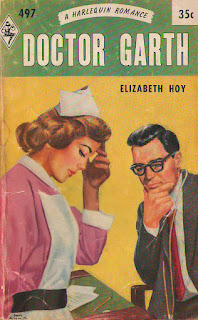
Doctor Garth

By Elizabeth Hoy, ©1959

Cover illustration by Paul Anna Soik
 
“What exactly is an honorary?” Joan Langden asked her fellow nurses on her first day at St. Angela’s.
“A visiting consultant—either physician or surgeon,” explained the senior. “Usually they are men with big reputations. They give their services to the hospital free.”
“Oh!” though Joan softly. So Garth at twenty-nine was an “honorary.” An important surgeon with a reputation. She had known only vaguely of his connection with St. Angela’s and hadn’t been sure just what it was. It warmed her heart to hear the quick commendation of him in this girl’s voice. It made her glow with secret happiness that she might see him soon at his work … but although Joan had known Doctor Garth most of her life, she now found there were many things she didn’t understand about him. Why did he make her feel she was something “special” to him and yet keep so distant? And what was his connection with the pretty mother and her son on whom he was to operate? The story of Joan and Doctor Garth is an unusually appealing one.
 
GRADE: B
 
BEST QUOTES:
“There was no use being a nurse if you were going to be squeamish.”
 
“It would be good indeed if a heart could be no more and no less than Miss Don was describing it, a little chalk sketch on a blackboard, a queer, impersonal muscle with complicated vascular and arterial equipment, a bundle of valves and pumps that had nothing to do with aching and grieving, that could not possibly lie like a lump of stone in a person’s breast day after day!”
 
REVIEW:
Joan Langden is a 21-year-old nurse from the English countryside who has been in love with 29-year-old Dr. Garth Perros since she was knee-high to a tea table. She’s just starting her nurse’s training in the hospital where he is a surgeon, and all is going swimmingly between them until the arrival of the adorable seven-year-old Ivan Petrovna, stricken with appendicitis, and his mother, ballet dancer Vera. From the moment he claps eyes on Vera, Garth is “ashen” and walking around like a zombie. Soon enough, Joan learns the horrific truth: Garth knew Vera eight years ago, and the little tyke Ivan is the product of their friendship.
 
Joan is almost literally hysterical with this news, acting as if she has learned that Garth is a serial axe murderer with anal warts. “Garth was lost to her,” Joan wails, and she is incable of even speaking to looking at Garth, much less speaking to him. “She wanted to be done with him now and forever. He had failed her,” she moans. Eventually, however, Garth forces her into a corner, where he offers her an explanation: He is actually married to Vera, though they had only gotten hitched because she needed a green card, and stayed together for just one summer before she took off, and he had been unable to track her down. So after 25 pages of Joan’s frantic heartbreak over Garth’s bastard child, now that the poor boy has been legitimized, we relive the sloppy hysterics anew over his marriage: “Garth was lost to her hopelessly and forever! The dream of her whole girlhood was burned to ashes. Garth! her heart cried in anguish. Garth!” And there’s another 25 pages of pale cheeks, stony looks, sobbing in bed, and sickening jerks of the heart now that we know that he’s not just a father, but a husband as well.
 
Eventually Garth corners Joan again and tells her that Vera will agree to a divorce if he promises never to see Ivan again, so will Joan marry him when it’s all fixed? After thinking it over, though, Joan selflessly decides that she cannot accept Garth’s proposal of marriage—if she turns him down, Garth will stay with Vera, and, more importantly to everyone concerned, with Ivan, who needs a father. And indeed, soon Vera and Ivan have moved into Garth’s flat, and Ivan is the happiest boy ever! But if Garth and Vera couldn’t last more than a summer when it was just the two of them, things aren’t going to last that even long now that there’s the boy to consider as well. Vera, it turns out, is unhealthily obsessed with Ivan, refusing to allow him to go to school or even have friends his own age. She is furious that Garth wants her to give up the stage, and has her Russian friends over for vodka and caviar and loud, brash parties. Take a wild guess as to how we dispose of Garth’s bride.
 
But before she goes, Vera—who until now had been a largely sympathetic character and even a friend of Joan’s—becomes “the poor girl with her mind half crazed at last, hiding her son in that poverty-stricken cottage, changing her name, half-starving herself, driven on by the senseless fears which were a legacy from her terrible, tragic childhood.” It’s as if VNRN authors can’t bring themselves to treat these up-until-now noble characters so shabbily unless they give them a hideous makeover first, a literary insult to injury. Furthermore, even before Vera is dispatched, all the utter impossibility of being with Garth, the pages upon pages of wailing and gnashing teeth, are utterly forgotten. “Her heart was singing suddenly as she slipped on her soft fur coat, thinking that after all it was she who had the most precious part of Garth Perros’ allegiance in spite of all that lay between them. Vera might have his name—his son. But to herself he had given his love.” Which she’d had from chapter one, but it wasn’t much consolation then, so why is it now?
 
For all my carping, this is mostly an agreeable book. True, Joan’s weeping is a bit much, and the wild oscillations of her logic when it comes to Garth are hard to follow. But the writing is pleasant, if not as stellar as that which brought us Nurse Tennant. Elizabeth Hoy knows how to create real emotion in her readers, and this book, if not the best, is a pleasant outing, worth taking.

Saturday, January 26, 2013

Visiting Nurse

By Jeanne Judson, ©1957
Also published as A Doctor for the Nurse

Proud, lovely, ardently devoted to the great task of aiding the poor and helpless, Elizabeth Downer knew she had found her calling. But her passionate young heart was torn between two doctors, each arrogantly claiming her as his alone. Dr. Galland was darkly handsome. Sometimes she believed his youth and high spirits hid a deep understanding of human suffering. Dr. Denham, quite but strong, was intensely dedicated to medicine. His burning eyes were like the eyes of a priest. And one of these doctors had a secret—a secret which Elizabeth was forced to face. How this warmly courageous girl forged the life she desired is the theme of this moving and fascinating story.

GRADE: A-

BEST QUOTES:
“You’re not old enough to be a public health nurse and you’re much too pretty. You can’t expect sensible people to take you seriously.”

“All blind dates were either dull or obstreperous. Attractive men could find their own girls.”

“She was delighted to find that among his other and more obvious attractions, he must be a most accomplished, tactful, and spontaneous liar.”

“What fools men were. They pretended to think nothing of dress, but they really saw little else in a girl. Helen of Troy in a dusty uniform, wearing clumsy-looking shoes, wouldn’t attract a second glance from any of them.”

“Link never let anything as prosaic as statistics interfere with his exuberant optimism.”

REVIEW:
Elizabeth Downer is a county nurse in Cornwall, PA. She’s working with two doctors: handsome Dr. Kit Galland, who is the nephew of Dr. Purvis, the town’s most senior MD, and is expected to step into his practice when the old man retires; and Dr. Frederic Denham, who has no connections and works tirelessly. But Dr. Denham is also a little creepy; when she first meets him, “She was trying to think what his eyes reminded her of—something disturbing. They were the eyes of a zealot, claiming a sacrifice of self that was beyond ordinary people. Dr. Denham’s eyes were as hard and bright as diamonds.” So right away we understand which of the two Elizabeth hankers for, and it isn’t too much longer before we figure out that he’s not the one who most wants her. (This makes the back cover blurb, above in italics, a complete fiction, one of my personal pet peeves.)

Soon it is revealed that Dr. Denham is to become the new chief of medicine at the local hospital—the very position that Dr. Purvis had been reserving for Dr. Galland. A wealthy foundation has approached the hospital, offering to finance a large new wing, but only on condition that Dr. Denham is made chief. Elizabeth tries to stay neutral in her opinion of Dr. Denham, but soon he’s asked her to dinner and is pressing her to help him in his new role. “You’re going to help me. We’re going to do this together,” he says, eagerly pressing her hand. Then he remembers he has patients waiting and abruptly ends the date, leaving her to get home from the restaurant on her own. After that Dr. Denham seems to pop up and invite himself to lunch a lot. Elizabeth’s friend Peggy warns her: “Whatever you do, don’t go and get yourself engaged to Frederic Denham. You couldn’t call your soul your own, married to a man like that. He’s the kind of man who would want to give you improving books.” Sure enough, he drops by with a “very heavy, much footnoted tome on geriatrics.”

Elizabeth is becoming increasingly disenchanted with Dr. Denham, changing her customary path home so she won’t pass by his office, but he finds her anyway and refuses her refusal of dinner with him. Unfortunately, she lacks the spine to insist. “Being with him was not a relaxation. It was more like a continuation of work,” she thinks—and then he tells her that he is a single man in want of a wife, and goes on to explain his plans for the future at length. “With a little training, a little guidance from me, you can learn to control your impulses,” says the romantic fool. She turns him down, saying she does not love him—and that he has not said the he loves her. “Oh, that—I forgot,” he says, and then kisses her so awkwardly that he is provoked to tell her, “I’ve never approved of the promiscuous familiarities.” He leaves, saying he’ll give her time to think it over, completely missing the fact that Elizabeth has already declined. “She realized that he believed she had refused him because she thought the honor or the responsibility too great.” (Shades of Jane Austen, anyone?) After this, Dr. Denham becomes increasingly irritating, and there’s “something disturbingly proprietary in his indulgent smiles which were more frequent than formerly.”

But she is also working with Dr. Galland on her rounds, and indeed becomes his patient when she falls and breaks her wrist (it’s a Colles fracture, if you’re curious). Dr. Galland is dropping by daily with flowers and mystery stories, while Dr. Denham stops in to lecture her on the virtues of constant study: “It is only by reading the conclusions of many different people that you attain the critical faculty to judge the value of a book for yourself,” he drones. He objects to Dr. Galland’s flowers and mysteries: “It’s high time we let him know that I’m going to marry you,” he says, still not hearing Elizabeth’s constant refusals: “You can’t marry me if I don’t say yes,” she tells him, and thinks, “He couldn’t—could he?”

Then Dr. Denham’s secret is revealed—he is actually very rich and the driving force behind the foundation that bought his own promotion in the hospital. His intention in his new position is to establish new medical techniques: “Cornwall is to be a sort of guinea-pig town,” Peggy tells Elizabeth. “When he has our hospital running as smoothly as a Russian slave labor camp, he’ll go on to some other place and do it all over again, until he’s made the entire country over the way he wants it.” This does not improve him in Elizabeth’s eyes—indeed, it sinks him: “One can’t feel sorry for a multimillionaire.” So now it’s just a matter of convincing him that Elizabeth isn’t going to marry him, and of convincing Dr. Galland that he should, which comes to pass in an enjoyable scene. The sweet ending is almost undone by an unexpected turn from one character on the penultimate page, but it’s a minor glitch.

This book is delightfully written, full of little gems like, “She rose quickly from the rocking chair, decanting three cats from her lap,” or “Peggy managed to get possession of the cakes and the absence of Mrs. Loftus by a combination of flattery and ruthlessness.” Peripheral characters are well-drawn and amusing, and the story itself is gentle and meandering. Most of the story is about Elizabeth’s patients and how she wrangles them and their problems, and frankly it’s difficult to remember much about the plot after the book is over, but it has a pleasant, sweet touch that lingers. It’s similar to the other Jeanne Judson book I’ve read, City Nurse, even down to the Austen-esque proposals. But that just means you have two delightful books to linger over, lucky you.

Saturday, December 29, 2012

The Courtship of Nurse Genie Hayes

By Peggy Gaddis, ©1963
Cover illustration by Robert Maguire
 
To Genie Hayes sent to nurse its crippled owner, the tiny island called Raiford Cay looked like paradise. But the enchanted spot had its share of serpents. Janice Burton, Henry Raiford’s lovely ward, was consumed with jealousy of the new nurse. And the patient himself was a source of worry and confusion. What was the mysterious ailment that confined him to a wheelchair? And why did he refuse to see his wife and son? Genie discovered that the unhappy family on Raiford Cay needed her understanding and tenderness as a woman even more than her skill as a nurse—and she gave both freely!
 
GRADE: C
 
BEST QUOTES:
“People who scarcely glanced at a girl in street clothes would pause and give her a startled, admiring glance once she was clothed in her crisp white. And that, Genie told herself firmly, was only fair, considering the way a girl had to work before she was given the privilege of donning that uniform!”
 
“The poor men go around believing that it is they who do the chasing—when any girl knows that if she really wants a man, she has to run him down and brand him.”
 
“Marriage and a home and children—that’s the most important thing in life for a woman.”
 
REVIEW:
When our heroine, Nurse Eugenie Hayes, arrives on Raiford Cay to care for dying paralyzed Henry Raiford, the island’s only other white girl greets her by saying, “There’s one good thing. At least you’re not pretty, are you?” Janice Burton, you see, has her eye on Henry Raiford’s son and heir Scott—either him or the boat captain Aleck Rogers, she hasn’t quite made up her mind yet. “And until I make up my mind, you’re to let them both strictly alone. Is that clear?” she tells Genie. Well, maybe not; soon Aleck is kissing Genie in the garden, and “it did something crazy to her heart, ordinarily a very well-behaved organ that minded its own business, and rarely indulged in acrobatics.” Though she’s convinced that Aleck is just toying with her, “she knew, much as she wanted to deny it, that she would be perfectly happy spending her life anywhere at all, as long as she was with Aleck! She had to face the fact that she was already in love with him!” And since Janice seems to pay little mind to Aleck, and is constantly seen on Scott’s arm, her declared interest in Aleck comes across as not exactly sincere, and we imagine that apart from territorial jealousy, she wouldn’t seem too upset to lose Aleck. So from the book’s outset we have everyone pretty nicely paired up.
 
When she’s not mooning over Aleck, Genie is trying to care for the curmudgeon Henry, who doesn’t seem to be dying at all and wants little to do with Genie. Instead, he spends all his time with his Asian manservant, Mike, who glares at Genie when he’s not playing chess with Henry. The only other person he talks to is Janice, his wife’s god-daughter, who runs the house. Henry hasn’t allowed his wife Mimi or son to see him in over a year, and Genie soon decides that Henry is “willing himself to die!” But why? He refuses to talk about it, and his family has no idea why—though it seems clear that Janice knows, and is working as hard to keep the secret as Mike and Henry.
 
Soon, though, the truth is outed to Genie in an offhanded way when the blanket Henry keeps in his lap gets caught in his wheelchair and is pulled away to reveal that he is a double amputee, a state so frightening that no one could ever love him if they knew. Later in the garden, Genie tracks down Janice, who spits up the whole story: Henry’s legs had been crushed in a boating accident, and he’s so convinced that Mimi and Scott will shriek in horror when they see him that he has vowed never to let them find out, the miserable dope. We get the entire family history in three paragraphs, how Henry signed over his business holdings to Scott and grew the hedges tall enough that he could go out on the balcony without being seen and had his rooms converted to a self-sustained suite so he would never have to leave them. I can’t stand this sort of sloppy story-telling, when we are brusquely told the back story—and not even by the principal actors—because the author can’t be bothered to figure out a less lazy way to deliver it to us.
 
Though Genie senses from the “genuine emotion” in Janice’s voice that she feels “a genuine love for Henry,” Janice insists that Genie keep the secret, saying, “It makes me sick to my stomach to look at him and know about those hideous stumps.” Genie, however, feels that Janice has an ulterior motive: “There’s just one thing that isn’t clear, Janice. That’s why you want things left as they are,” she says. But Genie has sworn to Henry that she will keep the secret, so she does—and then we have another offhanded reveal, when Henry has a heart attack and everyone just rushes in with the doctor and sees his stumps, and guess what? They don’t despise him, after all! And his heart is going to be just fine, too: “No scientist has ever been able to invent a more powerful medicine than love,” says the island’s doctor. “He’s going to be all right now that the strain of loneliness and heartsickness is over.” Phew!
 
Curiously, rather than slap her husband across the face for being such an ass, Mimi turns on Janice with the same allegations of double-dealing that Genie had made earlier: “You let him refuse to see us. Why, Janice?” When Janice replies that she did it because it’s what Henry wanted, Mimi answers, “What he wanted, Janice, or what you wanted?” and then stomps off before she can get an answer. “Janice seemed to hold herself somewhat aloof, but the Raifords were too happily absorbed in each other even to be aware of her behavior,” and that’s all the book is going to give us on this matter. But it’s unclear to me what Janice could gain from keeping the family apart: Since Henry has already given Scott the entire estate, he has no money to give her, and it doesn’t seem like he would have interfered with her marrying Scott. So this red herring is left dangling.
 
Another side plot involves a nefarious gun-runner Del Rivers, who has crashed offshore and is being nursed back to health by Genie and Dr. Caleb, the local medico. Curiously, after the Raifords are reunited, Janice pops up at the clinic, flirting with the outlaw and lying to Scott about it—and again, it’s not clear at all what Janice has to gain from winning over a thug who is being chased by international police, even if he is “the best-looking thing I’ve ever seen! He’s a dream-boat!” Up until now, Janice has been far too self-interested to be sucked in by a pretty face, and I couldn’t figure out why, with a wealthy landowner like Scott practically in the bag, she would risk losing him for a man with so little to give her. I had to chalk it up to more lazy writing.
 
To make matters even worse, Dr. Caleb then informs us that Henry’s heart attack was a complete fake—that he had decided to let Mimi and Scott back into his life, thanks to Genie’s persistence that he was mistaken about how they would feel about him with two hideous stumps for legs, and felt that this was the best way to go about it. This makes him far and away the most duplicitous rat in the book, even lower than Janice or Del Rivers, who at least are honest about their evil intentions. But Henry’s reputation as a dear, sweet old man is unsullied in Genie’s eyes, and her prior reputation as a gal with sense begins to slip.
 
Then, for the author’s crowning sin, Genie becomes engaged to a man she has not exchanged two glances with throughout the entire book. Needless to say, this comes totally out of the blue, particularly since throughout the book we have been treated to sentences such as, “Genie firmly ordered her heart to behave itself and stop whimpering Aleck’s name.” So the “courtship” that we have been promised in the book’s title, slim and miserable as it would have been if she had ended up with Aleck, is a total and utter fabrication with her actual betrothed. For the final slap on your way out the door, she turns to him and asks, “May I still be Dr. Caleb’s assistant?” as the old doctor has just hired her as his nurse. He condescends that he “wouldn’t mind” if she works. “You’re going to be a very nice husband. You’re so understanding and willing for me to do what I want to do,” she croons. “I’ll never do anything or go anywhere that you don’t want me to go.” And with that, my total disenchantment with Nurse Genie Hayes was complete.