Showing posts with label Indians. Show all posts

Monday, October 31, 2022

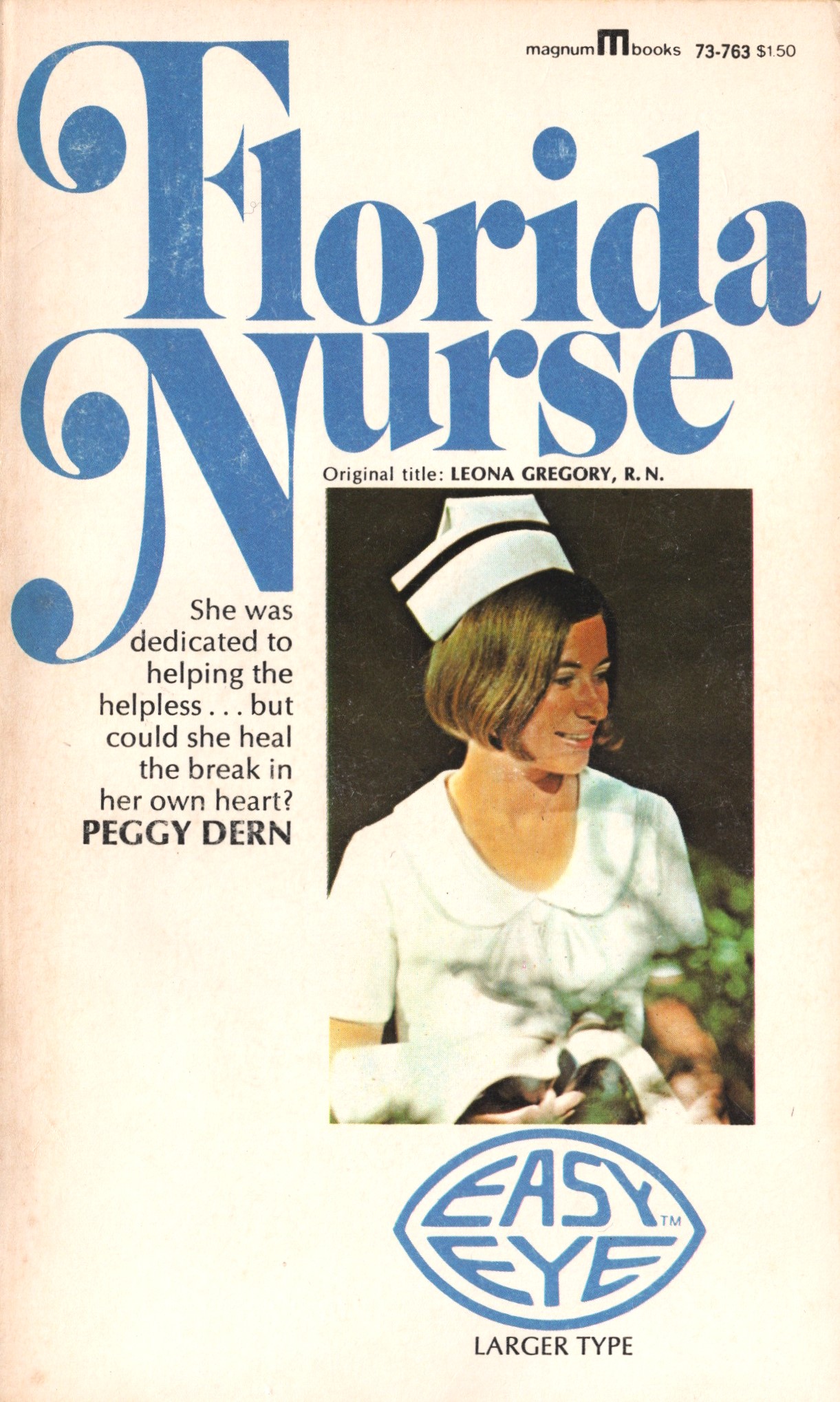
Florida Nurse

By Peggy Dern
(pseud. Peggy Gaddis), ©1961
Also published as Leona Gregory, R.N.

The daughter of a doctor, Leona Gregory had known since earliest childhood that she wanted to be a nurse. She had always thought that that would mean working with her father. But now that Dr. Gregory had married a young wife, Leona felt out of place in the household. The young R.N. gratefully accepted a position in a hospital in Cypress City on the Gulf Coast, even though she was afraid it would cut her off from everything she had known. Meeting the cold, beautiful supervisor of nurses, Paula Ingram, and the stern disciplinarian, Dr. Foster, who headed the hospital, seemed to confirm her fears. But Leona also found an opportunity for service she could not have had elsewhere. Then too, there was the handsome, charming senior intern, Cole Jordan … and, working with him, Leona began to feel that her heart might find wings again.

GRADE: C-

BEST QUOTES:
“Nothing is as inevitable as canned peaches in the hospital dining room.” 

“Well, well, so you’re going to be my special nurse. I feel a bad relapse coming on. I may be here for months.”

“When people are sick or hurt, a nurse’s uniform or a doctor’s is just about the most beautiful thing in the world.”

REVIEW:
It’s entirely possible that it took author Peggy Gaddis, here writing as Peggy Dern, less time to write this book than it did me to read it. The continuity and logic failures are numerous, and Gaddis frequently uses conspicuous words more than once in the same paragraph. Furthermore, this is not the first Gaddis heroine we have met named Leona (see also Nurse in the Shadows). 

Here, Leona Gregory is leaving the “brutal winters” of—not Chicago or Buffalo—Atlanta! a climate so inhospitable that to stand on the doorstep and ring the doorbell is to court pneumonia. Though she tells her father that it’s the frigid temperatures that are driving her to abandon the dream that they have held since she was nine—she was to work as a nurse in his office—the real fact is that it’s Leona herself who is bitterly cold. Her father remarried two years ago to a lovely woman named Irene who attempts repeatedly to befriend Leona only to the rebuffed again and again, and finally Leona is packing her bags and huffing off in a jealous pout for the Florida Coast.

Arriving, apparently not having bothered to interview for the job before signing a one-year contract, she is stunned to find that the head nurse and the chief doctor are unfriendly and militant disciplinarians. She befriends nurse’s aide Alma Pruitt, who appears to have bipolar disorder given the way she caroms between hysterical laughter and hysterical tears from one paragraph to the next. She also meets Dr. Cole Jordan, the up-and-coming surgical resident who always insists on commenting on Leona’s looks; bachelor number two is Bruce McLain (also spelled MacClain), who recently inherited a very lucrative ranch in town. Carol Decker is the daughter of the housekeeper on Bruce’s ranch, and though the original owner of the ranch left Carol and her mother well off, Carol has her sights set on Bruce’s larger fortune.

With three women and two men, it’s a game of the musical chairs to find out who is going to end up alone—and with Carol acting the part of the “weirdie,” “mental case,” and “spiteful malicious cat,” she is clearly the one we are not supposed to like. But honestly none of the women are terribly attractive—there’s Leona’s inexplicable animosity toward her lovely stepmother Irene, and Alma Pruitt herself engages in quite a few unattractive games to snare a man, such as pretending she has a fiancé in Tampa; her wild mood swings are also alarming, as she is usually in tears at some point in every scene in which she appears.

So what’s the plot? I mean, beyond thin and implausible? Well, Bruce has been thrown from his beloved horse and saved from paralysis when Dr. Foster plucks a miniscule bone fragment from his spine, and now Bruce has to lie in the hospital for weeks. But Leona is assisting in the surgery and hears Bruce mumble just before he’s going under, “Don’t let anything happened to Starlite.” So when Carol vows to have the horse shot, Leona peels off her scrubs and flies out to the ranch to prevent the murder because “it’s part of the nurse’s job to catch the faintest whisper from the patient and try to do what he asks,” apparently even if it means abandoning her shift. I hope one of my patients will ask me to make a Starbucks run.

Now the thwarted Carol is gunning for Leona—and soon the sheriff turns up at the hospital to arrest Leona because the horse has gone missing, and based on this accusation alone, the sheriff plans to toss Leona in jail. It seems a rather flimsy basis for legal system, but then this is Florida. Out on bond, Leona decides that Carol “will continue to harass me and the hospital as long as I am here.” So despite the fact that Dr. Foster has not agreed to release Leona from her contract, she decides she is quitting—Dr. Foster has better grounds for lawsuit than Carol does, but never mind about that.

Leona goes to tell Bruce goodbye, that she is going back to Atlanta to work with her father after all. “Her father would be overjoyed; and she and Irene would be friends!” This shocking transformation of character, we are told, occurs because “when I fell in love with Bruce, I suppose I sort of grew up.” Here’s surprise number two—she and Bruce, who had spent exactly two afternoons together, are madly in love and will be married the minute Bruce leaves the hospital! And Leona will be leaving her career too, because even though Bruce has expressed no opinion on the matter—and never mind about Leona’s pesky contract—“I’m going to do whatever Bruce wants me to do, always.” Irene tries to talk sense into Leona by saying, “In a successful marriage there is no necessity for a boss. It’s a partnership; an equal partnership; fifty-fifty all the way.” Nonetheless, though she has declared that nursing is vitally important to her, Leona insists on quitting a hospital so short-staffed that “there simply isn’t time for any of us to sit down and hold the families’ hands or soothe them.”

Ultimately this is a carelessly written book with stupid characters, compounded by a large helping of bigotry against the local Seminole population and the poor whites in town as well. (There’s another penitential donation going to the American Indian College Fund from the White Doctor Foundation.) Dr. Foster shouts at a family reluctant to put their five-year-old daughter to surgery for a possibly benign tumor based only on his say-so—in a conversation held in the hospital lobby, no less—and the head nurse explains the doctor’s shocking rudeness (not to mention privacy violation) by saying, “he simply has not the patience or the time to put up with ignorant, stupid creatures”—and Leona is shocked that the nurse thinks Leona might be critical of this approach.

Peggy Gaddis always wants to have everything both ways—Leona couldn’t possibly criticize a doctor for calling it “nonsense” to explain a surgery (these days it’s called “legal consent”), but we are supposed to like Dr. Jordan a lot more because he does. Some characters say some really appalling things about the Seminoles, and these remarks pass without comment, but Indians competently staff the hospital and ranches in town (and ultimately save Bruce’s horse). Women are strong, competent workers who manage large farms and hospital wards, but they chuck it all to land a man. Alma schemes to lure in her crush, including lying about a fiancé and flirting with men in whom she has no interest, but Carol is the one who is called a “scheming cat” for her desire to win Bruce. Alma never has a kind word to say about Carol but completely denies intending to hurt Carol’s feelings when Carol take offense. Every leading male character tells a woman at least once that he ought to “turn you across my knee and whale the daylight out of you!” Need I go on?

I’m ultimately not sure what author Gaddis herself thinks about her characters, but it seems clear to me that she does not have a high regard for women. That being the case, it’s hard for me to have a high regard for Peggy Gaddis or her books, and especially not this one.

Sunday, September 19, 2021

Emergency Nurse

By Rosamund Hunt, ©1964

Amy Whiting came to Elsalock Island seeking escape. The young nurse had lost the doctor she loved to another woman, and wanted nothing more to do with nursing or with men until her painful emotional wound had healed. But fate had other plans. Her first day on the lovely New England island, Amy was pressed into service when a tragic accident filled the understaffed local hospital with needy patients. Soon Amy had won far more than the professional admiration of two handsome young doctors, and the vengeful jealousy of a stunningly beautiful yet strangely moody fellow nurse. Amy had only her heart to guide her through a maze of personal rivalries and conflicting feelings … the heart she had sworn never to trust again …

GRADE: C+

BEST QUOTES:
“Couldn’t do that. Couldn’t pick out one woman in the whole world and make her happy. Think of how many others I’d make miserable if I took myself out of circulation!” 

REVIEW:
Amy Whiting RN has turned up on Elsalock Island, which is located off Cape Cod, vowing never to love again!!! Or nurse again, either, because even just being in a hospital makes her remember Dr. Alec Osborne, a boy she’d loved since high school and followed into medicine with the dream of working alongside him after they were married—except that he’d decided to marry someone else, the rat bastard! Amy needs a serious dose of coping skills. To demonstrate how destroyed she is, “she wore no make-up because she had lost faith in such things. Alec had rejected her for an older, plainer woman, and she was not interested in trying to make herself attractive any longer.” She’s also pretty shallow; did I mention that? 

Anyway, after quitting nursing and life altogether, she’s going to hole up on this remote island in the cottage left to her by an aunt. On the ferry over, she’s taken up by a suave charmer, Peter Pepper, who regales her with humorous stories to such an extent that she hardly notices the two cops who are scrutinizing every male passenger exiting the ferry. “A guy could lose himself up here for a long, long time,” Peter observes. “He could hide out from the world, and his enemies would never be able to find him.” Nope, Amy doesn’t pick up that clue he’s putting down, either. Peter also finds the island attractive because it’s itching to raise money to build a new hospital, and he’s just the man to make all that happen, as long as he gets to put his name on the bank account!

But en route from the ferry stop, the bus she and Peter are riding on tips over, and all the injured folks are hustled off to the local hospital. Amy is not harmed, but she is instantly pressed into duty by mean old Dr. Dan Spencer, who hears Amy’s story and is not exactly impressed. “You decided to quit the profession that you only went into for selfish reasons of your own,” he sums up. “Didn’t it mean anything to you at all, except as a means to your own ends?” At least she has the nerve to answer, “I don’t think it did. It was a job.” Ah. 

But with all these injured folks lying around, she does agree to help out, initially thinking it would be just for one day, but she keeps coming back, because she likes the patients, and besides, Dr. Aaron Moon is “the most impressive-looking man Amy had ever seen.” He’s Indian, of the Chackonee nation, which inhabits one end of the island. He and the charge nurse, Jeanne Halderson, are apparently desperately in love with each other, but for some reason—could it be his Indian heritage?—Jeanne is just nasty and brutish with poor Dr. Moon, so he dates Amy now and then.

Meanwhile, as Amy finds out that more and more folks who can’t really afford it are digging deep into their piggy banks to help the persuasive Mr. Pepper finance the new hospital, she starts to get uneasy. “Don’t get involved in something which isn’t your affair,” she eventually decides, and keeps her suspicions to herself. We’re lucky it’s just one con man, and not a band of international terrorists, that are hiding out on Elsalock Island. You will not be surprised to learn that Mr. Pepper and the money vanish on the same day, and the cops are not so pleased with Amy when they discover she had concerns all along. “Even though this crook was going around collecting money from everyone on the Island. You simply sat back and did nothing when, as you say, you felt that something was ‘wrong’?” Um, yeah, that about sums it up. Interestingly, we’ve met other VNRN heroines who minded their own business and allowed a baddie to get away with a crime (see Jane Arden Space Nurse), but she is not shamed for her stupid behavior the way Amy is. 

So the entire population of the island stops speaking to her, except for the Chackonee people and Dan, but surprisingly, Amy sticks to the job she never wanted in the first place. She even decides that she likes Dan; “there was a certain ease between them, as thought they had known each other for years. There had not been the strain, as there sometimes had been with Alec, of being bright and witty in order to hold his attention.” Because if one man hasn’t worked out, we just have to be informed that the fellow wasn’t all that awesome to start with, that it wasn’t really love that she felt, that it didn’t count for anything.

In the end there’s another disaster, a hurricane this time, and by the end of it, Amy is finally seeing the shining light of Florence’s lamp: “She had found the satisfaction of hard work, of service, of helping and being needed as she never had before in her life. Before, nursing had been to her only the means to an end, something impatiently learned for a selfish purpose. … Words like ‘serve’ had had no part in her life until she had come to the Island, in spite of her glib recitation of the Florence Nightingale oath.” It’s nice that the author bothered to try to give her character some personal growth, but it’s mostly told to us, not shown, unfortunately.

The book ends completely as expected. One big disappointment comes when Amy has just realized that she loves Dan as he is driving her home. He asks her what she’s thinking about, “and, of course, she could not tell him. She could not even turn her head and meet his eyes.” It isn’t until he puts his arm around her and tells her that he has feelings for her that she is able to reach for him. I’ve been realizing lately how passive all these heroines are romantically, how in the end, it is almost always the man who makes the first move. No matter what we’ve been sold throughout the pages about the heroine standing on her own feet and taking ownership of her life, she still can’t extend a hand or face toward a man she loves until his answer is assured. Weak and hypocritical is what it is. The only “plus” in this book is that the Indian community was treated respectably, with honorable, hardworking characters who don’t talk much, of course, but who stand by Amy when Peter runs off with the loot. It’s not much, but with Rosamund Hunt’s Emergency Nurse, we’re not given much, so it’s best to just take that small token and close the book.

Monday, January 25, 2021

Everglades Nurse

By Peggy Gaddis ©1964

Celia Chalmers was used to conquering men. And Jennie saw the look in her eyes when she met Johnnie Ottwell. It made her wonder if she had been foolish to postpone her marriage to Johnnie. He was a struggling schoolteacher. And she had vowed to help him save for their future. But Celia Chalmers knew how to use her beauty as a weapon to get what she wanted. And now she wanted the man who belonged to Nurse Jennie.

GRADE: C-

BEST QUOTES:
“Who was she, Jennie Cosgrove, with her cherished cap and pin still a beautiful novelty, to object to any orders given her by one of those lordly beings, a doctor?”

“I’m a heel to wish that you were as rich as you are beautiful. I’d do the caveman bit—throw you over my shoulder and lug you off screaming!”

“I’d rather be an irritant to a girl than somebody she just looks at and forgets.”

“I do declare, I cannot get over the fool things city folks will do when they are in the Glades, knowing as they must that the place swarms with poisonous snakes and alligators and mean-natured beasts. They just go blundering around as if they were mowing the lawn in their own back yard.”

“When you are in love you will know that one man, and one man alone, spells the fulfillment of all your dreams, hopes and aspirations.”

“Scruples? I don’t burden myself with anything so silly.”

REVIEW:
Author Peggy Gaddis must have been in a crabby mood in the four hours it took her to churn out this throwaway novel: Characters have the inexplicable habit of flying off the handle at the slightest provocation. Even Gaddis’ usually saintly mother character here gets all peevish when she is offered money for some jam she presents to a guest, snapping sharply at the hapless young woman and making her “flushed and uncomfortable.” The next second Mom “suddenly smiled a warm, friendly smile that wiped out any hint of the momentary resentment she had felt. ‘And I certainly hope you’re going to be a friend of mine and that you will come out again.’” No thanks!

Just like her mother, Nurse Jennie Cosgrove is also prone to being cold and snippy, such as to the rich patient’s handsome chauffeur, a seemingly friendly man who offers to take her to dinner, or to the patient’s daughter, who offers to drive her home and innocently remarks that Jennie’s family of eight might be a bit much taken en masse: “Put down that gun, pal!” Celia Chalmers drawls when Jennie comes at her all ablaze. But when Jennie is in the arms of her intended, Johnnie Ottwell, you’ll definitely need a slug of Pepto-Bismol to tame that tummy upset from too much sugar: “He and Jennie were looking at each other as though they would never tire of it,” and then he “drew Jennie close, entirely oblivious to the others, and kissed her, a long, ardent, satisfying kiss ... Jennie was starry-eyed when she got into the car.”

The lovestruck pair are not planning on getting married until after Johnnie finishes his PhD, which appears to be years in the future, since he works full-time as a teacher, and then there’s the little snag of how they will live together: She works in town, and his job, which he has no intention of ever giving up, keeps him in the heartest heart of the Everglades. You do have to wonder why he’s bothering with the PhD at all, actually.

The problem arises when Celia meets Johnnie and is instantly smitten with the heartthrob. Oblivious Jennie suggests that he take Celia on a tour of the Everglades in his “swamp buggy,” and while they are out, Celia’s conversation—apparently intended to win Johnny over—only proves that the two are completely unsuitable for each other. Johnny explains that he teaches English as a second language to the children of migrant Mexican farm workers, and his attitude is actually quite enlightened for the times: “They must be educated so that eventually they can climb above their parents’ present place in the world and be something more than migrant farm workers. Education is the only answer to the problem of the migrant farm worker, not only here in the Glades but all over the country.” “Sounds pretty dull,” cracks vixen Celia. She digs her hole deeper when she adds, “It seems a shame for a man like you to be wasted on a job like this.” Given this triumphant beginning, it is only natural that Celia should think Johnnie is “everything any same girl could possibly hope to find in the man she wants to snag for herself.” It must be his hot bod; I cannot otherwise explain it. But needless to say, Johnnie is not overly impressed.

Back at the ranch, in a remarkable conversation Celia tells Jennie that since she and Johnnie have not yet set a wedding date, “it looks to me very much as though Johnny were available to any girl who really meant to have him!” and tells Jennie that she plans to pursue Johnny. “Then I am afraid if that is what you want, you will probably win,” Jennie answers. “You are a novelty, new, beautiful, and you can probably sweep him off his feet without have to trying!” It’s a novel attitude about your relationship with your fiancé, I’ll say that much.

To put the deal across, Celia, perhaps realizing she’s blown the interview, tells Johnnie that he should break up with Jennie so Jennie can hook up with Dr. Mark Foreman, a handsome young resident who is clearly smitten with her. It seems Jennie is dating Mark regularly, and frankly we do agree that Mark is the better choice—certainly the more typical pick for a VNRN—but in fact we barely see poor Mark again, except one memorable scene in which Jennie tries to set up Mark with Celia and, when he asks her “just why you are shoving me off on Celia Chalmers,” she “stared at him, completely outraged,” and shrieks, “You must be out of your mind. What possible interest could I have in trying to shove you off on Celia?” when, of course, it’s clear that had been her exact intention, to try to divert Celia away from Johnnie and, at the same time, Mark away from herself.

The book takes a bizarre detour through the life of Celia, who has been adopted by a couple at the man’s request, and the “mother” has never cared for Celia at all. The marriage is not a happy one, and the pair snipe and spar through most of their scenes, but in the end, the husband, who has been on the brink of divorce the entire story, decides he’s going to stay with the horrible woman. Furthermore, he agrees to a lopsided and baffling trade: She will give up her current lover, and he will pack Celia off to college, essentially kicking out of the house for good the one person who dearly loves him. Another strange side story is the friendship of two older women who are patients of Jennie’s, one of whom is a pinched, angry woman who does not deserve the kindness of her wealthy and generous hospital roommate.

The story comes to an abrupt end when Jennie is offered a job in the Everglades at a clinic that caters to the local Seminole population—the doctor is in search of a nurse who is known to the Indians so they will learn to trust him—which means she will be living near Johnnie and they can get married. But there’s one hitch: Upon hearing of this turn of events, Johnnie snaps, “I will not be supported by my wife.” This does not mean that Jennie can’t have a job, but rather that her income will be set aside to pay for their children’s college educations.  Once this little hiccup in their plans is smoothed over, “all about them the jungle seemed to stir and whisper as though the very palms themselves and the unseen animals that looked in the undergrowth were joining in the song that was filling both their hearts.” Time for another slug of antacid.

Peggy Gaddis can write some good books, but this is not one; it’s a perfunctory story that lurches around like drunks in a van. The characters are a mercurial, moody, disturbed lot, not one of them worth the ink. The most interesting part of the book is its approach to teaching English as a second language and education for migrant children, and that is sadly brief. It offers a mixed bag toward the Indians; on one hand, Celia—honest to God—greets an Indian shopkeeper by saying “How!” and “lifted her hand in what she had long ago been taught was the proper greeting to an Indian.” But the shopkeeper just snickers and answers, “Haven’t you heard? We all speak English now.” Whenever we meet Indians in the book, they are seen through Celia’s bigoted eyes (“Celia stared at them, and suddenly realized that they were Indians!”), even if the Indian characters do have the last laugh, and “turned away as though he had found her unworthy of his scrutiny.” So it’s another donation for the American Indian College Fund, and another book I can’t recommend, though you might want to check out a Peggy Gaddis novel that might vaguely pass for a sequel, County Nurse—you really can’t beat a monster running loose in the swamp!

Sunday, October 4, 2020

High Country Nurse

By Virginia Smiley, ©1970

Lovely young Cass Fleming wanted nothing more than to be a good nurse. But suddenly her work at City Hospital, the suffering of small helpless children and kind elderly people, seemed too much for her. To make matters worse, her fiancé, Dr. Dan Driscoll, could not understand her feelings. Could she marry a man who was that cold-hearted? Cass decided she needed to get away from it all—to sort out her bruised and mixed-up emotions. The remote Navajo Reservation, where her Aunt Norma taught school, seemed the perfect refuge. But “getting away” wasn’t quite that easy. There were the Navajo people whom she quickly learned to love, and who needed her help. And there was the tall, self-assured young flyer, Sandy Russell, whose playful mockery suddenly turned into something much more serious. Cass realized there was no escape from life and its decisions … and the most important decision of all still lay in wait for her.

GRADE: C

REVIEW:
Nurse Cass Fleming, apparently just a few years out of nursing school, is already burned out. Working at City Hospital in Phoenix, she has witnessed both children dying of cancer and elderly people dying of old people diseases, and she just can’t take it! Plus she had a fight with her fiancé, Dr. Dan Driscoll! So she decides to take a four-week vacation—can you imagine such a thing?—and heads off into the desert to visit her aunt Norma, who is a schoolteacher on the Navajo Reservation. 

OK, I know, you’re already bracing for the racist attitudes of the Great White Woman descending into sandy poverty to bring holy healing to the unwashed, and I will in fact be making reparations in the form of a donation to the American Indian College Fund, a truly inspiring organization that has already benefitted from another horrific book I’ve read (Peace Corps Nurse) and, unfortunately, is likely to be hearing from my checking account in the future as well. On the whole, however, High Country Nurse is less appalling than other VNRNs I’ve read, in that our heroine Cass actually seems to respect and admire the Navajo people she meets. She does, however, feel that their lifestyle is backward—never mind that they were forced out of their homelands and marched on the Long Walk to a prison camp, and then to a piece of land no one else wanted, not exactly prime farmland. Can you blame the Navajo for not trusting anything white people brought them?

Initially Cass is reluctant to get involved in the community clinic, run by an aging Dr. Barton, who begs her repeatedly to help out even for a few hours, but she is on vacation, she insists, and still struggling to get over her heartbreak from witnessing bad outcomes in patients she had cared for. But before long a crisis forces her to get involved, helping to ferry a man with appendicitis to the hospital on the local medical rescue helicopter piloted by heartthrob Sandy Russell. The patient sleeps the whole way, but that’s all it takes for Cass to overcome her reluctance, and now she’s showing up at the clinic in a pale green shift because she neglected to bring any nursing uniforms with her on the trip.

She’s also hanging out with Sandy, and increasingly musing over fiancé Dan’s shortcomings in classic VNRN style. “Dan would want a large, well-staffed office in the best section of the city, with patients in the upper-income bracket.” “Dan had always been so very serious, almost to the point of being stuffy.” “Sometimes lately, when she thought of Dan, he seemed shallow and a bit selfish.” So naturally, when Sandy asks her why she doesn’t wear her engagement ring on her hand—she keeps it on a chain tucked into her blouse—she jams it back on her finger, snaps angrily at Sandy, and, when he coolly says goodbye, she decides, “She would return home to repair her relationship with Dan—and just as soon as possible, they would  be married.” Because marriage will fix everything!

Central to the story is a young girl, Daisy, who wants to attend school but is prevented from going by her grandmother. This is one of Cass’s biggest obsessions during her stay, and she tries again and again to befriend Daisy as well as win over Grandmother Many Blankets—who may recall the compulsory boarding schools for Native Americans that attempted to wipe out Navajo and other Indian Nations’ culture, but no one ever bothers to ask Grandmother about her objections.

Cass’s vacation winds down, and with Sandy now a bit more cool, she heads back to Phoenix to her job, but soon finds it—and her betrothed—a bit dull. “Cass did her work efficiently, but it was always the same—assisting the doctors on rounds, routine work, taking orders, endless orders. More and more often, in spite of her intentions to push it aside, she thought of Dr. B. and his clinic. There, she had shouldered responsibility—there she had felt alive.” Furthermore, Dan has not turned out to be all that great, surprise! Furthermore “since you came back, our dates have been a bit on the dull side,” Dan says. So she decides to return his ring, because “the butte country had changed her. There was no use in trying to force him out of her mind any longer,” she says, and then, out of nowhere, “She was in love with the young flyer.” Now she’s mooning over Sandy, but can’t possibly tell him how she feels.

Eventually Daisy, now ill with tuberculosis, runs away from home and collapses on Cass’s doorstep. Sandy’s helicopter, coming to carry her to the hospital, frightens Grandmother, who is hot on Daisy’s heels. Grandmother believes the helicopter and its radio to be “magic,” though it’s inconceivable that she hasn’t seen the ubiquitous chopper before. Suddenly Grandmother is on board with white man’s medicine and education as well: “You take Daisy to place in city to make her well. Then she will go to the school like other boys and girls.” This shockingly sudden about face sweeps Grandmother’s years of resistance away with the backwash from the helicopter rotors, delegitimizing her feelings without even informing the reader what they even were.

Another side story is Navajo Louise Beh, who wants to go to nursing school, but whose father, a medicine man, is against it. Cass visits Louise in Louise’s home, and “there was, Cass noted, nothing in the room to show that an Indian family loved here.” Louise says, “White man’s school has taught me much better ways,” and my heart broke for poor misguided Louise.

This book is fairly simplistic and formulaic, with cardboard characters and perfunctory writing that yielded nothing for the Best Quotes section. While the thinly veiled racism will make you wince, there’s not much else here to either upset you--or interest you, either. If we hear a lot about sand, we really don’t have much description of the southern Arizona landscape.  Like the other two Virginia Smiley books I’ve read (Nurse Kate’s Mercy Flight and Nurse of the Grand Canyon), this book is not the worst I’ve reviewed, but it certainly is a flat and arid desert.

Tuesday, October 21, 2014

Desert Nurse

By Marguerite Nelson, ©1964
 
Three’s a crowd—and blonde Nurse Nacie Williams knew it. But in her new job as district nurse, she was suddenly one-third of a trio. Two men loved Nacie—and she cared for both of them. But only one meant love. Only one could be her future. Was it the handsome doctor? Or the young high school principal? Why couldn’t she decide?
 
GRADE: C+
 
BEST QUOTES:
“Nacie didn’t trust a living room as spotless as this one. It showed a tendency for its housekeeper to dwell on trivialities and sometimes let the big issue—the important things—slide by unnoticed.”
 
“You’re too beautiful to be a nurse. Nurses should be bony, homely animals—then no doctor or patient would fall in love with them.”
 
REVIEW:
Nurse Nacie Williams is, I am sorry to report, “a small, beautiful girl with sea-blue eyes and glistening blonde hair, trim in her white uniform, her nurse’s cap perched at a jaunty angle.” She’s the county’s school nurse, overseeing elementary and high schools in Mountain City, in the California desert, including both the mainstream population and the Wapi Indian Reservation. As the book opens, she has two major concerns on her hands: Enid Marconi, who has fainted in English class, and the gentlemen she is dating, Principal Hal Edwards and Dr. Gary Morgan. Enid seems healthy, but Nurse Nacie soon discovers that Enid’s father hasn’t had a job in eight months and has run through his unemployment insurance. If nursing ever wears thin, she should consider detective work.
 
Anyway, Nacie suspects that Enid simply isn’t getting enough to eat, but instead of chasing down this lead (maybe detective work isn’t going to work for her after all), she exerts an enormous amount of energy getting Enid a free physical, wrangling with doctors and their office nurses and Enid’s father for more than a week before grumpy Dr. Hanson finally gets around to it. In the meantime, we hear a lot about Enid’s headaches and the extensive differential diagnosis that could have led to the notorious syncopal episode. Nacie’s attempts to cure the child of whatever unknown disease might be ailing her even go so far as coercing a male student to ask Enid to the school’s Get Acquainted Hop—which, in a school with only 200 students, seems unlikely to be necessary. In the high school of that size that I attended, the biggest obstacle to dating was not that you didn’t know the other students, it was that you were related to at least 20 percent of them. In any event, Nacie’s endeavors in this regard are for naught when, on the weekend of the big dance, the boy hitch-hikes to Los Angeles and enlists in the Army, we can only hope for reasons other than to get out of the date. Nacie sighs in relief: “Let’s not try this caper again,” she tells co-conspirator Hal. “It might backfire, and with serious repercussions.” Uh, right.
 
Having missed the obvious lesson, Nacie looks around for something else she shouldn’t get involved in, and drops by the electrical union office to beg for a job on Mr. Marconi’s behalf. Here, though, she meets with more success: The union boss surprisingly agrees to move Mr. Marconi to the top of the list for a job that starts next week. And on his first day, Nacies spots Enid in the line for the school’s hot lunch, when previously the girl had been bringing her own lunches—a story Nacie has doubted but never bothered to check out. A week later Enid is blooming and walking down the hall with boys. “Enid had only fainted from malnutrition,” Nacie sighs with relief, having done not one thing to feed the child in the past weeks.
 
This little problem solved, Nacie can now worry about her boyfriends. She sees both Gary and Hal regularly, and gets involved in some fairly hot necking in their cars at the end of her dates. The shameless hussy, on a date with Gary, “her arms had gone boldly around his neck,” though after kissing him “long and ardently,” putting her arm around his neck seems hardly bold. She’s repeatedly worrying that “she was getting involved—deeply—with two men. Had she led them on?” she wonders, after all that smooching. “The ultimate goal of ‘going steady’ was marriage,” she decides, then frets over whether she will have to quit the job that she loves when she has children—though she has protested loudly to each man that she is not engaged to either of them and has no obligations to be exclusive. She likes to worry, this Nurse Nacie.
 
Her solution to this problem is to start telling Gary and Hal that she’s busy and refusing their dates. This plan backfires, however, when she runs into Hal out with another woman. “Fate had dealt her a cruel blow,” she moans to herself, then puts her head on Hal’s chest while they are dancing and tells him, “You and I are just friends.” When she’s not leading him on, she’s a big tease.
 
With the boys out of her life, Nacie has little else to do but stir up trouble, largely among the innocent juvenile Wapi population. After she notices that little Johnny Woodchuck has red eyes—he’d just been working on a lathe in shop class with no eye protection from the sawdust, but she doesn’t think for a second that has anything to do with it—she’s like an evil hawk, swooping out to the Wapi school unannounced to inspect the sanitation of the bathrooms and haul poor Johnny out of class to scrutinize his eyes and give him the third degree about whether he’s been following his treatments. She obsessed with the idea that there might be a trachoma “virus” (it’s a bacteria, actually) loose on the reservation, and lo and behold, Johnny actually shows up a few weeks later with actual conjunctivitis, poor kid, and now she is a rabid nightmare, locking up the entire elementary school population in the building and refusing to let them out for 36 hours, until every child has been given a shot of antibiotics and had their eyes washed out with copper sulfate, an apparently painful procedure, as persecuted Johnny is “grimacing as pain hit him” when she repeats the washings the next day—the kids have had to sleep on the floor overnight—before finally letting them all go home. I hope I do not have to tell you that this treatment is ridiculously over the top, even for 1960s standards.
 
When cold season hits a few weeks later, she’s out there again, inspecting throats in addition to the boys’ bathroom and deciding, “Almost every Wapi student needed his tonsils out.” No wonder Dr. Gary, an ENT specialist, loves her so; it’s thanks to her he can afford that spiffing new Cadillac he’s been driving around town. But before she is able to start forcing the kids into the OR, one of her beaux suffers a “strangulation” hernia, which is going to kill him in another minute or two, but prompt surgical attention—with Nurse Nacie standing in as scrub, of course—saves his life! Now she knows which one she really loves and they can get married!
 
Inattention to detail is a cardinal sin in my book, as it were, and author Marguerite Nelson leads us down too many blind alleys (Nacie spends a weekend alone in San Diego where she sees two movies and puts down a “masher,” to name just one bizarre extraneous interlude) and creates too many illogical situations (Nacie tends to a Wapi baby who refuses to eat because he is suffering from malnutrition due to too many flies in the house). The writing occasionally tends toward the syrupy, with Nacie giving us a “silvery tinkle” instead of a laugh, her “glistening blonde hair” referenced a few too many times. My favorite gaffe was a very bad transition, when Nacie is kissing Gary after a date, and tells him, “ ‘Good night, Dr. Gary.’ Nacie disrobed swiftly, throwing her clothes over a chair. She lay on her back in the silent apartment, staring at the ceiling.” For a brief, wild moment, I thought we were in for something really interesting, but no such luck. And so, because this book is far more aggravating than enjoyable, I advise you leave this one alone.

Sunday, September 30, 2012

Arctic Nurse

By Dorothy Dowdell, ©1966
Cover illustration by Allan Kass

When beautiful, dark-haired Lori Waters came home to Alaska, she was escaping the memory of heartbreak. She had fallen in love with young Dr. Cliff Randolph, handsome, brilliant, and devil-may-care. But she had lost him, and now she desperately plunged into the excitement and challenge of her work as head nurse on difficult, peril-filled medical missions to distant Alaskan villages. Then, one day, the new doctor arrived. As he descended from the airplane, Lori felt her heart skip a beat, then start throbbing violently. It was Cliff—who now said he loved her. But could she believe him, with his mocking smile and ironic gaze? Could she trust this man who had once so cruelly betrayed her?

GRADE: C

BEST QUOTES:
“As they drove back to the Littner home, she half-wished that Bob would carry her off like a cave man and end the matter once and for all.”

REVIEW:
Lori Waters is a bit unusual in VNRNs in that she is biracial, half Indian and half white. She was “raised white” by her mother, but her Indian heritage manifests itself in an ivory amulet around her neck that she spends a lot of time fondling throughout the book. She lives in Fairbanks, Alaska, with her grandfather, Chief Whitewaters, who is college-educated and holds an important position with the Bureau of Indian Affairs. (Her parents are, as is common amongst VNRN heroines, dead; her mother died of cancer when Lori was in nursing school and her father was killed in the Korean War.) She works as the nurse on a series of clinics run in the remote areas around Fairbanks, which she reaches by plane with doctor and pilot Bob Littner. She is crucial to these missions because her grandfather taught her many Indian languages, so she can converse with the natives.

Bob is a childhood friend of Lori’s who is increasingly putting the pressure on her to marry him. She feels very torn about this: She thinks he would make a great husband, but her heart’s not in it. You see, when she was in training in Seattle, she fell madly in love with upper-crust Dr. Clifford Randolph. He dated her for a year—but after one hot and heavy date, she returned to the nurse’s dorm to find a newspaper left anonymously on her pillow with an announcement of Cliff’s engagement to a society princess. Now, a year later, she’s still not over him.

So when one of the usual Alaskan MDs is away for the summer and a new doc from Seattle arrives to take his place, you should not be at all surprised to find that it is Dr. Randolph who steps off the plane. He tells Lori that his engagement ended last week by mutual consent—“it was one of those deals where we had always known each other,” Cliff tells her, describing, curiously, the same situation as Lori and Bob’s. Upon finding himself single, he has made tracks to Alaska to see her. Indeed, he soon proposes to Lori, and though she is a bit wary of him, she accepts. This means that she is going to have to leave Alaska for Seattle, perhaps never to see her grandfather again. Chief Whitewaters is vehemently against the marriage because, as he tells Lori, “Only you can carry out my dream to better the lot of our people.” Although, since Lori is planning to quit working “for good” when she marries, I’m not really sure how much of a difference Lori is going to make.

It’s the usual formula, with Bob begging Lori to reconsider and moping around a lot, even coming to blows with Cliff, until Lori is finally persuaded that Cliff is—duh—the wrong man. This occurs when there is a major earthquake in the north, coincidentally occurring the day before Lori and Cliff are to fly to Hawaii to meet up with his family and get married. Lori, Cliff, and Bob fly off to the hinterlands, where they spend 24 hours patching people up. But then Cliff, increasingly anxious about the fact that further delay will make him and Lori late for the party his mother has arranged for them in Honolulu, arranges for them to fly with a batch of wounded patients on a Red Cross plane to Fairbanks, where they can catch their jet to Hawaii. Lori, aghast that Cliff would rank his own personal interests first during a major disaster, puts him on the Red Cross plane, alone. “I guess I’m far more Indian than I realize,” she tells him. “I can’t go off and leave them.”

When the disaster is laid to rest and they’re back in Fairbanks, Lori and Bob are having coffee in the hospital—the VNRN romantic equivalent of a candlelight bistro in Paris—when she tells him, “I guess I’m not in love with Cliff after all,” and suddenly Bob is making her eyes light up in a new way. It’s a bit perplexing and way too pat, given the earlier descriptions of how she cried her eyes out for a year after Cliff dumped her and her hand-wringing about how, though Bob is otherwise so perfect for her, she does not love him. But I shouldn’t have been surprised; this entire book is perfunctory and automatic, with little of interest to keep the pages turning.

Sunday, May 27, 2012

Young Nurse Rayburn

By Arlene J. Fitzgerald, ©1964
Cover illustration by Mort Engel

A career in a big-city hospital … marriage to a brilliant, popular surgeon—or a life of service to the Indians and lumbermen of the rugged timber country…and the thrill of working beside a virile, dedicated young doctor? As Nurse Rheva Rayburn hesitates between two ways of life, drama and mystery explode—and in a night of crisis and terror, she makes her fateful choice.

GRADE: D+

BEST QUOTES:
“One of the first things a good nurse learned was not to take the drug inspired comments of her male patients too seriously.”

“It was common knowledge that an Indian was incapable of holding his liquor with any kind of grace.”

“Half aware of Dave’s appraising eyes following her movements, she thought again that the administration of a pain relieving agent, or an anesthetic certainly had the power to release the wolf in a male patient.”

“Pregnancy is a woman’s natural role.”


“Hell, Doc, I’ll bet you could take it. And I can stand anything a damn Indian can.”

“Once we’re married, you won’t have to worry over patients, or anything but making me happy.”


REVIEW:
Being optimistic in nature, I always start a new nurse novel with a sense of hope, an expectation of a pleasant hour or two, a few laughs, enjoyable characters, and good writing. And I took up this book, with its Mort Engel cover, with just such anticipation. “The road twined inland,” it began, but right there – with that one word, twined, a feeling of dismay settled over me, an inclination that only worsened until the back cover approached and the realization that it would soon come to an end dawned.

Rheva grew up with her lumberjack father, Tim, in rough logging country in the Pacific Northwest, but left all that behind to move to San Francisco to become a nurse. In that fabulous city she was scooped up by Dr. Spencer Sandeen, and the handsome, wealthy surgeon is about to head off to a glorious internship at a fancy Chicago hospital with her as his bride. Her heart doesn’t seem to be in it, though, judging by the constant snarky observations she makes about her so-called beloved. For starters, “He would be shocked, to the tips of his immaculately polished kidskin shoes, if he could see her now, crouching in the dense woods beside the big, rugged ranger.” And then, “Spence had never exhibited that certain, thrilled exuberance for his work—or anything else.” “It was the sort of thing Spence would say. And do, Rheva thought. The easy way out, with little danger—to Dr. Spencer Sandeen’s flawless medical record.” “Spence had made it clear to her that he wanted a wife willing to devote herself exclusively to him, body and soul.” Good luck with that, buddy.

She’s come home to visit her dad for two weeks and help him bag an elk (he scored one of the few permits distributed during the elk season). While she’s there, she meets Dr. John O’Garra, a “strange, dark halfbreed doctor” of Irish and Hoopa Indian ancestry. If you find the term half breed a bit unsettling, better pour a tall glass of Pepto Bismol right now, because the word is used at least half a dozen more times, along with a liberal helping of “inscrutable” and “mysterious” – we are treated to all your favorite Native American stereotypes, from the beautiful, wild young woman Sasoo to drunk Indians getting into bar fights.

Rheva really has quite the hots for the doctor, and her lust is quite startling for a VNRN: “Dr. O’Garra’s long thigh pressed against her own, as he leaned with the swerving ambulance. The hard, sinewy pressure of his muscles burned through the thin fabric of her uniform. A sudden surging tingled along her veins in response to his ruggedly appealing masculinity. She hadn’t known a woman could be … She pushed the thought out of her mind, telling herself that the feeling Dr. O’Garra aroused in her was the mysterious ‘libido’ defined by her nursing textbooks.” Call it what you will, sister, but I call it more appropriate for a sleaze novel.

Beyond her own unabashed hankering for Dr. O’Garra’s lithe, muscular form and “exotic Indian darkness,” it seems we’re also supposed to sport a hard-on for Rheva herself, as we are regularly offered glimpses of her uniform “rustling cleanly against the length of her shapely thighs,” her “soft, full mouth,” or in the shower, where “the chilling water sliced against her creamy, pink tinted body.” She’s scrubbing to assist in a surgery in which her father, gored by his elk, may die, but before we scrub up for a very serious operation, we watch her “slip a wrinkled scrubgown over panties and bra, and bind her generous mop of soft hair away from her pert face.” Speaking of lingerie, we learn more about that, too:“She slipped out of her old hunting pants revealing startlingly brief and pretty underwear, mere wisps of filmy, delicately tinted nylon. Most of the nurses Rheva knew were extravagant in their choice of undergarments. A nurse’s uniforms were attractive, coming in a variety of attractive styles. But it somehow enhanced the femininity of the white garments to know that she was daintily attired beneath them.” Whoa, Nellie!

In a shockingly original plot twist, Dr. O’Garra offers Rheva a job at the woefully understaffed hospital, and she can’t decide whether to stay with the half breed hunk or go back to her asshole fiancé who will force her to give up the career she loves and host parties for his shallow friends. Hmmm – what to do, what to do? Then there’s the “night of crisis and terror” alluded to on the back cover blurb (see above), when she and Dr. O’Garra deliver a baby. We’ve already met the woman’s husband, Dave, when he checked into the hospital after rolling his rig. In Rheva’s every encounter with Dave, he makes salacious remarks and looks her over with x-ray vision. She tries to shame him by mentioning his enormously pregnant wife Peggy, but it doesn’t work: “ ‘She’s not much to look at right now,’ he added, his young, handsome face naïve. His gaze traveled the length of her trim figure, shapely in the well fitted, princess style uniform.” The best thing about his wife’s pregnancy, it seems, is that it will soon be over. Indeed, the first words out of Peggy’s mouth after she delivers her son allude to her relief at getting her figure back: “ ‘It feels … good to be thin again,’ Peggy managed. ‘Dave … will be glad.’ ”

So with the baby – and Peggy and Dave’s sex life – saved, all that’s left is for Rheva to choose Dr. O’Garra. Spence shows up to be jilted to his face, but not to worry: There’s that hot Indian woman, Sasoo, for him to claim instead. All the better that she’s actually an accomplished painter.“Sasoo was beautiful. And with a talent like that she could make a fortune in San Francisco. Spence had a penchant for primitive art, as did most of his friends.” Apparently no matter how many art classes you’ve taken – and she’s been studying for years, financed by Dr. O’Garra – if you paint people with brown faces, it’s classified as primitive.

If I were a bigger person, I would not feel compelled at this point to whine about the book’s numerous allusions to Rheva’s pericardiac anatomy: “Her heart twisted behind her sternum.” “Rheva felt a dull ache starting behind her sternum.” “Rheva felt her heart quicken behind her sternum.” “Her heart had begun a sudden fluttering behind her sternum.” “Fear tugged behind her sternum.” “A knife-sharp pang sliced somewhere behind Rheva’s sternum.” “The wild beating behind her mediastinum had grown to thundering proportions.” (Apart from everything else, it would have helped if the author had checked an anatomy book to find out what the mediastinum actually is.) But this book has not encouraged my finer qualities, no doubt because it has none of its own.

Saturday, April 30, 2011

Desert Doctor

By Nell Marr Dean, ©1959

“We figure women should stay home.” That’s what they told Dr. Ann Logan, beautiful and only twenty-five, when she dared set up practice in the wild desert country of the Southwest. But the need for medical care in this desolate area was a challenge Ann could not ignore. When she discovered that more than prejudice against her sex was behind the threats she received, she still performed her duties as she saw them. Then a criminal struck, leaving Ann unconscious on a lonely mountain road. Through her long recovery, Ann battled with the question: “Was her dedication to her profession worth the risk of her life?”

GRADE: B-

BEST QUOTES:
“I would much rather have you operate on my appendix than on my office ledger.”

“Being aware of a man’s emotional apparatus, she was careful to keep her physical weariness to herself. Men always enjoyed the company of a lively, happy woman; not a droopy, harassed one.”

“You mean, Doctor, you’re going to keep him in your nice house all night? A foreigner—and all lousy with fleas!”

“Don’t think a woman doctor isn’t human like all other people. Don’t think she’s exempt from the need of falling in love and having a husband and being protected like every other woman in the world.”

“Never, she went on thinking as they drove along in silence, must she let her career become too all-consuming. She must learn to divide her energies between her work and Tim, never letting her work steal too much of her vitality and gaiety so that there was none left for Tim. And her skill at being a wife would be tested to its ultimate when they had children and her time must be divided to include them.”

“Doctor—if I do have the hysterectomy, will I still be nervous and want to snap at John for no reason at all?”

REVIEW:
Dr. Ann Logan has bought the practice of the retiring doctor in Pueblo Mesa, New Mexico, a town of 5,000 in which half the population is Indians and Spanish-speaking people and the other half white. There’s no other doctor in town, and the nearest hospital is 70 miles away, but that doesn’t stop the townspeople, who “haven’t become used to women doctors,” from giving Ann the cold shoulder. Well, all except the drug addict who attempts to carjack her for the morphine she carries in her bag. And Tim Butler, who “saves” her after she flashes an SOS with her headlights, by simply opening the car door—gosh, if only she’d thought of that! He takes to going around with her, because “a woman’s really not safe in this town—with crazy Mexicans running loose.”

Ann is, of course, a woman doctor, and this fact is thrown in the reader’s face on every other page, with reminders of what a terrible obstacle this is for her, as if she had warts on her nose or something. Curiously, the prejudice that Ann is so conscious of does not help her see the hypocrisy of her attitudes toward the minority residents. “Would these Indians never learn to follow her advice?” she grumps when one of her patients with strep throat goes swimming. She’s “thoroughly exasperated with her thoughtless, self-willed patients,” who “often indulged in the wild extravagance of owning several pieces of high-price electrical equipment” like washing machines and automobiles, items she herself could not imagine living without. Her boyfriend’s not much better; he tells her that although “a lot of these Indians get checks for two or three thousand dollars every few months,” they are “nothing but moochers” who pay Ann in beans and corn.

Ann has an idea to start a free clinic for well babies so she can get to know the townspeople and, she hopes, gain them as patients, but the cranky chair of the city council turns down her request to use space in the city hall. The owners of the local mine dismiss her suggestion that they open a separate clinic because they don’t want to pay for “socialized medicine” for their employees, even though it’s a dangerous job with lots of injuries. She nags the townspeople that they ought to use the funds they have allocated to create a museum to build a hospital instead, and is shot down. But she’s got enough patients to keep her head above water—until a doctor with a penis comes to town and is promptly granted use of the town hall to give immunizations to the town’s children, and the gas company opens up a clinic and puts him in charge of it. Ann is furious that he has “stolen” her idea of a clinic, and scorns him because he drinks too many martinis. The book winds itself up after this with another (more successful) appearance from the drug addict, everyone finally rallies around Ann, and ground is broken on the hospital that the reader can easily see has been in the works from early in the story—three guesses as to what it’s named.

Numerous little plot threads come and go, a good deal of them nowhere, like a woman who has to have her foot amputated when it’s caught in a trap on a night when Ann has gone out on a date instead of waiting by the phone lest someone need her. Or Dr. Jones’ drinking, or Ann’s strictly platonic relationship with the flirtatious Dr. Lacy at the hospital, or the traveling couple who have rented her their house in their abscence telling some people they are coming home but not Ann. In another book, these things would portend something, or amount to more they do. In this one, it just feels like we are hearing about every element of Ann’s life, no matter how inconsequential, and it’s just confusing to wonder which details are important. The only thing you never wonder about is her relationship with Tim, and we’re subjected to a little too much spooning and swooning from the pair to make you at all enthusiastic about their eventual and totally inevitable engagement. The ending suddenly drops off a cliff, like you’re expecting floor when there’s really one more step to go. It’s not a painful read, but the book has a fair number of little flaws that make it not worth the effort.

Saturday, April 16, 2011

Timberline Nurse

By Ruth McCarthy Sears, ©1965
Cover illustration by Chuck Miller


Crystal Garnette loved the beautiful, pine-covered mountains where she had grown up. But when her romance with wealthy Jeffrey Varian ended in heartbreak, Crystal fled to the city to forget. She succeeded, working at busy Rochester-Main Hospital—until her father’s death brought her back to Timber Town. Crystal vowed she would quickly leave. But she could not resist when old Doctor Curtis begged her to stay on at the understaffed mountain hospital. Then, in the midst of her greatest challenge as a nurse, she was faced with the hardest decision of her young life. How could she choose between two very different men—one a rough lumberman, the other a handsome doctor—who said they loved her? In this place where she already had made one painful mistake, dare she risk her heart again?

GRADE: C-

BEST QUOTES:
“You use much better grammar than the other people up here.”

“Sam says when two wimmin can’t seem t’ git along you can jus’ bet there’s a man mixed up in it somewheres.”

“Hill-country morals, darling, are so dreary!”

“Pink dresses are always magic.”

“No man in his right mind would let his girl see him in a shortie nightgown!”

“She longed to pour out the full strength of her womanhood on him.”

“I don’t know much about underwear and that stuff.”

“How you could hate Case a little when he forgot you to go about his mysterious man affairs.”

REVIEW:
Crystal Garnette is a nurse who has returned home to her mountainous hometown in the Sierras of California for her father’s funeral, but she cannot leave fast enough. When the book opens she’s all packed up and waiting for her ride to the train station—but then four women in the hospital decide to give birth at once and she is prevailed upon to stay and help out just one more day. Before you know it, Crystal has moved into a little house and appears ready to stay on indefinitely.

But she hates the towntownsfolk because they think she’s trash, stemming back to an incident when she was 16. (Now she’s either 22, as on page 19, or 24, as on page 153.) She had gone for a drive up in the mountains with young logger Clark Casey, aka “Big Case,” and when he made a pass at her and she tried to escape in his jeep, she drove the car off a cliff. They were forced to walk back into town, arriving there after midnight and landing smack in the middle of a search party about to set out looking for her. When she asked Case to explain where they’d been, he just said, “Explain what? That was no accident, sweetheart!” and stomped off. I’m hard-pressed to find anything even minimally scandalous in this misadventure—she’s clearly a wreck, with “torn clothes, the scratches on her arms and legs, the dirt caking her from head to foot,” and the wrecked jeep had been found earlier—but even now, six or eight years later, the villagers still scorn her; when she walks downtown, “two women, fat-hipped and heavy-busted, lifted their chins in a direct snub.”

Her reputation wasn’t the only ruin that Case’s refusal to clear her name created. Her then-boyfriend, summer resident Jeff Varian, the son of the man who owns all the timberland surrounding the town, dumped her following the incident. In her heartbreak she followed him to Rochester, New York, where Jeff’s family lives, to go to nursing school and occasionally call his house and hang up when the butler answered. Eventually, though, she ran into him, and the fickle cad took up right where he left off, until he used his father’s disapproval of her to leverage a trip to Europe: “I told him that unless he let me go to Paris I intended to marry you! … Isn’t that rich, darling?” So off he went, while Crystal furnished “their” apartment, waiting for his return and their marriage—but when he came back, he had (surprise!) a British wife in tow.

Crystal still blames Case for the wreck of her relationship with Jeff, although the fellow had displayed plenty of shallow tendencies all along. Case is big, arrogant, violent, and sneering, a complete boor. But he’s not the only flame in town; there’s Dr. Rich Lane, who dates Crystal briefly until he reveals that’s he’s really in love with the town’s wild half-breed Indian woman, Tondelaya. Then there’s a big dance, when Case asks Crystal to polka—and then, four pages later, “Why, I love Case! she thought wondrously.” What?!? Are they kidding? To make the absurdity complete, three paragraphs after that, Jeff turns up again, sporting a phony little British accent, telling her that his now-ex-wife has given his parents a blue-blooded grandson so he’s free to marry her at last. What a romantic! Case stomps off, and Crystal’s all heartbroken because “Case had wiped her kiss off his lips!” With this, my disgust with Timberline Nurse was complete.

Nauseating prose (e.g. “If she moved to serve him in any way, it would only affront his virility”), plot twists that defy logic, an Indian character drawn in a stereotypically bigoted fashion (“there’s buried treasure in that wild little heart of hers … She just doesn’t feel equipped to cope with the so-called civilization we try to inflict on her”), and a romantic interest who we’ve been set up to despise for the first 100 pages of the book did not endear this book to me. The best thing about it is the cover, which is truly spectacular. It is uncredited in the book, though it has the signature “Miller” in the corner. After a few hours of research, I’ve come to think that it was done by Chuck Miller, who apparently worked for Playboy, based almost entirely on its uncanny similarity to another painting of his, which appeared on the cover of the March 1962 issue, just three years before this book. So while you should spend some time with the cover, just don’t open it.