Showing posts with label racism. Show all posts

Saturday, May 6, 2023

The Nurse and the Star

By Peggy Gaddis, ©1963

Star Disappears after Romantic Fiasco Exposed: Hollywood – The Eve Stacy-Rix Blake romance fell apart “live” on coast-to-coast TV last night. In an unexpected bit of audience participation, Blake’s wife rushed on stage and claimed her man. Miss Stacy left quickly and her mysterious whereabouts are still unknown … Where was Eve Stacy? There were fantastic stories, lies, rumors. Everybody guessed, but nobody knew for sure—nobody except Kay Harrell, R.N. Deep in the tropics, Kay thought she was rid of “Eve Stacy” forever. But how long could she hide her glamorous past when the handsome, cynical Dr. Fleming was more than just curious?

GRADE: C-

BEST QUOTES:
“How’d we ever luck onto anybody that looks like you to work in this Back o’ Beyond?” 

“What a perfectly loathsome get-up! You should go on strike against wearing such hideous garb. It’s revolting!”

“The big shots who are so important, swaying vast companies, throwing their weight around, shattering empires with their lightest word. But strip ’em down to a hospital gown and tuck ’em into bed, and they are sniveling babies, as any nurse knows.”

“Being in love is not a gloriously happy experience.”

REVIEW:
Nurse Kay Harrell is one of numerous VNRN heroines who’d had the accursed luck of being noticed by a Hollywood director and become, briefly, a rising starlet. This detour is not one that readers will understand, because it doesn’t sound like anything Kay had especially wanted or enjoyed: “She had been like a creature molded of wax, pulled and pushed and twisted this way and that. Often, after the wardrobe department had finished with her, she looked in the mirror and felt quite sure that the seductive, alluring creature that looked back at her couldn’t possibly be Kay Harrell. And of course she wasn’t.” But she hadn’t been alone; the publicity department had fabricated a romance for her with also-rising Rix Blake, and we are given no hint of Kay’s feelings toward him except that when his heretofore unknown wife turns up, Kay had fled Hollywood and taken a job at Mercy Hospital on an unnamed Caribbean island (possibly the Dominican Republic).

Here she instantly develops a deep, boundless hatred for Dr. Anson Fleming, who absolutely deserves it. Aware of her past (despite the lying cover lines), he is convinced that she has come to the island with no other purpose in mind except to seduce Dr. Richard Marston, the wealthy hospital chief who happens to be married. It might help that Valerie Marston is an unbelievably horrible person half his age, one who despises the hospital and the island, and appears to have a severe untreated personality disorder, screeching during her introduction to Kay, “I hate it here! I hate it!s And I’m beginning to hate you!” before falling tear-stained into her husband’s arms and whimpering, “I didn’t mean that, Lover! I adore you! I couldn’t live without you, even if you do keep me locked up in this horrible place with all these horrible natives.”

Kay could never interest Dr. Marston, we are told, because the man is hopelessly devoted to his wife: He “just worships the ground she walks on” even if everyone admits she is “a child,” mentally about 16, who “lives in a dream world she created herself and is very cross if anyone tries to slip in a faint hint of reality.” Valerie is also the most frighteningly racist character I have ever encountered in a VNRN (I cannot reprint the truly despicable lines she utters in this book) who has somehow managed to convince her “Mammy,” who is a native of this country, to come with her and suffer her patronizing insults and serve as housekeeper and cook, finally proving satisfactory after months of training: “Now she does what she is told,” Valerie triumphantly reports. Another success for the patriarchy.

Dr. Fleming—who casually lets drop early on that he was in prison for a year for malpractice, a startling detail that is immediately dropped, never to be seen again—takes every opportunity to all but call Kay a slut every time she passes Dr. Marston a kelly clamp or goes for a walk alone at night, even threatening her “unless you’d like to have your neck broken, stay away from the chief!” Pretty much everyone at Mercy Hospital is insane—as is Kay for continuing to work there.

Dr. Fleming concocts a weird idea that he and Kay should pretend they are in love so that Dr. Marston won’t leave his wife; somehow it seems he believes that Dr. Marston would not trespass on another man’s woman even if he has no qualms about straying from his own wife. It only takes Kay 40 pages to let everyone know this is not true. Then there are vague mentions of voodoo, about the only explanation of which we are given is that it is “a very real and very filthy evil” and somehow the hospital is battling voodoo with modern medicine. Then a woman shows up with her husband, who has been cursed by Old Nick, the local witch doctor, who tied a rope around the man’s leg that no one bothered to remove so now gangrene has set in and the man dies. Old Nick starts hanging around the hospital in a mask at night, apparently after the man’s wife, and now half the staff has fled in fright. Valerie’s “mammy” Maria departs as well, but not before delivering a sound telling off to Kay: “You come here, you treat us like dirt. This is our country. You come here and want to make slaves of us again. Did we ask for your help? Did we send for you? Did we ask you to treat us like we are not humans? You come, you force your ways on us. You tell us all that we do, all that came before you were here, the way we live, is wrong. No, we did not send for you. Go away and leave us to our own ways.” Maria is the smartest, most honest, and most clear-eyed character in the book.

But everyone Kay tells this to only sneers or laughs that probably most of the natives are glad for the help. They wouldn’t know because they never asked—nor are they likely to start inquiring now—but what a shocking thing for the outrageous old biddy to say! “Why the blazes don’t we get out and let them wallow in their poverty and disease and superstition?” snaps one doctor’s wife—and then she decides to train the wife of Old Nick’s deceased victim to become Dr. Marston’s new maid. “She’s so eager to learn and grateful to all of us. So why don’t we give her Maria’s job? She’d take loving care of the chief.” Another problem with ungrateful staff solved!

Kay eventually breaks down and tells the unbalanced Dr. Fleming that she loves him, so at best she wins points for assertiveness, but there’s absolutely no reason why she should love such a dangerously unstable person, any more than she had for loving Rix, or abandoning Hollywood in such an extreme fashion just because a fake romance was publicly revealed as exactly that. The only thing that could possibly make any sense of Kay’s flight and Dr. Fleming’s horrible treatment of her is if, in an earlier draft of the book, Kay had actually had an affair with Rix and was fleeing the scandal when she ran off to the ends of the earth, and if Dr. Fleming had known of it, in which case his concern for Kay’s interference in Dr. Marston’s marriage would be legitimate. But who knows?

But the truly horrifying racism that a number of characters—including Dr. Fleming, who snarls that the locals “breed like flies”—exhibit is even more unacceptable when the other characters vainly try to knock it down (one local doctor points out to Dr. Fleming in the “shocked silence” that follows his remark, that they also “die like flies” and that “it is our job here to cut down on the death rate rather than the birth rage,” but his wife immediately apologizes for her husband’s “impertinent” remark. Why would author Peggy Gaddis have Maria and the local doctor make such excellent points against racism only to have the main characters dismiss them so cavalierly, and without any acknowledgement of their complicity and participation in a racist system, and continue on unrepentant with their own racist attitudes? It’s utterly bewildering—but not unexpected from Ms. Gaddis, who enjoys a large sprinkling of racism in her novels, and who also likes to play both sides of every argument without choosing one side or the other. And so as I urge you to give this very bizarre and disturbing book a solid chuck into the trash, another donation from the White Doctor Foundation goes into the mail.

Monday, October 31, 2022

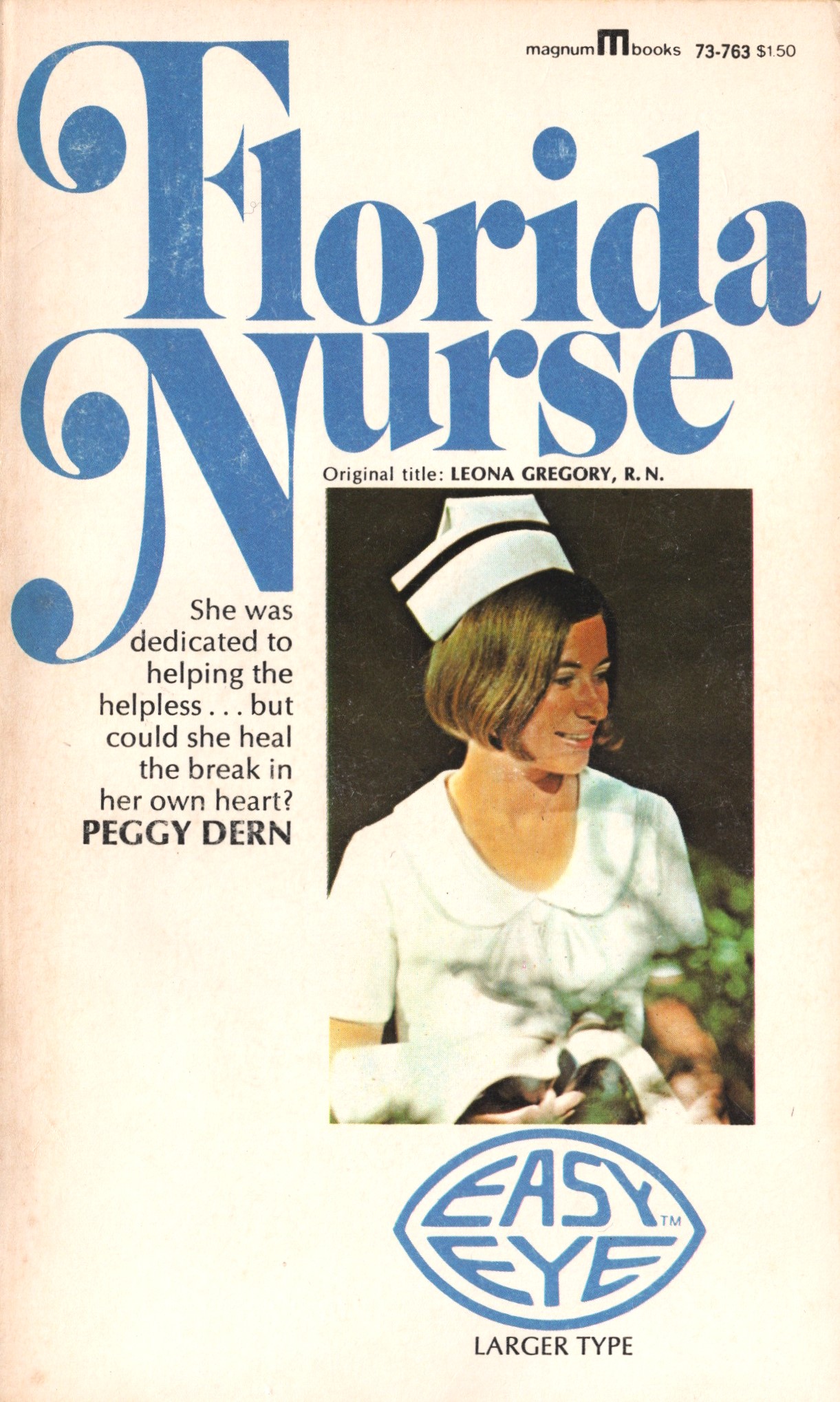
Florida Nurse

By Peggy Dern
(pseud. Peggy Gaddis), ©1961
Also published as Leona Gregory, R.N.

The daughter of a doctor, Leona Gregory had known since earliest childhood that she wanted to be a nurse. She had always thought that that would mean working with her father. But now that Dr. Gregory had married a young wife, Leona felt out of place in the household. The young R.N. gratefully accepted a position in a hospital in Cypress City on the Gulf Coast, even though she was afraid it would cut her off from everything she had known. Meeting the cold, beautiful supervisor of nurses, Paula Ingram, and the stern disciplinarian, Dr. Foster, who headed the hospital, seemed to confirm her fears. But Leona also found an opportunity for service she could not have had elsewhere. Then too, there was the handsome, charming senior intern, Cole Jordan … and, working with him, Leona began to feel that her heart might find wings again.

GRADE: C-

BEST QUOTES:
“Nothing is as inevitable as canned peaches in the hospital dining room.” 

“Well, well, so you’re going to be my special nurse. I feel a bad relapse coming on. I may be here for months.”

“When people are sick or hurt, a nurse’s uniform or a doctor’s is just about the most beautiful thing in the world.”

REVIEW:
It’s entirely possible that it took author Peggy Gaddis, here writing as Peggy Dern, less time to write this book than it did me to read it. The continuity and logic failures are numerous, and Gaddis frequently uses conspicuous words more than once in the same paragraph. Furthermore, this is not the first Gaddis heroine we have met named Leona (see also Nurse in the Shadows). 

Here, Leona Gregory is leaving the “brutal winters” of—not Chicago or Buffalo—Atlanta! a climate so inhospitable that to stand on the doorstep and ring the doorbell is to court pneumonia. Though she tells her father that it’s the frigid temperatures that are driving her to abandon the dream that they have held since she was nine—she was to work as a nurse in his office—the real fact is that it’s Leona herself who is bitterly cold. Her father remarried two years ago to a lovely woman named Irene who attempts repeatedly to befriend Leona only to the rebuffed again and again, and finally Leona is packing her bags and huffing off in a jealous pout for the Florida Coast.

Arriving, apparently not having bothered to interview for the job before signing a one-year contract, she is stunned to find that the head nurse and the chief doctor are unfriendly and militant disciplinarians. She befriends nurse’s aide Alma Pruitt, who appears to have bipolar disorder given the way she caroms between hysterical laughter and hysterical tears from one paragraph to the next. She also meets Dr. Cole Jordan, the up-and-coming surgical resident who always insists on commenting on Leona’s looks; bachelor number two is Bruce McLain (also spelled MacClain), who recently inherited a very lucrative ranch in town. Carol Decker is the daughter of the housekeeper on Bruce’s ranch, and though the original owner of the ranch left Carol and her mother well off, Carol has her sights set on Bruce’s larger fortune.

With three women and two men, it’s a game of the musical chairs to find out who is going to end up alone—and with Carol acting the part of the “weirdie,” “mental case,” and “spiteful malicious cat,” she is clearly the one we are not supposed to like. But honestly none of the women are terribly attractive—there’s Leona’s inexplicable animosity toward her lovely stepmother Irene, and Alma Pruitt herself engages in quite a few unattractive games to snare a man, such as pretending she has a fiancĂ© in Tampa; her wild mood swings are also alarming, as she is usually in tears at some point in every scene in which she appears.

So what’s the plot? I mean, beyond thin and implausible? Well, Bruce has been thrown from his beloved horse and saved from paralysis when Dr. Foster plucks a miniscule bone fragment from his spine, and now Bruce has to lie in the hospital for weeks. But Leona is assisting in the surgery and hears Bruce mumble just before he’s going under, “Don’t let anything happened to Starlite.” So when Carol vows to have the horse shot, Leona peels off her scrubs and flies out to the ranch to prevent the murder because “it’s part of the nurse’s job to catch the faintest whisper from the patient and try to do what he asks,” apparently even if it means abandoning her shift. I hope one of my patients will ask me to make a Starbucks run.

Now the thwarted Carol is gunning for Leona—and soon the sheriff turns up at the hospital to arrest Leona because the horse has gone missing, and based on this accusation alone, the sheriff plans to toss Leona in jail. It seems a rather flimsy basis for legal system, but then this is Florida. Out on bond, Leona decides that Carol “will continue to harass me and the hospital as long as I am here.” So despite the fact that Dr. Foster has not agreed to release Leona from her contract, she decides she is quitting—Dr. Foster has better grounds for lawsuit than Carol does, but never mind about that.

Leona goes to tell Bruce goodbye, that she is going back to Atlanta to work with her father after all. “Her father would be overjoyed; and she and Irene would be friends!” This shocking transformation of character, we are told, occurs because “when I fell in love with Bruce, I suppose I sort of grew up.” Here’s surprise number two—she and Bruce, who had spent exactly two afternoons together, are madly in love and will be married the minute Bruce leaves the hospital! And Leona will be leaving her career too, because even though Bruce has expressed no opinion on the matter—and never mind about Leona’s pesky contract—“I’m going to do whatever Bruce wants me to do, always.” Irene tries to talk sense into Leona by saying, “In a successful marriage there is no necessity for a boss. It’s a partnership; an equal partnership; fifty-fifty all the way.” Nonetheless, though she has declared that nursing is vitally important to her, Leona insists on quitting a hospital so short-staffed that “there simply isn’t time for any of us to sit down and hold the families’ hands or soothe them.”

Ultimately this is a carelessly written book with stupid characters, compounded by a large helping of bigotry against the local Seminole population and the poor whites in town as well. (There’s another penitential donation going to the American Indian College Fund from the White Doctor Foundation.) Dr. Foster shouts at a family reluctant to put their five-year-old daughter to surgery for a possibly benign tumor based only on his say-so—in a conversation held in the hospital lobby, no less—and the head nurse explains the doctor’s shocking rudeness (not to mention privacy violation) by saying, “he simply has not the patience or the time to put up with ignorant, stupid creatures”—and Leona is shocked that the nurse thinks Leona might be critical of this approach.

Peggy Gaddis always wants to have everything both ways—Leona couldn’t possibly criticize a doctor for calling it “nonsense” to explain a surgery (these days it’s called “legal consent”), but we are supposed to like Dr. Jordan a lot more because he does. Some characters say some really appalling things about the Seminoles, and these remarks pass without comment, but Indians competently staff the hospital and ranches in town (and ultimately save Bruce’s horse). Women are strong, competent workers who manage large farms and hospital wards, but they chuck it all to land a man. Alma schemes to lure in her crush, including lying about a fiancĂ© and flirting with men in whom she has no interest, but Carol is the one who is called a “scheming cat” for her desire to win Bruce. Alma never has a kind word to say about Carol but completely denies intending to hurt Carol’s feelings when Carol take offense. Every leading male character tells a woman at least once that he ought to “turn you across my knee and whale the daylight out of you!” Need I go on?

I’m ultimately not sure what author Gaddis herself thinks about her characters, but it seems clear to me that she does not have a high regard for women. That being the case, it’s hard for me to have a high regard for Peggy Gaddis or her books, and especially not this one.

Monday, January 17, 2022

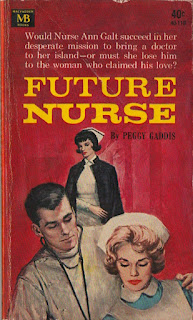
Nurse at Spanish Cay

By Peggy Gaddis, ©1962
Also published as Future Nurse 

Ann Galt had come to Blalock Hospital to receive her nurse’s training. Then it was back to home on the Caribbean island of Spanish Key to care for the natives who had been working for her family for years. But Ann wanted more than to be a nurse; she set out on a desperate admission to marry a doctor and bring him back to her beloved ancestral island, and Dr. David Lochran, handsome, dedicated, and unmarried, seemed the ideal choice. But was there an understanding between David and beautiful Julia Anderson, the senior nurse who had taken Ann under her wing? Anne’s decision was taken out of her hands when a tropical hurricane roared across her island and opened her eyes to the meaning of love.

GRADE: C-

BEST QUOTES:
“Greater friendship hath no man than that he should lend his cherished car to a woman driver!” 

“I wasn’t permitted to read Oscar Wilde when I was growing up.”

“Well, of course I’m right. I’m the doctor, Nurse—remember?”

“Well, R.N.’s are taught they must maintain composure and move swiftly without running and a lot of other things.”

REVIEW:
Author Peggy Gaddis has many annoying habits. Her heroines frequently lie about their feelings towards men, and they tend to be syrupy to the point of inducing nausea: They are regularly wide-eyed and/or near tears; they don’t speak, they trill; their laughter is always gay; and their interjections usually include “Forevermore!” “Zounds!” and “Phooey!” But here on Spanish Cay, unfortunately, Gaddis must have put a pound of sugar in her sweet tea, as she’s off the charts with the sentiment—and to make matters worse, she’s added a nauseating dose of racism to boot. 

The Galt family seems to own most of this small island located between Honduras and Haiti, on which their plantation grows coffee and—fittingly—sugar cane. Ann Galt, who is 18 when we open the book, is about to be sent to the United States to nursing school by her 80-year-old great-grandmother (the Galt women all appear to have been teen brides), who is called Clarita by everyone except Ann, who leans heavily on “darling.” Ann’s wishes to remain forever on the island must be sacrificed for nursing school because old Dr. John, who has either no first name or no last name, is on the brink of expiring with no one in line to step into his shoes. This tragedy the family would accept with equanimity if they did not feel responsible for the healthcare of the island’s native population. “They have been faithful and devoted and we are responsible for them,” Clarita tells Ann, and plantation business manager Tad agrees, saying that when she is a nurse Ann will be able to “look after the people who adore you and who have made a living for the Galts for 200 years.” (When a visitor to the Island asks if they have racial trouble, “Ann turned to stare at him, wide-eyed and shocked. ‘Racial trouble?’ she repeated incredulously. ‘Why, these are people, our people!’” demonstrating exactly why there might be a problem.)

Ann’s older brother Jerry had initially been teed up to serve as the sacrificial lamb, and had even been just a couple of months short of finishing his residency before returning to the island to pick up the stethoscope, “and then he had that beastly hunting accident!” Ann stomps her foot in frustration over the death of her apparently unloved older brother. “Oh, Clarita, it’s all so unfair. There were others on that hunting trip who could have been spared much easier than Jerry.” Total bummer!

So off to nursing school she goes, and there Ann meets Julia Anderson, who is appointed Ann’s “Big Sister,” to look after her during the brutal probie year. In addition to studying, from the first chapter Ann has been pretty frank about her plan to “snag some fine, upstanding young medic who’ll fall head over heels in love with me and be willing to marry me and come down here to practice.” Julia, who graduates when the year is up, has been dating Dr. David Lochran, who ends his residency at the same time. Of his relationship with Julia Ann is well aware, but that doesn’t stop her from fastening her wide eyes on the man and inviting him to Spanish Cay when the year is up. He mentions this invitation to Julia in Ann’s presence, so the little vixen is forced to invite Julia as well. Darn!

The year passes in pages, and soon the trio has landed in the Caribbean. Julia, who is no moron, is on to Ann, and David notices “just possibly the faintest tinge of acid in their tone” when they speak to one another. Ann even suggests to Tad that he start flirting with Julia so that she can work her wiles upon David without interruption. (Tad responds, “Why, you shameless, outrageous little somebody! I ought to spank the daylights out of you, the way I used to enjoy doing when we were kids and you’d got out of line”—spanking being one of Gaddis’s kinkier staples.)

But two weeks into the trip, when Ann and Julia are nourishing incipient skin cancers on the beach, Julia mentions that doesn’t know what she is going to do now that she is graduated, as “I can’t decide, of course, unless he does,” because “whatever David wants is what I want.” Ann’s eyes—wait for it—widen, and she is shocked! to learn of their relationship, and immediately chucks her evil scheme.

Four pages later, a hurricane of a strength never before seen on the island is upon them, which they didn’t notice until the winds were so ferocious they nearly knock a Jeep off the road, so it’s too late to evacuate. David and Julia hustle down to the clinic to help Dr. John, while Ann and Tad comb the island for the resident witch doctor, an elderly woman who has gone into hiding. Somehow, Ann manages to swim a tempest-tossed inlet to reach the woman, who is clinging to a cliff face, and haul her back across to safety. Once they’ve driven the old woman back to the clinic, Ann and Tad collapse into each other’s arms. “Then she drew a little away from him and stared up at him, her eyes wide with a sudden realization, her tear-wet face flushed. ‘Why, Tad!’ she breathed, her voice touched with wonder. ‘Are we in love with each other?’” Guess what the answer is? Tad declares, “You’re staying right here, and you’re going to marry me,” continuing the family teen-bride tradition.

After the storm blows out, the kids head for the hacienda, which is built on high ground, where “there were not too many signs of the hurricane,” the lights are still on, and everyone has a hot shower and plenty of breakfast. “Everything’s just fine and dandy,” Ann sighs. She’s sorry to tell Clarita that the village is gone, but the matriarch responds “as though it were of no importance.” Indifference is catching; Julia declares, “It’s been a terrific experience. Oh, of course I’m terribly sorry about the village being washed away and all that.” Will Clarita be disappointed that Ann isn’t going to finish her training? Naw! “I sent you away with the very kindly intent of giving you and Tad a chance to find out that you really loved each other,” she says. “I hoped it would happen, but I couldn’t be sure. And if it didn’t, and you came back with her R.N. degree then there would no harm have been done.” Which left me unconvinced that there was only one witch on the island.

Now we have time to catch up with the other pair of love birds: David suggests to Julia that he take over Dr. John’s post and that Julia join him. And it’s Julia’s turn to be disingenuous: “Of course. You would need a nurse,” she says, and when David answers that what he needs is a wife, she pretends that he must be talking about Ann. When that phony little misunderstanding is cleared up, it’s their turn to act all surprised and starry-eyed when they realize they’re in love with each other, complete news even after years of dating. “Well, I’ll be darned!” David says dazedly.

The worse part of it is that this insipid, dripping washout doesn’t even qualify as a nurse novel, since the central character quits after just one year of training; I don’t think Julia and David’s peripheral storyline moves it over the mark. The racism is of course hugely problematic, and I’m mailing off another check as per the White Doctor protocol. Every single female character is cloying, and even the aged characters, usually beloved Gaddis staples, are horrid: Dr. John is a constantly shouting ass, and the matriarch is alarmingly Machiavellian. Gaddis should have been given a strict limit on adjectives and altogether barred from using adverbs; in just one page selected at random, we get “said Tad carefully,” “said Ann hastily,” “he repeated slowly, carefully” “Ann cut in swiftly,” “he said gently,” “Ann said quickly,” “She added quietly.” Ugh! This book is not even of the so-bad-it’s-good variety (looking at you, Nurse at the Fair and Harbor Nurse); really it’s those C-range novels you have to be most cautious of. The only thing remarkable about this novel is that in it we have a particularly excellent example of a book that should never be read.

This book was also published
under the title Future Nurse, 
which is a complete lie, since 
the heroine drops out of 
nursing school.


Monday, October 26, 2020

Nurse Fairchild’s Decision

By Zillah K. Macdonald, ©1952

When she graduated from St. Agatha’s Hospital, all the other young nurses envied Corrine Fairchild. Daughter of wealth, Corrine was engaged to socialite Heathby Grant. “She has her future settled,” the girls said. “Corrine’s got herself a nice soft spot on millionaire’s row!” So as she plunged into the hard, gruelling life of a big city hospital, Corrine had to struggle against temptation to follow the path of ease and pleasure offered by her handsome fiancĂ©—had to struggle to be true to the high calling she had chosen. And then into her life strode young Dr. John Burnette, aloof and arrogant as a Bedouin chief, who had his own plans for this warm and gifted girl. 

GRADE: C

BEST QUOTES:

“Her eyes were caught by a small panel in one of the clerestory windows. It showed Christ on the cross. Her three years in the training school made her see it with new eyes. No medication had eased the intolerable pain of the festering thorn wounds!”

“When we educate a man, we educate an individual; but when we educate a woman, we educate a family.”

“She moved nervously on her wooden chair. Bing! Her stocking snagged on a splinter. Horror struck her. A run in one’s stocking, a hair out of place—such things brought instant reproval. Would they deny her her diploma if they saw the run?”

“Oh dear, Corrine, how could you let your feet grow so? You had such beautiful feet. They’re quite ruined. It’s that dreadful nursing you insisted on doing!”


REVIEW:
When I picked up Nurse Fairchild’s Decision, I had high hopes that this would be as bad as the other books of Zillah Macdonald’s that I’ve read, to wit, Roxanne, Company Nurse and Nurse Todd’s Strange Summer. (Yes, sometimes a bad novel can be a lot of fun—love to hate and that sort of thing.) Unfortunately, though completely mediocre, this book has little of the laugh-out-loud stupidity that the others offered in abundance. But then, both those books had co-authors, so perhaps Zillah really had her partners to blame. Only time and a few more of her books will tell.

Corrine Fairchild is just graduating from nursing school with chums Clare, Betty, Barbara, Jean, Beth and Tsuneko (unfortunately painted with a racist brush, so there’s another penitent donation for me to make). Early on we’re informed that her career has caused problems between her and her mother, to whom she refers by her first name, Elsa, because “her Southern mother recognized only one career for a girl, a socially important marriage.” The marriage Elsa is banking on, now that graduation is over, is to longtime friend and beau Heathby Grant, a very wealthy neighbor who is constantly pressuring Corinne to marry him. She, unfortunately, even gives the matter a lot of thought, in classic VNRN trope: “Couldn’t she be wrong? Wouldn’t the feeling she had for him inevitably ripen into something deeper if she married him?” she wails for about the fifth time in the book. Part of her consideration of Heathby’s proposal lies in the fact that she’s fallen for another VNRN classic, the lab man whose “devotion to his beloved science excluded ordinary human feelings.” Though she does have one encounter with him—she’s delivering a message to him in the lab when the mean old nursing supervisor finds her there and threatens to report her, and Dr. Burnette saves her by telling the supervisor that they’re engaged—but outside of that weird meeting she’s mostly just peering hopefully around corners or watching miserably as his white coat disappears onto the elevator. “He had been on the floor, and he had not waited to talk to her! It was as if he were deliberately avoiding her.” You can see what the attraction is.

Other curiosities lie in the rumors that Dr. Burnette was kicked out of the army, and that the family he grew up with—he’s an orphan—doesn’t like him much and so taint his reputation with innuendo. Some even suggest that he’s the one who is breaking into the narcotics cabinet and stealing the drugs! (He’s not, of course, and when the true thief is outed—a much-beloved longtime cancer patient whom Dr. Burnette thinks of as a mother—the completely benign reaction of Corinne and Dr. Burnette is rather bizarre.) Even Corinne suspects him of taking the drugs, both early and late in the book, after he’s asked her to wait three months for him, until he’s “free”—though he will tell her nothing about what the issue is. She also worries that he’s fallen for another woman, but that too is quickly brushed away with, “She did trust him,” though it’s clear that she does not, and indeed she later thinks that “this might be the end of things between them” when she tells him she’s had to report another narcotics theft.

In the end he comes to tell her the story, that he was kicked out of the army for taking an experimental drug that turned out to be a cure for a deadly tropical disease, and that he’s been taking another and, until it’s proved it won’t kill him, he can’t possibly marry Corinne, or even tell her what he’s been up to, though his secrecy is hard to understand—as is her willingness to accept it in someone who says they want to marry her.

Another odd aspect of the book is that despite her oft-stated disgust with her mother’s social climbing, she herself is a snob—it’s clear that she revels in the luxurious life she’s dipped into when she’s with Heathby: When they visit “the most exclusive club this side of Hades,” she briefly considers the sumptuous surroundings and the club motto “Up above the world, careless of men, like gods are we!” and compares it to the lives of some of her patients, including one who suffers from malnutrition—but then without another thought about it she changes in the cabana, swims at the private beach, stuffs herself and throws leftovers to the seagulls. “ ‘It’s nice to be free, away from the city crowds,’ she said as she stretched out lazily on the beach.” So much for Corinne’s conscience.

It’s hard to care for Corinne, understand her devotion to Dr. Burnette, or believe her passion for nursing—“this was not a career on which she was embarking. It was a dedication”—since she doesn’t truly seem dedicated to anything outside of her unswerving pursuit of a man she’s barely spoken to, and who doesn’t seem capable of human interaction, much less honest communication. Whatever Corinne Fairchild’s decision was—that’s not really clear either—it’s not a bad decision on the reader’s part to give this book a miss.

Sunday, October 4, 2020

High Country Nurse

By Virginia Smiley, ©1970

Lovely young Cass Fleming wanted nothing more than to be a good nurse. But suddenly her work at City Hospital, the suffering of small helpless children and kind elderly people, seemed too much for her. To make matters worse, her fiancĂ©, Dr. Dan Driscoll, could not understand her feelings. Could she marry a man who was that cold-hearted? Cass decided she needed to get away from it all—to sort out her bruised and mixed-up emotions. The remote Navajo Reservation, where her Aunt Norma taught school, seemed the perfect refuge. But “getting away” wasn’t quite that easy. There were the Navajo people whom she quickly learned to love, and who needed her help. And there was the tall, self-assured young flyer, Sandy Russell, whose playful mockery suddenly turned into something much more serious. Cass realized there was no escape from life and its decisions … and the most important decision of all still lay in wait for her.

GRADE: C

REVIEW:
Nurse Cass Fleming, apparently just a few years out of nursing school, is already burned out. Working at City Hospital in Phoenix, she has witnessed both children dying of cancer and elderly people dying of old people diseases, and she just can’t take it! Plus she had a fight with her fiancĂ©, Dr. Dan Driscoll! So she decides to take a four-week vacation—can you imagine such a thing?—and heads off into the desert to visit her aunt Norma, who is a schoolteacher on the Navajo Reservation. 

OK, I know, you’re already bracing for the racist attitudes of the Great White Woman descending into sandy poverty to bring holy healing to the unwashed, and I will in fact be making reparations in the form of a donation to the American Indian College Fund, a truly inspiring organization that has already benefitted from another horrific book I’ve read (Peace Corps Nurse) and, unfortunately, is likely to be hearing from my checking account in the future as well. On the whole, however, High Country Nurse is less appalling than other VNRNs I’ve read, in that our heroine Cass actually seems to respect and admire the Navajo people she meets. She does, however, feel that their lifestyle is backward—never mind that they were forced out of their homelands and marched on the Long Walk to a prison camp, and then to a piece of land no one else wanted, not exactly prime farmland. Can you blame the Navajo for not trusting anything white people brought them?

Initially Cass is reluctant to get involved in the community clinic, run by an aging Dr. Barton, who begs her repeatedly to help out even for a few hours, but she is on vacation, she insists, and still struggling to get over her heartbreak from witnessing bad outcomes in patients she had cared for. But before long a crisis forces her to get involved, helping to ferry a man with appendicitis to the hospital on the local medical rescue helicopter piloted by heartthrob Sandy Russell. The patient sleeps the whole way, but that’s all it takes for Cass to overcome her reluctance, and now she’s showing up at the clinic in a pale green shift because she neglected to bring any nursing uniforms with her on the trip.

She’s also hanging out with Sandy, and increasingly musing over fiancĂ© Dan’s shortcomings in classic VNRN style. “Dan would want a large, well-staffed office in the best section of the city, with patients in the upper-income bracket.” “Dan had always been so very serious, almost to the point of being stuffy.” “Sometimes lately, when she thought of Dan, he seemed shallow and a bit selfish.” So naturally, when Sandy asks her why she doesn’t wear her engagement ring on her hand—she keeps it on a chain tucked into her blouse—she jams it back on her finger, snaps angrily at Sandy, and, when he coolly says goodbye, she decides, “She would return home to repair her relationship with Dan—and just as soon as possible, they would  be married.” Because marriage will fix everything!

Central to the story is a young girl, Daisy, who wants to attend school but is prevented from going by her grandmother. This is one of Cass’s biggest obsessions during her stay, and she tries again and again to befriend Daisy as well as win over Grandmother Many Blankets—who may recall the compulsory boarding schools for Native Americans that attempted to wipe out Navajo and other Indian Nations’ culture, but no one ever bothers to ask Grandmother about her objections.

Cass’s vacation winds down, and with Sandy now a bit more cool, she heads back to Phoenix to her job, but soon finds it—and her betrothed—a bit dull. “Cass did her work efficiently, but it was always the same—assisting the doctors on rounds, routine work, taking orders, endless orders. More and more often, in spite of her intentions to push it aside, she thought of Dr. B. and his clinic. There, she had shouldered responsibility—there she had felt alive.” Furthermore, Dan has not turned out to be all that great, surprise! Furthermore “since you came back, our dates have been a bit on the dull side,” Dan says. So she decides to return his ring, because “the butte country had changed her. There was no use in trying to force him out of her mind any longer,” she says, and then, out of nowhere, “She was in love with the young flyer.” Now she’s mooning over Sandy, but can’t possibly tell him how she feels.

Eventually Daisy, now ill with tuberculosis, runs away from home and collapses on Cass’s doorstep. Sandy’s helicopter, coming to carry her to the hospital, frightens Grandmother, who is hot on Daisy’s heels. Grandmother believes the helicopter and its radio to be “magic,” though it’s inconceivable that she hasn’t seen the ubiquitous chopper before. Suddenly Grandmother is on board with white man’s medicine and education as well: “You take Daisy to place in city to make her well. Then she will go to the school like other boys and girls.” This shockingly sudden about face sweeps Grandmother’s years of resistance away with the backwash from the helicopter rotors, delegitimizing her feelings without even informing the reader what they even were.

Another side story is Navajo Louise Beh, who wants to go to nursing school, but whose father, a medicine man, is against it. Cass visits Louise in Louise’s home, and “there was, Cass noted, nothing in the room to show that an Indian family loved here.” Louise says, “White man’s school has taught me much better ways,” and my heart broke for poor misguided Louise.

This book is fairly simplistic and formulaic, with cardboard characters and perfunctory writing that yielded nothing for the Best Quotes section. While the thinly veiled racism will make you wince, there’s not much else here to either upset you--or interest you, either. If we hear a lot about sand, we really don’t have much description of the southern Arizona landscape.  Like the other two Virginia Smiley books I’ve read (Nurse Kate’s Mercy Flight and Nurse of the Grand Canyon), this book is not the worst I’ve reviewed, but it certainly is a flat and arid desert.

Wednesday, August 12, 2020

Jane Arden Head Nurse

Book 5 of 7
By Kathleen Harris, ©1959

When Jane Arden took over as Head Nurse at the Friedmont Hospital, she knew that the job had many pitfalls. But it was an exciting challenge in a field she loved. Then she met Jeff Wallace, the young, outspoken Chairman of a strife-torn Hospital Board. Jane needed his support and his friendship. She saw him more and more. At first when people started to talk she didn’t care. But she had enemies who wanted to get rid of her any way they could. Suddenly Jane realized that her whole career was threatened—as well as her growing love for Jeff. Was it already too late?

GRADE: D

BEST QUOTES:
“A good-night kiss didn’t necessarily mean anything; in fact, it was not much of a compliment to a girl when a man didn’t want to kiss her good night after such a pleasant evening.”

“A man liked to do the pursuing, and Tony, more than most men, got scared off when the women pursued him.”

“Too much time, I sometimes think, is spent over charts when it’s the patient that needs the nurse’s time.”

REVIEW:
On some things we can completely depend: Death, taxes, and that Jane Arden is an infantile, heartless borderline psychopath. Here in the fifth volume (good news! only two more to go!) to chronicle her endeavors to jerk around as many men as possible, we find that she has returned to Florida, the site of the previous unpleasantness in Jane Arden Registered Nurse, but to inland “farming territory known as the Glades,” because she was too embarrassed about her appalling behavior to return to West Palm Beach. No, that’s not it—she is as clueless and self-righteous as ever and dives right in with her usual rapidly shifting realities as pertains to her men friends: On the second page she is only “tentatively engaged” to Dr. Anthony Gray, the NYC surgeon she has left behind for a year to work as head nurse and director of a children’s hospital (though she has maybe three years tops experience as a nurse, none of it in peds). Why the waffling? Either you’re engaged or your not—and Jane can’t decide which version of reality is more expedient.

First she claims that bastard Tony “was almost too willing to wait that long to get married and had never actually asked her again” after his first proposal after the phone—but how many proposals do you need? And what about that time at the airport when he’d said, “Don’t go, Jane. Let’s get married right away and the heck with everything!” Well, that doesn’t count, and neither does her own lack of commitment—“Jane had been the one to insist that they wait before making their engagement absolutely positive.” She hasn’t even told her parents about Tony’s existence, much less that they’re engaged, and somehow she can’t bring herself to mention him to Jefferson Wallace, farmer and hospital board chair, whom she dates in what is on her side an allegedly entirely platonic guise, because “it seemed silly” to mention it. Besides, “telling him about Tony might spoil their friendship,” based as it is on the lie of her relationship status. “Why spoil the evening—and take the risk of spoiling others that might follow?” thinks the narcissistic and manipulative Jane. And if Jeff doesn’t know about Tony, Tony certainly knows about Jeff, as Jane brings him up every time she writes or calls, because “she didn’t want him to be too sure of her, after all!” “If Tony didn’t want Jane to see too much of someone else—Jeff for instance—he ought to come visit her in Florida,” though he is a very busy surgeon and she could far more easily pop up to New York for the weekend. With fiancĂ©es like Jane …

Even her acceptance of the position at the children’s hospital is bipolar as well: On one hand she and Tony “had agreed that it was best for Jane to obtain a little more nursing experience” before she is married, though “that would mean abandoning her beloved nursing career,” so it’s not clear why she needs more experience. But one page later we find “she had had to accept this new position because so much pressure had been brought to bear on her; it would have been next to impossible to turn down the offer.”

Anyway, after she arrives in Florida and scores a free ride to the hospital from Jeff—“when I start taking money from women—well, that will be the day,” he chivalrously declares—she allows him to think she’s visiting her sick child, never correcting his assumptions, though his own brusque, bossy and rude demeanor might justify her disinclination to engage more than necessary with the boor. Imagine her shock, and his, when she discovers he’s chair of the board, and he finds she’s the new director! He’s unduly pissy about it, feeling he’s been made a fool, and she’s unduly nasty back, likely because even if “she looked just like the Angel of Mercy men dreamed about waking up to find holding their hand and smoothing their fevered brow,” “here was one man not affected that way. Jane might just as well have been ugly and old and fat,” as if it’s justifiable to treat anyone rudely—but that’s not the point! How dare he! So when he eventually apologizes after the board meeting where they are officially introduced, “Jane’s response was cool and reserved; she had no intention of meeting him halfway, or showing that his apology was accepted.” When he asks if she minds if he smokes, “Jane did not mind in the least. But just to be perverse, she said that if she did not mind, she would prefer that he didn’t smoke. It amused Jane to have the upper hand even in such a small incident.” I really hate Jane Arden.

Though the warning signs are writ large, Jeff asks Jane out on Christmas, even though she’s promised to wait by the phone for Tony to call. New Year’s Eve finds them out together again, and soon Mrs. Griffin, shrew member of the board, is warning Jane that she’s being “indiscreet” by dating Jeff, though I’m not sure exactly what the objection is, but it appears that it’s having a personal life that’s objectionable. “It never pays for a young woman to get herself talked about. It is so easy for a girl to lose her good name. Men don’t always consider that they may be placing a young woman in a difficult situation so it is up to the woman to protect her good name. Then there is the good name of the hospital to be taken into consideration.” The morals police really go ballistic when Jane brings Tony to her sister Roberta and her husband Nicky’s house for the weekend. (Jane, true to her narcissistic form, takes complete credit for Nicky’s transformation: “She had turned a playboy into a man” when “she had been the one to encourage him in his art an insist that he take it up in earnest.” The truth being, as usual, not that at all: Jane had jerked Nicky around for a while, trying to decide if she should marry him even though she didn’t love him, eventually dropping him for the bird in the hand that was Dr. Tony, and now her insistence on their “brotherly-sisterly attachment” smacks a bit of sour grapes, since it was her sister who snatched him up after Jane kicked him to the curb.)

All but calling Jane a slut, Mrs. Griffin insists that Jane resign at once. However, encountering a crazed father sporting a sawed-off shotgun in the hospital one night, Jane saves the day and the entire hospital from a senseless massacre by karate-chopping the gun out of his hand. Now the town hero on top of local darling (after a newspaper article touts her finer points, which appear to be the facts that she is descended from Revolutionary War-era ancestors and that her brother in law is worth millions), Jeff pulls out his testosterone and “spoke in the masterful masculine way that his Jamaican houseboy had said a woman liked her man to use.” (And with this, continuing the pledge I made after reading White Doctor, I mailed off a check to the NAACP.) Jeff insists that Jane take to her bed after the incident, and “what could … a gal do when a man was as masterful as Jeff?” So when Masterful Jeff proposes, “now was the time to tell him about Tony,” but nope, instead she agrees, realizing that he’s the first of her string of unlucky beaux who feels she should keep nursing, and so she suddenly finds “a love she had never known before; a mature love,” though it can’t be that mature, a word we would never associate with Jane, because she decides she’s not going to tell him about Tony, “not now,” and though she decides she would have given up nursing if Jeff had asked her—having it both ways—in response to his proposal of marriage, she replies, “I think we should have three.” Children, that is. Jeff, rather than bolt for the nearest exit, seems stunned but remains rooted to the spot, so he’s stuck for now, until the next book and the next sap hoves into view. I count myself one such sap, since I’ll be there to witness Jane’s next infuriating adventure.

Wednesday, July 15, 2020

Nurse Morgan’s Triumph

Book 2 of 4
By Rubie Saunders, ©1970

Don’t get involved. That was the hospital rule, but how could a beautiful, sensitive nurse keep her distance … when she is nursing a 5-year-old back to life after an accident that has killed the child’s parents? … when she watches a boy’s mother trying to keep her son an invalid? … when a dynamic young artist finds her as absorbing as the hospital mural he’s commissioned to paint? … when the handsome new chief resident comes to dinner and doesn’t want to go away?

GRADE: B+

BEST QUOTES:
“You can’t really get to know a girl until you’ve seen her at the kitchen sink.”

“She was certainly a good-looking girl, and intelligent, too. Maybe too intelligent. Marilyn had often wondered if that scared men off.”

“I never would have slept through the noise of you being chased around the sofa—or maybe him being chased around the sofa.”

“I just got off duty. I need to be revitalized.”

REVIEW:
Marilyn Morgan is a nurse from Harlem who, fed up with her parents, moved out of the family home on 127th Street and into an apartment near City Hospital with her best friend, fellow nurse Marcia Goldstein, in the first book of the series, Marilyn Morgan, R.N., and now, almost a year later, we pick up with the swinging bachelorettes. One of Marilyn’s boyfriends, Matt, has just moved to Chicago for a residency there, so she’s down to just Dr. Bill Burke—but never fear, Marilyn is quite the dating machine! In no time flat she’s added Dr. Hank Brown and artist James Mitchell to her collection, and is out and about with all three on a regular basis. Hank, though, is a bit problematic—a senior resident, he’s ready to marry, and three weeks after his first date with Marilyn he suggests they tie the knot. “No, she didn’t want this to happen. Hank needed a woman who was ready to be a wife and mother, but it wasn’t Marilyn. ‘I don’t think I’m ready for those things,’” she tells him. They still date, but not with the same ardor—and when Marilyn’s “old maid” sister Liz stands in for Marilyn when Marilyn has to work, well, it’s not hard to see the writing on the wall, especially after it turns out that Liz and Hank both like to go to concerts but Marilyn does not.

In the interim, there are patients to care for—Marilyn works on the pediatrics ward of one of the busiest hospitals in New York City, so there are lots of stories, including a five-year-old girl who is seriously injured in a car crash that kills her parents, a young boy who is trying to regain use of his legs after back surgery but his mother seems determined to keep him an invalid, and lots of tummy aches after ice cream and cake are served on the ward. It’s a hectic life!

But the main interest in the story is Marilyn and Marcia’s admirable social life. Their apartment is quite the swinging pad, and there are many parties to throw and attend, dates to go out on, whisky and wine to drink, and boys to kiss! But the book isn’t all fun and games—there is one subplot involving M&M’s new upstairs neighbors, Lucy Anne Hancock and her husband George. The issue is that Lucy Anne is from Mississippi, and Marilyn decides from day one that “I’m just not in the mood to meet any cute little thing from Mississippi, and I doubt if she’ll ever be in the mood to meet me,” though her fear of Lucy Anne’s racism is not overtly mentioned. She warily avoids Lucy Anne at work—because of course Lucy Anne is a nurse on Marilyn’s same ward—but the pair are thrown together caring for the orphaned little car crash victim. Their relationship is mostly formal, but Lucy Anne does call Marilyn at home one evening to tell her that the little girl has finally regained consciousness, and slowly the pair become, well, not exactly friends, but not enemies. Then Lucy Anne runs into Marilyn in the otherwise empty kitchen at one of the wild parties, George’s lethal champagne punch unlooses their tongues, and they have an honest talk about racism. “Do you know that’s the first time in my life I ever sat down and talked to a colored girl?” Lucy Anne says, recalling their first conversation in the nurse’s lounge. “The only colored people I’ve ever known before were my mother’s cleaning woman, or the next door neighbor’s cook. It’s not the same at all. You see, that morning I talked to you as a person. That’s what made it so important.” Marilyn admits that she had decided Lucy Anne couldn’t be a good nurse because she was from Mississippi, and had been determined not to like her. “That’s just how distorted these things can get,” she ends. “Oh, Marilyn, I hope someday things can get undistorted all over,” Lucy Anne sighs, and even if this conversation was not quite as enlightened as it might have been, it was a step in the right direction, for 1970 and maybe even for today—half a century later—and I sighed, too.

The book ends much as it began, with a new drought of men on the horizon for Marilyn, as Dr. Bill heads off to Chicago to accept a fellowship alongside the departed beau Matt, and Hank gets married—you’ll never guess to whom! But you can scroll on over to the review of Marilyn Morgan, Cruise Nurse and learn that our Marilyn never has to spend her nights alone for long. If this series does not exactly count as a VNRN, since the heroine never ends up engaged at the end, I like its forthright honesty about how Marilyn feels about settling down, and honestly, I am wildly jealous of M&M’s social lives, as they really have a lot of interesting friends, amusing conversations, and endless parties (though I have to say I was a little shocked that Marilyn would roll out of a party at 4:30 am and into the hospital less than three hours later for a full day on the floor, with her and the other hungover nurses joking that they hoped they would be able to give the patients the right medications, ha ha ha!). The humor in this book is quite good and fairly nonstop, especially when the boys are around, and I’m sorry to say there’s only one more book in the series, the last one: Nurse Morgan Sees It Through. If I can't really explain what triumph Nurse Morgan experienced that the book’s title might be referring to, except her victory in not getting married, I can easily state that of the four nurse novel series I’ve read, Marilyn Morgan handily beats all the others by a mile.

Saturday, January 11, 2020

Peace Corps Nurse

By George Sullivan, ©1964

GRADE: D

REVIEW:
Right out of the gate I have to tell you that this not a nurse novel at all, and is badly advertised on other counts as well. First of all, heroine Judy Jones, an 18-year-old high school graduate, is no nurse, just an occasional volunteer at the hospital. Secondly, she never even gets to the Peace Corps, but instead is followed during her ten-week training course in Arizona. Third, though the adverts tell us “it is already being acclaimed as one of the most popular romantic novels of the season!” Judy does not even have a boyfriend. Too many similarities to the other Peace Corps Nurse, the main difference being that this book is much worse.

Judy Jones is an immature twit, probably not helped in this regard by the fact that this book was written by a man. As her plane is about to land in Arizona, “Judy greeted the arrival announcement in typically feminine fashion. She reached into her handbag on the seat beside her and took out her mirror and comb. After a few strokes through her short black hair, she smoothed on a little lipstick. Her confidence restored, she tightened her seat belt.” If confidence came in a twist-up tube, women would rule the world. But if this were the extent of Judy’s insipid nature we would be lucky; instead we are treated to her shrieks and childish behavior in class again and again, not to mention her patronizing attitude toward the people of Colombia, whom she is intending to grace with her ignorant suburban attitudes. She daydreams about wearing a serape in Colombia: “The villagers were clustered in front of their poor hovels and as she walked along she imagined them saying to one another, ‘Look at the Peace Corps lady; she dresses just like we do. She is so wonderful; we love her so.’” Excuse me while I go throw up.

She is fortunate to have a chance to patronize a small community of Indians living in Mexico as part of her training when she spends a week there. These impoverished folks need to be “taught” to drink milk, although any moron should realize the problem would stem from being too poor to own or raise an animal that produces milk, not ignorance of its benefits. Judy shows up with boxes of powdered milk and foists it on the friendly but bewildered Indians, and when one woman tries to feed the powder to her baby, Judy responds with understanding and calm: “She was so stunned she could hardly speak. ‘Wait! Wait!’ she screeched, completely forgetting that she must use Spanish. Judy’s screams so frightened the woman that she dropped the carton and the spoon and scurried to the other side of the room.” On the following page Judy “gasped in horror” as the mom tests the temperature of the now-mixed powdered milk by sucking on the bottle herself. “She thought every mother in the world knew how to test the temperature of a baby’s bottle by sprinkling a few drops of milk on the inside of the wrist. Everyone knew that—didn’t they?” Judy is going to be awesome in Colombia.

When Judy and her partner show up at the village with an armful of buckets and mops, intending to teach the women to keep a cleaner house, they are horrified that the women “greeted their plans with a noticeable lack of enthusiasm,” not that I blame them one whit. After a day trying to get Maria’s husband to carry water down from the mountain stream for them—“and then he only did it reluctantly!”—and to get the kids to stop using the mops as pretend horses and the women down on their knees and scrub floors, Judy is so upset that she “exploded” at her partner, “Don’t they realize that all we want to do is help them?” But don’t worry, by the end of her week in Mexico, Judy “was being hailed as the village heroine” because she’s taught the village women to make apple pies of fruit the community had previously allowed to drop and rot, which seems highly unrealistic when the village is described as near starving. At the send-off party the Indians throw for Judy and her partner, Judy “basked in the friendly warmth of the Indians’ affection for them,” which if true demonstrates that the Mexicans have far better souls than Judy. As a parting gift to the villagers, Judy gives the women bottle brushes and the men corn-cob pipes to “serve as models should the men care to carve some for sale.” On her way home she “absently fingered the stones of her shining bracelet,” a gift the villagers have made and given to her, not for one second considering that this might be a far more logical and lucrative economic opportunity than corn cob pipes. 

When not shrieking at spiders or ignorance borne of poverty, Judy is prancing with joy over an impending trip to the bowling alley, pouting silently, speaking petulantly, stomping off to her room, hanging her head sullenly, disrupting class when she freaks out because she can’t understand the conversation in Spanish class, and repetitively moaning, “What shall we do? What shall we do?” when confronted with a new situation, not that she’s likely to meet any as a leader in a foreign country. In short, Judy is the very model of everything one does not want in a Peace Corps volunteer. We can only be relieved in the end when Judy is not offered a place in Colombia because she needs another year to “mature,” which a serious underestimation of what it will take to transform Judy into a responsible adult. Upon hearing the news, Judy is convinced that “the Peace Corps bore a childish prejudice against her,” only proving the point. The shame is that the Peace Corps offers her a job recruiting young people to the Peace Corps, so she can infect more recruits with her patronizing attitude.

Curiously, the author of this book is held up as a champion of the Peace Corps, having written the nonfiction Story of the Peace Corps, “which has an official introduction by R. Sargent Shriver,” the first Peace Corps director. What he has written here is a horror story of racist white middle class entitlement run amok, giving us a heroine who can engender nothing but alarm in the reader that this is the kind of shallow, ignorant person the Peace Corps is recruiting. It’s not. My parents were Peace Corps volunteers in Nigeria from 1964–6, where they taught high school. A book that should be an homage to the dedication and hard work of honest, true community is instead a knife in the back. The best thing about this book is the cover, which is an absolute gem. And maybe the fact that continuing the pledge I made after reading White Doctor, after reading this disturbing novel, I’m doing penance by donating to the American Indian College Fund.


Saturday, December 14, 2019

The Palm Thatched Hospital

By Juliet Shore, ©1963

Doctor Christina Roberts was on her way to Lake Kampili in Kenya, where she was to join her fiancĂ©. But her careful plans went astray when tropical rains left her stranded on the far side of the Umbulu River—in the company of the devastatingly attractive Doctor Dominic Mount.

GRADE: B-

BEST QUOTES:
“I am at my least successful when in the company of members of the opposite sex. Perhaps during our enforced exile together you can teach me how to be a wow with the ladies.”

“You can’t embark on a career in medicine unless you’re tougher than the rest.”

“Being ‘good friends’ can prove an interesting relationship with no holds barred. You should try it sometime, with somebody.”

REVIEW:
Dr. Christina Roberts has a common problem: She’s engaged to an ass. Melvyn is medical director of a nursing home at Lake Kampili in Kenya, “where you deal with the fads and diets of large and lazy women addicted to hypochondria,” so that’s not a good start—but more than that, he has a “tidy, uncluttered, analytical mind” that thinks not at all about anyone but himself. He’s arranged for Christina to spend a year working in pediatrics—to prepare herself for the job of being his wife and mother of his children, no doubt—and then they are to be married, “which would automatically sever her from her brief, so far undistinguished, medical career,” and never mind the money and years of study that went into the making of it. Fortunately for her, however, she missed a boat and was delayed in her voyage from England to Mombasa Island. This led to her getting caught in the winter monsoon, which had arrived two weeks ahead of schedule, the inconsiderate thing, and washed away the Umbulu bridge, so there is no way for her to reach Lake Kampili until the rains stop and the bridge is rebuilt—in several months. Fortunately, on the road where it meets the Umbulu River is a small palm-thatched hospital. Dr. Dominic Mount and his spinster sister Cicely live and work at this hospital, and Dominic offers Christina a job and a home for the months she is stranded, which she gladly accepts. You do not need me to tell you how this story is going to play out. You can probably even predict that a former girlfriend of Dominic’s, Dr. Delia Courtnay, also manages to get herself stuck at the hospital, a clever plan on her part to try to win Dominic back after she’d left him at the altar to chase after another man.

A few surprises do land in our lap, like the fact that Christina clues in early—and dumps early—her loser fiancĂ©. Also a bit unusual is that the star-crossed lovers actually marry halfway through the book, but this is complicated by the fact that Christine contracts malaria on her wedding day and is packed off to Nairobi to recover with Dr. Delia, who pulls in Melvyn to assist in her plan to break up the marriage by making Christina believe that she was too delirious with fever to render her vows anything but null and void.

The stock characters include the bitter spinster made bright by a pep talk from Christina and a boyfriend, the evil vixen who attempts to steal the man but who is eventually thwarted, the domineering (and properly named) doctor Dom, the mousy little woman afraid to speak her mind, and the shiny Fifth Avenue–type MD who caters to rich anxious, bored women. The surprising thing is that this book is nonetheless fairly enjoyable to read—except that it makes little of its location beyond the heat and humidity, the rain, the flowers, and slight hints of the wonderful way Africans have of personifying objects, such as when Christina’s Kenyan guide George points out, “Bridge—bridge, him gone.” We get an odd take on racism here, where individuals such as George and other Kenyan hospital staff are hard-working and intelligent. Indeed, Dominic is praised as “a man who recognized character and achievement in anyone and everyone”—while simultaneously dismissing entire groups of people as “children,” so I’m sending off another check of atonement to the UNCF as my penance for reading racist books. If the plot winds up predictably and the last page with a whimper, you could still do worse than to spend time in the palm-thatched hospital, even if they’ve neglected to include the hyphen in the title.

Monday, July 22, 2019

White Doctor

By Celine Conway, ©1957

Here is a hospital story with a difference, for it is set on a Burmese island where one white doctor and two nurses, with a native staff, waged a ceaseless war against tropical diseases, parasites and an utterly exhausting climate. Pat found it hard going in any case … but much more so when she fell in love with the doctor whose only feeling for her seemed to be intense irritation.

GRADE: B+

BEST QUOTES:
“Your bed always looks like the aftermath of a dog-fight.”

“Marriage is still a good career, you know. Not so good as nursing, in my opinion—but the next best.”

“It is only the open heart that lets in magic.”

“There’s a lot to be said for having a nitwit for a wife. I married her because she was too dumb to know a tea-plant from a banana. I wouldn’t have her different;  keeps me amused and gives me a good opinion of my own mental equipment!”

“You’re cold and composed and very efficient, and I ask for nothing more in any nurse. But on the inside you’re still a bit of a woman, and that’s what it is that gives you headaches.”

REVIEW:
What do you do with the racism that is sometimes indigenous in a nurse novel written more than 50 years ago? In the past I have given it a disgusted snort, maybe even tacked up some passages in the Best Quotes section, not because they are best but because they are so ludicrous that they deserve to be ridiculed alongside campy exhortations that the nurse check what she’s done to the patient’s heart rate. But something happened to me as I read White Doctor, a book I expected to blow off with that same sneer. Maybe it’s the climate we’re living in lately, in which national political figures express similar sentiments (and only occasionally in more veiled language), where children are stolen from their families and locked in jails without adequate supervision, much less diapers or food. The distressing racism in these books is not antiquated as I had once naively thought they were, but are violently alive and thriving. I’ve decided that from now on every time I read one of these horrible sentences I will make a donation to an organization that combats racism. I’m starting off with a $100 donation to the Southern Poverty Law Center, and I’m going to have to be careful about which books I read too far out from payday.

The odd thing is that White Doctor is actually a sweet book overall, one that snuck up on me. It opens at a small hospital in what is now Myanmar, where two nurses—our heroine, Patricia Millay, age 22, and veteran RN Lisa Collett, 35—are working alongside Dr. Vincent, who at 50 is on the brink of jungle-induced collapse. He’s being replaced by Dr. Mark Bradlaw, a 34-year-old bachelor, who blows in like a thunderstorm, all full of fire and shouting.

Pat is barely out of her student days but applied for an overseas position in an attempt to outrun the heartache of being dumped after a year of dating by a young MD who out of the blue told her he was engaged to marry a woman he’d met on vacation a few months prior. “And here she was, after three months, studentship quickly forgotten because she had been accepted as assistant to Nurse Collett, and they were the only two white women in Molang.” She and Dr. Mark immediately get off on the wrong foot when he scolds her for being too friendly with one of the two white patients they have, a young man who was temporarily blinded by an explosion. After that, the two spar fairly regularly, if they do have some occasional friendly chats in his quarters. “She gave me back almost as good as she got, so I piped down,” the doctor recalls his and Pat’s early days together to a friend.

Soon Lisa starts with a cough, and then rapidly starts to dwindle in the best Ali MacGraw tradition. We should not be surprised, because after eight years in the tropics she is “ravaged.” But Pat suspects there’s something else underneath it, and as her feelings toward Mark inexplicably sweeten, she thinks she knows why. She tells Mark that Lisa is in love with Dr. Vincent and is pining away now that he’s returned to England. As Lisa’s case looks increasingly hopeless, Dr. Vincent turns up and installs himself at Lisa’s bedside, determined to make her well and take her back to England as his bride. At the same time, an old girlfriend of Mark’s, Fane Dering Ernston, turns up. She had been a nurse who had dumped Mark to marry a wealthy patient who had promptly died, and now she wants her old beau back. Because they are so short-staffed with Lisa being ill, Mark hires her, and now Pat becomes more depressed, torn as she is by jealousy.

It’s not hard to see where this book is headed, but overall it meanders there in a gentle, sweet fashion. Most of the book is spent following Pat around the countryside as she visits friends, and if not consequential or brilliantly written, the book is pleasant and enjoyable. The biggest problem I had with it—apart from the endemic  condescension toward the local folk—is that I never got over my initial dislike of the blustering, domineering Mark, who continues to be rather mean all the way through; on page 163 we are told, “However kind his tone there was hostility somewhere underneath it, even today.” This is a common problem with VNRNs that initially present the love interest as a jerk and then have the heroine slowly warm to him; seldom is the writer skilled enough to illustrate a plausible change in the man’s character or misunderstanding of it by the woman. I didn’t like him at the start, and hadn’t changed my mind at the book’s end. We are told that Mark’s ongoing meanness to Pat stems from his own jealousy of her, but how are we supposed to get past the fact that he has never been nice? Apart from this, however, White Doctor is surprisingly worth reading.