Showing posts with label Caribbean. Show all posts

Wednesday, June 4, 2025

Nurse at Ste. Monique

By Juliet Armstrong, ©1966

That foggy London morning, when someone tried to snatch her handbag, was to have far-reaching consequences for Maura O’Shea, sending her winging across the seas to a new life in the sunny West Indies. It was indeed a far cry from the renowned St. Matthew’s Hospital in London to the little nursing home at Ste. Monique, but Nurse Maura was to find that the emotional problems facing her there were far, far greater than ever they were in London.

GRADE: B+

REVIEW:
Maura O’Shea is the Irish stereotype, red-haired and feisty; “You could deal out a very smart box on the ear, if you thought a chap deserved it,” she’s told. She is working in London when right there on the first page her handbag is stolen and she is knocked to the ground. “A tall man, carrying a suitcase, strode over to her and lifted her to her feet with his free arm, firmly but gently, as though she were a precious piece of china.” Do we think this gentleman makes an appearance on the last page of the book as well? We sure do! His name is Paul Lasalle, and he is in town on business for his plantation (yeesh) in the Caribbean. Because the robber is soon nabbed, he is required to come back to town to testify at the trial in a few weeks, so the pair go out regularly before he heads back home. But his brother, Claude, is also in town—and he’s a more social fellow, frivolous with his emotions, soon taking her out on a regular basis and calling her “darling,” which makes Paul’s eyebrows rise concernedly when he returns, and he’s a bit too brusque for Maura. “Was it that he suspected her of setting her cap at Claude, and regarded her as on a lower social level than the Lasalles?” 

But Claude has to return to the Caribbean soon, and Maura tells him she’s not going to see him any more—so he shows up and proposes marriage. It’s arranged that she will sail to the Caribbean in a few weeks, and at the first stop she gets a telegram telling her to get off there, though she’d planned to finish her trip at another island, and when she steps off, she’s met by Paul, who tells her that Claude has gone back to his ex-wife—whose existence surprises Maura. When Paul tells her he will pay for her to fly back to London on the next flight, instead of being grateful, she’s rude: “You’re in a great hurry to get me out of the island! I might have the plague!” she snaps, not at all grateful that he’s trying to help her out of a huge jam. Instead she takes a room in a boarding house and gets a job at a nursing home, but Paul warns her that the nursing home is on the verge of going bankrupt, because although it’s a profitable business, the owner, Mrs. Martin, took on a lot of debt to finance its startup and is having trouble paying her creditors as well as the business expenses. Again, is she thankful for the tip? No, she is not!

Yet he keeps popping around to see her or take her to dinner, and they inevitably squabble, mostly about his concerns about the men she is dating—his motivations transparent to everyone except Maura, who thinks, “How hard and distrustful he could be, how lacking in charity”—although one time when they are driving to dinner and she has fallen asleep in the car she dreams that he gently kissed her lips … and then suddenly, out of nowhere, Maura decides “to part with him finally and forever, would be utterly unbearable”! This is one of the worst sorts of plot twists, completely inconsistent—even if completely predictable—with the character we have followed in the last hundred pages. Yet she still argues with him at every turn, and then does her best friend Phyllis a bad turn when she dates her boyfriend and he thinks he’s fallen in love with her. Only a series of crises with both Paul and Phyllis—again, completely predictable—sort out everyone’s true feelings, although one of the crises, which lands Paul in the hospital, is so bizarre it’s hard for me to imagine Paul would ever look at Maura again.

In the meantime, Maura is being quite rude to a coworker who, it must be confessed, is not a nice person, though she should know even at 22 that she’s not helping the situation. Oddly, she is reluctant to visit Paul in the hospital but finally goes a week or two later, “cost her what it might in pride,” though it’s clear to me that she owes him a lot more than a visit—but he’s left the hospital days ago. She meets the nurse who had cared for him there, and now she’s stupidly in agonies that Paul has fallen for his nurse, wondering if she “was the reason for his silence”—and never mind that she hasn’t reached out to him at all, either, so maybe he’s wondering about her silence, but “she was too proud to ring up the Lasalles, as she would have loved to do.” Maura is her own worst enemy, and it’s a little difficult to understand what all the men see in her. And now she’s decided to leave the Caribbean in two weeks, another smart decision. Then her feud with her co-worker lands her in hot water at the immigration office, as she’s been working without a permit, and is told to leave the island the next day. What will happen next?

The obstacle with this book is that Maura is a stupid and not very likeable person. She deserves little of the good that happens to her and all of the bad. But the writing is good, even if I found nothing for the Best Quotes section above, and the other characters in the book are interesting. If you can tolerate a very predictable plot (but then, aren’t all VNRN plots very predictable?) and a foolish heroine, it’s not a bad read.

Saturday, May 6, 2023

The Nurse and the Star

By Peggy Gaddis, ©1963

Star Disappears after Romantic Fiasco Exposed: Hollywood – The Eve Stacy-Rix Blake romance fell apart “live” on coast-to-coast TV last night. In an unexpected bit of audience participation, Blake’s wife rushed on stage and claimed her man. Miss Stacy left quickly and her mysterious whereabouts are still unknown … Where was Eve Stacy? There were fantastic stories, lies, rumors. Everybody guessed, but nobody knew for sure—nobody except Kay Harrell, R.N. Deep in the tropics, Kay thought she was rid of “Eve Stacy” forever. But how long could she hide her glamorous past when the handsome, cynical Dr. Fleming was more than just curious?

GRADE: C-

BEST QUOTES:
“How’d we ever luck onto anybody that looks like you to work in this Back o’ Beyond?” 

“What a perfectly loathsome get-up! You should go on strike against wearing such hideous garb. It’s revolting!”

“The big shots who are so important, swaying vast companies, throwing their weight around, shattering empires with their lightest word. But strip ’em down to a hospital gown and tuck ’em into bed, and they are sniveling babies, as any nurse knows.”

“Being in love is not a gloriously happy experience.”

REVIEW:
Nurse Kay Harrell is one of numerous VNRN heroines who’d had the accursed luck of being noticed by a Hollywood director and become, briefly, a rising starlet. This detour is not one that readers will understand, because it doesn’t sound like anything Kay had especially wanted or enjoyed: “She had been like a creature molded of wax, pulled and pushed and twisted this way and that. Often, after the wardrobe department had finished with her, she looked in the mirror and felt quite sure that the seductive, alluring creature that looked back at her couldn’t possibly be Kay Harrell. And of course she wasn’t.” But she hadn’t been alone; the publicity department had fabricated a romance for her with also-rising Rix Blake, and we are given no hint of Kay’s feelings toward him except that when his heretofore unknown wife turns up, Kay had fled Hollywood and taken a job at Mercy Hospital on an unnamed Caribbean island (possibly the Dominican Republic).

Here she instantly develops a deep, boundless hatred for Dr. Anson Fleming, who absolutely deserves it. Aware of her past (despite the lying cover lines), he is convinced that she has come to the island with no other purpose in mind except to seduce Dr. Richard Marston, the wealthy hospital chief who happens to be married. It might help that Valerie Marston is an unbelievably horrible person half his age, one who despises the hospital and the island, and appears to have a severe untreated personality disorder, screeching during her introduction to Kay, “I hate it here! I hate it!s And I’m beginning to hate you!” before falling tear-stained into her husband’s arms and whimpering, “I didn’t mean that, Lover! I adore you! I couldn’t live without you, even if you do keep me locked up in this horrible place with all these horrible natives.”

Kay could never interest Dr. Marston, we are told, because the man is hopelessly devoted to his wife: He “just worships the ground she walks on” even if everyone admits she is “a child,” mentally about 16, who “lives in a dream world she created herself and is very cross if anyone tries to slip in a faint hint of reality.” Valerie is also the most frighteningly racist character I have ever encountered in a VNRN (I cannot reprint the truly despicable lines she utters in this book) who has somehow managed to convince her “Mammy,” who is a native of this country, to come with her and suffer her patronizing insults and serve as housekeeper and cook, finally proving satisfactory after months of training: “Now she does what she is told,” Valerie triumphantly reports. Another success for the patriarchy.

Dr. Fleming—who casually lets drop early on that he was in prison for a year for malpractice, a startling detail that is immediately dropped, never to be seen again—takes every opportunity to all but call Kay a slut every time she passes Dr. Marston a kelly clamp or goes for a walk alone at night, even threatening her “unless you’d like to have your neck broken, stay away from the chief!” Pretty much everyone at Mercy Hospital is insane—as is Kay for continuing to work there.

Dr. Fleming concocts a weird idea that he and Kay should pretend they are in love so that Dr. Marston won’t leave his wife; somehow it seems he believes that Dr. Marston would not trespass on another man’s woman even if he has no qualms about straying from his own wife. It only takes Kay 40 pages to let everyone know this is not true. Then there are vague mentions of voodoo, about the only explanation of which we are given is that it is “a very real and very filthy evil” and somehow the hospital is battling voodoo with modern medicine. Then a woman shows up with her husband, who has been cursed by Old Nick, the local witch doctor, who tied a rope around the man’s leg that no one bothered to remove so now gangrene has set in and the man dies. Old Nick starts hanging around the hospital in a mask at night, apparently after the man’s wife, and now half the staff has fled in fright. Valerie’s “mammy” Maria departs as well, but not before delivering a sound telling off to Kay: “You come here, you treat us like dirt. This is our country. You come here and want to make slaves of us again. Did we ask for your help? Did we send for you? Did we ask you to treat us like we are not humans? You come, you force your ways on us. You tell us all that we do, all that came before you were here, the way we live, is wrong. No, we did not send for you. Go away and leave us to our own ways.” Maria is the smartest, most honest, and most clear-eyed character in the book.

But everyone Kay tells this to only sneers or laughs that probably most of the natives are glad for the help. They wouldn’t know because they never asked—nor are they likely to start inquiring now—but what a shocking thing for the outrageous old biddy to say! “Why the blazes don’t we get out and let them wallow in their poverty and disease and superstition?” snaps one doctor’s wife—and then she decides to train the wife of Old Nick’s deceased victim to become Dr. Marston’s new maid. “She’s so eager to learn and grateful to all of us. So why don’t we give her Maria’s job? She’d take loving care of the chief.” Another problem with ungrateful staff solved!

Kay eventually breaks down and tells the unbalanced Dr. Fleming that she loves him, so at best she wins points for assertiveness, but there’s absolutely no reason why she should love such a dangerously unstable person, any more than she had for loving Rix, or abandoning Hollywood in such an extreme fashion just because a fake romance was publicly revealed as exactly that. The only thing that could possibly make any sense of Kay’s flight and Dr. Fleming’s horrible treatment of her is if, in an earlier draft of the book, Kay had actually had an affair with Rix and was fleeing the scandal when she ran off to the ends of the earth, and if Dr. Fleming had known of it, in which case his concern for Kay’s interference in Dr. Marston’s marriage would be legitimate. But who knows?

But the truly horrifying racism that a number of characters—including Dr. Fleming, who snarls that the locals “breed like flies”—exhibit is even more unacceptable when the other characters vainly try to knock it down (one local doctor points out to Dr. Fleming in the “shocked silence” that follows his remark, that they also “die like flies” and that “it is our job here to cut down on the death rate rather than the birth rage,” but his wife immediately apologizes for her husband’s “impertinent” remark. Why would author Peggy Gaddis have Maria and the local doctor make such excellent points against racism only to have the main characters dismiss them so cavalierly, and without any acknowledgement of their complicity and participation in a racist system, and continue on unrepentant with their own racist attitudes? It’s utterly bewildering—but not unexpected from Ms. Gaddis, who enjoys a large sprinkling of racism in her novels, and who also likes to play both sides of every argument without choosing one side or the other. And so as I urge you to give this very bizarre and disturbing book a solid chuck into the trash, another donation from the White Doctor Foundation goes into the mail.

Monday, January 17, 2022

Nurse at Spanish Cay

By Peggy Gaddis, ©1962
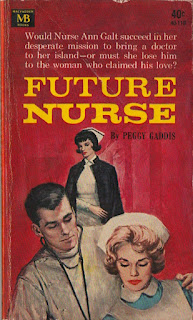
Also published as Future Nurse 

Ann Galt had come to Blalock Hospital to receive her nurse’s training. Then it was back to home on the Caribbean island of Spanish Key to care for the natives who had been working for her family for years. But Ann wanted more than to be a nurse; she set out on a desperate admission to marry a doctor and bring him back to her beloved ancestral island, and Dr. David Lochran, handsome, dedicated, and unmarried, seemed the ideal choice. But was there an understanding between David and beautiful Julia Anderson, the senior nurse who had taken Ann under her wing? Anne’s decision was taken out of her hands when a tropical hurricane roared across her island and opened her eyes to the meaning of love.

GRADE: C-

BEST QUOTES:
“Greater friendship hath no man than that he should lend his cherished car to a woman driver!” 

“I wasn’t permitted to read Oscar Wilde when I was growing up.”

“Well, of course I’m right. I’m the doctor, Nurse—remember?”

“Well, R.N.’s are taught they must maintain composure and move swiftly without running and a lot of other things.”

REVIEW:
Author Peggy Gaddis has many annoying habits. Her heroines frequently lie about their feelings towards men, and they tend to be syrupy to the point of inducing nausea: They are regularly wide-eyed and/or near tears; they don’t speak, they trill; their laughter is always gay; and their interjections usually include “Forevermore!” “Zounds!” and “Phooey!” But here on Spanish Cay, unfortunately, Gaddis must have put a pound of sugar in her sweet tea, as she’s off the charts with the sentiment—and to make matters worse, she’s added a nauseating dose of racism to boot. 

The Galt family seems to own most of this small island located between Honduras and Haiti, on which their plantation grows coffee and—fittingly—sugar cane. Ann Galt, who is 18 when we open the book, is about to be sent to the United States to nursing school by her 80-year-old great-grandmother (the Galt women all appear to have been teen brides), who is called Clarita by everyone except Ann, who leans heavily on “darling.” Ann’s wishes to remain forever on the island must be sacrificed for nursing school because old Dr. John, who has either no first name or no last name, is on the brink of expiring with no one in line to step into his shoes. This tragedy the family would accept with equanimity if they did not feel responsible for the healthcare of the island’s native population. “They have been faithful and devoted and we are responsible for them,” Clarita tells Ann, and plantation business manager Tad agrees, saying that when she is a nurse Ann will be able to “look after the people who adore you and who have made a living for the Galts for 200 years.” (When a visitor to the Island asks if they have racial trouble, “Ann turned to stare at him, wide-eyed and shocked. ‘Racial trouble?’ she repeated incredulously. ‘Why, these are people, our people!’” demonstrating exactly why there might be a problem.)

Ann’s older brother Jerry had initially been teed up to serve as the sacrificial lamb, and had even been just a couple of months short of finishing his residency before returning to the island to pick up the stethoscope, “and then he had that beastly hunting accident!” Ann stomps her foot in frustration over the death of her apparently unloved older brother. “Oh, Clarita, it’s all so unfair. There were others on that hunting trip who could have been spared much easier than Jerry.” Total bummer!

So off to nursing school she goes, and there Ann meets Julia Anderson, who is appointed Ann’s “Big Sister,” to look after her during the brutal probie year. In addition to studying, from the first chapter Ann has been pretty frank about her plan to “snag some fine, upstanding young medic who’ll fall head over heels in love with me and be willing to marry me and come down here to practice.” Julia, who graduates when the year is up, has been dating Dr. David Lochran, who ends his residency at the same time. Of his relationship with Julia Ann is well aware, but that doesn’t stop her from fastening her wide eyes on the man and inviting him to Spanish Cay when the year is up. He mentions this invitation to Julia in Ann’s presence, so the little vixen is forced to invite Julia as well. Darn!

The year passes in pages, and soon the trio has landed in the Caribbean. Julia, who is no moron, is on to Ann, and David notices “just possibly the faintest tinge of acid in their tone” when they speak to one another. Ann even suggests to Tad that he start flirting with Julia so that she can work her wiles upon David without interruption. (Tad responds, “Why, you shameless, outrageous little somebody! I ought to spank the daylights out of you, the way I used to enjoy doing when we were kids and you’d got out of line”—spanking being one of Gaddis’s kinkier staples.)

But two weeks into the trip, when Ann and Julia are nourishing incipient skin cancers on the beach, Julia mentions that doesn’t know what she is going to do now that she is graduated, as “I can’t decide, of course, unless he does,” because “whatever David wants is what I want.” Ann’s eyes—wait for it—widen, and she is shocked! to learn of their relationship, and immediately chucks her evil scheme.

Four pages later, a hurricane of a strength never before seen on the island is upon them, which they didn’t notice until the winds were so ferocious they nearly knock a Jeep off the road, so it’s too late to evacuate. David and Julia hustle down to the clinic to help Dr. John, while Ann and Tad comb the island for the resident witch doctor, an elderly woman who has gone into hiding. Somehow, Ann manages to swim a tempest-tossed inlet to reach the woman, who is clinging to a cliff face, and haul her back across to safety. Once they’ve driven the old woman back to the clinic, Ann and Tad collapse into each other’s arms. “Then she drew a little away from him and stared up at him, her eyes wide with a sudden realization, her tear-wet face flushed. ‘Why, Tad!’ she breathed, her voice touched with wonder. ‘Are we in love with each other?’” Guess what the answer is? Tad declares, “You’re staying right here, and you’re going to marry me,” continuing the family teen-bride tradition.

After the storm blows out, the kids head for the hacienda, which is built on high ground, where “there were not too many signs of the hurricane,” the lights are still on, and everyone has a hot shower and plenty of breakfast. “Everything’s just fine and dandy,” Ann sighs. She’s sorry to tell Clarita that the village is gone, but the matriarch responds “as though it were of no importance.” Indifference is catching; Julia declares, “It’s been a terrific experience. Oh, of course I’m terribly sorry about the village being washed away and all that.” Will Clarita be disappointed that Ann isn’t going to finish her training? Naw! “I sent you away with the very kindly intent of giving you and Tad a chance to find out that you really loved each other,” she says. “I hoped it would happen, but I couldn’t be sure. And if it didn’t, and you came back with her R.N. degree then there would no harm have been done.” Which left me unconvinced that there was only one witch on the island.

Now we have time to catch up with the other pair of love birds: David suggests to Julia that he take over Dr. John’s post and that Julia join him. And it’s Julia’s turn to be disingenuous: “Of course. You would need a nurse,” she says, and when David answers that what he needs is a wife, she pretends that he must be talking about Ann. When that phony little misunderstanding is cleared up, it’s their turn to act all surprised and starry-eyed when they realize they’re in love with each other, complete news even after years of dating. “Well, I’ll be darned!” David says dazedly.

The worse part of it is that this insipid, dripping washout doesn’t even qualify as a nurse novel, since the central character quits after just one year of training; I don’t think Julia and David’s peripheral storyline moves it over the mark. The racism is of course hugely problematic, and I’m mailing off another check as per the White Doctor protocol. Every single female character is cloying, and even the aged characters, usually beloved Gaddis staples, are horrid: Dr. John is a constantly shouting ass, and the matriarch is alarmingly Machiavellian. Gaddis should have been given a strict limit on adjectives and altogether barred from using adverbs; in just one page selected at random, we get “said Tad carefully,” “said Ann hastily,” “he repeated slowly, carefully” “Ann cut in swiftly,” “he said gently,” “Ann said quickly,” “She added quietly.” Ugh! This book is not even of the so-bad-it’s-good variety (looking at you, Nurse at the Fair and Harbor Nurse); really it’s those C-range novels you have to be most cautious of. The only thing remarkable about this novel is that in it we have a particularly excellent example of a book that should never be read.

This book was also published
under the title Future Nurse, 
which is a complete lie, since 
the heroine drops out of 
nursing school.


Friday, June 19, 2020

Nurse Angela

By Peggy Gaddis, ©1965

“There’s a contagious disease sweeping the hospital!” Handsome Doctor MacDaniel stood before Nurse Angela. She sprang up, her eyes enormous with shock. “It’s a thing called love,” he added, grinning. Nurse Angela sank back in relief. “It’s the spell of the tropics,” she said. “I hear it’s pretty potent.” He moved closer and took her into his arms. His kiss was like a small, gentle hand curling about her heart. But why was her heart afraid?

GRADE: C-

BEST QUOTES:
“We’d much prefer that men shouldn’t understand us. We’re not a bit complex, but we like to have the masterful sex think so.”

“You couldn’t offer a man a more deadly insult than to tell him he is not your type and that he’s safe with you because there’s no danger of you falling in love with him.”

“I probably won’t ever fall in love with anybody. It’s a very undignified emotion.”

“There was a twinkle in his dark eyes as he turned and walked away toward the men’s ward, where there were four sailors who had been badly burned in an explosion aboard a fishing smack a few days before.”

“You’re doing beautifully, Mr. Abernathy. And we’re going to send you home in another week or ten days.”

REVIEW:
As the book opens, Nurse Angela Dennard is arriving in Pirate’s Cove somewhere in the Caribbean to work for two doctors who have hired her for two years based on her resume, without having met or spoken to her in advance. Immediately upon her arrival, it’s clear that there’s going to be a big problem: “Dr. Mac will flip his lid when he sees you,” says the other “nurse” on the team, a young woman named Nancy Galloway, who has no license or formal schooling but was trained by Dr. Mac. “We were expecting a nurse, but not someone as young and beautiful as you are.” Apparently “there’s an unwritten law at the Cove that no woman under fifty who is easy on the eyes—and you most certainly are all of that—should be allowed to set foot on the place.” This is a real predicament!

For the next dozen or so pages, everyone who meets Angela remarks about how gorgeous she is, to the point where our patience has grown more than a little thin. “Perhaps I can wear some sort of disguise that will conceal what you seem to feel is a very disturbing appearance,” she snaps at Dr. Mac, and then performs the Patented Peggy Gaddis Heroine Exit, marching out of the room with her head held high.

Before long, though, everyone’s forgotten about Angela and her troublesome face, and now we swirl around five people on the island: not-nurse Nancy; ferry captain Nelson Phillips, with whom Nancy is in love; 17-year-old debutante Kathleen “Kitten” Hansell, who has been whisked to the island to escape the scandal of her having witnessed a murder in a New York City night club; Burke Abernathy, a 25-year-old society man whom Kitten has lured to the island to keep her company; and Barbara Clayton, a 30-year-old millionaire who owns most of the island and acts as its main benefactress. These characters also quickly wear thin, as Nancy and Barbara are described as plain in appearance and are both insanely insecure, thinking that no man could ever possibly want to be involved with them. Barbara develops a crush on Nelson, though she is “much too old for him,” and she and Nancy have a contest to see who can be the nastiest, the most self-centered, and the most childish. Nancy wins by a fair amount, as she soon develops a raging dislike of Angela when Angela buys Barbara, hospitalized after she was stomped by Champ the bull, a bunch of pastel negligees. Worse yet, Angela fixes Barbara’s hair and introduces her to Nelson, who kindly agrees to take Barbara to town when she asks him if he will—and Nancy construes this as worst kind of betrayal. “You couldn’t have found her things that would make her look drab and plain and downright ugly,” she snarls at Angela. “I purely hate you!” She continues to be quite nasty to Angela for most of the rest of the book, and to “purr acidly” in a jealous rage at Nelson too, which is sure to help her accomplish her goal of winning the man’s heart, which she had just laid out three pages earlier. Good luck with that, honey.

Nelson, for his part, stirs up more trouble when Kitten Hansell’s grandmother hires him to chauffeur Kitten out to a few nearby cities for an afternoon’s entertainment, and Nancy's jealousy spirals even further out of control—as does Barbara’s, who rips off her new nighties and smashes her mirror in a petulant display when she hears of the outing. Nelson also offers to smack, wallop and spank Kitten—another Peggy Gaddis staple—and, bizarrely, her grandmother chimes in, “And I’ll help him.” Kitten, not too surprisingly, tells Gran, “I think I hate you!” Kitten uses her outings with Nelson to enrage Burke, who has also landed in the hospital after being thrown from a bicycle, and though he knows no one else on the island and has come there only to keep Kitten company, that lovely lass refuses to visit him for the rest of his week-long stay in the hospital, and instead tells him that in time “I’ll hate you even a little more than I do now.” All the women in this book have studied exactly the same playbook, not to mention the same script, and it is dull, self-defeating, and infantile.

Out of nowhere, Kitten’s character makes an abrupt about-face. When Burke, finally discharged from the hospital, shows up at the Hansell house, the two women are talking about how much they care about each other, when they’ve been screaming and threatening violence in every other encounter up until now, Kitten hugging her grandmother and calling her sweetie-pie (Gran reasonably responds, “What a disgusting phrase”). A page later, Burke has proposed and Kathleen is pronounced old enough to marry, though I think at under 18 she qualifies as a child bride.

Things finally start to wrap up, much to our relief: Barbara has asked the accounts man to go over the business accounts with her, and the pair hit it off, so she’s quickly disposed of. As for Nancy and Nelson, out of the blue, they are suddenly “hand in hand, obviously very much in love and radiantly happy” on their way to announce their engagement, no doubt because the last thing Nancy had said to Nelson before this turn of events is announced, was—take one guess—“I think I hate you!”

Angela, meanwhile, a minor character in the book that bears her name, has had a few short but snippy conversations with Dr. Mac, which end either with her marching off in anger—head held high, of course—or she is warning “her silly heart to stop its pounding.” We don’t even learn the man’s first name until page 80. So you know what is coming: In what is their seventh actual conversation together—most of which have been under a page—Dr. Mac proposes to Angela. Well, I must admit that they did have dinner together one night, but they spent most of it talking to other people and not to each other, so that doesn’t really count. Angela responds to his kind offer by telling him, “You’ve been treating me like a piece of office equipment or X-ray machinery,” but “after all your arrogance and brusqueness of these past weeks,” it seems a perfectly reasonable thing to ask, so after a page of de riguer sniping back and forth, she agrees, and his kiss “was like a small, gentle hand curling about her heart and lifting it to her lips.” She’s kissing her own heart? What? It’s a bizarre ending, but after everything we’ve been through with this book, par for the awkward course.

Apart from everything I’ve cited above, there are even more oddities to the book. Author Gaddis throws a gossip columnist into the story early on, the woman arriving at the island to stir up more scandal about Kitten, but she abruptly drops out of the story halfway through, never to be seen again.  There’s also a scene between island local Lisa Morales, who works as a nurse’s aide, drooling with joy at her chance to care for “our patron saint.” Lisa reveals that the Father at their church has cut Barbara’s photo out of a newspaper and hung it up, and the parishioners burn candles and keep flowers before it in their reverence of Barbara, who once bought a bell for the church. In response to what is to say the least a very uncomfortable encounter, at least for us the readers, Barbara does not die of horror and shame, but instead offers Lisa “a real picture, the very best one I can possibly manage,” for them to continue worshipping. I think this qualifies as requiring a donation to the Florence Immigrant and Refugee Rights Project in penance.

The book hums along steadily and the writing mostly isn’t bad, but there are just so many psychotic characters in this story—women predominantly, but the men don’t prove too sane, either—that it’s a good thing they’re all stuck on this tiny island in the Caribbean, because it would not be a good idea to turn them loose on general society.

Sunday, February 2, 2014

Cruise Nurse

By Joan Sargent
(pseud. Sara Jenkins Cunningham), ©1960
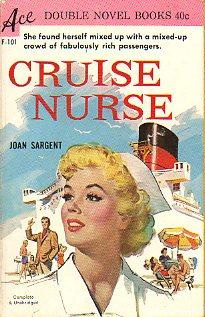
Cover illustration by Robert Maguire
 
Sheila Dorrance was young and lovely, and determined to make the most of her God-given assets. With memories of her impoverished youth always in back of her mind, she set out to use her nurse’s training as a passport to wealth and luxury. And the job as ship’s nurse on the pleasure liner Southwind certainly provided ample opportunity. There were any number of wealthy playboys aboard, and more than one of them was interested in wining and dining—and maybe even marrying—the pretty young nurse. But in spite of her longing for luxury, Sheila found herself falling for the Southwind’s dedicated young medical officer. And she knew that before her job as cruise nurse was over, she would have to decide whether her destiny was to be ruled by her head … or her heart!
 
GRADE: B+
 
BEST QUOTES:
“You couldn’t be sure how an intern might turn out; he might be one of those who could think only of serving humanity and would never bother to collect a bill.”
 
“You never can tell young people anything. They always know everything.”
 
“After we’re back home, I want your job to be me.”
 
REVIEW:
Our heroine, 21-year-old Sheila Dorrance, is admittedly shallow: She decided to be a nurse so she could “meet a doctor or a prosperous patient, marry him, and never again have to worry about being poor.” She is quite candid with her aspirations with Dr. Peter Stowe, the young doctor on board the cruise ship where she is working; he turns out to be one of the noble types who interned at a local charity hospital and so is off her banquet table. But after an initial spat about it, he seems to forgive her, because after all, she’s a very competent nurse.
 
Sheila soon meets Clay Masters, an apparently wealthy young man with pressed white linen pants. Soon he’s beauing her around the Caribbean ports—she’s on the night shift her first week—and she’s dreaming of sparkly diamond rings. But she is also growing to like—take a guess—the good Dr. Peter, who is a sturdy, dependable sort and less inclined toward frivolous parties than Clay. So one evening, when Clay loses his head on a moonlight deck and kisses her a bit too much, Sheila panics and tells him that she isn’t ready to be serious. She soon tells her friend Peter, explaining that though she hasn’t ascertained Clay’s net worth, she hasn’t really thought about it much, only that she has fun with him, and that this isn’t enough to base a marriage on. He laughs, “Sheila Dorrance, you’re a fraud. You’re not honestly looking for a rich man. That’s just the way you talk.”
 
Soon Sheila is encouraging Clay to take out mousy Elise Ferrier, a browbeaten millionairess whose mother all but chains Elise to the radiator to keep her under her thumb. Mrs. Ferrier has been felled by her appendix and is recuperating ever so slowly in sick bay, leaving Elise to her own devices for the first time in her life, and she likes it!
 
The book trots along predictably, but there’s nothing wrong with that if it’s an enjoyable ride. The scenery—Havana, Haiti, Kingstown—is well-drawn, and as the plot progresses we are offered increasing glimpses into people’s characters. Clay, says his sister, enjoys taking Elise out because he can boss her around, and “this one would mean ‘love, honor, and obey’ if she said it.” When Sheila expresses surprise at this characterization, Angela Masters replies, “You didn’t know him very well, did you?” Touché, but to Sheila’s credit, this was one of her own objections to getting too deeply involved with Clay. Though the poor little rich girl does grow a bit of a spine, standing up for herself when her mother tries to insist that Elise stop seeing Clay, she doesn’t make any superhuman recovery. She’s always going to be emotionally fragile, Sheila realizes: “Elise would always need somebody who could make most of her decisions, somebody she thought wise beyond anything human.”  The thought of feeling that way about someone makes Sheila herself snort in disgust, so we are left to feel pleased that Sheila was saved from Clay—who in the end turns out not to be rich, after all, so double phew! And on a tour of the Trinidad countryside, where the children are mostly naked with the swollen bellies of severe protein deficiency, Sheila and Peter’s taxi breaks down, and Sheila spends an afternoon at the hut of a rural woman and her seven children, coming to realize what real poverty is.
 
This is a fun little book, with a pleasant population, interesting armchair travel, and an occasional dose of humor. The writing is quite good as far as VNRNs go, and the plausible evolution of the characters is a welcome surprise. My only disappointment is that the book backing this Ace double novel, Calling Dr. Merryman, is not another nurse novel, and so is wasted on me. But apart from that, this is a cruise worth taking, and though there seems to be just a pitiful handful, I will look forward to more novels from Joan Sargent.

Shop this title, now reprinted 
by Nurse Novels Publishing,
at Amazon!


Monday, August 15, 2011

Jet Set Nurse

By Jane Converse
(pseud. Adele Kay Maritano), ©1970
Cover illustration by Allan Kass


They were island hopping, flitting from one tropical paradise to another … laughing readily, drinking steadily—wealthy heiress Marlaine Hayden, her fifth husband, Noah, her financier cousin, Durward, and an entourage of hangers-on. Why did they add Nurse Roxy Ferris, blue-eyed, beautiful and disapproving, to their glittering, glamorous caravan? Someone had to watch over Marlaine’s sixteen-year-old daughter, Gee Gee, a gorgeous child, really, with a genius I.Q. but with a personality her private-school principal had called sick … “very sick.” Gee Gee’s was a rare malady, an infection destined to endanger them all!

GRADE: C

BEST QUOTES:
“I shouldn’t even consider ending my blessed bachelorhood with a girl who can’t mix a decent martini.”

“Another ring on her parched hands would have tilted her to starboard.”

REVIEW:
Wealthy Wall Street financier Durwood Kingsley is recovering from a heart attack under the care of Nurse Roxy Ferris. He’s also attempting to persuade her to marry him, but she won’t. For starters, she’s decided that she will never marry a man who doesn’t “share my interest in medicine.” (You can bet she doesn’t mean an orderly.) Furthermore, like many a VNRN heroine, she is recovering from a broken heart: Her previous fiancé, after the invitations had been mailed, decided he didn’t want to be married or a doctor and ran off to San Francisco to write poetry, study Zen Buddhism, and play the sitar.

In his efforts to persuade her that he can do something other than work, Durwood invites Roxy to accompany him and Marlaine, his newly married sister (this is her fifth husband), on a tour of the Caribbean by private jet. She will be needed to tend to Marlaine’s daughter, Gee Gee, who is 16 and, in Roxy’s words, a “weirdie”: She’s voluptuous, contemptuous of her mother, a genius, and plotting to ensnare her new stepfather, who she thinks is “masculine and sexy.” There’s also an entourage of pathetic rich people, including an astrologer, an aging tennis star, a French art film actress, a Russian prince, and a Colombian coffee magnate. And Dr. Noah Hayden, “Daddy Five,” as Gee Gee calls him. Roxy, upon clapping eyes on the medicine man, is instantly smitten, and spends a lot of time chastely wishing he weren’t married.

The travelers are soon identified as a party of lazy drunks hurtling from one entertainment to the next; Roxy and Noah are the only two who find this activity nauseating. Noah spends a lot of time “talking sense to Marlaine, pleading with her to stop drinking, to stop running, to end her shallow existence and begin living as the wife of a dependable, devoted physician.” It never works, and a few pages after these heart-to-hearts, she’s found screaming with wild laughter on the dance floor, clutching her fourth martini glass.

Before long, Roxy and Noah are strolling on a beach in Trinidad at sunset. Noah tells Roxy that his previous fiancée was discovered returning from a weekend away, not visiting her mother, but with an ex-boyfriend. He’d fled to Las Vegas, drunken too much, and woken up married to a virtual stranger. But he’s such a good guy, so devoted to the institution of marriage, that he decides he loves Marlaine and is determined to make a go of it. But his long walk with Roxy leads them both to realize “we sensed a rapport that had no right to exist.” I sure didn’t see that coming.

Most of the book is one party after another; Roxy psychoanalyzing Gee Gee (“No child could have emerged from her background unscarred … only a thoroughly miserable youngster would seek attention with destruction and hysteria.”); Noah shouting at his drunk wife, breaking her bar glasses, and punching would-be sycophants in the mouth; Gee Gee pitching hysterical rampages; and Noah suggesting that the best cure for her would be a lobotomy. Finally they decide on a cruise, a “quiet relaxation” with just the family—which, in addition to the Haydens, includes Durwood, Roxy, and eight of Marlaine’s dearest drinking buddies. One night Roxy wakes up in the night and finds Gee Gee missing from her bunk, and when the entire yacht rises to search for her, it is determined that Marlaine is also missing—and then Gee Gee turns up safe and sound in her bunk. It is soon determined that Marlaine has gone overboard in the night, and Gee Gee accuses Roxy of having murdered her in an attempt to win Noah for herself, but Roxy knows that Gee Gee is in fact the guilty party. In retrospect she realizes, too late, that it was a terrible mistake not to inform everyone about Gee Gee’s morbid obsession with the “ruthless genius” of Emperor Christophe, who suppressed the “crummy, expendable natives” of Haiti: “Can’t you almost smell blood and hear wild shrieks?” Gee Gee had asked Roxy in “enraptured fascination with horror.”

Roxy does eventually clear her name, but only by a chance stroke of luck, not through any actual intelligence on her part. The book doesn’t close on her in Noah’s arms but instead a year later, the two of them having endured an enforced separation, waiting for an appropriate amount of time to pass before the widowed Noah can see her again. This book is not one of Jane Converse’s best, without even much camp that she can usually do so well, and we certainly know she can do better (e.g. Surf Safari Nurse, Nurse in Crisis). I’m always a bit disappointed with books that purport to take you inside a glamorous world but then sneer at it, suggesting that we poor stiffs in dungarees are so much better off than wealthy people living on luxurious yachts or in staffed Caribbean villas. None of the sumptuousness of this lifestyle is given to us in this book, just drunken tirades and pathetic sycophants. It’s too easy to villainize a way of life you can’t have, and in the end it makes this book not very much fun.