Tuesday, November 22, 2022

Love the Physician

By Hilda Pressley Nickson, ©1960
Cover illustration by Jack Harman

Doctor Laura Travers had always mothered and taken charge of her young sister, and when an unfortunate episode threatened to ruin Jacquel’ne's life she was only too willing to give up her job in London and help her sister to make a fresh start. So they retreated to a remote Norfolk village, where things at last seemed to be soring themselves out—but would they ever be able to escape from the past forever?

GRADE: B

BEST QUOTES:
“A raging torrent is always more interesting than a frozen lake.” 

“One’s follies were never committed in complete isolation.”

REVIEW:
Dr. Laura Travers has raised her younger sister Jacqueline since Laura was 16 and their parents were killed in a car crash. Through sheer grit and determination, despite having no money, Laura was able to put herself through medical school while supporting Jackie. Whether she always was or was forced to be, though, Laura is now “cool, self-sufficient and rather domineering … apt to take charge of people and situations.” She’s taking charge again now—because Jackie had gotten herself mixed up with a con man, Dennis Logan, who had used Jackie as a decoy in his swindling schemes, and Jackie had only barely been found innocent at the trial that had sent Dennis to jail. To escape the publicity, Laura quits her job in London and applies for a position in a small village in Norfolk.

At the interview, Laura is bafflingly outraged to discover that Dr. Adam Strickland, her would-be partner, is a young man. She’s overtly rude to Adam when she thinks he is an imposter, and barely less so when she discovers the truth; she speaks “coolly” three times during their four-page interview. She condescends to accept the job, though “their relationship might well be stormy.” And that’s putting it mildly! She is usually rude or seething when they speak, all the while convinced that Adam is falling for Jackie, and she works assiduously to promote the relationship. Nonetheless, he’s already kissing Laura and pulling the pins from her hair in chapter three. It’s the patented love-hate relationship in classic proportions.  

Contrast the angry Laura with Adam, a flimsy sort who campaigns for a seat on the town council by delivering stand-up comedy routines instead of speeches; “life to him is one long joke,” she thinks. He’s relentlessly pursued by town rich girl Pauline Brimsden, whose father is the business leader in town and the council representative responsible for squashing plans to install a town sewage system. Adam drifts along with Pauline, and when rumors run through town that he is engaged to her, he makes no attempt to correct the story even to Laura when she refers to Pauline as his fiancĂ©e.

Then Laura, encountering numerous sore throats and stomach aches in town that she chalks up to poor sanitation, decides to crusade for a public sewage plant and starts to make headway among other town councilors. When Adam finds out about Laura’s campaign, he loses his cool, bizarrely furious that she hasn’t consulted with him before starting her efforts. “Of all the bossy, domineering females I’ve ever come across!” he shouts, apparently forgetting that Laura had tried to discuss it with him, but he’d been playing with a wind-up toy clown during their entire conversation and had told her she should not expect him to get “hot under the collar” about the situation because “I’ve been brought up with it,” before dropping the conversation altogether to answer a telephone call from Pauline. When Laura curiously decides to apologize, Adam is won over: “Was this the real Laura Travers? This soft-voiced woman with the humble, contrite expression?” Why must her “real” personality be the meek one, and why is this so much more attractive?

There’s another man in town, Alec, who hangs around the Travers sisters as well, and Laura tries to convince herself that she should marry him, almost as hard as she works to push Jackie and Adam together. The writing on the wall is so staggeringly large, however, that Laura’s incessant worries and maneuverings quickly become tiresome and hypocritical—one minute she’s happy Jackie is holding Adam’s hand, and the next she’s furiously convinced that Adam is just playing games with Jackie and is going to break her heart—and all the while “she could not understand the ache in her throat and in her heart.”

Eventually Dennis escapes from jail and turns up in town with a gun and a letter written by Jackie that makes it sound like she was involved in his schemes, so the sisters are essentially being held hostage. How will all this sort out? If you guessed, as I did, that somewhere along the line there would be a car crash, you’d be right!

The problem with a character like Laura Travers is that we are supposed to disapprove of her assertive nature. We’re told she’s a “fiery-tempered shrew” who likes “to boss you and organize you and generally run your life. It won’t be long before Dr. Travers tries to run the village.” “Bossy” is a pejorative never used to describe a man—men are just exercising their natural leadership skills. But it’s peculiar here that Adam doesn’t really seem to have any, and just drifts along—even in his moment of triumph, when he’s re-elected to the town council, it’s shy Mr. Baxter who requests a committee to look into a sewage system; Adam only “reluctantly” seconds the motion, he states in his big speech, saying that he’s promised a rich man on the town council not to bring it up, “And so, even if the whole of Westhorpe dies of typhoid fever, I have my promise to keep. I will drop the subject and leave it to those of you whose consciences have recently been stirred, very appropriately, by a woman, new to this village. Gentlemen, the matter is entirely in your hands.” Somehow this makes him a hero of the town.

Ironically, in the end, it is even suggested that soon Laura will be elected to the town council. Is she a success for having put the sewage system across? Is she unlikeable for her assertive character? Sadly, I think the truth of the story is that even now, sixty years after this book was written, strong women are both—successful and accomplished, perhaps, but also struggling with the stereotypes that cause others to disapprove of the very qualities that bring them success. If Laura had been more like Adam, a go-along-get-along kind of person, she and her sister would have been wards of the state, Laura would never have been a doctor, and the town of Westhorpe would still be pooping in their drinking water. But Laura would have been so much more admirable and charismatic!

In the end, if you can tolerate Laura’s steamrolling endeavors in her personal life and her sister’s, ignore the bigotry she generates in others when she campaigns for a better town, and overlook the success Adam paradoxically achieves when he literally refuses to try, you might find this book more enjoyable than I did.

Tuesday, November 15, 2022

Love ... the Surgeon

By Hilda Pressley, ©1961 
Cover illustration by Bern Smith

Badly hurt by an unhappy love affair, Sister Beth Anderson tried to avoid further disaster by adopting an aloof coldness toward men. Would the kindly consultant, Owen Hastings, make her change her mind—or, as she became unwillingly attracted to the philandering R.S.O., Andrew Longford, would history repeat itself?

GRADE: B

BEST QUOTES:
“On duty, you give an impression of being one of those entirely dedicated women whose only use for the opposite sex is for ministering to them, whose nature in general matches the stiff starchiness of the uniform she wears.” 

“Not that I do much to be talked about, but you never know—I might want to some time.”

“I never met a man yet who didn’t know how to wriggle out of something he didn’t really want to do.”

REVIEW:
The start of this book made me a little bit nervous. Nurse Beth Anderson, the head nurse of the Men’s Surgical ward, is a snippy, embittered woman, having been dumped by her fiancĂ© for her best friend. This has left her “headed straight for the category of soured old maid,” as she is a harsh taskmaster of the young nurses on her ward and is cold and aloof with the doctors, especially Dr. Andrew Langford, the new surgeon, who insists on being introduced to every young nurse—and then seems to be dating a good number of them, even if they are literal teenagers (albeit shortly to age out) and he is about twice their age. This nurse heroine type is one that is wearisome because they are generally unsympathetic, so it’s quite hard to like them, or to look forward to spending another 100-plus pages with them. 

Fortunately, Beth starts to evolve quickly. She unbends enough to make friends with one of the surgeons who is recovering from an appendectomy on her floor, mostly because he is kind and calm and almost inhumanly even-tempered. Owen Hastings is the nicest man alive—but really that’s the best she can say about him, that he’s really nice. Their friendship grows slowly, and soon she is befriended by a nurse on another ward, Dorothy Hughes, who is looking for someone to share a flat with. Owen helps them find one—conveniently located nearby his own apartment, so he can always drop by—and soon the two women are hosting dinner parties and having people over for drinks and conversation, even that bounder Andrew. Now Beth is thinking that she might be in love with Owen, though when he is around “she felt no quickening of her heartbeat or any other emotional disturbance.” And after on of their early dates, “she was glad he made no attempt to kiss her. If he had, both the evening and their whole relationship would have been spoiled.”

As much as she disapproves of Andrew, Beth still goes out with him from time to time, and even if they argue a lot, she still seems to be gradually warming to him—and he to her. As their friendship warms, so too does the one between Dorothy and Owen, who seem to whisper together when Beth is out of the room. When Owen has to leave town for two weeks on business, Beth and Andrew spend most of their evenings together, and soon Beth’s heart, which never thumped for Owen, is pounding for Andrew. But when Owen comes home and proposes to Beth, she accepts—and when Andrew snubs her cruelly in the following days, she soon figures out with whom she’s actually in love.

It's a fairly predictable story right from the beginning, but it was actually pleasant to watch it unfold. Owen and Dorothy are the calm, pleasant characters we’re told they are, though Andrew doesn’t have much life to him, and certainly not persuadingly inducing Beth’s tachycardia. Beth’s growth back into a caring human being was believable, even if her reason for having turned into a popsicle wasn’t, and the final disaster that brings everything to rights is a bit much. Still, it was an enjoyable story, and a worthwhile companion for an afternoon.

Thursday, November 10, 2022

Nurse in Residence

By Arlene Hale, ©1968 


Lovely April Douglas grew up haunted by the disappearance of her father. What kind of man was he? Why had he left his wife and infant daughter? Had he really perished at sea, his body never found? That ghost of the past now came to trouble April again, turning her dream of a job as nurse in a luxury rest home into a nightmare. Sign after sign pointed to her father’s having returned alive, yet the handsome architect who claimed April’s heart only mocked her belief that her father was somewhere tantalizingly near. Even the attentive young doctor who kept coming out second best in April’s affections would not help her in her hunt. And now April was forced to face not only painful doubts about her father, but about all the men in her life, as she wondered if she would ever know a love that did not fail the test of her need.

GRADE: C

BEST QUOTES:
“It was good to let Reon tell her what to do, to lift the burden from her shoulders.” 

“What goes on in that nurses’ office, anyway? I thought you were there to look after patients, not have necking sessions with the doctor!”

“Don’t be a flirt. Ain’t becoming in a woman, and it gets a man in a peck of trouble.”

“You don’t know how it is when you get old, April. You start looking back and see all the mistakes you’ve made—and if ti’s not too late, you try to do something about them.”

“For the rest of the day, I want your mind on nothing but me. Okay?”

REVIEW:
It’s an impressive talent that can fill 160 pages without really saying anything at all, and Arlene Hale is just such a writer. Nurse April Douglas is an orphan, only child of a woman with no first name who died ten years ago. Her father was a sailor who she believes died when she was five—but then she gets a visit from Maude Pringle, who had been her mother’s best friend. Maude has suddenly decided to visit April to give her some breaking news—her father, Frank Douglas, may still be alive! Ten years ago he was seen in Britton Beach, the very town April is now living in! You see why Maude rushed right over! 

April is dating architect Reon Wheeler, and the pair tell each other that they’re in love, but he’s a distant sort of guy who’s busy a lot, plus he works with this hot interior designer named Olga. April has another man hanging around, though, Dr. Keith Foster, and he’s always grabbing April and pressing his fingers painfully into her arms and kissing her even when she tells him not to. Nothing says true love like sexual assault, so we are not surprised that April’s knees have an annoying tendency to go to jelly when he’s around. Soon she’s kissing him back and going out to dinner with him when Reon is in New York “on business” with Olga. On one of her dates with Keith, he tells her he loves her and proposes. “I don’t like being unfaithful,” she tells Keith, and then the pair kiss a lot.

Then crotchety Sam Sullivan moves into the old folks’ home where April works. She tries repeatedly to make friends with the old goat, but he is just not having it. Finally she can stand him no longer, and huffs, “Why do you reject every overture of friendliness I make?” in her usual informal, folksy way. 

Then April decides she’s going to spend all her savings to try to track down her father, without any real explanation of why it’s so important to her. “We could get acquainted,” is all she has to say about it. Then someone breaks into her apartment and gets into a box in which she keeps personal items, and moves an ivory statuette that her father had once sent her mother from the top of the pile to the bottom! That’s the end of that, and then April finds a clue, a letter from her father headed “aboard the SSBR.” This very skimpy clue is supposed to help the detectives find a ship her father had been on, locate other crewmen and interview them to see if they know what happened to Frank Douglas. Then some flowers mysteriously turn up on her mother’s grave, sent from Britton Beach. “Did she dare to suppose it might be her father?” She did! And then it turns out the janitor in the old folks’ home has a tattoo that says SSBR—with her mother’s name, too! Before she can act on this clue, however, Reon is trapped in a building cave-in, and has to be dug out—but it turns out that Olga the interior desecrator is more worried about Reon than April is.

Nurse in Residence is a longish story with nowhere to go and no real engine to drive it, since we’re never really given much understanding about why April is so insistent on tracking down her father. Maybe it’s understandable, but a paragraph explaining her need would have been helpful. The scenery along the way is also fairly dull, as the “clues” are fairly lame, and it’s hard to see how they can be helpful—papers shuffled in a box? Flowers sent to a woman’s grave ten years after her death? It was hard to care much about this fairly dull “mystery,” much less its central romance, so it’s hard for me to recommend that you spend much time with it yourself.


Thursday, November 3, 2022

Registered Nurse

By Paul Ernst, ©1960

Nurse Carol Bond was a witnessed to death! She had arrived at the scene of the accident seconds after the two cars had crashed head-on. The victims—wealthy George Caldwell and his lifelong friend, Henry Ebon—died a few minutes later. But which man died first? To the heirs the answer was worth $1,500,000. But to Carol it marked to the beginning of frightening events that threatened her career-- and her life. For someone who would stop at nothing—even murder—put this pretty young witness into a very well-built frame.

GRADE: B+

BEST QUOTES:
“This was a girl who could carry her own suitcase and handle her own hysterics.” 

REVIEW:
The inside cover blurb for this book declares it “combines suspense and romance in a compelling novel,” and this is a very accurate description. Front and center is a mystery about who is trying to frame Nurse Carol Bond, while in the background a romance blooms between Carol and a young attorney trying to clear her name. Throughout we are treated with some really fine writing by an author who was known for penning the original 24 Avenger novels. At the end of the day, though, it’s more mystery than romance, so I feel compelled to mark it down slightly. 

Nurse Carol Bond is on her way home from work as a private duty nurse on the evening shift when she happens upon a car crash. Two men from one of the cars lie on the pavement, rapidly shuffling off this mortal coil. There is another woman who pops up to help Carol tend the victims, who are both dead within 15 minutes of her arrival. But who died first? And why would anyone care? Well, one of the men, George Caldwell, was a very wealthy businessman, while the other, Dr. Henry Ebon, was his not-so-rich best friend. Caldwell’s will leaves his very large estate to Dr. Ebon, but if the doctor predeceases him, the estate goes to his extended family. And Carol is quite certain that Caldwell died first, of a sucking chest wound.

The next day, a delivery boy drops off a luxurious mink stole at Carol’s apartment. Carol’s best friend Arlene—the wise-cracking, smartass type—tries to help Carol figure out who might have given to her: “I’ve got it. A grateful patient. Someone whose fevered brow you’ve cooled recently.” A few days later, Carol receives a notice from the bank in the mail stating that her account has been credited with a cash deposit of $1,000. What could all this be about? Summoned to Caldwell’s attorney’s office that afternoon, it quickly becomes clear: Someone who might have benefited from Caldwell’s estate is using these anonymous gifts to throw suspicion on Carol’s testimony. The attorney for Dr. Ebon’s estate, Andy Stewart, quickly comes to appreciate Carol’s veracity, and her figure. Soon he is leading to chase all over town for clues and suspects, with Carol acting as Dr. Watson.

It really is a very entertaining book, with excellent writing from the first paragraph: “Cocked up at a crazy angle was a single beam, piercing the midnight sky like a slanted finger.” Carol is a sturdy, competent character, who “did not have that nice firm little chin for nothing.” She can figure a few things out for herself and isn’t just led around by Andy in their pursuit of the truth and the guilty party. The answer to the mystery is not easily deduced, and the plotting moves along at a good pace, but not so fast you can’t follow each development. Again, my only real problem with the book is that the romance is the most predictable and boring aspect of it, revealed in fairly plain prose such as “Carol was beginning to think that perhaps they added up to something more than average.” And I really wish we had spent a lot more time with bestie Arlene, who was by far the most interesting character in the book. If you are looking for a VNRN that is not at all the usual fare, this book exactly fits that bill, and if the ending is sealed with a charming kiss, we can only wish that there had been more of that elsewhere in the book.

Monday, October 31, 2022

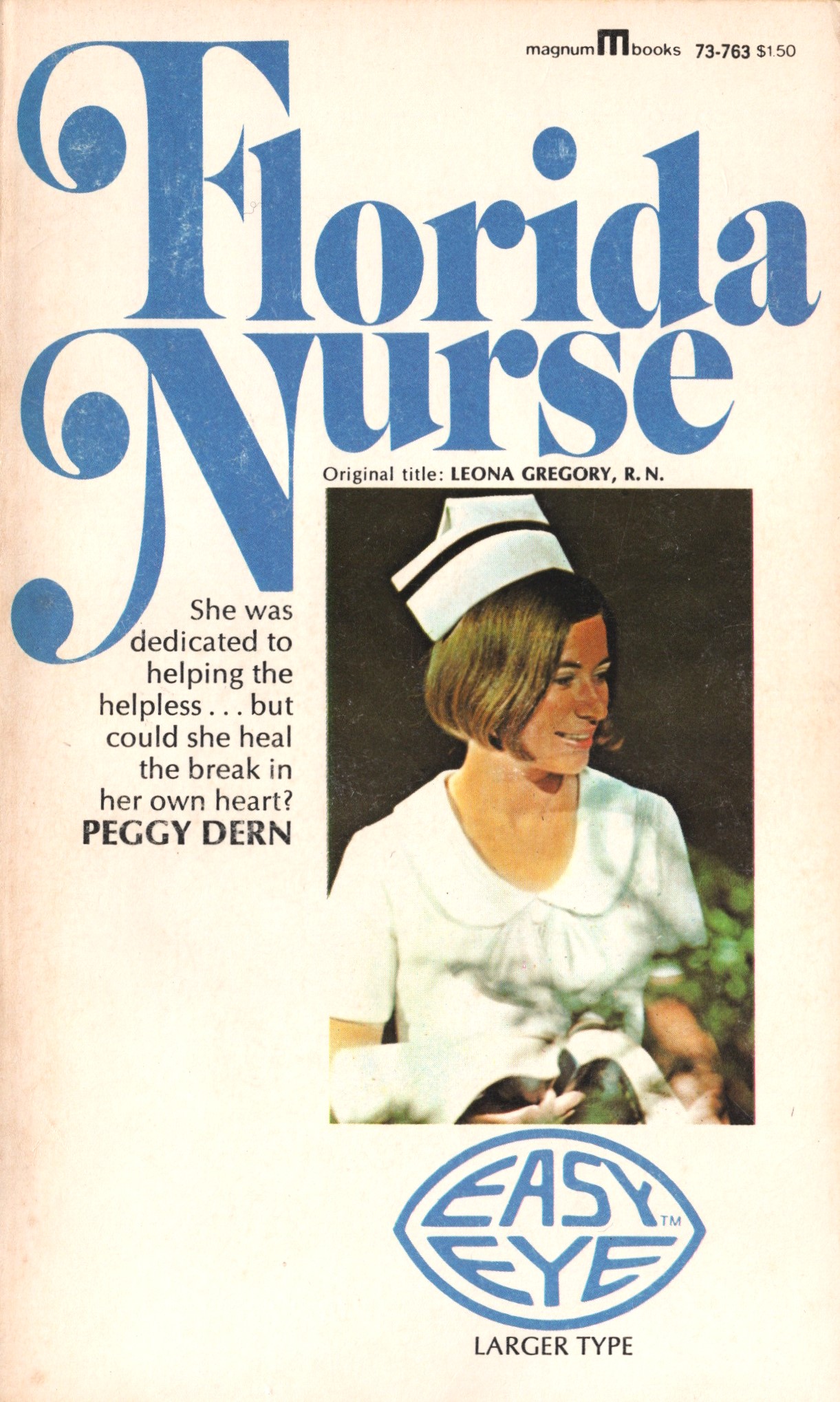
Florida Nurse

By Peggy Dern
(pseud. Peggy Gaddis), ©1961
Also published as Leona Gregory, R.N.

The daughter of a doctor, Leona Gregory had known since earliest childhood that she wanted to be a nurse. She had always thought that that would mean working with her father. But now that Dr. Gregory had married a young wife, Leona felt out of place in the household. The young R.N. gratefully accepted a position in a hospital in Cypress City on the Gulf Coast, even though she was afraid it would cut her off from everything she had known. Meeting the cold, beautiful supervisor of nurses, Paula Ingram, and the stern disciplinarian, Dr. Foster, who headed the hospital, seemed to confirm her fears. But Leona also found an opportunity for service she could not have had elsewhere. Then too, there was the handsome, charming senior intern, Cole Jordan … and, working with him, Leona began to feel that her heart might find wings again.

GRADE: C-

BEST QUOTES:
“Nothing is as inevitable as canned peaches in the hospital dining room.” 

“Well, well, so you’re going to be my special nurse. I feel a bad relapse coming on. I may be here for months.”

“When people are sick or hurt, a nurse’s uniform or a doctor’s is just about the most beautiful thing in the world.”

REVIEW:
It’s entirely possible that it took author Peggy Gaddis, here writing as Peggy Dern, less time to write this book than it did me to read it. The continuity and logic failures are numerous, and Gaddis frequently uses conspicuous words more than once in the same paragraph. Furthermore, this is not the first Gaddis heroine we have met named Leona (see also Nurse in the Shadows). 

Here, Leona Gregory is leaving the “brutal winters” of—not Chicago or Buffalo—Atlanta! a climate so inhospitable that to stand on the doorstep and ring the doorbell is to court pneumonia. Though she tells her father that it’s the frigid temperatures that are driving her to abandon the dream that they have held since she was nine—she was to work as a nurse in his office—the real fact is that it’s Leona herself who is bitterly cold. Her father remarried two years ago to a lovely woman named Irene who attempts repeatedly to befriend Leona only to the rebuffed again and again, and finally Leona is packing her bags and huffing off in a jealous pout for the Florida Coast.

Arriving, apparently not having bothered to interview for the job before signing a one-year contract, she is stunned to find that the head nurse and the chief doctor are unfriendly and militant disciplinarians. She befriends nurse’s aide Alma Pruitt, who appears to have bipolar disorder given the way she caroms between hysterical laughter and hysterical tears from one paragraph to the next. She also meets Dr. Cole Jordan, the up-and-coming surgical resident who always insists on commenting on Leona’s looks; bachelor number two is Bruce McLain (also spelled MacClain), who recently inherited a very lucrative ranch in town. Carol Decker is the daughter of the housekeeper on Bruce’s ranch, and though the original owner of the ranch left Carol and her mother well off, Carol has her sights set on Bruce’s larger fortune.

With three women and two men, it’s a game of the musical chairs to find out who is going to end up alone—and with Carol acting the part of the “weirdie,” “mental case,” and “spiteful malicious cat,” she is clearly the one we are not supposed to like. But honestly none of the women are terribly attractive—there’s Leona’s inexplicable animosity toward her lovely stepmother Irene, and Alma Pruitt herself engages in quite a few unattractive games to snare a man, such as pretending she has a fiancĂ© in Tampa; her wild mood swings are also alarming, as she is usually in tears at some point in every scene in which she appears.

So what’s the plot? I mean, beyond thin and implausible? Well, Bruce has been thrown from his beloved horse and saved from paralysis when Dr. Foster plucks a miniscule bone fragment from his spine, and now Bruce has to lie in the hospital for weeks. But Leona is assisting in the surgery and hears Bruce mumble just before he’s going under, “Don’t let anything happened to Starlite.” So when Carol vows to have the horse shot, Leona peels off her scrubs and flies out to the ranch to prevent the murder because “it’s part of the nurse’s job to catch the faintest whisper from the patient and try to do what he asks,” apparently even if it means abandoning her shift. I hope one of my patients will ask me to make a Starbucks run.

Now the thwarted Carol is gunning for Leona—and soon the sheriff turns up at the hospital to arrest Leona because the horse has gone missing, and based on this accusation alone, the sheriff plans to toss Leona in jail. It seems a rather flimsy basis for legal system, but then this is Florida. Out on bond, Leona decides that Carol “will continue to harass me and the hospital as long as I am here.” So despite the fact that Dr. Foster has not agreed to release Leona from her contract, she decides she is quitting—Dr. Foster has better grounds for lawsuit than Carol does, but never mind about that.

Leona goes to tell Bruce goodbye, that she is going back to Atlanta to work with her father after all. “Her father would be overjoyed; and she and Irene would be friends!” This shocking transformation of character, we are told, occurs because “when I fell in love with Bruce, I suppose I sort of grew up.” Here’s surprise number two—she and Bruce, who had spent exactly two afternoons together, are madly in love and will be married the minute Bruce leaves the hospital! And Leona will be leaving her career too, because even though Bruce has expressed no opinion on the matter—and never mind about Leona’s pesky contract—“I’m going to do whatever Bruce wants me to do, always.” Irene tries to talk sense into Leona by saying, “In a successful marriage there is no necessity for a boss. It’s a partnership; an equal partnership; fifty-fifty all the way.” Nonetheless, though she has declared that nursing is vitally important to her, Leona insists on quitting a hospital so short-staffed that “there simply isn’t time for any of us to sit down and hold the families’ hands or soothe them.”

Ultimately this is a carelessly written book with stupid characters, compounded by a large helping of bigotry against the local Seminole population and the poor whites in town as well. (There’s another penitential donation going to the American Indian College Fund from the White Doctor Foundation.) Dr. Foster shouts at a family reluctant to put their five-year-old daughter to surgery for a possibly benign tumor based only on his say-so—in a conversation held in the hospital lobby, no less—and the head nurse explains the doctor’s shocking rudeness (not to mention privacy violation) by saying, “he simply has not the patience or the time to put up with ignorant, stupid creatures”—and Leona is shocked that the nurse thinks Leona might be critical of this approach.

Peggy Gaddis always wants to have everything both ways—Leona couldn’t possibly criticize a doctor for calling it “nonsense” to explain a surgery (these days it’s called “legal consent”), but we are supposed to like Dr. Jordan a lot more because he does. Some characters say some really appalling things about the Seminoles, and these remarks pass without comment, but Indians competently staff the hospital and ranches in town (and ultimately save Bruce’s horse). Women are strong, competent workers who manage large farms and hospital wards, but they chuck it all to land a man. Alma schemes to lure in her crush, including lying about a fiancĂ© and flirting with men in whom she has no interest, but Carol is the one who is called a “scheming cat” for her desire to win Bruce. Alma never has a kind word to say about Carol but completely denies intending to hurt Carol’s feelings when Carol take offense. Every leading male character tells a woman at least once that he ought to “turn you across my knee and whale the daylight out of you!” Need I go on?

I’m ultimately not sure what author Gaddis herself thinks about her characters, but it seems clear to me that she does not have a high regard for women. That being the case, it’s hard for me to have a high regard for Peggy Gaddis or her books, and especially not this one.

Sunday, October 30, 2022

That Nice Nurse Nevin

By Jan Tempest, ©1963

Eight years ago Eunice Nevin had been rich and carefree. Now, her father dead in her money gone, she was a hard-working nurse. Her old home had become the hospital where she was now to work. With the love she had found for her new life be strong enough to overcome her nostalgia for the old?

GRADE: B+

BEST QUOTES:
“To be a successful beauty and heartbreaker, one has to have a certain mentality. One has to care passionately for admiration and for pleasing people. I don’t. I have to say what I think, and that doesn’t endear a girl to men.” 

“If money doesn’t talk, what’s the use of it?”

REVIEW:
Eunice Nevin is the sort of heroine it’s not hard to like. She’d been orphaned at 18 after an upper-class upbringing when her father was financially ruined making some risky investments and dropped dead from the shock. The icing on her tragic cake came when she’d been dumped by her handsome cad of a boyfriend, Eamonn Crail, so she’d moved to London and gone to nursing school. Now at 25 she has returned to her hometown and a hospital that has been established at her former home, so large and expansive were the house and grounds.

Eunice is soon drawn into the upper-crust circle of the Yaxley family, headed by social-climbing, scheming mother Shuna. Martin is the oldest child, and everyone seems to believe that Eunice is going to be the one who drags Martin to the altar, but she finds him to be a wishy-washy milquetoast who can’t stand up to his domineering mother. The younger twin girls, Tilly and Thyme, are fans of Eunice’s, as they had grown up watching her ride horses in competition—and usually win. Thyme has some sort of kidney disease and needs a transplant, while Tilly needs a transplant of her own—a spine, as she wants to pursue a career in music while her mother wants her to pursue wealthy men with royal titles, and mom is winning the battle. But behind mom’s back, Tilly has taken up with Eamonn—though he is actually in love with Thyme, who had turned him down because he is poor.

At the hospital, Eunice spars with 40-year-old urological surgeon Jupiter Janine, and it’s not hard to see where that’s headed. He appreciates her outspokenness, and kids her about the fact that she’s “known as ‘that Nice Nurse Nevin.’ Such a singularly inappropriate adjective for a personality as spicy as yours.” It’s admirable that she is such a feisty gal, but I continue to be perplexed and unsettled by the large number of Harlequin nurse novels that give the heroine away to a man more than ten years her senior—fifteen in this case.

The book is made more unique by its heavy concentration on riding, and we attend quite a few shows, ride frequently through the countryside, and admire numerous horses. As for our lead character, Eunice is also more unusual, a strong, outspoken woman, and only once declares, “it would be a real wrench to give up nursing,” but in the end plans to keep at it until she has children. The book has a good-sized cast of interesting characters (though Eunice’s girlhood best friend turns out to be a nasty, selfish witch, and it’s not at all clear why Eunice continues to interact with her), and overall the book has more than most VNRNs to make it worth reading. The writing isn’t witty or remarkable enough to push it into an A grade, but there is more than enough here to make for a nice read.

Sunday, October 9, 2022

Reach for Tomorrow

By Georgia Craig 
(pseud. Peggy Gaddis), ©1960
Cover illustration by Mort Engel

When Claire Frazier turned in her candy-striped probationer’s uniform for a pin reading Registered Nurse, she knew she owed a debt to those who had made her happiness possible. At once she set out to pay off her obligation with interest—and with love. To her patients, Claire gave time and understanding and the skill of her hands. To her fiancĂ©, Dr. Richard Massey, she gave the devotion and tenderness of her heart. And both mocked her, abusing her good intentions. Disillusioned and burning with shame, Claire had to pick up and mend the pieces of her broken heart. The scene of Claire’s reunion with life and love is a world cruise. Among the fellow passengers who changed her life are the attractive second officer, a detective, a confidence artist, and a romantic teenager. And the ports of call on her emotion-filled voyage include a visit with a would-be suicide, a ship-wide search for a strangely missing passenger, and an expensive game of cards which might have been dishonest.

GRADE: B+

BEST QUOTES:
“I do love the way you nurses parcel me out among you, as though I were a cold Sunday night supper!” 

“Even if we are strung up like a side of beef in a smoke-house, patients do have feelings and fears and hopes and aspirations.” 

“Next to the Christmas card racket is the ‘get well’ card foolishness. I’ll take a wager that ninety percent of that bundle of mail is made up of ‘get well’ cards and all of them from people who don’t give a darn whether I do or not!”

“If a woman is truly in love with a man, she wants to do what he wants, live the way he wants to live, because since he will be the breadwinner, it’s her responsibility to go along.”

REVIEW:
Frankly, as I was almost finished with this book, I was shocked to see that Peggy Gaddis is the author, because this book is not much like her usual fare. It’s got a little bit of a mystery to it, and has a few plot threads to it that make it a bit more complex than the usual VNRN, and not once does a man offer to spank the woman he’s pursuing (although the nurse does mention spanking her female patient at one point, so it’s a partial credit). Instead, here we have Nurse Claire Frazier, who as the cover opens is madly in love with Dr. Richard Massey to a degree that does in fact seem doomed; every time the pair meet up in the hospital hallway they are drinking each other in and speaking with a “yearning tenderness” and a “radiant, bright-eyed” expression about how desperately they wish they were off in a corner making out. But at the end of Chapter Two, Dr. Massey has eloped with a wealthy “man-hunter,” and Claire has been offered a cruise by a delightful, cantankerous spinster patient with a broken leg who won’t be able to go; to be honest, I wish I’d been left behind to hang out with Miss Dawson, reading the financial section and gossiping about everyone in the hospital. 

Instead, we are dumped on a ship departing Jacksonville for Hawaii by way of the Panama Canal. There are a dozen passengers aboard, but we are principally concerned with the glamorous Vera Barclay and her frumpy 18-year-old daughter Nora; an older, dapper gentleman called Major Lesley; and “sullen-looking, withdrawn” 25-year-old MacEwen Russell. There’s also the devastatingly handsome second officer, Curt Wayne, who tries to be polite to Claire, but she is as mean and nasty as MacEwen and snubs him ruthlessly at every turn, convinced he is having an affair with Mrs. Barclay.

The mysteries of the book center on why Mrs. Barclay looks so familiar to Major Lesley, who has quickly become Claire’s best friend on board. Nora turns out to be another sullen child, which Mrs. Barclay attributes to the fact that she has “rescued” Nora from an “awful boy! A mere nobody—an oaf!” back home and dragged her off on this cruise. But every time Claire tries to commiserate with Nora about their broken hearts, Nora just looks confused; even after a half-dozen conversations like this, Claire never catches on, which is another mystery. As is the issue of why, when Claire points out to Mrs. Barclay that Nora has a hand-shaped bruise on her cheek, she is shocked when MacEwen tells her that Mrs. Barclay beats Nora, and why Curt is so insistent that the accusation is “bilge” and “arrant nonsense.” Nora at one point even attempts suicide, which Claire treats with bandages and a hearty scolding, snapping, “Aren’t you ashamed of yourself, scaring us all?” and ultimately deciding that everyone should “pretend it never happened.” Again, Claire is convinced it’s due to this phantom boyfriend, but the reader is never told why Nora is in such despair. There are a few possible clues in some alleged card sharking and a very fancy wallet, but these questions drop out of view off the port bow in a matter of minutes.

It is finally revealed that Mrs. Barclay is not what she appears!!! At this point one of the young men insists, “I’m going to marry Nora and take her home with me—for keeps, whether she likes the idea or not,” telling Nora, “I’m taking over from here on out.” Naturally, Nora swoons. Claire is cured of her heartbreak in half a page’s conversation with another eligible bachelor, but more nasty sniping follows a misunderstanding, and the final mystery is why anyone would have her after she’s been nothing but mean, nasty, and suspicious the entire trip. So if the book is a little meatier in its plotting, the characters are the usual pasteboard, making this book a decent enough read but not a superlative one.