Showing posts sorted by relevance for query future nurse. Sort by date Show all posts

Monday, January 2, 2023

2022 VNRN Awards

Wow, what a year. This is our tenth anniversary, friends, but I’m disappointed to tell you that no glamorous alloy do we merit for this accomplishment; tin or aluminum is our reward, meant to symbolize resilience. Well, resilient we are, to soldier on in our mission to restore the vintage nurse romance novel to its former glory and to frolic in the camp, the sparkly ballgowns, the moody beaux, the humor, and the strength of our nurse heroines.

I will add that this year has also seen my 500th nurse novel review (the most enjoyable Recovery Room Nurse by William Neubauer; see below) as well as a new venture, Nurse Novels Publishing, which is re-releasing as ebooks the very best of the VNRNs (run, don’t walk, to the web site, and shop your little hearts out!).

And for the fine print: Winners are chosen from the 47 VNRNs I read this past year, which were penned by 36 different authors. The Best and Worst Authors categories includes all the VNRNs reviewed for this blog (516 to date), but only authors with more than one review are included. The Best Books category is packed with old favorites (e.g. Dorothy Fletcher, Olive Norton, Jean Francis Webb III, Florence Stonebraker), while Ida Cook (writing as Mary Burchell) is breaking into the top echelons with a bang. It’s an interesting year for Peggy Gaddis, who has the dubious distinction of gracing both the Best Books and the Worst Books categories (the latter twice, which is not the first time she has done this; see 2010).

In conclusion: Thanks to all who have supported this endeavor with a kind word. It means a lot.


Best Books
1. Nurse Sally's Last ChanceAnne Durham
2. Graduate NurseAnn Rush (pseud. Sara Jenkins Cunningham)
3. Hope Wears WhiteFlorence Stuart (pseud. Florence Stonebraker)
4. Surgeon of DistinctionMary Burchell (pseud. Ida Cook)
5. House of Hate, Dorothy Fletcher
6. Recovery Room Nurse, Rebecca Marsh (pseud. William Neubauer)
7. The Doctor’s Challenge, Marjorie Moore
8. The Nurse from Hawaii, Ethel Hamill (pseud. Jean Francis Webb III)
9. Night Duty at Duke’s, Bess Norton (pseud. Olive Norton)
10. Reach for Tomorrow, Georgia Craig (pseud. Peggy Gaddis)

Worst Books
1. Florida Nurse, Peggy Dern (pseud. Peggy Gaddis)
2. Future Nurse, Peggy Gaddis
3. North Country Nurse, Robert Ackworth
4. Nurse of the Wine Country, Ruth McCarthy Sears
5. Amy Marsh, Star Nurse, Sarah Nichols
6. Nurse Jenny, Margaret Howe
7. Park Avenue Nurse, Adelaide Humphries
8. Community Nurse, Arlene Hale
9. Nurse Harlowe, Jane Arbor
10. Nurse in ResidenceArlene Hale 


Best Authors
1. Noreen Ford (3.9 average, based on 2 reviews)
2. Faith Baldwin (3.8 average, based on 4 reviews)
3. Ida Cook (3.7 average, based on 2 reviews)
4. Marguerite Mooers Marshall (3.7 average, based on 4 reviews)
5. Olive Norton (3.6 average, based on 6 reviews)
6. Maysie Sopoushek (3.5 average, based on 2 reviews)
7. Elizabeth Seifert (3.4 average, based on 3 reviews)

Worst Authors
1. Mary Mann Fletcher (1.5 average, based on 2 reviews)
2. Arlene Fitzgerald (1.6 average, based on 5 reviews)
3. Ruth McCarthy Sears (1.6 average, based on 6 reviews)
4. Zillah Macdonald (1.7 average, based on 3 reviews)
5. Peggy Blocklinger (1.7 average, based on 11 reviews)
6. Kellier, Elizabeth (1.9 average, based on 3 reviews)
7. Virginia K. Smiley (1.9 average, based on 4 reviews)


Best Quotes

“Lena made a quick check of his condition and confirmed the fact that he was in a coma.” 
Behind Hospital Walls, by Ruth Dorset

“I’m just sick that I lost my temper and shot you!”
Betsy Moran, R.N., by Peggy Gaddis

“Number Fifteen has just slopped over herself her new bottle of orange squash and the other dimwit who came with you is making heavy weather of mopping up. Go and see how much you can add to the confusion.”
Nurse Sally’s Last Chance, by Anne Durham

“Just about the time you think the guy’s human, he gets a faraway look in his eye, and then he explains why he prefers to use Sim’s abdominal tenaculum over Kelly’s.”
Nurse in Danger, by Jane Converse (pseud. Adele Maritano) 

“The knowledge that Jimmie would never be a mental case cheered her.”
Nurse Jenny, by Margaret Howe 

“‘Want to hear about the abscess now?’ he inquired, and she forced a look of interest into her face.”
The Hospital World of Susan Wray, by Anne Lorraine 

“You’re a lousy nurse. You stick to too much procedure. Don’t you know that a kiss or two would do me more good than anything?”
Camp Nurse, by Arlene Hale 

“No, I had no special plans. Nothing that couldn’t be arranged, anyway. Eddie Fisher wanted to take me to the New York Hilton for dinner, but I put him off. Some other time, I told him. He was terribly disappointed, but never let it be said I let a colleague down.”
First Year Nurse, by Diane Frazer (pseud. Dorothy Fletcher)

“Whoever would have thought this place would have a homey air? I would call it a definite triumph over the landlord’s intentions.”
Airport Nurse, by Monica Edwards

“If I had my teeth in, I’d bite you, honey.” 
Hope Wears White, by Florence Stuart (pseud. Florence Stonebraker)


Best Covers

First Year Nurse, illustration by Harry Bennett


Thursday, January 9, 2025

12th Annual VNRN Awards

Welcome back to the 12th annual vintage nurse romance novel awards! But in the spirit of my grandmother, who was known to say, “Have some chicken—it’s kind of tough,” I have to state that I don’t think this year’s offerings were particularly outstanding, earning an average grade of C+. Perhaps that was because I fell off a bit in terms of my reading, only getting through 24 books by 18 different authors, but even the Best Quotes, which usually have me snorting with laughter, seemed lackluster. It seems like every five years I lose some steam, and that was the case in 2024. Hopefully I’ll get it back next year!

Someone who never seems to lose it is one of my favorite authors, Bill Neubauer (a really remarkable person; please do read his biography through the link), who authored two of the seven Best Books this year. He wears the biggest tiara of all, having now chalked up the most wins—nine—in this category. Betty Neels, a grande dame of the genre, debuted shockingly late in this blog just last year, but this is her second year in a row winning top honors, and I expect we’ll be seeing more of her in the future. Marguerite Mooers Marshall and Olive Norton, numbers 4 and 5 respectively on 2022’s Best Authors list, again snag a couple berths on the Best Books list for themselves this year. And looking over to the doghouse, there aren’t many surprises on the Worst Books list, as we find Arlene Fitzgerald, Arlene Hale and William Daniel Ross reliably popping up like dandelions in the lawn.

If 2024 is not the most exciting year I’ve had, there are still enough gems to keep the faithful happy, books and authors to enjoy (and dis, which can be just as much fun!). Enjoy, and we’ll meet back here next year for more excitement! 


Best Books

1. Damsel in Green by Betty Neels

2. Arms and the Girl by Marguerite Mooers Marshall

3. Tangled Autumn by Betty Neels

4. Nurse March by William Neubauer

5. Dedication Jones by Kate Norway (pseud. Olive Norton)

6. Nurse Rivers’ Secret by Anne Durham

7. Million Dollar Nurse by Rebecca Marsh (pseud. William Neubauer) 


Worst Books

1. Hurricane Nurse by Joan Sargent (pseud. Sara Jenkins Cunningham)

2. Log Camp Nurse by Arlene J. Fitzgerald

3. A Nurse’s Strange Romance by Arlene Hale

4. Beauty Doctor’s Nurse by W.E.D Ross

5. Navy Nurse by Adelaide Humphries

6. Nurse Jane and Cousin Paul by Valerie K. Nelson 


Best Quotes

“‘Your bosom is heaving too—so many girls don’t have bosoms these days. I supposed it’s the fashion.’ He sighed.” Damsel in Green, Betty Neels

“She wished Walt would stop referring to Norman as a man who had committed manslaughter.” Cynthia Doyle, Nurse in Love; Adelaide Humphries

“In the back of her mind she was constantly thinking of Dick.” Navy Nurse, Virginia McCall

 “I do believe you would feel compelled to offer any burglar foolish enough to enter a cup of tea before you laid him out with a poker.” Tangled Autumn, Betty Neels

“The hospital frowns upon interns and nurses smooching in the hallways.” A Nurse’s Strange Romance, Arlene Hale

 “There’s more to conversation than attractive legs.”  Million Dollar Nurse, Rebecca Marsh (pseud. William Neubauer)

“The way to a man’s heart isn’t through his stomach anymore. It’s through his twin carburetors or his new putter, old dear. You’re not with it.” Dedication Jones, Kate Norway (pseud. Olive Norton)

“What a tasty looking neck!” A Nurse’s Strange Romance, Arlene Hale

“New lipstick had made the menace of the storm seem less imminent.” Hurricane Nurse, Joan Sargent (pseud. Sara Jenkins Cunningham)

“She always liked to start a new case feeling as fresh and crisp as the pert, white cap perched on top of her shining head which looked like a spread winged dove ready to take flight.” Log Camp Nurse, Arlene J. Fitzgerald


Best Covers

Million Dollar Nurse, illustration by Darrell Greene

Navy Nurse

Cynthia Doyle, Nurse in Love; illustration by Tom Miller

Log Camp Nurse, illustration by Mort Engel

Nurse in Jeopardy

Monday, January 17, 2022

Nurse at Spanish Cay

By Peggy Gaddis, ©1962
Also published as Future Nurse 

Ann Galt had come to Blalock Hospital to receive her nurse’s training. Then it was back to home on the Caribbean island of Spanish Key to care for the natives who had been working for her family for years. But Ann wanted more than to be a nurse; she set out on a desperate admission to marry a doctor and bring him back to her beloved ancestral island, and Dr. David Lochran, handsome, dedicated, and unmarried, seemed the ideal choice. But was there an understanding between David and beautiful Julia Anderson, the senior nurse who had taken Ann under her wing? Anne’s decision was taken out of her hands when a tropical hurricane roared across her island and opened her eyes to the meaning of love.

GRADE: C-

BEST QUOTES:
“Greater friendship hath no man than that he should lend his cherished car to a woman driver!” 

“I wasn’t permitted to read Oscar Wilde when I was growing up.”

“Well, of course I’m right. I’m the doctor, Nurse—remember?”

“Well, R.N.’s are taught they must maintain composure and move swiftly without running and a lot of other things.”

REVIEW:
Author Peggy Gaddis has many annoying habits. Her heroines frequently lie about their feelings towards men, and they tend to be syrupy to the point of inducing nausea: They are regularly wide-eyed and/or near tears; they don’t speak, they trill; their laughter is always gay; and their interjections usually include “Forevermore!” “Zounds!” and “Phooey!” But here on Spanish Cay, unfortunately, Gaddis must have put a pound of sugar in her sweet tea, as she’s off the charts with the sentiment—and to make matters worse, she’s added a nauseating dose of racism to boot. 

The Galt family seems to own most of this small island located between Honduras and Haiti, on which their plantation grows coffee and—fittingly—sugar cane. Ann Galt, who is 18 when we open the book, is about to be sent to the United States to nursing school by her 80-year-old great-grandmother (the Galt women all appear to have been teen brides), who is called Clarita by everyone except Ann, who leans heavily on “darling.” Ann’s wishes to remain forever on the island must be sacrificed for nursing school because old Dr. John, who has either no first name or no last name, is on the brink of expiring with no one in line to step into his shoes. This tragedy the family would accept with equanimity if they did not feel responsible for the healthcare of the island’s native population. “They have been faithful and devoted and we are responsible for them,” Clarita tells Ann, and plantation business manager Tad agrees, saying that when she is a nurse Ann will be able to “look after the people who adore you and who have made a living for the Galts for 200 years.” (When a visitor to the Island asks if they have racial trouble, “Ann turned to stare at him, wide-eyed and shocked. ‘Racial trouble?’ she repeated incredulously. ‘Why, these are people, our people!’” demonstrating exactly why there might be a problem.)

Ann’s older brother Jerry had initially been teed up to serve as the sacrificial lamb, and had even been just a couple of months short of finishing his residency before returning to the island to pick up the stethoscope, “and then he had that beastly hunting accident!” Ann stomps her foot in frustration over the death of her apparently unloved older brother. “Oh, Clarita, it’s all so unfair. There were others on that hunting trip who could have been spared much easier than Jerry.” Total bummer!

So off to nursing school she goes, and there Ann meets Julia Anderson, who is appointed Ann’s “Big Sister,” to look after her during the brutal probie year. In addition to studying, from the first chapter Ann has been pretty frank about her plan to “snag some fine, upstanding young medic who’ll fall head over heels in love with me and be willing to marry me and come down here to practice.” Julia, who graduates when the year is up, has been dating Dr. David Lochran, who ends his residency at the same time. Of his relationship with Julia Ann is well aware, but that doesn’t stop her from fastening her wide eyes on the man and inviting him to Spanish Cay when the year is up. He mentions this invitation to Julia in Ann’s presence, so the little vixen is forced to invite Julia as well. Darn!

The year passes in pages, and soon the trio has landed in the Caribbean. Julia, who is no moron, is on to Ann, and David notices “just possibly the faintest tinge of acid in their tone” when they speak to one another. Ann even suggests to Tad that he start flirting with Julia so that she can work her wiles upon David without interruption. (Tad responds, “Why, you shameless, outrageous little somebody! I ought to spank the daylights out of you, the way I used to enjoy doing when we were kids and you’d got out of line”—spanking being one of Gaddis’s kinkier staples.)

But two weeks into the trip, when Ann and Julia are nourishing incipient skin cancers on the beach, Julia mentions that doesn’t know what she is going to do now that she is graduated, as “I can’t decide, of course, unless he does,” because “whatever David wants is what I want.” Ann’s eyes—wait for it—widen, and she is shocked! to learn of their relationship, and immediately chucks her evil scheme.

Four pages later, a hurricane of a strength never before seen on the island is upon them, which they didn’t notice until the winds were so ferocious they nearly knock a Jeep off the road, so it’s too late to evacuate. David and Julia hustle down to the clinic to help Dr. John, while Ann and Tad comb the island for the resident witch doctor, an elderly woman who has gone into hiding. Somehow, Ann manages to swim a tempest-tossed inlet to reach the woman, who is clinging to a cliff face, and haul her back across to safety. Once they’ve driven the old woman back to the clinic, Ann and Tad collapse into each other’s arms. “Then she drew a little away from him and stared up at him, her eyes wide with a sudden realization, her tear-wet face flushed. ‘Why, Tad!’ she breathed, her voice touched with wonder. ‘Are we in love with each other?’” Guess what the answer is? Tad declares, “You’re staying right here, and you’re going to marry me,” continuing the family teen-bride tradition.

After the storm blows out, the kids head for the hacienda, which is built on high ground, where “there were not too many signs of the hurricane,” the lights are still on, and everyone has a hot shower and plenty of breakfast. “Everything’s just fine and dandy,” Ann sighs. She’s sorry to tell Clarita that the village is gone, but the matriarch responds “as though it were of no importance.” Indifference is catching; Julia declares, “It’s been a terrific experience. Oh, of course I’m terribly sorry about the village being washed away and all that.” Will Clarita be disappointed that Ann isn’t going to finish her training? Naw! “I sent you away with the very kindly intent of giving you and Tad a chance to find out that you really loved each other,” she says. “I hoped it would happen, but I couldn’t be sure. And if it didn’t, and you came back with her R.N. degree then there would no harm have been done.” Which left me unconvinced that there was only one witch on the island.

Now we have time to catch up with the other pair of love birds: David suggests to Julia that he take over Dr. John’s post and that Julia join him. And it’s Julia’s turn to be disingenuous: “Of course. You would need a nurse,” she says, and when David answers that what he needs is a wife, she pretends that he must be talking about Ann. When that phony little misunderstanding is cleared up, it’s their turn to act all surprised and starry-eyed when they realize they’re in love with each other, complete news even after years of dating. “Well, I’ll be darned!” David says dazedly.

The worse part of it is that this insipid, dripping washout doesn’t even qualify as a nurse novel, since the central character quits after just one year of training; I don’t think Julia and David’s peripheral storyline moves it over the mark. The racism is of course hugely problematic, and I’m mailing off another check as per the White Doctor protocol. Every single female character is cloying, and even the aged characters, usually beloved Gaddis staples, are horrid: Dr. John is a constantly shouting ass, and the matriarch is alarmingly Machiavellian. Gaddis should have been given a strict limit on adjectives and altogether barred from using adverbs; in just one page selected at random, we get “said Tad carefully,” “said Ann hastily,” “he repeated slowly, carefully” “Ann cut in swiftly,” “he said gently,” “Ann said quickly,” “She added quietly.” Ugh! This book is not even of the so-bad-it’s-good variety (looking at you, Nurse at the Fair and Harbor Nurse); really it’s those C-range novels you have to be most cautious of. The only thing remarkable about this novel is that in it we have a particularly excellent example of a book that should never be read.
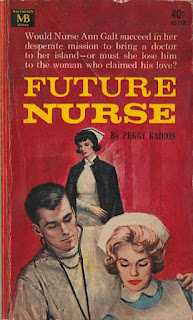
This book was also published
under the title Future Nurse
which is a complete lie, since 
the heroine drops out of 
nursing school.


Friday, August 12, 2022

Nurse Jenny

By Margaret Howe, ©1958
Cover illustration by Harry Bennett 

Jenny Dawson was pretty, young and blonde, but she had absolutely made up her mind to dedicate herself to her nursing career and to the little nephew who was left in her care … Then, in her new job at the famous Merriman Memorial Hospital, she met—Dr. Peter Hurley—broad-shouldered and serious-minded … and Jack Merriman—handsome, wealthy, debonair … The story of a lovely and courageous nurse who finds that  life can be very complicated indeed when one is devoted to a demanding career, and much more so when one is young, beautiful, and admired by two very attractive and eligible men …


GRADE: C-


BEST QUOTES:

“The knowledge that Jimmie would never be a mental case cheered her.”


“Jack told me I was silly not to have a pretty nurse. It’s bad enough to be here, without having to watch a homely woman for hours.”


“A pretty girl like you shouldn’t dedicate her future to a crippled child.”


“We’d better get out of here before the hospital gossips start a rumor that they caught me necking with a nurse.”


REVIEW:

I have said before that a C grade is really the worst possible grade for a novel: not so awful that it engenders at least some emotion, not laugh-out-loud bad, and certainly not enjoyable, it plops squarely into the category of books that there is absolutely no reason to read.


Nurse Jenny Dawson has inherited her nephew, Jimmie, a four-year-old with cerebral palsy, from the boy’s mother Belle, after the father, Jenny’s brother, died in a truck accident; “how callous and indifferent Belle had been from the moment Jimmie was born. She hated him. She would have put him in an institution.” So Jenny had taken him, then depleted her savings and abandoned her job to travel around the country to see various specialists to try to get him care. Merriman Clinic has gotten her one remaining dime for “this last attempt to find someone who could help,” and sure enough, Dr. Peter Hurley agrees that Jimmie has the potential to learn to talk, possibly even walk. In return for his treatment, Jenny takes on a job as nurse at the next-door hospital, caring for demanding matriarch Nora Merriman, whose money has endowed the hospital, and who has broken her hip in a fall and “might easily become a cripple” without proper nursing care.


Nora’s son Jack is a cad, flirting with everything but settling on nothing, encouraged by his mother, who feels that nothing is good enough for her boy. He starts chasing Jenny, who goes on dates with him and appreciates his charm, but she is put off by his lack of seriousness. At the other extreme is Dr. Peter, who is nothing but serious: “He doesn’t seem to get a kick out of anything but his profession,” observes Jack.


Well, his profession … and Jenny, whom he repeatedly asks out for coffee, even starts hugging and kissing her, all the while telling her, “I can’t allow my emotions to trick me into anything which might endanger my ambition to be a successful doctor.” That’s why he likes Jenny, he tells her, because she “expects no more than I can offer.” What a tease!


Eventually Jenny’s savings are wiped out and she worries she will have to take Jimmie out of the clinic, where he now receives round-the-clock care and therapy three times a week, which has somehow brought him to a vocabulary of ten words from none. But Dr. Peter contacts some wealthy philanthropists who offer to fund Jimmie’s treatment as long as Jimmie’s mother Belle agrees. Belle smells the money that could be made off Jimmie, as Dr. Peter and the investors are thinking of starting a national charity to benefit kids with cerebral palsy and starring Jimmie on posters to draw public attention. (It’s a little weird that either by coincidence or deliberate rip-off, the author has hijacked the story of the Jimmy Fund, which began a decade before this book was written by utilizing a 12-year-old cancer patient to raise funds and awareness, even down to using the same name for the boy with CP.) Now Jack, Peter, and Nora are all working to save Jimmie from Belle’s clutches, all to win Jennie for themselves, as a nurse or a wife. Who will succeed? Well, you won’t be shocked to learn that it isn’t Nora.


The curious parallel between Jimmie and Nora Merriman is only briefly touched on, when Nora wails, “It’s the prospect of a future as a cripple that appalls me.” When Jenny reminds Nora of Jimmie’s deficits, Nora replies, “Thinking about others doesn’t make it easier for me to face the future,” and flops back into her satin pillows and eiderdown quilts.


In the end, Jimmie is saved from his mother, who is essentially bought off, and Jenny wins the man you know she will in the final three lightning-fast paragraphs. The characters are flat and the writing is wooden, which is surprising, given that Margaret Howe has put her name on the cover of 2011 Top Ten VNRN Visiting Nurse—though she also claimed three other mediocre books (Special Nurse, Debutante Nurse, and The Girl in the White Cap). The best thing about this book is the Harry Bennett cover, even if on my copy of this book the printing register is out of alignment, making it look blurry and alien. But what’s inside the cover is off as well, so that may be fittingly appropriate.

Friday, November 26, 2010

Debutante Nurse

By Margaret Howe, ©1958

As Dana Gordon put on her new mink coat, she remembered the quizzical eyes of the young intern. To him she was nothing but an ornament—beautiful but useless. At that moment she made her decision to show him that she had the courage and will to win a place in his hard, dedicated world of medicine—even if it meant giving up her soft, glittering social world.

GRADE: C

BEST QUOTE:
“The respect of those student nurses would mean more to me than ten mink coats, Kate.”

REVIEW:
Dana Gordon is an Ohio girl attending college in New York, which is a bit of a controversy at home. Her mother thinks “it’s foolish for a girl to spend the best years of her life going to school.” Dana insists, however, because she felt the “desire to take a college course which would fit her for something more than the social future her mother anticipated for her.” Mom has been planning, since Dana was a toddler, that her daughter marry Jeff Forrester. Dana and Jeff are the products of business partners, both made wealthy by their venture, and this has doomed the couple to a fairly miserable existence—him as “still handsome, with a little added weight. Still stubborn and yes—lazy. Indifferent to everything but his golf score and the possession of the latest-model car.” Her as someone who will “acquiesce in anything they plan for me,” someone whose only future is as a wife. “Are you real, Dana Gordon?” she asks herself.

But she’s beginning to think that she would rather do something useful with her life, and that she would rather not marry the indolent Jeff. What has made her “talk like a Communist,” in her mother’s words, is that back in New York, she took a college chum with a broken ankle to the hospital, and there she saw “all those girls who wore their white caps so proudly.” She admires the nurses’ “serious occupation,” the fact that they don’t waste time shopping, and that “a uniform did not disguise a girl’s beauty. Instead, it enhanced even the plainest girl’s looks.” And, of course, she also meets “a man quite unlike Jeff, a man who did not accept life as one long holiday.” That would be Dr. Martin Emory, an intern orthopedic doctor, a man with “square and strong” hands.

She tells him she wants to become a nurse, and he all but laughs in her face. “I suppose you think I haven’t enough character to do anything more exhausting than dance the samba,” she snaps at him. She next tries the idea on the nursing superintendent, who also looks down her nose at Dana: “I have no reason to believe that a debutante would make a good nurse.” But Dana perseveres. Her father strikes a deal with her: If she keeps going with Jeff, he’ll let her go to nursing school here in town. The reason he’s keen to see her with Jeff is more than parental concern for her future. He agrees that Jeff is weak and lazy, but “business was rotten,” he tells her, and “our financial future depends too much on what Kent Forrester”—Jeff’s father and the owner of the business that employs Dana’s father as its president—“thinks to allow Dana to rush into a situation which will upset Jeff.” So she pretends she cares for Jeff, which is easy once he leaves to go back to school in New York—and more difficult after he flunks out of school and returns to Ohio.

When nursing school starts, the other girls shun her—they’re a little jealous of her cashmere and two mink coats. But she takes her roommate for an attractive haircut, and then they begin to warm to her: “Kate’s appearance brought requests from other girls about hairdos and clothes.” Apart from learning about makeup, there are other subjects to master—and it turns out that nursing school is hard! “ ‘Now we have to study,’ said Dana, with a frown. ‘I didn’t realize that. And most of the study is boring to me. I always hated physiology when I went to grade school. I avoided everything like science. Now I have no choice.’” It does strike me as odd that someone who hates science could really make a go of nursing as a career—or would even want to—but there it is.

If it’s not a love of science or medicine, what does she see in nursing? It seems to me she is looking more to gain control of her own life, and become more than just a puppet. “You’re a person too, Dana, with a right to plan your own future,” her roommate tells her. When she tells Dr. Emory that she is enrolling in nursing school, “She could read surprise in his face. Surprise and something else she had never seen on a man’s face before. Respect.”

Even though nursing schools is difficult, and she does flunk a few tests, she pulls it off. She even snags Dr. Emory—the catch is that she has to keep pretending to go with Jeff, and he gets drunk and marries a tarty showgirl and makes Dana promise not to tell anyone, and everyone thinks it is she who has eloped with Jeff, and what will Dr. Emory think when he hears this? It’s a little contrived, and frankly, I just didn’t really give a damn what Dr. Emory thought of it, because even if he were to become upset, it wouldn’t take much to put the situation to rights.

Debutante Nurse is really a much lesser version of Nurse Landon’s Challenge. It was mildly interesting to watch Dana find herself, but her choice of nursing, and her success in that field despite any apparent interest, was a bit unbelievable. I have to say that one of my favorite things about this book is the cover, which I see as a sly pun on the portraiture of wealthy Americans at the turn of the century; think John Singer Sargent painting a red-headed nurse. Which really isn’t enough to make this book worth reading.

Monday, December 15, 2014

Nurse Nancy

By Jane Scott
(pseud. Adeline McElfresh), ©1959

Special-duty Nurse Nancy Davies thought her case with Angela Crayton, the famous actress, would be a dream. She lived with the beautiful star in her summer home where Angela kept open house for all her Hollywood and Broadway friends. But Nancy soon learned that these men and women had a code of easy morality which said, “live for today, forget tomorrow.” Beautiful, young Nurse Nancy faced the sternest test of her professional career—could she be true to her own standards as a nurse—and a woman—in this glittering world?

GRADE: C-

BEST QUOTES:
“She’s so sure she’s going to die on the table, I wouldn’t be surprised if she does.”

“Everyone knew that Lee Saltonsbie was counting the days until he would go into private practice and ‘get started on my first hundred thousand.’ ”

“Clay’s future in politics had nothing whatever to do with their growing apart. If they had, she thought. No, it was her career—her dedication to it—that was causing the trouble.”

“Angela was improving. Or seemed to be. Sometimes, with these mental things, you couldn’t tell.”

REVIEW:
Nurse Nancy Davies is one of those sad VNRN heroines engaged to a man who not only is unfortunately named Clay Randall but who is not the man she thought he was when they met in Maine last summer “on a glorious vacation of sunswept days and moon-drenched nights. They were a bronzed god and a laughing nymph alone in the enchantment of their love,” if you must know. Unfortunately, however, these deities were obliged to go back to work, and now she’s desperately trying to convince herself that her fiancé doesn’t have feet of Clay—and there’s only so much of this a reader can take before you’re ready to pummel Nurse Nancy right upside the head. “She didn’t hate Clay; she couldn’t do that. But did she love him? She had at first—of course she had! she told herself sternly. Surely that surge of happiness, the wonderful, exciting, different happiness, had been love! She wasn’t the type of girl to fall lightly in love and then out … and yet …”

See what I mean?

Clay, it turns out, is ambitious for a career in politics, and so Nancy must quit her job when they are married. “Why couldn’t he understand that the hospital and her work there were such an important part of her that without them she wouldn’t be the Nancy Davies he had fallen in love with? It didn’t matter that as Mrs. Clay Randall she wouldn’t have to work for financial reasons. She wanted to do more with her life than head committees and have lunch and play golf at the country club.” Why would anyone continue to entertain the idea of marrying this man through 100 pages, even when from page two “Clay’s kisses had become just kisses” and the man is clearly making her miserable—and would only make her more so if she actually went through with it? Have I mentioned that I find this plot device patronizing, idiotic, and lazy?

Anyway, the central plot is also somewhat patronizing, at least to faded theater star Angela Crayton, who once was the queen of Broadway but after three successive flops about a decade ago has holed herself up on the shores of Birch Lake, Indiana, and is showing depressive—bordering on suicidal—tendencies. Dr. Bartlett Howard, her physician, needs a nurse to pose as a secretary for Miss Crayton. “If Angela Crayton finds out that her doctor thinks she’s borderline mental the fat might be in the fire,” explains Dr. Paulson, the chief of surgery at Nancy’s hospital, when he urges her to take the position. It’s not evident that Nancy is the right person for the job; as Dr. Howard is filling her in on the details of the case, “Angela Crayton didn’t need a secretary or a nurse, Nancy thought. She needed a keeper.” Psychiatry, when viewed through the myopic lens of a 1950s-era VNRN, is horrifically stunted and frequently sexist. Angela “was being driven, something over which she had no control was lashing her into a frenzy of despondency,” we’re told—and Nancy’s next thought is, “Poor thing. Lonely, and getting old, hating the crow’s feet and wrinkles—” It’s a wonder all women don’t kill themselves at 45.

So the book is mostly a tennis match between Nancy’s distaste for her fiancé and her work as a typist and spy, noting every despondent look and midnight drive of Angela’s, and doing absolutely nothing about it. Eventually Dr. Howard strikes on the idea of having the local theater group stage the play that was Angela’s greatest triumph and asking her to reprise her starring “rôle”—and have a Hollywood director offer her the leading part in a movie. Just the thing to shake off the crow’s-feet blahs!

As Angela naturally improves under this thoughtful treatment, she eventually fires Nancy, telling her that she’s known all along that Nancy is really a nurse—her shorthand was terrible! Angela suggests that Nancy continue to stay on at her house, though, and take a job at the little hospital nearby, working for Dr. Howard. Now we have another trite device: A tornado whips through town, and Nancy is busy patching up victims—and breaking up with Clay, who shows up during the crisis to drag her by the hair back to his cave while she’s giving Mary Claudion another cooling bath and alcohol rub. Curiously, Clay is on his way out of town—empty-handed, of course—at 90 mph when he wraps his car around a tree, so now he’s back at the hospital, this time as a guest under Nancy’s care. Ordinarily this leads to some sort of epiphany or understanding between the couple, even if it’s just to agree they’re not right for each other and part as friends. But in this book, Clay is admitted, Nancy pours him a glass of ice water, and then three pages later she’s dropping him off at his law office and he’s stomping angrily up the walk on his crutches.

Back in Birch Lake, where Nancy has decided to stay permanently, everything is neatly wrapped up. Guess what happens with Angela? Guess who kisses Nancy next? You probably won’t actually guess there’ll be yet another calamity to attend to, with Nancy fervently urging, “Oh, Bart, hurry!” or that the final page will include the death of a minor character for Nancy and her new beau to smooch over—one of the more unusual endings I’ve come across—but these small surprises give not pleasure, only bewilderment.

This is a pedestrian, automatic, stupid book. It’s not badly written, and its most irritating aspects—its views on psychiatry, and Nancy’s reluctance to give up a man she doesn’t like and a future she will despise—can in part be chalked up to the archaic attitudes of the times. But the book is lazy, and the heroine who cannot acknowledge the dichotomy between adherence to sexist attitudes and the complete abandonment of logic and reason that these positions require is not worthy of our time. No one—especially not nurses, who are by definition strong, independent, smart, and capable—should be a willing victim. While I’ve certainly read nurse novels that are far worse than Nurse Nancy, I find after a couple hundred VNRNs under my belt I am becoming increasingly intolerant of stupid heroines, and so I cannot suggest that you stop and visit with Nurse Nancy.

Saturday, July 30, 2011

A Challenge for Nurse Melanie

By Isabel Moore, ©1963
Cover illustration by Bob Schinella

Melanie Woods had all the qualifications of a fine nurse—intelligence, quickness and dedication. But one fault threatened her brilliant career; she placed people ahead of rules. So when Melanie, acting almost instinctively, performed an emergency tracheotomy with only a penknife and a key, the Director of Nurses gave her a final warning. Although Melanie promised to obey hospital rules in the future, could she live up to her promise when a dying man requested the one thing forbidden to him?

GRADE: A

BEST QUOTES: 
“A high, bateau neckline had, this year, replaced the V-neck which, Edith Roberts had decided on excellent evidence, offered much too good a view to male patients as students bent over to take a pulse or a temperature reading.”

“Now, just to shock the town if for no other reason, she deliberately wore the tightest sheaths she could squeeze into, went into a bar to drink alone if she felt like it, and allowed boys she had known before her marriage to take her out.”

“It wasn’t right, somehow, thought Sally, for such a pretty young girl to be so—well—masculine.”

“The students took their meals in the hospital cafeteria, if they felt wealthy enough to afford the fifty cents or so it cost for lunch.”

“When I entered nursing, it was with a feeling of dedication, of putting others before myself, of knowing the satisfaction that comes from putting all of one’s self into whatever job one is doing. These girls seem to have nothing on their minds but finding a husband—preferably a rich patient or a promising young doctor!”

“Nurses nurse, Melanie. They don’t doctor. And above all, they don’t make public spectacles of themselves.”


“What a dope. That spirit of dedication to good old Fletcher [Hospital] and the patient isn’t going to get her a thing except fallen arches and a home for retired nurses.”

“ ‘Nursing!’ she had huffed. ‘Seeing men with their clothes off. Seems to me there’s something downright indecent about it!’ ”

“We never know what the day is like until it’s ended.”

“Marriage … that’s the best thing for a woman.”

“Pride is a luxury no woman in love can afford.”

“What finer future can a girl have, really, than to find a man she loves, who loves her back, and marry him?”

“Most of our lives are based on dreams.”

“Even when hope is dead, she thought, the heart still hopes.”

“We cannot be important to ourselves unless we are important to our work, to the things to which we have decided to commit ourselves, to dedicate our lives.”

REVIEW:
Right on the first page, Melanie Woods, a student nurse, does something very bad: She saves a man’s life in the Blue Ribbon bar by giving him an emergency tracheotomy with a jackknife and a key. When it’s all over, and the bar patrons are looking at her with “something close to distaste if not dislike,” and her roommate Sally says to her, “As far as your superiors are concerned, you’ve simply broken every rule in the book.” As they say, no good deed goes unpunished. Her fiancé, Andy Strand, adds, “Everyone thinks it just wasn’t—very ladylike, and that maybe you were just trying to be a—a sort of show-off.”

But Melanie’s lives by her own lights, chief of which is, “What are rules compared to people?” Naturally, this isn’t going to sit well with the folks in charge. She’s known as “the most fiercely dedicated young student to ever cross the threshold of Fletcher Hall, and at the same time, one of the fiercest rebels.” In fact, some wonder why she didn’t just go to medical school and become a doctor. But she couldn’t afford it: Her father was an inventor whose lucrative creation was stolen by magnate Sam Fletcher and whose spirit was broken by the incident, driving him to alcoholism and an early grave.

But every nurse should have a boyfriend, and hers is “basically weak, and that was why she was afraid to trust him with her life.” It seems she’s been unwilling to agree to a wedding date. And with good reason: It’s not long before he’s chasing after a sophisticated New Yorker ten years older than he is who strings him along for fun. He asks Melanie for his ring back, because “maybe Mom is right,” and he should be seeing other people. When Dr. Steve Conroy sees her ringless hand, “he was oddly pleased, which should have warned him, but it did not.” Steve is engaged to a New York socialite, and when his residency is up in six months, he is going back to her in the big city to establish a cushy uptown practice. But he approves of her spirit, how she stands up to the head nurse (always on behalf of someone else), and even thinks her stunt in the Blue Ribbon was “courageous.”

In typical VNRN, Sam checks in to his own hospital, partially blinded by melanoma made worse by a heart condition, and he will be dead in a matter of months. Melanie is sent to take care of him, of course, being the best student nurse in the hospital, and “she’s even good to look at,” as Steve points out to the old man. Before long, Sam has developed a great fondness for her, and she for him, seeing him for the lonely pitiful old man he is. He convinces her to allow him an occasional glass of whisky, though this is expressly forbidden by the doctors, because it’s the only thing that eases his pain.

This is eventually discovered by the head nurse, whom Melanie has worshipped all her life, who dismisses Melanie from nursing school, a month short of graduation and a week from Christmas. The showdown is a little heartbreaking, the stern disciplinarian who turned down the love of her life for her career scolding Melanie for caring too much. “If, in order to be a nurse, I have to become someone—inhuman, then I have no wish to be a nurse,” Melanie responds, and throws her cap on her mentor’s desk. She runs out the door and straight into Steve’s arms, and he takes her out for coffee and, just to put the final nail in her heart, tells her that though he loves her, he cannot marry her because he doesn’t want to spend his life in that small town. But then the final crisis, foretold by the cover, erupts, and Melanie redeems herself and gets herself reinstalled in school just in time to collect a diploma. Then there’s just Steve’s fiancée to dispose of, on Christmas Eve, when she pitches a fit in the ED and throws her engagement ring at him, and, as Steve says, “That’s that.”

This is a really good book. Nursing is not tidy or sanitized, and people have messy human lives. One young woman commits suicide by carbon monoxide because her married boyfriend won’t leave his wife. Children are born with heart defects. There are several alcoholics, including the man Melanie saved in the bar, who had passed out and choked on his own vomit. Women get breast cancer and die, even after radical mastectomies. The characters are believable and endearing, but things don’t work out for everyone, and leading characters don’t survive the fire. The book is well-written and absorbing, and I read it in one sitting (which I would have done even if I weren’t on a long plane ride). And this is the only VNRN of the 102 I’ve read that made me tear up, just a little, at the end. I’m a little grieved that this seems to be the only VNRN that Isabel Moore ever wrote, but this book is an absolute keeper.