Showing posts with label movie. Show all posts

Saturday, February 11, 2017

Daredevil Nurse

By Arlene J. Fitzgerald, ©1964
Cover illustration by Mort Engel

Dr. Stag Shaylor fascinated Nurse Robin Reid—and most of the people in her home town. Why did the gifted young surgeon live alone in the strange old house? Who were his late-night visitors? Were his unusual medical practices only unorthodox—or dangerous fakery? Robin had to find out the answers—for she sensed that Stag Shaylor could be more exciting—and dangerous—than Robin’s daring hobby of skydiving!

GRADE: B

BEST QUOTES:
“I don’t want to have to pry you away, when the time comes for us to get married. I want you to come peacefully.”

“A fellow has to be lucrative, if he plans to take on a wife, someday.”

“The girls feel they have to comply, in order to succeed. The more daring the neckline, the better. IF a few of us would show a little righteous indignation against violations of good taste … ”

“You look like cotton candy. Good enough to eat.”

“Maybe I’m wise to plan on marriage, after I’ve satisfied my career urges.”

REVIEW:
Not long after bestowing Arlene J. Fitzgerald with the top berth on the list of Worst VNRN Authors in the 2016 VNRN awards, I picked up Daredevil Nurse—and found it really not so awful. High praise for her.

Alas, the cover illustration does not give us an accurate prediction of what nurse Robin Reid will be getting herself into between the book’s covers. Coming home to Pine Grove, Oregon, after completing her nurse’s training, she is starting her first job at Pine Grove Memorial. She’s also coming home to Jay Bradley, her high school sweetheart, with whom we are repeatedly reminded she has no formal understanding despite a five-year relationship. The couple discusses their future a lot, though, Jay telling her she’ll have to quit her job when they get married. Like all VNRN heroines with a longtime steady, she really doesn’t like much about Jay: He’s reckless, inconsiderate, and not very interested in her. He takes her skydiving regularly, which she doesn’t enjoy at all, but she doesn’t feel comfortable just telling him that. Instead of the practical medical bag she’s long admired, it’s a sky blue parachute he gives her, one that matches the jumpsuit he gave her last year. But “if she wanted Jay Bradley’s love, she had to pretend”—and never mind that it’s not clear why she wants his love in the first place.

Enter the doctor who makes her tachycardic—named, I am very sorry to tell you, Stag Shaylor. He is quite hot, but aloof and distant with the nurses—until he chats up Robin in front of the elevators and starts the gossip mill churning. Soon she’s assisting him in the OR at his request, and defending his unusual practice of talking to the anesthetized patients as if they are conscious, gently encouraging them throughout their surgical procedures. Curiously, the hospital is in uproar about  this harmless idiosyncrasy, and Dr. Stag is on the brink of being drummed out of the hospital for this and for his thoroughly unforgiveable habit of flying his small prop plane out of town every weekend and not telling anyone where he’s going or what he’ll be doing.

Robin eventually is invited to come with him one weekend—and Stag gives her that shiny medical bag she’s been wanting for so long (why didn’t she just buy it for herself?)—but when they arrive, she’s livid to find out he’s running a small general practice in an isolated coastal town. She thinks it’s just a ploy to win her over as he faces a medical board inquiry—as if the truth is some sort of trick, but he invites her to assist him in office hours, and she’s soon won over. The backstory she eventually learns is that Stag’s best friend in medical school was planning to open this clinic, but was attacked by a shark before graduation and died because medical care was too distant to save him.

Meanwhile, Jay conveniently takes a crop-dusting contract out of town for two weeks, freeing Robin to go out with Stag and succumb to his “male demand,” which here is a euphemism for kissing her. Here she begins to demonstrate some fairly nauseous beliefs, such as “knowing with deep, sure feminine instinct, that the only real comfort a man could know came to him through his own aggressiveness.”

A forest fire sends Robin and Stag on a medical mission in his plane to render medical aid to a trapped movie crew. The adventure ends in Robin being offered a movie contract, and Stag tells her he would have proposed if she weren’t going off to Hollywood—and she never bothers to mention, though she’s now in love with Stag, that she has no intention whatsoever of leaving nursing.

Jay comes home and she immediately breaks up with him, now that she feels all is lost with Stag, that “it was up to Dr. Shaylor to come to her, if he was interested. She wanted to shout out her desires, knowing instinctively that if she did, she might lose him for all time. She could only sit quietly, alerted by her knowledge that a man wanted to be the aggressor, had to be, to fulfill his own male urges, just as a woman had to remain silent, as a fulfillment of her best, female self.” She immediately follows up this revolting theory by sky diving out of Stag’s airplane to adjust the landing lights so Stag can land his plane and deliver a baby in his weekend job.

It’s easily the best Arlene Fitzgerald book I’ve read, but it is not without flaws, the most egregious being her insane attitude about being a passive little ornament—which, I should note, she completely undoes at the end of the book by kissing Stag on the mouth when is marriage proposal is interrupted by that darned baby—“it was a wanton thing to do,” she thinks. The I-really-do-love-my-irritating-boyfriend theme is not as badly done here as it is in some VNRNs, as Robin soon realizes that she does not love Jay, though her inability to be upfront with him about her true feelings, while not surprising, is still annoying. Without what I hope are relics of the times, it’s a good read, even if Robin is not the daredevil we are led to believe by the otherwise glorious cover.

Saturday, April 9, 2016

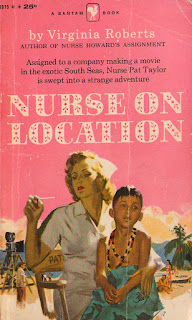
Nurse on Location

By Virginia Roberts, ©1958

When Five Star Pictures decided to shoot Island Intrigue on location on a beautiful Pacific island, Nurse Pat Taylor was put in charge of the health of the glamorous stars. To young Pat, this was a dream come true. But barely had Pat set up her tiny hospital when she met a strange young American doctor, John Stewart, mysteriously hiding himself in this remote tropic outpost, and found that by giving succor to a dying native girl, she had broken an implacable tribal law and aroused the primitive anger of the native chieftain. Here is an adventure which might happen to any nurse if she was nurse on location.

GRADE: C+


BEST QUOTES:
“Who but a movie star could walk right up and ask a man for a date? Here she was reluctant even to phone Catherine’s friend, Dr. John Stewart. It did seem aggressive.”

“A fascinating woman. Beautiful. Mysterious. Everything that intrigues a man.”

“Suddenly she thought of the scene at Los Angeles Airport, just before the plane left. He had clutched his wife and two children as though he thought he was never going to see them again. He must have some sort of complex.”

“What a real, down-to-earth attitude movie people have.”

“Young women. What a batch of champagne bubbles you all are.”

“Most people think that an anesthetist is some jerk who flips a vacuum over your nose and yells to breathe deep.”

“Later that afternoon, when Pat returned to the hut, she found Vivienne weeping with as much fervor as though she were being paid $5,000 a week to emote.”

“You’ve got to stop worrying about other people, and start relaxing. If you don’t, you’re apt to swell up like a blimp.”

“His specialty is mental disturbances. He might take one look at you and pop you into a sanitarium.”

“Haven’t you learned yet a girl has to flirt a little if she wants to catch a man?”

“If it’s a career you’re after, always remember it’s never more important than a woman’s appearance.”

“It’s never good technique to keep a man waiting—too long.”

“Advice is cheap when you’re giving it out.”

REVIEW:
Pat Taylor has completed her nurse’s training and is about to embark on her graduate studies at Johns Hopkins to become a nurse anesthetist, but she has a few months to kill before school starts in the fall. Through the intervention of a former preceptor, she has scored a dream job: traveling to Fiji for the summer with a film crew that is making a major motion picture. She’s been asked to drop in on the preceptor’s old friend, John Stewart, who is a doctor doing some unspecified research into “mental diseases among people far away from civilization.” Needless to say, Pat is instantly smitten with Dr. Stewart: Though their telephone conversation is purely small talk and lasts less than a page, it results in his politely asking her to dinner, and after hanging up, she thinks, “I shall look forward to tonight more than any other night I can remember.” Though their date confirms Pat’s opinion of him as “the most fascinating man I’ll ever meet,” his career is put forth as something of a mystery: Though her friend has told her what he is studying, he doesn’t really talk about it (but she doesn’t ask, either), and she starts jumping to all sorts of wild conclusions: “Who are you? What are you? Why are you? Was he running away from something?”

As it is soon revealed, this propensity for wild flights of imagination is one of Pat’s major characteristics. Shortly after she moves into her clinic, a local boy carries in a very sick young native woman, who dies hours later of perforated appendicitis. Pat overhears the crew discussing how “those dumb natives are trying to put the blame for that girl’s death on poor Pat. … No telling what they’ll do.” From then on, the poor Fijians, previously described as warm, welcoming, and civilized, are viewed by Pat with increasing hysteria: They’re ferocious, angry, “mean and secretive and suspicious”—words that really could be used to describe Pat’s own attitude. Again and again, she’s freaking out because some local person happens to be behind her or is looking at her when she walks down the street. On virtually every other page there’s some nasty thought of hers about how when they speak to each other in their native tongue they are saying something “ugly and obscene” and how at any moment “the natives might strike.” If they ever did, I’d be inclined to jump in and help.
                                                                
She voices her paranoid opinions to John Stewart, who manages to stay seated for the remainder of their date. Later, he tells her he loves her—but that he has no right to woo her. Pat’s delusions immediately take flight again: “Was he engaged? Married? What was it that suddenly caused a mountain to spring up between them? Why should he choose to remove her, at the flick of an eyelash, from his life?” Someone has been seriously skipping their meds. Eventually her time in the Pacific winds to a close, and there’s nothing but a luau between her and the plane ride home when she is asked to tend to another native child, this one a mere toddler, with an infected foot wound. She angrily agrees to see the child, and we are told that “here again was a mercy call she could not refuse and be true to her profession”—though it’s hard to see how Pat’s overwhelming fear and brusque treatment of the patient and his family could be called mercy.

Two days later, John Stewart shows up, for the first time since he told Pat he loved her but couldn’t see her any more, to let her know that the child had an allergic reaction to the antibiotics she had given him and had almost died. He helpfully reveals that it had taken every bit of his skill to convince the local chief not to “take matters into his own hands. Or did you know what those drums meant? The drums were for you, and it wasn’t a celebration in your honor.” Thanks, John. But now the natives love Pat, showering her with gifts and flowers when she's out and about, and we’re treated to a ghastly description of the natives as “a paradoxial people, teetering between savagery and civilization,” again, a description better suited for Pat herself. All that’s left is for Pat to be anointed princess of the island at the luau—the villagers all drop to their knees and shout, “Long live the white princess!” as, wearing a crown made of ferns and flowers, she ascends a podium to her throne—and we are hard-pressed to retain our lunch.

But wait, there’s more! Guess who is the white king of the island? Guess who relents and asks Pat to marry him? Guess who tells her, “You can forget about being a stuffy anesthetist. I’m the one who needs you”? Guess who instantly chucks her career aspirations and sighs, “No girl was a real woman until she possessed the love of the right man”? Guess who finally loses her struggle and throws up?
                                                                                                       
You’d think I’d learn by now that if there is ever anyone brown on the cover of one of these books, the interior is almost guaranteed to be filled with hateful racism. It’s really too bad, because if the prejudice had been edited from this book, it would have been quite pleasant: The writing is generally enjoyable, the author has a fine sense of humor, and the minor characters, anyway, are well-drawn and interesting. Unfortunately, the plot is thoroughly saturated with bigotry, not just against the Fijians but also, at the end, women as well. If you can manage to take an anthropologic view, examining the relics of a bygone era with a detached eye, you might get some enjoyment from this book, but the author just doesn’t make it easy.

Saturday, March 12, 2011

Studio Nurse

By Virginia Roberts, ©1961

Being studio nurse meant for golden-haired Lori Todd sharing all the excitement of Hollywood picture-making, as well as taking care of Producer Mike Lancaster’s ulcer. Mike’s worry was the picture that would never be finished… Lori had two worries. Handsome Mace Hunter, test pilot for Pacific Aircraft, who persisted in risking his life daily for the sheer adventure of it… and naval Lieutenant Dirk Patou. The future Dirk offered Lori was both stable and secure, and in his white uniform Dirk was every bit as handsome as the test pilot who simply would not listen to reason…

GRADE: C

BEST QUOTES:
“ ‘Bill Cox has an iron hand,’ she reminded him. ‘He’ll spank her if she doesn’t follow orders.’ ”

“Sleeping keeps me from drinking coffee.”

“ ‘What he needs,’ Lori theorized, ‘is a good wife to take care of him and boss him around.’ ”

“I didn’t know you’d look so fragile and blonde in your uniform.”

“Hildegarde, maybe if you’d have gone to charm school, like I suggested, you’d have a job somewhere else by now.”

REVIEW:
Lori Todd lives in a rooming house off Sunset Boulevard in Hollywood with four other people, plus the landlord and the “colored” cook. She’s a nurse at Richlieu Pictures in Culver City, where she ministers to extras and tries to encourage the spoiled leading lady, Wendy Wilks, to show up on time and put a little effort into her acting. It’s not working. Wendy is the daughter of the millionaire who is bankrolling the film, and if she feels like taking three days off to go party in Las Vegas, well, that’s what she’s going to do.

But truthfully, Lori is about as detrimental to the film as the apathetic starlet. Right off the bat, in Chapter 2, she brings her landlady’s dog to work with her because, “being a city dog, he doesn’t get the exercise he needs.” In the middle of shooting a scene involving a large number of extras and a horse, the dog, which Lori has not even put on a leash, runs onto the set and spooks the horse, which plunges through the crowd, injuring five people. A woman loses a front tooth, another sustains a concussion, and one man has two broken vertebrae and has to remain in the hospital for “an indefinite number of weeks.” Lori gives not one moment’s thought to her role in this tragedy, instead concentrating on the superstition that “accidents always came in threes.”

And she doesn’t waste much time bringing on the next catastrophe. She’s concerned that director Mike Lancaster is developing an ulcer, and insists that he take a few weeks off. This means that Mike, who has been gently coaxing Wendy through her role, is replaced by an assistant director who is a bit less patient. In his very first day on the set with Wendy, he is filming a scene in which she has to ride a burro. It turns out that Wendy has a pathological fear of burros. “It was one of those things requiring psychoanalysis to be understood,” deduces Lori, the medical marvel, and frankly, I think Wendy would find the time and money involved in getting to the bottom of this phobia well worth the effort. But at the traumatic moment, when Wendy, quaking with fear, insists on getting off the burro, the assistant director calls her “some little dumb, spoiled doll,” and Wendy up and quits.

This could spell ruin for Richlieu Pictures. Mike is on the hook for $750,000 to Wendy’s father—“the figure seemed tremendously big, like the national debt,” Lori thinks—so without a finished film to release, the studio will go bankrupt. Lori is deputized to break the news to Mike, on holiday in Hawaii. His reaction—and sensitive readers may wish to avert their eyes here—is, “Oh—rats!” Lori helpfully reminds him, “You said yourself that the picture was jinxed—that it would never be released. If it hadn’t been this, it would probably have been something else.” What a thoughtful thing to say.

When Lori’s not building up the spirits of her director, she’s worrying about her boyfriend, Mace, a test pilot, because, you know, those planes could crash! Mace even proposes, but she tells him, “I’ll never marry you as long as you’re a test pilot.” Which essentially puts that relationship on ice. Not to worry, though—the nephew of her landlady is a hot Navy lieutenant who went to Annapolis. Dirk is putting the moves on Lori on their first date, and is speaking of marriage on their second—right before he sails off for three weeks. When the landlady starts planning the reception, Lori nods and smiles.

Back at work, director Mike has dug an old script that his father wrote out of the closet, phoned Central Casting, and now he has a hot property on his hands. Everything is going very well, “But then she remembered—trouble comes in threes.” So Lori is not at all surprised when one of the lighting guys topples off a scaffold. He’s a hemophiliac, and Lori turns to her ex-boyfriend Mace to fly the man to see a cardiologist. This is of no use whatsoever, because it turns out the patient has an abdominal aortic aneurysm. Because of his hemophilia, the doctors can’t operate, and the patient has only six months to live. Lori bravely visits the patient, who tells her he can’t wait to get out of the hospital so he can find a new home for his little dog. “Sure good thing I’m a widower and not leaving a wife behind. Only my sister.” Another job well done for Lori.

But with disaster number three over with, we can have a really great party celebrating the premiere of Mike’s fabulous new Oscar contender!!! And pick out a husband, too!!

Studio Nurse is not impossible to get through, but it’s nothing really special. Despite the fact that you’re supposed to be inside this movie studio, you really don’t get much of an idea of what it’s like to make a movie, beyond the stereotypical nursing of the petulant star. With over 30 characters to keep track of, it’s a little confusing trying to remember what’s going on. And it’s never a good sign when you pick up a book again, having laid it aside the night before, and have to flip through it to remember what the plot is and the main character’s name. And our protagonist is not the most endearing heroine I’ve ever met, even if she is perky and blonde. The book isn’t badly written, but it’s just not very much fun. Which doesn’t give you very much reason to read it.