Showing posts with label psychiatry. Show all posts

Saturday, February 3, 2024

Dedication Jones

By Kate Norway
(pseud. Olive Norton), ©1969

Staff Nurse Didi Jones was torn between enthusiasm for her interesting new job and the feeling that she ought to be “settling down” as her fiancé wanted. But would there have been any problem, if she had really cared about him?

GRADE: B+

BEST QUOTES:
“I don’t know how you dare to argue with that woman. She terrifies me. I go all hemiplegic at the sight of her.” 

“The way to a man’s heart isn’t through his stomach anymore. It’s through his twin carburetors or his new putter, old dear. You’re not with it.”

“Depression in a young woman of under twenty-five is either a psychosis or it’s reactive to the boy-friend situation.”

“Incompetent people are always terribly bossy, just to try to prove that they can control things.”

“Gossip can be psychotherapy. So can cigarettes, love affairs, fast driving, a good boo-hoo or a nice cup of tea.”

“You’ve had too much vitamin B. You’re getting aggressive.”

REVIEW:
As we meet “dedicated” nurse Delia Jones (she also goes by Didi, unfortunately), she is working at King Edward VII Memorial Hospital in England and has fallen victim to the classic romance trope in which her fiancé is not an especially charming individual who is always pestering her to quit her job and get married even though she really loves her work. “Geoff didn’t approve of wives who worked. He didn’t understand, I told myself. Teddy’s wasn’t like a shop, or an office. It was a life.” So you know there’s going to be a lot of tedious back-and-forth about that, when the answer is obvious. Her best friend, Rose—a delightful, flirtatious, sassy type—tells her, “If you marry him, dear girl, you’ll just be a—a chattel.” And worst of all, for you literary folks, “Geoff didn’t approve of Muriel Spark. He had found Miss Brodie unsavoury.” Just leave the bum! 

In the meantime Didi has started working in the Isolation Ward, which for some reason includes a lot of psychiatry cases. This means she is seeing a lot of a certain Dr. Dwyryd Ffestin-Jones (he’s Welsh). He’s kind, firm, but a little distant—in short, the quintessential British nurse novel love interest.

Next comes trope #3, in which Didi has mailed her engagement ring back to Geoff, but he’s been injured and may never walk again, so it’s not clear if she feels free to keep walking out the door. Then suddenly Dr. F-J is not speaking to Didi, and she’s not sure what has happened—so naturally she comes down with flu and is in a coma for a week, but fails to recover because she’s so upset about Dr. F-J’s behavior that she is shipped home to recover for a month or two. Only a chat with a psychiatrist—just not that psychiatrist—helps her get caught up with hospital gossip and figure out what the problem is. She promptly takes action and saves her own day …

Overall the book is very formulaic, but it has pleasant characters—again, per usual, the best are the strong, independent heroine and her feisty roommate, as well as a few other nurses who come across well, while the men are mostly limpid and uninteresting, including Dr. F-J, I’m sorry to report. There is a subtle humor throughout, such as when Didi tells a friend, “If I don’t spill to some neutral observer, I shall burst,” and he replies, “And I’m no surgeon, so we can’t have that. Spill away.” Once again Olive Norton, here writing as Kate Norway, lives up to her solid reputation as a gem of an author, and I can again recommend the tenth book I have read by this excellent writer, and hope that she’s written a lot more nurse romance novels that I can look forward to.

Sunday, February 13, 2022

Stop-Over Nurse

By Fern Shepard
(pseud. Florence Stonebraker), ©1968
 

Brenda Gregory, a nurse, was driving a drugged woman patient to the hospital when their car crashed over a cliff, the patient died in flames which burned her beyond recognition, and Brenda, surviving, suffered injuries which required plastic surgery to her face and wiped out all memory of the past. Gradually she recovered in the confines of Stop-Over House, a convalescent home in a California beach town, and even began nursing again there. Then suddenly her memory returned, and she found she had mistakenly been identified as the dead woman and was unable to prove her true identity. Furthermore, a certain quack psychiatrist who was interested in keeping her dead so she could not reveal what she knew about him was willing to swear to the lie and declare her a mental case. 

GRADE: C

BEST QUOTES:
“Six miles all told! She could never walk it. She’d fall dead in her tracks.” 

REVIEW:
For the first few chapters of this book, I would have bet hefty sums that I had read it before. After a thorough search of my blog, I found a couple of books that could have been sisters to this one (the pretty good Masquerade Nurse and the god-awful Jane Arden’s Home-Coming), but no identical twins. So it was a mistaken identity, which as it happens is exactly what this book is about. Nurse Brenda Gregory had caught her awful boyfriend, psychiatrist Dr. Nelson Ludlow, injecting STP, a hallucinogenic that had its debut in the Haight-Ashbury in San Francisco in the mid-1960s, into Brenda’s friend Kitty Carter. Stuffing Kitty into the car, Brenda heads for the hospital, but is hit by another car and knocked over a cliff. The resulting crash and fire kills Kitty and leave her body burned beyond recognition, while Brenda suffers amnesia and terrible facial trauma that requires the best efforts of a plastic surgeon, who has given her a different appearance. When the book begins, it’s more than a year later, Brenda is waking up at Stop-Over House, a convalescent home for people with psychiatric illness, and slowly realizes she’s an employee there, formerly a patient, and is known to all as Kitty Carter—seems Dr. Ludlow and her sister Eve had at the time of the accident both identified her as Kitty, and since she had amnesia she had been thinking she was Kitty. The trick is, how is she going to prove that she is actually Brenda if her ex-fiancé and sister say she’s not? I dunno, fingerprints? Dental records? Birth marks? Blood type? Consult a lawyer? Nah. 

Nonetheless, Brenda finds an ally in Kitty’s brother Tom Scott, who is a famous foreign correspondent and who does believe that she’s not Kitty. Tom hatches a plan to catch Dr. Ludlow in the lie: He will tell the press that he has become engaged to her, thereby getting her story into the papers—because her story on its own wouldn’t be at all interesting. The crazy ploy actually works: Ludlow takes the bait and turns up at Brenda’s house to murder her, but it seems that Tom has not bothered to take any precautions once he got the story out. Ludlow nearly succeeds, aided and abetted at every turn by Brenda herself, who first lets the psychopath in—he’s taken so many psychedelics that he thinks he’s the Roman emperor Nero—then fails to telephone the cops or shout for help, sits beside him, and takes the drink he offers her, even though she was “feeling ill with alarm,” all because “she did not want him causing a disturbance.” How considerate! Fortunately, though, two friends of Brenda’s drop by before she’s had more than a small sip of the poisoned cocktail, so she survives.

Next Ludlow tries to kill Brenda’s sister Eve, since Eve was in on the original scheme to misidentify Brenda, and then there’s another hare-brained scheme to get Dr. Ludlow to admit that “Kitty” is really Brenda, and this one succeeds, so everyone lives happily ever after. First, though, we have to a bit of dancing around, with Brenda saying that she thinks Tom doesn’t love her and Tom insisting that he really does. But I will acknowledge that the ending was actually a little sweet.

It’s not the most original of novels, and seems to be not much more than a heaping handful of Florence Stonebraker’s usual tricks—psychedelic drugs, car crashes, amnesia, crazy psychiatrists, and characters named Kitty (see her heroines in Night Nurse, Nurse Kitty’s Secret, and The New Nurse). The writing is fairly perfunctory, with no real amusing quotes to offer you, certainly not what Stonebraker is capable of (Doctor by Day, City Doctor). This is one of four books I’ve read of hers that were published in 1968; an author that busy can’t always knock it out of the park.  William Faulkner churned out what he called “potboilers”—books written largely to earn money—but some of those also earned Pulitzer prizes. Stonebraker will win no awards with this attempt to pay the rent, and more is the pity, since I know she can do so much better.

Saturday, December 21, 2019

Believe in Miracles

By Florence Stuart, 
pseud. Florence Stonebraker, ©1968
Also published as Celebrity Nurse and Television Nurse

Nurse Clare Kincaid was caught in a web of conflict which was tying her in knots. Dr. Hal Grove, the handsome, brainy, rich psychiatrist, was in love with her, but he would not take on the responsibility of the child who had become so much a part of her. How could Clare leave Tracy, the five-year-old daughter of her adoptive brother Larry? The child was hungry for love and clung to her. Yet Larry, though charming, was totally irresponsible, while holding onto his hope of marrying Clare. To complicate matters still more, Jeff Haymes, a TV personality in Clare’s care, was making sensational proposals to her and extravagant promises to Tracy. Clare had to make a choice. How could she be sure she was making the right one?

GRADE: C-

BEST QUOTES:
“‘You should wear that white swim suit around the hospital,’ Jeff Haymes told Clare. ‘The male patients would have no further need of wonder drugs.’”

“Try some hot compresses on your heart. See if you can’t warm it up while I’m gone.”

REVIEW:
I love author Florence Stonebraker (here writing as Florence Stuart) so much that I am reluctant to actually read her books because it means there will be one less for me to enjoy (it took me more than a decade to read the last Jane Austen). I needn’t have held off with this one, because enjoy it I did not.

Here we have nurse Clare Kincaid, at 25 a well-established nurse who has managed to hook desirable Dr Hal Grove, a 38-year-old former confirmed bachelor psychiatrist of the Park Avenue type, with a thickly carpeted office suite and highly bankrolled female clientele—we know the type all too well, and he never turns out well, does he, readers? Particularly since in this case he’s a psychiatrist, as author Florence does love a psycho psychiatrist (see also A Nurse Named Courage). The writing is writ especially large here  because Clare is effectively the guardian of her five-year-old niece, whose mother is dead and whose father, Clare’s adopted brother Larry, has abandoned the girl. Little Tracy is now living with Clare and mother Rose, who has suffered several heart attacks and as a result is a near invalid likely to keel over at any second. Clare is essentially a mother to Tracy, but Dr. Hal has absolutely refused to accept Tracy into his home when he and Clare are married. Clare spends a lot of time worrying about what to do—give up Tracy for adoption? Dump Hal and fast is not high on her list of options, unfortunately, though the reader is completely unable to see why.

At work Tracy is caring for wealthy television show star Jeff Haymes, who hosts a sort of gotcha-type program where “he gets people up to interview them; then all he does is make fools of them. He’s made a big name just by insulting people.” Many nurses are won over by Jeff, but not Clare: “She did not imagine she could ever possibly like Jeff as a person.” This means, of course, that they’ll be engaged at book’s end. If Clare is not impressed, Tracy is: Clare had brought Tracy to work one day to cheer up the patients, and never mind how wildly inappropriate that is, but now Tracy is smitten with—brace yourself—“Unk Jeff,” who wants to take her to Disneyland for her birthday.

Though no one has ordered a psych consult, Hal takes it upon himself to interview Jeff, who is recovering from his second plane crash, and tells Jeff that he has suicidal tendencies. Jeff responds by beaning Hal on the head with a crystal ball, and I am not kidding, which makes me think Hal may have a point. And now Hal is insisting Clare stay away from Jeff—but she goes to his room to tell him to stop making empty promises to her lonely little niece. Instead Jeff turns the tables and asks Clare about her own empty promises to Tracy, whom she is considering abandoning to strangers when she marries Hal. Jeff then suggests that he could get Tracy some work in TV commercials so Clare could afford to hire a nanny to look after Tracy while she’s at work. Despite herself, Clare starts to think this Jeff guy isn’t so bad …

Especially after her next date with Hal, when he says he’s arranged the adoption for Tracy that Care had not even agreed to, that he’s taken a job in the Midwest and Clare can come too, get a job, and undergo psychoanalysis—and when she’s cured of her “neurotic attachment to her little niece,” they can be married. Clare rightly calls Hal “a smug, self-centered, swollen-headed creep”—but it that the end of the engagement? Heck, no! It’s not even the end of the date! She lets Hal drive her home, but “there were not let’s-kiss-and-make-up embraces,” which teaches Hal to be a better person.

Or maybe not, because before long, we are questioning Hal’s sanity—and you knew we would. “He ranted and raved; he paced the floor and pounded his fists on the semi-circular metal desk. His face thinned; his cheeks turned a purplish hue.” And we’re only on page 72. There’s still a lot of plot to get through, such as Larry’s very alarming pass at his sister Clare, his decision to take Tracy back and make a lot of money off her impending TV career, Hal’s idea to kidnap Tracy with Jeff’s help, Clare and Tracy’s several appearances on Jeff’s show, including one in which Jeff proposes to Clare on air. In the end, there’s a big showdown in which Tracy is shot “just a fraction above her heart,” and though the injury is described as “just a flesh wound,” but she really whacked her head when she fell down and has been in a coma and on the critical list for a week, and “almost didn’t make it.” Nevermind about gunshot wounds; it’s those bumps on the head that will really kill you.

So many elements of this story are the usual tricks from author Florence Stonebraker’s repertoire: the psycho (Nurse Under Fire, The Nurse from Alaska, and of course Psychiatric Nurse), the unwanted yet fiercely fought-over child (The Nurse from Alaska, Runaway Nurse), the adopted daughter (Ozark Nurse). There is none of the gorgeous writing that she can be capable of (run, do not walk, to find City Doctor and Doctor by Day), and here she’s developed an annoying habit of dropping the quotation marks halfway through a quote and paraphrasing the remainder of the remarks. The characters are not particularly likeable, as Clare is a pathetic pushover who on one hand claims, “I can take care of myself,” but on the other can’t figure out that Hal is a horrible person. Even Jeff, the supposed love interest, is far too arrogant and pushy, telling Clare within minutes of their first meeting that he looked into the crystal ball and “this girl appeared in the crystal, plain as anything. And she had big, beautiful, golden eyes, exactly like yours. Now what do you make of that, sweetheart?” His on-air proposal to Clare screams of an overly controlling stalker, and his attentions to Tracy are too much to be anything but disturbing. This is actually the worst-rated Stonebraker novel of the 16 of her books I’ve read. If you’ve got others on your shelf, don’t bother pick up this one—not even the cover is worth looking at.

Saturday, April 9, 2016

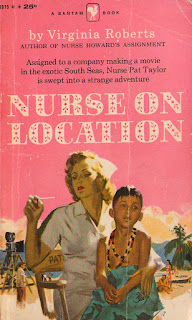
Nurse on Location

By Virginia Roberts, ©1958

When Five Star Pictures decided to shoot Island Intrigue on location on a beautiful Pacific island, Nurse Pat Taylor was put in charge of the health of the glamorous stars. To young Pat, this was a dream come true. But barely had Pat set up her tiny hospital when she met a strange young American doctor, John Stewart, mysteriously hiding himself in this remote tropic outpost, and found that by giving succor to a dying native girl, she had broken an implacable tribal law and aroused the primitive anger of the native chieftain. Here is an adventure which might happen to any nurse if she was nurse on location.

GRADE: C+


BEST QUOTES:
“Who but a movie star could walk right up and ask a man for a date? Here she was reluctant even to phone Catherine’s friend, Dr. John Stewart. It did seem aggressive.”

“A fascinating woman. Beautiful. Mysterious. Everything that intrigues a man.”

“Suddenly she thought of the scene at Los Angeles Airport, just before the plane left. He had clutched his wife and two children as though he thought he was never going to see them again. He must have some sort of complex.”

“What a real, down-to-earth attitude movie people have.”

“Young women. What a batch of champagne bubbles you all are.”

“Most people think that an anesthetist is some jerk who flips a vacuum over your nose and yells to breathe deep.”

“Later that afternoon, when Pat returned to the hut, she found Vivienne weeping with as much fervor as though she were being paid $5,000 a week to emote.”

“You’ve got to stop worrying about other people, and start relaxing. If you don’t, you’re apt to swell up like a blimp.”

“His specialty is mental disturbances. He might take one look at you and pop you into a sanitarium.”

“Haven’t you learned yet a girl has to flirt a little if she wants to catch a man?”

“If it’s a career you’re after, always remember it’s never more important than a woman’s appearance.”

“It’s never good technique to keep a man waiting—too long.”

“Advice is cheap when you’re giving it out.”

REVIEW:
Pat Taylor has completed her nurse’s training and is about to embark on her graduate studies at Johns Hopkins to become a nurse anesthetist, but she has a few months to kill before school starts in the fall. Through the intervention of a former preceptor, she has scored a dream job: traveling to Fiji for the summer with a film crew that is making a major motion picture. She’s been asked to drop in on the preceptor’s old friend, John Stewart, who is a doctor doing some unspecified research into “mental diseases among people far away from civilization.” Needless to say, Pat is instantly smitten with Dr. Stewart: Though their telephone conversation is purely small talk and lasts less than a page, it results in his politely asking her to dinner, and after hanging up, she thinks, “I shall look forward to tonight more than any other night I can remember.” Though their date confirms Pat’s opinion of him as “the most fascinating man I’ll ever meet,” his career is put forth as something of a mystery: Though her friend has told her what he is studying, he doesn’t really talk about it (but she doesn’t ask, either), and she starts jumping to all sorts of wild conclusions: “Who are you? What are you? Why are you? Was he running away from something?”

As it is soon revealed, this propensity for wild flights of imagination is one of Pat’s major characteristics. Shortly after she moves into her clinic, a local boy carries in a very sick young native woman, who dies hours later of perforated appendicitis. Pat overhears the crew discussing how “those dumb natives are trying to put the blame for that girl’s death on poor Pat. … No telling what they’ll do.” From then on, the poor Fijians, previously described as warm, welcoming, and civilized, are viewed by Pat with increasing hysteria: They’re ferocious, angry, “mean and secretive and suspicious”—words that really could be used to describe Pat’s own attitude. Again and again, she’s freaking out because some local person happens to be behind her or is looking at her when she walks down the street. On virtually every other page there’s some nasty thought of hers about how when they speak to each other in their native tongue they are saying something “ugly and obscene” and how at any moment “the natives might strike.” If they ever did, I’d be inclined to jump in and help.
                                                                
She voices her paranoid opinions to John Stewart, who manages to stay seated for the remainder of their date. Later, he tells her he loves her—but that he has no right to woo her. Pat’s delusions immediately take flight again: “Was he engaged? Married? What was it that suddenly caused a mountain to spring up between them? Why should he choose to remove her, at the flick of an eyelash, from his life?” Someone has been seriously skipping their meds. Eventually her time in the Pacific winds to a close, and there’s nothing but a luau between her and the plane ride home when she is asked to tend to another native child, this one a mere toddler, with an infected foot wound. She angrily agrees to see the child, and we are told that “here again was a mercy call she could not refuse and be true to her profession”—though it’s hard to see how Pat’s overwhelming fear and brusque treatment of the patient and his family could be called mercy.

Two days later, John Stewart shows up, for the first time since he told Pat he loved her but couldn’t see her any more, to let her know that the child had an allergic reaction to the antibiotics she had given him and had almost died. He helpfully reveals that it had taken every bit of his skill to convince the local chief not to “take matters into his own hands. Or did you know what those drums meant? The drums were for you, and it wasn’t a celebration in your honor.” Thanks, John. But now the natives love Pat, showering her with gifts and flowers when she's out and about, and we’re treated to a ghastly description of the natives as “a paradoxial people, teetering between savagery and civilization,” again, a description better suited for Pat herself. All that’s left is for Pat to be anointed princess of the island at the luau—the villagers all drop to their knees and shout, “Long live the white princess!” as, wearing a crown made of ferns and flowers, she ascends a podium to her throne—and we are hard-pressed to retain our lunch.

But wait, there’s more! Guess who is the white king of the island? Guess who relents and asks Pat to marry him? Guess who tells her, “You can forget about being a stuffy anesthetist. I’m the one who needs you”? Guess who instantly chucks her career aspirations and sighs, “No girl was a real woman until she possessed the love of the right man”? Guess who finally loses her struggle and throws up?
                                                                                                       
You’d think I’d learn by now that if there is ever anyone brown on the cover of one of these books, the interior is almost guaranteed to be filled with hateful racism. It’s really too bad, because if the prejudice had been edited from this book, it would have been quite pleasant: The writing is generally enjoyable, the author has a fine sense of humor, and the minor characters, anyway, are well-drawn and interesting. Unfortunately, the plot is thoroughly saturated with bigotry, not just against the Fijians but also, at the end, women as well. If you can manage to take an anthropologic view, examining the relics of a bygone era with a detached eye, you might get some enjoyment from this book, but the author just doesn’t make it easy.

Monday, October 8, 2012

Love Comes to Dr. Starr

By William Johnston, ©1963
Cover illustration by Lou Marchetti

Dr. Claudia Martin stood by as she watched her fiancé, Dr. Dan Starr, treat his new patient, Kathleen Emory, who suffered from a partial paralysis that could only be cured by physical therapy. Spoiled and petted by her husband, Kathleen was used to getting what she wanted. And Claudia was sure that right now Kathleen wanted Dan. Claudia was used to Dan's becoming involved with his patients' problems. But this time it was different. This time the patient was a very beautiful girl. How long could Claudia's love for Dan last if she was forced to share his emotional commitment with another woman? After all, being a doctor didn't mean that she wasn't a woman. She had a woman’s need for her man's attention. How could she make Dan see that she, too, needed him?
 
GRADE: B+
 
BEST QUOTES:
“That’s the secret of French cooking. Time. You’re so hungry by the time you get it, you’re sure it’s super-colossal.”
 
“Why don’t you marry the girl and get her out of your life?”
 
“She felt she had to compensate for being a woman in what was generally considered a man’s profession, and so she was less quick to show compassion, an expression which she subconsciously felt would give the impression that she was more of a woman than a doctor.”
 
REVIEW:
I’ve spent a fair amount of time trying to decide if this actually accounts as a nurse novel (and yes, books about women doctors do count as “nurse novels”). The character we spend the most time with is Dr. Dan Starr, and it’s his name that populates the cover. But Dr. Claudia Martin is also a leading character, we do get into her head a fair amount, and she ends up with her man (again) at the end; they were engaged from the opening page. The story is largely about him, his infatuation with another woman and how he extricates himself from it, but VNRNs can be about a man’s wandering attention and how he comes to his senses. In the end, though, I think the fact that he occupies more of the book than she does, that we don’t follow Claudia’s daily life, and that we don’t get to know her as well as we do him, means that this book is not actually a VNRN.
 
So the question of whether I should review it on this blog also comes up. The answer to that is easier; I read the book, so what the heck, I’ll do a review. Purists should skip to the next post.
 
Dan Starr is a chief resident at Rothwell Clinic in Manhattan. His fiancée is Dr. Claudia Martin, a psychiatrist. They get together for dinner and witty repartee: “Wouldn’t you like to put your feet up and relax?” she asks him when he arrives at her place. “I’m sorry I don’t have a dog to bring you your pipe and slippers.” But something must intrude on their happy affair or there wouldn’t be a book, so enter Kathleen Emory, a 20-year-old waif married to 50-year-old Eugene Emory. Theirs is an epic love story: He hired her to work at his factory as a secretary, but she was completely incompetent, so he shuffled her around the office until the only position left for her to take was the one as his wife. He takes care of her, because she’s ridiculously insecure and inadequate—this is due to an overbearing mother—and they don’t have a physical relationship, because she’s so childlike that neither one of them think she can handle it.
 
She’s landed in the clinic after a car accident ruined her arms, which she cannot raise or even twitch. Her physical therapist, Dr. Mary Young, is a burly sort—“From the rear, from Dan’s view, she had much the look of a Yale lineman”—who pushes her patients hard. Mr. Emory feels she is pushing Kathleen overmuch, and complains to the head of the hospital, who asks Dan to look into it. But—and this point is one of some contention between the Drs. Starr and Martin—Dan has a tendency to get overly involved with his patients. Sure enough, once Dan claps eyes on the pretty, helpless, tearful young thing in room 713, he feels the only way he can get to the bottom of the question of whether Dr. Young is working Kathleen too hard is if he himself personally gives her physical therapy treatments every night, in addition to the treatments she gets from Dr. Young, even though he admits he has little knowledge of physical therapy. Needless to say, Claudia is not too excited about this, and after visiting Kathleen, she quickly arrives at the idea that Kathleen is in love with Dan.
 
And how does Dan feel? “Dan avoided asking himself if he were in love with her. He was not sure what the answer would be. He knew, however, what he must do. He had to continue treating her.” Because if you think you might be falling in love with a patient, married or not, and it’s pretty clear that the patient is falling for you, the best thing is to go right on spending too much time with them. Even the head of the hospital, when he hears what’s going on, tells Dan, “You’ve made something complicated out of something simple.” Yet night after night, there is the altruistic doctor, rubbing Kathleen’s pale, limp arms and feeding her chocolates that she can’t lift for herself. How sweet.
 
It turns out that Eugene does not want Kathleen to get better; if she is crippled, she will be helpless and dependent upon him for life, and that suits him just fine. When she figures this out, Kathleen tells Eugene that she wants to be strong and well, and he responds by nastily describing all the enormous responsibilities he is going to load on her when she gets home, and won’t that be great? Naturally, when he leaves, she has a hysterical fit. The next night, when Eugene returns to visit his wife, “he had the look of a man who has won a battle and who assumed that he had thus won the war.” Not so fast, buddy. Kathleen tells Eugene that she is leaving him for Dan, who loves her and wants to marry her. “He’s a handsome and wonderful man. A man—understand?” she snipes at him.
 
Eugene naturally goes straight to Dan, whose answer is to visit Kathleen. There, he pulls essentially the same stunt that Eugene did earlier—one that came across as low and despicable when Eugene did it—by telling her that he’s all excited to marry her, and give her “a normal life,” and Dr. Martin is going to be brought in “to get you ready, to prepare you to be my wife.” Nudge, nudge, wink, wink. I was curious as to how Claudia was going to do this, exactly—show her porn movies? Review sex toys and techniques? But never mind, Kathleen caves to the pressure and screams at him to go away and leave her alone. Not content to stop there, Dan chews out Kathleen in the most heartless and unjustified way: “This business of being in love with me, do you know why you pulled that one? To give you a tighter hold on your husband. You intended all along to let him win you back. What a joke that was. You could never leave him. He was your closet where you could hide out. You couldn’t be a wife to any man because you’re not a woman—not the way you are.” Frankly, I did not see where this was coming from; nothing in Kathleen’s behavior or speeches makes me think that she did not believe herself to be in love with Dan. So my opinion of Dan plunged even further.
 
That’s not the end of the weirdness, however. Having beaten the emotional stuffing out of Kathleen, he marches off to see Eugene. There he pulls the same cruel game, telling Eugene that Kathleen is going to sue him for an annulment. “In that way, the fact that you and Kathleen have never really been man and wife and the reason for it will be brought out,” he says. What this “reason” could be is only hinted at. “How much do you know?” Eugene asks Dan, and then goes on to tell Dan that he married Kathleen because the men at his company were needling him about being single: “A man of fifty who’s never—who’s never … wanted a woman. They know about me.”
 
Could he … could he be … gay? In retrospect, all the classic signs are there. Eugene’s apartment is lavish and well-appointed, and he says, “Most people comment on my excellent taste,” when he shows Dan in. Flash back to our first meeting with Eugene: “Emory could have very well just stepped from the pages of Esquire magazine. He was wearing a meticulously trim, black worsted suit, a sparkling white silk shirt, and a silver silk tie, which more only the meagerest hint of a pattern, black shoes polished to conservative gloss, and a black homburg that sat on his head at a precisely correct tilt. His face, long and narrow, was interrupted by a guardsman moustache. Whoever kept it in trim was quite clearly a precisionist.” Why didn’t we see this before?
 
But let’s not beat ourselves up over it. Because there are greater villains at hand, and they grow increasingly more odious: Dan, not content to stop there, essentially blackmails Eugene into helping Kathleen get therapy so “she can someday be a woman.” He insists that Eugene “tell her about yourself—fully. And then, if you’re in love with her, by seeking the cause of your own abnormalcy, and trying to—” I assumed he was going to say have sexual relations, but that’s going too far for Eugene. “It can’t be that,” he cuts off Dan. “I’m what I am and I’m not ashamed of it.” Dan tries to encourage Eugene to get psychoanalysis, but Eugene refuses. “I’ve lived fifty years with this. If I changed, I wouldn’t be myself any more. I have my ways of living—my books, my apartment here, my privacy.” Instead he agrees to offer Kathleen a quiet divorce, which Dan graciously accepts on Kathleen’s behalf, although I’m not sure how the quivering aspic Kathleen is going to feel about all of Dan’s “help.”
 
I wonder if author William Johnston thought this was going to play as a happy ending, but to me it seemed a colossal nightmare, with no one winning. Kathleen might get therapy and someday go on to have sex—that is, after all, what all the “being a woman” euphemisms are about, and it seems that her virginity is of colossal importance to not only Dan but also her success as a human being according to the author—but Eugene is destroyed, and Dan is revealed as an evil, persecuting tyrant who will emotionally bully his own patient, and her husband as well, if it suits him. The no doubt unintended irony here is that the reason he got involved with Kathleen to begin with is that he was asked to look into whether she was being bullied by a doctor. It turns out that she is, but the perpetrator is Dr. Starr. And at the end of the book he’s hailed as a hero, and goes off to have coffee with the now-exonerated Dr. Young.
 
This is an odd book, but nonetheless a good one. It is well-written and humorous, and trots along at a good pace. The bizarre situation, the constant allusions to Kathleen’s sex life, and the hints at Eugene’s homosexuality make it one of the more unique and risqué books I’ve read, but since it’s not really a nurse novel, I guess that means it doesn’t count. Even so, it’s an interesting and worthwhile detour.

Friday, December 30, 2011

Hootenanny Nurse

By Suzanne Roberts, ©1964

Julie Dodd was in love with David Stace, the boy next door, ever since she could remember. When he studied to become a doctor, Julie decided that nursing would be her career so that their work would bring them together. And that is exactly what happened. Then Chad, a handsome folk singer, came into her life, and suddenly there was a new song in her heart.

GRADE: C

 
BEST QUOTES:
“Julie walked as fast as she dared down the hall, pressed the elevator button, and hoped on the brief ride that she still had a bit of lipstick on.”

“ ‘All right,’ Julie said crisply, asserting her authority as on-duty nurse in Emergency. ‘Let’s get those last two out of the hall. That boy with the harmonica, too.’ ”

“Julie’s hands were shaking as she gathered up her purse and the library book on disturbed children she wanted to renew.”

“Losing a dream can sometimes be as hard as losing someone you love.”


REVIEW:
If you are a fan of this genre, you’ve surely been waiting for Hootenanny Nurse. I must confess that I let out a small shriek when I saw this book in Kayo Books, the fabulous vintage book shop in San Francisco. (Florence Stonebraker once lived in the apartment building across the street, for added VNRN thrills!) I promise, you will never find a book in which the word hootenanny is used so frequently, which has its ups and downs. It’s way too much to expect that this book could live up to such an outrageous title, and I’m sorry to report that it doesn’t possess anywhere near the camp factor you’re probably hoping for. But it does offer up a few laughs, so it’s not a complete waste of time.

Nurse Julie Dodd is a student nurse in her final year at a hospital in Louisville, Kentucky. She’s nervous about doing a stint in the ED, though the supervisor tells her not to worry: “Some nights we only get a few phony suicides that need a good stomach wash, and then we send them home. Hysterical women, mostly.” Julie’s true calling is up on the child psych ward, because she more than the other nurses realizes that all these psychotic kids need is “love and comfort and soft words and kisses,” and soon they’re all behaving and there are no more incidents like the one where a schizophrenic boy broke into a medicine cabinet and attacked a nurse with a surgical knife.

Her boyfriend—you knew there was one—is David Stace, who grew up barefoot next door, on a ramshackle farm crowded with too many children. At fourteen, she’d been trying to figure out what she wanted from life—“somehow, just falling in love didn’t seem to be enough.” So when David declared a pre-med major, she signed up for nursing school so they could start a clinic in their poor hometown together. But as he nears the end of school, David buys an expensive car on credit and starts taking her to expensive restaurants, and soon he’s talking of setting up shop in Chicago. Well, she doesn’t think much of this at all! So she smoothes down her uniform and her pride and says, “I want whatever you want, of course.” She spends a lot of time seething about it, but “she didn’t want to be a nagging, pushy wife. She wanted to be, as she’d been all these years, deeply in love with him, letting him make the decisions, and glad that he did.”

Then a bus holding a group of folk singers rolls over, and now they’re encamped on the hospital’s fourth floor. She goes up to visit them and strikes up a conversation with the lead folkie, Chad. Soon she’s singing along with them on an impromptu “folk singing whing-ding.” “I think we’ve found ourselves a regular little Hootenanny Nurse!” Chad says. Before long, Chad is kissing her and talking about having kids. Run, Julie, run! But alas, she is another VNRN heroine without an ounce of sense.

Chad makes an appearance under her window with his guitar and asks her to join his group. They’re finally well enough to leave the hospital to go on tour, but he’s calling her every night and pressuring her to tell her she loves him. She hates the weakness inside herself that “made her cling to Chad, and yes—David. David still, and her parents, and yet she felt as if she didn’t belong with any of them.” Fortunately she has those schizophrenic kids to help cheer her up. Little Maryjo is blooming, thanks to a rag doll that Julie sat up all night sewing for her. “Honestly, Julie, without you, I think that kid would still be sitting up in bed, screaming and needing medication every four hours to calm her!” the ward nurse tells her. “All she needed was love and attention.”

She invites Chad and the gang to her parents’ house for Christmas, and when she gets off the plane, Chad is there to meet her: “We’ve got a Christmas Eve hootenanny going full blast!” He proposes to her, and she accepts, for the best of reasons: “If I don’t marry him, someone else will! And I may end up all alone, an unmarried nurse, just like some of them I’ve seen—with no place to go at night when I get off duty except a lonely little apartment and a TV set for company!” But when she goes back to the hospital wearing his tiny diamond and he goes back on tour, he’s peeved that she has to work and can’t talk to him on the phone. He calls constantly when she’s supposed to be studying for her final exams, sometimes after hours when could get in trouble for being on the phone. Then she goes to visit him one weekend in Memphis and one of the singers comes down with appendicitis, and Julie takes her place in the big solo number, “My Butternut Tree.” She’s a smash hit, of course, so now on weekends she’s performing with the group. “And if a small, nagging doubt, a bit of sadness, came to her now and then, she pushed it back firmly.” There’s a big TV performance coming up, after all, and graduation, and then a wedding to plan: “What more could a girl ask?”

So when graduation is all over and Julie is just about to leave the hospital forever, she learns that little Maryjo, who Julie has been too busy to say goodbye to, has gone missing. Julie misses the big performance in Atlanta to help find her, hiding in the locker where she’d left an old uniform. Despite this little setback, she decides that Maryjo is “nearly well! And Julie realized, with a sudden stab of pride, that she was responsible for Maryjo’s complete change.” So she puts on that old uniform again, “and quite suddenly, without any more struggle, worrying, heartbreak, Julie knew she had found her answer. A wonderful, deep meaning had come into her life.” She calls Chad to dump him: “I can’t leave those children!” she tells him, and tomorrow she’ll talk to the superintendent about getting a permanent job on the children’s ward. And then there’s intern Mike Farrell, a “short, homely young man with unruly, sandy-colored hair and steady, mature gray eyes,” who’s been helping in the search. He offers to buy her a cup of coffee, and Julie thinks, “This too, might be a beginning,” and the two of them walk off together into the elevator.

This is the first nurse romance that doesn’t end with the heroine’s love life completely sewn up, and I have to say that was a nice break. But overall I was not won over by Julie’s spinelessness and her constant obsessing about what to do, what to do? Chad was kind of a creepy character, but she can’t see him for the controlling manipulator that he really is, even if she does leave him in the end. The hootenanny shtick can be amusing, but the constant pounding on this one note makes it a bit wearing in the end. You may not come away exactly singing its praises, but if you must read Hootenanny Nurse, it’s not a complete flop.

Saturday, November 26, 2011

The Nurse

By Lucy Agnes Hancock, ©1945
Cover illustration by D. Rickard
Also published as The Nurse at Whittles

The life of a nurse is not an easy one, but Susan Trent enjoyed every minute of her work, even those times of tragedy when unavoidable accidents brought disaster, bloodshed and suffering. She found it absorbing because she shared in those difficulties and problems of all those whose lives and health she guarded. But Susan had not expected to be involved so deeply that the problems of others would affect her own secure existence. Nor that the sinister and deadly happenings in the busy shops and factories would culminate in her own quiet office.

GRADE: B+

BEST QUOTES:
“Almost she wished she were a girl with a past—an intriguing past.”

“Life held many far more important things than mere marriage—or did it?”

“I haven’t eaten a little girl in years. Reformed, you know.”

“How a few pleasant words of commendation brightened one’s day! Too bad more people didn’t go in for that sort of philanthropy.”

“Once she had asked Dr. Marshall why professional men were notoriously such poor penmen and he had laughed and told her it was necessary to impress the public just as using long unpronounceable medical terms did.”

“You know what men are. They don’t know what real pain is; that is, most of them don’t. If they had to suffer as we women do they’d be less ornery.”

“It was queer that it so often rained just at twelve and at five when most people were quitting work.”

REVIEW:
The cover of this book is certainly a tough act to follow. Though it is a bit of a spoiler—you’ll get to the penultimate chapter before the heat-packing thugs make an entrance—I’m hard-pressed to think of many better. I know Ms. Hancock to be capable of very fine work (see
Graduate Nurse), and while The Nurse is a pretty good book, it’s just not quite that good.

Written in 1954, this book is set more than ten years earlier. The United States has not yet entered World War II, and the men are always debating enlisting in the Army versus waiting to be drafted. (Even our heroine, Susan Trent, discusses enlisting, as “nurses will be needed, you know.”) In the meantime, Susan lives in the family home in the eastern town of Ashton, working at the Whittle Tool and Implement Plant with Dr. Joel Marshall and supporting her family: widowed mother; middle sister Barbara, age 19; and baby brother Dick, age 17, who is reluctantly studying to be a lawyer as his father was. Susan’s salary keeps the family afloat and allows Barbara the luxuries that have turned her into a spoiled brat who hangs out with the wrong crowd. Susan, almost to compensate for her younger sister, “seldom had dates—she wasn’t the type.”

So while sis is partying—and even vomiting in the bathroom at 3 a.m. after a hard night of drinking—Susan has only Dr. Marshall in her life, with whom she has shared nothing but the most professional of relationships, until architect Alan MacDowell comes into her life. He’s working on a plan for housing for the factory workers, but Dr. Marshall doesn’t approve. Could it be that the doctor is a bit jealous? Well, of course he is, and he asks Susan out on a date—the first time he’s ever noticed her—shortly after she starts seeing Alan. She can’t go, as she has a date with Alan that night, but she thinks about how much she cares for him. “He was such a grand person!” Then Susan hears that the doctor is married to a woman who has been in a psychiatric asylum for the last 15 years. So the doctor moves to the back burner—and Alan also has qualities that make him unattractive to Susan, such as his infatuation with the beautiful and charming Barbara when he spends an evening at the Trent home.

Of course, everything sorts out in the end, down to the wayward sister, but overall the plotting is pretty weak. Some things (a worker with an apparent gunshot wound to the shoulder, a man of Austrian descent suspected of bombing the factory, the identity of the person who has been writing threatening letters to Dr. Marshall for years) are never explained, and the wrap-up explanation of why the two gunmen come after Susan and Dr. Marshall is so strange and loose that I still don’t get it. But the plot is not really important; as with Graduate Nurse, the heart of the book is the heroine’s daily life, and this is what makes the story worth reading. Susan visits numerous patients, handles emergencies in the plant, frets about her sister, cooks eggs and bacon with her brother, soothes her nervous mother. It’s an old-fashioned, sweet and simple life, even quaintly socialistic, in which the emphasis is on the community over the individual, where men who take shortcuts on the job wind up with injuries and a guilty conscience for thinking they knew better and trying to buck the system. Here a secretary is a far better person than a socialite, and ambitions of working as a machinist or joining the army are held in higher esteem than going to college.

I find a number of parallels between this book and Ms. Hancock’s real life. As with Graduate Nurse, this story touches sympathetically on psychiatric patients; Ms. Hancock’s oldest sister lived in an institution for most of her life, so perhaps there is a connection there. Ms. Hancock also held various positions at International Harvester throughout most of her career, as she didn’t start publishing books until she was in her late 50s, and this informs the book’s setting in the tool factory. And of her seven siblings, only two married (the oldest of her three brothers); Ms. Hancock lived with three of her sisters all her life, so their home must necessarily have been the center of their lives. The fondness and devotion Ms. Hancock shows for family life—Susan’s eventual fiancé even agrees to move into their house with them—makes me think that her home must have been very happy indeed.

Monday, September 5, 2011

Psychiatric Nurse

By Fern Shepard
(pseud. Florence Stonebraker), ©1967
Cover illustration by Armand Weston

Nurse Tracy Ross had many reasons for going home. Her mother needed her … and she needed a rest from the terrible strain she had been under. But her welcome was marred by the shocking realization that you can’t go home again. The problems she fled were neither as immediate nor as difficult as the ones she faced now. Back in her home town, she found herself working with a doctor with whom she had once been violently in love. That was hard enough in itself … but even more difficult was the terrible secret she carried within her breast. Ethically, she could not reveal it … but if she kept it hidden, many lives were doomed to tragedy!

GRADE: C+

BEST QUOTES:
“And why shouldn’t it rub him the wrong way to be informed in no uncertain terms that he wasn’t the six-foot bundle of perfection which he seemed to believe he was?”


REVIEW:
Once again, we find that Florence Stonebraker has teased us again with her title. Tracy Ross is actually working in pediatrics, but she used to be a psychiatric nurse. It was then that she first met Fern Wilson, a volunteer at the hospital who appears more than a little unbalanced. She tells a seven-year-old girl dying of leukemia that she is going to burn in hell after she dies, and when a mysterious fire erupts outside of town, most people think it was started by “a bunch of juvenile delinquents,” but Tracy knows better. Unfortunately, her professional oath prevents her from alerting the town to the fact that there’s a nut job in their midst.

Fern (again, as in College Nurse, Florence has named a character after her pseudonym) is doing well since Tracy last saw her; she is now engaged to widower Dr. Bert Brooks, the hospital chief of staff. But she’s not taking well to Bert’s daughter, Cathy, who is seven. She accuses Cathy of having stolen a photograph of Bert’s deceased wife out of his study and burned it, and Bert locks Cathy in her room for an entire day because Cathy says it was actually Fern who took and burned the photo.

Tracy knew Bert when they were children, and had been hopelessly smitten with him, crying during his wedding for the wrong reasons. Now she’s not sure how she feels about him. Bert is suave, handsome, “ambitious to attract wealthy patients and cash in on his work,” and would have “done wonderfully well as a con man,” as many of his aging women patients fall under his spell and leave him a bundle after their deaths, and never mind about that little conflict of interest in someone whose profession is purportedly to keep people alive. But her long-standing relationship with him puts Tracy in a unique position to be able to try to set Bert straight. She tells him that though he may be successful professionally, he’s “a failure as a person” and “a spoiled, irresponsible mama’s boy.” Needless to say, he isn’t exactly brought around to Tracy’s way of thinking about himself or Fern.

In the meantime, Tracy has Dr. Larry Sizer on her side at the hospital. Larry agrees that Fern is a lunatic, since the leukemia patient was his, but Larry doesn’t have a lot of influence with Bert, who is trying to get Larry kicked out of the hospital because he occasionally uses hypnosis in his treatments. So even though her ethics have kept her from spilling the beans about Fern to Bert, there she is, before the book is half over, telling Larry about how Fern was brought into the psych hospital “dangerously berserk,” but after shock treatments and analysis, she underwent a miracle cure and was dismissed from the hospital as cured. Larry’s take on this is that Tracy is still in love with Bert and is jealous, even though he thinks Fern is a “vapid-faced … first-class idiot.” So she and Larry fight a lot, then literally kiss and make up, then fight some more.

Eventually Fern drives Tracy to the outskirts of town and tries to shoot her, but Tracy calls on her training and uses a “trick she had learned through practice, how to twist and hold helpless the arm of a deranged patient,” pitches the gun out the window, clubs Fern on the head and escapes on foot back to town. But Fern has beaten her there and told Bert that it was Tracy who was the attacker. She has also told Bert that she was admitted to the asylum—to research the treatment of the insane for a book she was writing, and she was just pretending to be a lunatic while she was there. In the meantime, Fern has planted stolen jewelry in Cathy’s room and helped Bert find it, so Bert has concluded that his daughter is “pre-psychotic” and needs to be committed. He tells this to Tracy when he meets her after the attack, and suggests that Tracy herself needs to check in for a little rest.

That night, Cathy runs away to Tracy’s house, having escaped out the window from her room, where Bert has locked her again. Larry scoops up Cathy and Tracy and carts them off to his cabin in the woods, which many VNRN doctors seem to own for the sole purpose of sheltering persecuted nurses until their would-be assassin tracks them down there just minutes before the hero walks in and saves her. Psychiatric Nurse runs true to the form, except that Fern unexpectedly lights herself on fire and burns to death rather than be caught: “Daddy, I’m on my way,” she screams as she sprints for her stash of kerosene outside. “You always said I’d burn in hell for being so naughty, and here I go!” This may well be the most magnificent VNRN stage exit to date.

We know this is a book about psychiatry because it is packed with technical jargon: little Cathy is “seriously deranged,” Tracy fears she is “cracking up,” Larry worries he is “going nuts,” Bert believes Fern was never a “mental case,” Bert’s housekeeper thinks Bert has “lost some of his marbles,” Tracy recalls the basic rule from psychiatric training, “never let a psycho know you are afraid.” Tracy is not the most endearing heroine, as she regularly turns peevish on Bert and Larry, and even Fern, in the role of beautiful evil vixen, isn’t what she could be. The plot holds promise, but it just wasn’t executed all that well. The writing is nowhere near Florence’s best (consider that I could only find one decent Best Quote), and just grinds through the story without inspiration or even much interest. Sometimes Florence has got it, and sometimes she doesn’t. In Psychiatric Nurse, not so much.

Sunday, June 5, 2011

Nurse Liza Hale

By Jane Corby, ©1965
Cover illustration by Mort Engel

“I’m so frightened!” The terrified girl who had appeared out of the night at Liza’s door clung to her, sobbing.
“Please,” Liza said, “try to tell me what’s the matter.”
“The noises,” the girl said. “As if someone was tearing down the house. It’s haunted! But my husband won’t believe me. He thinks I’m …”
Psychiatric nurse Liza Hale thought she knew what lay behind her lovely neighbor’s panic—the tragedy of mental illness. But the truth was stranger and more sinister—and, disregarding the warning of the young doctor who loved her, Liza soon found herself in a maze of mystery of menace … with no way out!

GRADE: C+

BEST QUOTES:
“Dr. Kimberly did, however, look at Liza with interest. Liza thought he was probably looking for signs of mental disturbance.”

“Psychiatrists! I suppose it’s all right to work with them if that’s your job, but I certainly wouldn’t let one of them near Harriet. They’re home-wreckers. Why, I know of several marriages that were broken up because the wife went to be psychoanalyzed.”

“They watched the rest of the show together and danced later in the center of the room, while music from records encouraged them to join the others in experimenting with novel twists and turns and inspired gyrations of every kind.”

“I’ll go barefoot if you have the stage floor sanded. I don’t want to get splinters in my feet. I might get lockjaw. Long Island used to be farming country, you know, and there may be tetanus germs around.”

“When you’re in the Village, you have to talk as the Villagers do, or they won’t dig you.”

“I’m neither rich nor famous—yet, but with you beside me, I know I soon would be. There’s something about you, Liza, a kind of warmth, that is what a man needs if he’s to make a success in life.”

“Now we’re in our twenties—grown up!”

“You must know, Liza, it’s hard for a man to keep his hands off you.”

“ ‘My pockets aren’t big enough to hold them all,’ she said after a while. She eyed the capacious pockets of Bret’s seersucker suit longingly.”

REVIEW:
The back cover blurb wants to make this book out to be some sort of mystery, but there is no secret whatsoever as to what is going on in the house next door. Nurse Liza Hale is helping two doctors research a book on the drug treatment of psychiatric illnesses—“Dr. Mathews thinks that in time this kind of treatment will supercede most of the other types,” she explains—when newlywed Harriet Duane knocks on her door, saying that she hears noises and she thinks they are made by a ghost. She is a wealthy, naïve 20-year-old mouse from Atlanta, and Liza immediately thinks that Harriet would make a good case study for Dr. Mathews’ book.

Harriet’s husband Charles, age 35, has “a narrow-eyed, supercilious face with a wisp of carefully shaped moustache above an arrogant mouth.” When Liza sees the couple at a party a few days later, Charles finds a pair of pearl earrings that Harriet denies having worn, and he suggests that Harriet is under mental strain, saying things like, “Now, Harriet, you know how easily you forget things.” Dr. Bret Kimberley, the younger psychiatrist who is working with Dr. Mathews, immediately sees that Charles is a rat with something up his sleeve. Liza, the astute trained professional, responds, “Don’t analyze him; he’s simply upset about his wife. He’s very distinguished-looking and cultured, and he’s deeply in love with Harriet.” Not too many pages later, though, Charles’s suggesting that Harriet should be instionalized because she doesn’t like the wallpaper in the sitting room where Charles forces her to sit quietly for hours every day. I want to think this is a reference to The Yellow Wallpaper by Charlotte Perkins Gilman, but I’m not too optimistic.

In between arguments with Bret about whether Charles is a devoted husband or a ruthless con man, she is pursued by Don, a high school chum chasing a career in the theater, who attempts to persuade her to give up nursing for acting. In addition to acting, of course, Don wants Liza to take on the role of his wife, and asks her if she loves him. “I’m afraid not,” Liza answers, in a novel response for a VNRN (and I do think we were meant to chuckle here). She goes on to explain, “I can’t see myself as your partner, rooting for your success, while I stumble along in a minor acting role myself.” Apparently remaining in nursing while he works as an actor is not an option. She thinks that nursing is a far more noble profession: “Nursing was real. That would be thrill enough for her—to see people whole and happy through her participation as part of a team, working side by side with a doctor, not only content but elated as she carried out his orders.” It’s curious that she won’t marry Don because she doesn’t want to be second-rate to him, yet seems totally oblivious to the fact that as a nurse, she may be literally at the doctor’s side, but carrying out orders, no matter how elatedly, does not make her an equal.

It isn’t too long before Dr. Mathews spots a squib in the paper saying that a Mrs. Charles Duane of Chicago is looking for her missing husband, who has absconded with all her money. Liza then reveals that Harriet has told her that Charles is angling for power of attorney, is angry that Harriet wants to consult her own lawyer, and thinks she ought to spend a few weeks in a rest home. “What can we do to protect Harriet?” Liza asks the doctor. “Nothing, I’m afraid,” says the doctor, who is apparently unaware of the existance of the police force. “I always distrusted him,” Bret chimes in, and Liza, in an abrupt about-face, defends Charles by saying, “Oh, you’re just antisocial.” Later, when they hear on the radio that police are looking for this Chicago Charles Duane, Liza comments, “It may not be our Charles Duane,” and nobody bothers to drop a dime to the boys in blue.

When it is finally revealed that the two are one and the same, Liza has no explanation or self-recrimination as to why she has been such a complete dope. Totally distraught, Harriet tries to kill herself by cutting her wrists, but “only succeeded in making mere scratches.” The next day, Harriet apologizes for the trouble she’s caused the doctors, and Liza is finally able to put her years of training as a psychiatric nurse to clincial use: “ ‘You should be!’ scolded Liza. “Think how good they’ve been to you—and they’re such busy people, too!’ ” Psychiatrist Bret shares Liza’s concern for Harriet’s mental health, referring to Harriet’s crisis as “that silly slashed-wrist business.”

There is some humor in the story and the writing isn’t bad, but it’s full of dead-end side trips, including a major hurricane that renders some of the characters homeless, a shelter for battered women, a missing child and a childless couple, and a traumatic incident from Harriet’s childhood that undermines the idea that Harriet is not mentally incompetent. Its biggest flaw, however, is the heroine’s utter stupidity in regards to the true situation with Harriet and Charles Duane. When an allegedly intelligent woman with highly specialized training is unable to see what we have known since page 8, I just can’t like the book.


Sunday, February 27, 2011

Challenge for Nurse Laurel

By Fay Stone, ©1970

“Is that you, Laurel? How are you, darling?” When Nurse Laurel Winston realized who was on the phone, she was startled, then angry, at her pulse-pounding reaction. Ambitious young Dr. Neil Elliott had jilted her months before, for a rich heiress. Now here he was calling the suicide prevention center where she worked, asking her … what? To come on a case where a 12-year-old child tried to drown herself? To “watch over the poor psychotic little thing until she can be committed.” Laurel’s impulse was to say no—she wanted nothing more to do with Neil Elliott. But she changed her mind when her chief, Dr. Powers, asked her to take the case, as a favor to him. And when she met her young patient, Laurel was glad she had changed her mind. Because something was very wrong—something she didn’t begin to understand until it threatened them both…

GRADE: D+

BEST QUOTES:
“For six months you haven’t heard the fellow’s voice. The minute you do, your body chemistry goes right out of balance.”

“She was just another jilted girl, and she’d have to make the best of it.”

“A little girl burning up with fever really should have priority over such minor considerations as to whether a nurse had the right to be blonde and dressed in black pants.”

“She considered all the psychopaths running loose around California. One could read any front page. Some nice-appearing, apparently trustworthy character would suddenly go berserk and murder somebody, many half a dozen somebodies. And as often as not, the murderer turned out to be the gardener! Oh, yes. For some reason not at all clear, psychos seemed to gravitate to wealthy homes to look after the flowers.”

“Plenty of women seemed grim indeed when they showed their faces as nature made them.”

REVIEW:
An unwanted child; a glamorous, wealthy mother perched on the brink of psychosis; a hunky guy in love with the nurse but contemplating marrying the shrew for the sake of the child—haven’t I just read this book? Well, yes and no. It’s true that the circumstances of Challenge for Nurse Laurel are strikingly similar to the last book I read, Runaway Nurse, but oh, what a difference an author makes. While Runaway Nurse is lively, campy, and fun, Nurse Laurel is ponderous, dull, and stupid. The best line—the back cover blurb quote in which nurse Laurel is exhorted to “watch over the poor psychotic little thing”—is not even in the book, and it’s a sad day when the blurb writer outshines in one paragraph an author who has 208 pages to exert her muscles.

Laurel, a country bumpkin loose in the concrete jungle of Los Angeles, was jilted by the suave psychiatrist Neil Elliott months ago. But now, for reasons never explained, the only nurse who can help him is Laurel. She is to babysit the adopted and despised daughter of Nina Newlands, 12-year-old Pat, who is hearing her recently deceased father’s voice telling her to kill herself. Laurel, first hearing the story, asks, “Could it be that the youngster was psychic?” If Neil weren’t such a jerk, he would have entertained this perfectly rational explanation. But instead, mean old Neil “brushed the notion aside as so much nonsense.” Probably because Neil needs Laurel’s testimony that the girl is nuts so Pat can be popped into a straightjacket and whisked off to the asylum for a lifetime of shock treatments. This would mean that her father’s oil well fortune, which has been left entirely to Pat, would then be at Nina’s disposal—just an incidental fact that surely has no bearing on the matter.

When Laurel first meets the little nut job, Pat has been tied to her bed for two hours because Nina “must have a little time to rest and meditate, and not be worried wondering if you’ve run off to destroy yourself again.” The gardener, Al Kendrick, shimmies up the drainpipe to assist the girl, who has started screaming. For just a hired boy, he is pretty aggressive and rude to Nina, who uncharacteristically wilts before him. Pat is untied, and Laurel gives her a bath. (My 12-year-old daughter would rather hack off an arm with a butter knife than let me give her a bath, but I hear girls grow up quicker these days.) Tucked amongst the towels is a note ostensibly written by Pat’s dead father Byron, urging her to join him in heaven. That night Laurel, in the next room from Pat’s, hears scraping and whistling, and then Pat is screaming her head off about a ghost in her room. This is all Dr. Neil needs to start ordering the girl’s one-way ticket to the nuthouse.

Laurel is horrified by the prospect, because everyone knows those places are just packed with “hopeless derelicts of a subterranean world; a variety of defectives, from high-grade morons to low-grade imbeciles and idiots … the abnormal, the mentally twisted, the grotesque creatures who were lost to hope. … the mentally retarded, the unfit, some of them Mongolian idiots.” Oh, God, anything but people with Down syndrome!!! If this is the qualified opinion of a highly skilled psychiatric nurse, the profession is in serious trouble.

Will Laurel and her new-found love Al be able to get to the bottom of the mystery in time? Well, if all it takes is a hare-brained scheme, everything will be great, because this pair has them in spades. First, Laurel is going to kidnap Pat, and Laurel’s esteemed physician friend and mentor, whose medical license apparently means nothing to him, is going to help them hide the child. If that doesn’t work, Al is going to marry Nina in exchange for her promise to leave Pat alone. Nina is all over this plan like the dog on your leg. Never mind that there is absolutely no reason why a very wealthy woman should go for the gardener (Lady Chatterley notwithstanding) when she has done nothing but snarl at this one, and she certainly has no shortage of better prospects, Dr. Neil included. The only thing Al can give her, she herself acknowledges, is “the delight of abandoning herself to the joy and delights of a vital woman in the arms of a truly fabulous man.” As it were. She could probably just drive down to Sunset Boulevard and get herself a gigolo for a lot less hassle.

The plot is telegraphed from every page. Again and again Laurel goes over the implausibility of there being an actual ghost, who might be behind it, what there is to gain from this plot—though only a low-grade imbecile could miss it. Could it be Nina? Is it Al? Neil? Nina? Al? Neil? Around and around we go, pounding to death a question no reader could possibly care about. There are a few other “mysteries” tossed in, like who Pat’s parents really were, and has anyone else noticed that her eyes are so much like Al’s?

Then there are the parts that just make no sense at all. Nina takes a great deal of crap from Al, and when she tries to fire him, he tells her that the house belongs to Pat, so she can’t make him leave, because Pat “has the legal right to decide who was to stay there, who was to go.” I really don’t think a 12-year-old child has that kind of legal authority, even in California. When Nina rightfully retorts that she, as Pat’s guardian, indeed has that right, Al says that the court has not yet appointed her Pat’s guardian. Again, wha-a-a-a-a? Are we really supposed to believe that Pat was adopted by Byron Newlands alone, and that Nina has no legal relationship whatsoever to a girl she has raised for 12 years? And when you get to the final aha moment, when all is revealed, the unbelievable coincidence is so contrived and lame that it’s all you can do to keep your gorge in check. Really, just toss this bore of a book and run straight to Runaway Nurse.

Wednesday, February 2, 2011

Nurse's Alibi

By Jane Corby, ©1966

Kate Saunders, R.N., returned from a working vacation as a ship’s nurse on a Caribbean cruise to find that a sensational murder had taken place in her home town on the very night of her departure. The chief suspect, George Hewlett, was claiming Kate as his alibi, and although Kate’s fiancé, Dr. Tim Weaver, advised her not to become involved, Kate felt she had a duty to tell what she knew, however dangerous that might be. With the support of handsome newspaper reporter Dave Warren who loved her, Kate followed her instincts and nearly risked losing love…and life as well.

GRADE: C-

BEST QUOTES:
“There was something about the young man that annoyed her. Perhaps it was the way his sandy hair was cut, so that one side of it was combed down over his forehead in a kind of ragged bang.”

“I couldn’t help thinking how much more athletic you look without your clothes.”

“For this occasion she had not spared the eye shadow.”

“Don’t eat that candy! It may be poisoned!”

“The district attorney did manage to bring out the fact that George’s mother was ‘emotionally disturbed,’ but even this, Kate thought, would only prejudice the jury in his favor. Most of the men—and there were seven on the jury—had perhaps had a similar experience with their wives for a short period.”

REVIEW:
There is just no excuse for a dumb heroine. How can you have any sympathy for a woman who continually makes the worst possible choices, who throws logic to the wind, who is a complete hypocrite?

Meet Kate Saunders, who is working part-time as a nurse while she returns to Stratton University in Mansfield, NY, to obtain a graduate degree in psychiatry. A fellow student and acquaintance, George Hewlett, age 20, has been accused of murdering his girlfriend, Claire Taylor, who we are told is both 16 and 17. Kate has heard George say that he would kill Claire before he “let someone else have her,” and that he would do it by strangling her with a wire hanger, which is the exact way she died. She has heard him threaten other people as well. He has told the police that Kate was with him at the time of Claire’s murder, which is not true. She was “frightened at the way he lost control” when she told him she would not give him a false alibi. After George has been released from jail, a car just like his tries to run her off the road, and then George lies to her about where he was that night. And she receives an anonymous box of chocolates that has been poisoned.

What does Kate do with all this? Why, she tells no one at all about being run off the road, because “there was no use to add to the counts against him.” She asks the lab worker who tests the candy to destroy it all as well as his lab report. When she sees George on campus, she hurries to catch up with him and apologizes for not giving him an alibi, and seems hurt when he says, “If a man is going to be persecuted by someone, he ought at least to have the sense to stay away from her,” and stalks off. She apparently agrees that George killed Claire, but does not dwell at all on that question, rather insisting that is going to “help” him by providing a “nurse’s alibi,” which means she is going to testify to the fact that she thinks George is a “borderline disturbed personality,” possibly schizophrenic. She wants to testify on George’s behalf, she tells her fiancé Dr. Tim Weaver, because “nobody else knows what I know about George Hewlett,” and she is willing to break off her engagement with Tim over it. So although she will make considerable personal sacrifices to tell the world one thing she believes about George, she simultaneously buries her other suspicion, barely even admitting it to herself, that he is attempting to kill her.

Tim is opposed to her testifying because he is concerned that the attorneys will attempt to destroy her character and try to convince the jury that she is in love with George. As her fiancé, this will damage his reputation as well. Most of the book details their quarrels, his dates with “number one belle of New England” Mandy Burr, and Kate’s dates with reporter Dave Warren, with an interlude in which she stars in a play about a group of young women in 1910 seeking admission to the then-all-male university. There’s the trial in the end, of course, when all is revealed, and the engagement in the end, when all the difficulties are swept under the rug, but you knew that would happen.

The pop psychology in this book quickly becomes annoying. When George tells Kate that she is “persecuting” him, she starts with the psychoanalysis: “This was something that was definitely tied up with emotional instability. … Had George ever suffered from a persecution mania before?” Does use of the word on one occasion make for a “mania”? George’s mother is living in a sanitarium for the mentally disturbed, and Kate reasons that “her highly nervous condition might have been the cause of her son’s instability, and [George’s father] Jim Hewlett, unwilling to recognize the signs of emotional disturbance as an inherited trait, would be all the more belligerent toward anyone who suspected trouble.”

There is also a curious dichotomy about sexism. Kate and Tim get into an argument prompted by Kate’s horror at how constricted women’s lives were in 1910, when their roles were limited only to “making a man’s life ‘easy and agreeable,’ educating the young and taking care of those who were sick.” However, the other vintage nurse romance novels of the 1960s I have read suggest not a widely different role for women even at that “modern” era. Kate also mentions that in 1910 women teachers “had to work for half of what men were paid,” but in 1960, women were earning only 59¢ for each dollar earned by a man (
Getting Even, by Evelyn Murphy, ©2006). So it’s not clear to me that Kate is all that better off than the character she was playing. Especially when her fiancé starts arguing that “there was no use saying women were better off because they could earn their own living. In many cases, this simply meant they supported members of the family, or an indolent husband. They had actually been better off under the old system of being cared for and attending to their household chores.” Kate, the ninny, responds to this by bringing up wife beating, totally missing the point that women are human beings, not possessions, with the same right to choose their own destiny as men.

It should not come as a great surprise that at the end of the book Kate agrees to marry Tim, despite what she has called “the great differences in their points of view on almost everything.” “You won’t let me be myself, and I can be no one else,” she tells him when she breaks up with him. Yet at the end of the book, when she brings up the fact that they don’t “see eye to eye on many subjects,” he answers, “You don’t want a yes-man for a husband,” and tells her that he likes green hair and green eyes like hers more than black hair and brown eyes like Mandy’s. If you’re as dumb as Kate Saunders, R.N., a person’s coloring is just as good a foundation for a life-long relationship as any other. And it shouldn’t be too hard to get used to being considered chattel.