Showing posts with label murder. Show all posts

Sunday, May 3, 2026

Nurse by Night

By Doris Knight, ©1965 

Dr. Tony Warren and Nurse Norma Ferris; how could a love so beautiful go so wrong? That was the question everyone asked—the hospital staff, Norma’s parents, even her patients. What they didn’t know was Norma’s very own secret and it took a heartbreaking experience and Dr. Rick Stanton before people could truly understand their romance. And then Norma understood herself …

GRADE: A-

BEST QUOTES:
“Norma forgot that he might be a murder and hurried to him.” 

“Now, Inspector, I am a busy man. I have lives to save. So this interview is at an end.”

REVIEW:
I’m never quite sure what to do with a book like Nurse by Night. It is an absolute gem, a rare masterpiece—but of the sort that it is brilliant in its daffy stupidity, like the classic Nurse at the Fair or almost anything by Arlene Fitzgerald. So is a stupid book that makes you repeatedly laugh out loud at its idiocy a bad book or a good one? These are nurse romance novels, after all, not capital-L Literature, so I must decide that if a book is amusing and makes you want to read passages out loud or recommend to a friend as “so bad it’s amazing”—in short, the perfect beach read—then it must be good. And so this book earns an A- (maybe one with an asterisk?) instead of a D. 

Nurse Norma Ferris, who it seems has only gotten three hours of sleep in the several days spanned by this book, is a ubiquitous orphan from New York who moved to London to surprise the obstetrician she’d been in love with, Dr. Tony Warren, when he’d abruptly taken a job there. Though actually, Norma found out about the job when Tony’s friend handed him a plane ticket and told him he had five hours to pack and get to the airport, so why she thought it would be a smart move to majorly disrupt her life and chase this guy across the ocean is the first of many mysteries we will encounter here. 

He’s unexpectedly ecstatic to see her again, though he had not written her during their separation, and now, two years later, he is pressing her to get married—in secret, because he plans to take a two-year job in the Bahamas that requires the physician be unmarried—can you imagine such a thing?—and it becomes increasingly apparent from Tony’s hot murmurings while in the throes of passion stolen in the hospital shrubbery what he really wants: “I can’t take any more of this. We must have this weekend together, Norma,” he whispers, and then he’ll go off for two years without seeing her after they’re married. You’d think there would be an easier way.

Then one evening at 11:00 pm, Norma decides to go for a walk when a thunderstorm is threatening, stays out too late after the storm starts even though lightening scares her silly, and takes a shortcut through Porter’s Alley, forbidden because a  nurse was strangled to death there a year ago, the murderer never caught. In the alley she sees two men in white raincoats fighting for possession of a knife. She hears one of the men scream “a cry of mortal agony” and runs off. When she reaches the hospital she calls the police from a phone booth outside, but hangs up before giving any more information other than that there’s been a murder in the alley because “she didn’t intend to get mixed up in this.”

But outside the phone booth door is a “good-looking” man in (gasp) a white raincoat who grabs her wrist and asks her if she’s American and if she heard a man scream. She pulls away and ducks into into the nurse’s dorm just in time for curfew. “Old Mike,” who is usually on duty at the door monitoring the residents, is absent, so she steals one of the wooden figurines he is always carving—but suddenly there’s a massive multi-car crash outside the dorm doors, so she does the obvious thing and runs up to her room to hide, then decides to put the figurine back, but cuts herself on something sharp as she tries to pull the object from her pocket. Returning the now-bloody object without bothering to figure out how she got cut, she heads back to her room, but notices some potted fir trees in the hallway have been re-arranged, and someone behind them sneezes! Now she bolts back upstairs, hides her muddy shoes and wet and bloody uniform in a locked drawer, then figures out that someone had hidden a bloody scalpel in her cape!

So she washes off the knife and has just added that to her collection of Suspicious Objects when someone knocks on her door! “Was it the murderer out there, come to collect the knife?” Because that’s what a murderer would be wanting of a witness, but if he knew how fervently Norma intends to aid and abet the crime, he wouldn’t bother. But no, it’s her roommatedid she forget her key?telling her that it’s all hands on deck for the car crash, so down to the Emergency Department Norma goes, where she finds that not only a murder and a car crash but a lightning strike in Potter’s Alley has ignited a farm building and burned a couple hiding there, and the farm truck that decided to go for a drive hit a pedestrian and then was found to have a body in the back, a man who’s been stabbed to death! “Norma sighed. If she did marry Tony secretly, she was going to miss being a part of St. Christopher’s Hospital,” and if this much zany activity is occurring in less than one hour, I have to agree it would be a tragic loss—though it might be pointed out that her job there is caring for the same people she had just run from at the first opportunity.

When the immediate traumas are cleared away, Norma is sent to special Dr. Stanton, a new addition to the staff who decided to show up for his first day at midnight and was, if you can believe it, the pedestrian struck by the farm truck. He’s literally bandaged head to toe, for a single rib fracture and a sprained ankle, but Norma knows it’s not really Dr. Stanton because she knew Hugh Stanton in high school in Manhattan, and his eyes were gray, but this man’s are blue! So she passes out on the spot! When she comes to, the patient insists she not leave his side, but sleep three hours in the chair next to his bed, and when she wakes up all his bandages have been removed and he’s better! But he’s still going to stay in the hospital for another two days because he’s the long-lost brother of Dr. Hugh Stanton, Dr. Rick Stanton! And she’s going to stay on duty 24 hours a day nursing a completely well man while they figure out who the murderer is!

Oh, and for her to break up with Tony—several times, in case he didn’t get the picture after the twice she’s told him to his face and the message she sent via her roommate, because “I hate secrets,” she says, bringing up Tonys not-so-secret other girlfriend. But despite being such a champion of truth, she lies to the police several times about what happened That Fateful Evening, and she does end up falling on top of her patient and kissing him until “she began to fear for his cracked and bruised ribs” (there’s only one), which required a full-torso cast, but only for 12 hours.

We’re only about halfway through the book at this point, and there are so many mysteries to wonder about, not least being how Norma is able to even walk most of the time as her legs are always going weak with fear—but also, how did the scalpel end up on top of the electric meter in Norma’s room? Who got her muddy clothes out of the locked drawer and how, and why did they just throw them on the floor for her roommate to clean up? How does Tony know so much about what’s going on in Norma’s room when he’s not supposed to even be in her dorm? What was the deal with the sneezing man behind the fir trees? How can a woman so constantly paralyzed with fear be an effective nurse, much less set herself up as bait to trap a murderer? And why isn’t there a quota on the number of exclamation points an author can use? The contradictions of plot and prose are nonstop and regularly hilarious, making for one highly entertaining book. If author Doris Knight (and you do have to admire the pun of the title Nurse by Night) tied for fourth in the Worst Author category in this year’s annual VNRN Awards, this book ironically proves the point while simultaneously vaulting her out of the running with its spectacularly fabulous flameout.

Monday, August 26, 2024

Nurse Laurie’s Cruise

By Adelaide Humphries, ©1956

A nurse-companion on a Caribbean cruise sounded like fun to Laurie Fielding. But to make sure she got the job, Laurie tried to disguise her blonde loveliness before she went for the interview. The first person Laurie met on the Bianca was Jeff Anderson, so much the picture of the man every girl hopes to meet on a cruise that Laurie was instantly put on guard. As they cruised the exotic tropical islands, Laurie found herself paired off with the young professor writing a book on the West Indies and her beautiful employer with the attractive Jeff—with Laurie becoming more and more attracted to Jeff. A delightful and exciting story of a young nurse in search of adventure—with both danger and love lurking for Laurie in the blue waters of the Caribbean.

GRADE: C+

BEST QUOTES:
“I always thought most nurses looked like majordomos.” 

“Nurses have a way of managing things—and people.”

“Isn’t every young, single woman who saves up enough money for a cruise on the lookout for husband material?”

“Fear flooded over her, and she wanted to turn and run. But her nurse’s training restrained her.”

REVIEW:
Nurse Laurie Fielding meets all the criteria for a nurse position that she sees advertised—except the ad specifically requests that the applicant be “preferably not too attractive.” Of course, Laurie does not fit that bill, with her “natural blonde hair, big blue eyes, creamy skin, and a figure that more often than not draws wolf whistles.” So she wears a hair net and large tortoiseshell glasses to the interview, where young widow Irma Potts, age 36, hires Laurie even though, she says, “I don’t want someone to outshine me!” Irma is a flighty, vapid heiress with no actual illnesses other than a few days of seasickness, so Laurie needn’t worry that she “wouldn’t like spending all her time shut up in a cabin with her patient, when she was longing to enjoy the sea air, the pleasures of the voyage, and the interesting sights.” In short, Laurie is hoping for what she herself calls “a vacation” while getting paid for not doing any work, and that is exactly what she gets! In fact, Irma soon advises Laurie to quit dressing down, so even the “disguise” Laurie wears to get the job is quickly abandoned—yet another dopey plot device that goes nowhere.

On board, Laurie soon meets Jeff Anderson, and “there was something about him—perhaps because he looked so much like the sort of man a girl might dream about meeting on a cruise—that made Laurie dislike him.” She’s not wrong, actually; he’s not a likable man, aggressive, always pushing himself onto her and attempting to control her. She is frequently furious with him, but alas, we know what that means—she won’t have the sense or the ability to resist him much longer.  Soon he’s kissing her on a regular basis. “If Jeff had wanted to kiss her again, she knew he would have, without asking,” and the thought gives her chills—of pleasure, unfortunately, because have I mentioned that Laurie doesn’t have much sense?

Laurie tries to make it her job to protect Irma from wolves and thieves, but it’s not going well. She suspects Jeff of being a crook in part because he refuses to have his photograph taken. “If he was the adventurer she believed him to be, his past might catch up with him,” she decides, but is unable to keep him away from Irma. And then Irma is travelling with an enormous amount of valuable jewelry and wears it all at once, so everyone is aware of it, and then she won’t keep it in the safe. Laurie has concerns about a few other suspicious people besides Jeff, starting with a man named John Harvey who uses crutches to walk and whom Irma constantly calls “pathetic” due to his disability. Laurie regularly catches Mr. Harvey in the hall outside Irma’s room, though his room is on another floor, but immediately decides not to say anything about it, deciding that it “most likely amounted to nothing.”

Eventually Laurie decides that the best thing is for her to keep the jewels in her own room, and guess what? The  next night they’re stolen, and Laurie is a suspect! Now she’s trying to figure out who stole them and making a poor job of it. When she finds Mr. Harvey arguing with a rich older woman passenger, “it was another riddle that Laurie decided she might as well forget.” The next night, after finding Mr. Harvey in the hall again, she finds the empty jewel case back in her room—and promptly tosses it overboard. Then Laurie stumbles across a crewmember who is dying from a gunshot wound. He tells her, “The jewels—she found out I knew where they—” but she mentions this to exactly no one, and the man promptly dies. Laurie has the common sense of a gnat. Eventually she does something really stupid and almost gets herself shot, too, but almost every strong male on the ship shows up at the same time and she is rescued! And discovers she’s in love, too!

This is a perfunctory story whose plot makes no sense. On one hand, Laurie cannot put two and two together and constantly sabotages herself—until she is deciding she alone can capture the criminal, who she selects essentially out of the blue, and nearly gets herself killed by someone whose presence is unexplainable, too. Her—no surprise, this—love interest is portrayed in unflattering terms at every meeting, but after hating him for most of the story, she falls for him hard, and the sudden conversion makes as little sense as pretty much everything else in the book. To cap it all off, we have the consistently insulting descriptions of Mr. Harvey’s handicap, and, on visits to numerous ports of call, all the typical colonialistic, patronizing attitudes about Caribbean citizens and countries. My White Doctor Foundation is making a dual donation following this review, to the UNCF and the Cabrillo College Accessibility Support Center (a favorite cause of disabled and most beloved VNRN author Bill Neubauer). You can avoid the particularly noxious ick factor I had to wade through by just refusing to get on board Nurse Laurie’s Cruise.

Sunday, January 7, 2024

Nurse in Jeopardy

By Rose Dana
(pseud. William E. Daniel Ross), ©1967

Beautiful Nurse Mavis Eaton had come to the quiet seacoast town to develop another talent: painting. But she was soon deeply enmeshed in a strange and terrifying struggle that involved a handsome young doctor and a brilliant mysterious stranger.

GRADE: B-

BEST QUOTES:
“I declare that half of my practice is tending to summer incompetents. They come down here and stay out in the sun until they’re boiled lobster red, work in their gardens until they get heart attacks, overeat and get every kind of gastrointestinal complication imaginable! I wonder if they realize how much healthier they’d be if they just stayed at home and took it easy?” 

“I wouldn’t trust her with an undersize lobster.”

“Just because I happen to be neurotic enough for two is no reason I should be in a hurry to share my neurosis with some unfortunate girl.”

“Romance! It louses up everything!”

REVIEW:
Nurse Mavis Eaton is one wildly lucky nurse—her dying patient, Mrs. Maltby, bequeaths her a year’s salary and a house on the Maine seacoast, which she accepts without hesitation, though I think the ethics of that are just a bit sketchy. Her dream is to work on her painting, hopefully to develop enough during her time off from nursing to decide whether she has the talent to pursue painting professionally. Moving into the small town, she meets local GP Dr. Timothy Ryan, who somehow manages to practice medicine though he his blind, and the other medico, Dr. Bill Rutherford. “He’s tall and blond and looks like those men in the shirt ads, a real serious young man,” we learn, and soon Dr. Rutherford has convinced Mavis that working a few days at the understaffed hospital in Bristol will help her paint better when she does have time off. She also is befriended by Stephen Metcalfe, once a lawyer but now a gadabout, living in an outbuilding and renting his family house to a man from California. “I am the modern equivalent of one of those misunderstood holy men—the hermits,” he tells Mavis modestly. He has a propensity to say absurd things like, “I am the lonely ghoul of the Metcalf estate, abhorred by all and sundry in the village.” If he talks like that to them, it’s no wonder.

Other locals include German-born John Ulrich, who moved to Maine before World War II. He is known to have been a Nazi sympathizer and is suspected by the locals of assisting the Nazis. “You know they caught a lot of spies that arrived here on the Maine coast from a submarine. But they had to have someone here to help them; someone they could trust. And I always thought John Ulrich was that man!” her cleaning woman tells her. Upon meeting Mavis, John says that prowlers are sneaking around his house and gives her a tin box with photos of his family and a newspaper in German that he says holds notices of his brother’s death in World War II, and asks her to keep it for him and mail it to his sister in Germany if he dies. Sure, she says, because she takes everything that total strangers give to her. Soon there are footsteps in the snow outside her house … what else could it be except that someone is coming after Ulrich’s box! Maybe it’s Hans Heinke, another local expat German, who was a prisoner in the German concentration camps during the war. Discussing John with Hans, Mavis thinks “his attitude toward John Ulrich remained very strange,” because it’s difficult to understand why a Nazi sympathizer might be disliked by someone who was in a concentration camp. “Hans still has a sort of complex from being in that concentration camp. It leaves a mark on a man. In his case, he takes a pretty downbeat view of life,” Steve tells Mavis. Hmmm, I wonder why?

Soon Steve is dropping unpassionate kisses on Mavis, who is not reported to have much feeling about the matter; she seems to have more response to a kiss from Dr. Rutherford. All that is essentially parenthetical to the story, and halfway through the book John Ulrich is bludgeoned to death. Now the question of who did it takes over the book. Mavis “wouldn’t want to cause trouble” by pointing out to the police that the dead man’s last word was Hans’ name, but Dr. Rutherford prevails upon her to tell the cops this and the fact that John had given her a box, which they promptly come to collect. Everyone falls under Mavis’ suspicion, and for the rest of the book we are either following her around the hospital or casting nervous glances at the neighbors.

Neither the mystery nor the romance held much interest for me. Few of the clues that Mavis considers are ever satisfactorily explained away, and the holes in the story are many and large. Even the mystery about what Mavis is going to do with her life remains unclear; at one point she decides, “She wouldn’t become a great artist overnight. It was going to take long months and perhaps years for her to perfect a technique individual enough to make her mark in the roughly competitive art world,” a realization that should have been obvious from Day One, but even with this idea suddenly dawning on her, she never declares what her ultimate career intentions are. Her final choice for a boyfriend is not satisfying and frankly doesn’t really even make sense to me, since just pages earlier she had been convinced the man was involved in the murder. Dan Ross, here writing as Rose Dana, has never been one of my favorites, and this book did little to change my opinion.

Thursday, December 7, 2023

Nurse at Shadow Manor

By Sharon Heath
(pseud. Norah Mary Bradley), ©1966
 

To forget the pain of a tragic romance, Nurse Frances Kimpton journeyed to Shadow Manor to act as companion to its elderly mistress. In that quiet countryside she would try to achieve peace of mind. But the peace she sought turned out to be a will-o’-the-wisp as Frances found when she learned the secret of the manor’s other woman—the young and willful niece of her employer. That secret meant danger and trouble. Frances turned to the attractive Dr. Ralph Grant for help. It was well that she did so. For, together, they were able to thwart a plot that could have ended in murder.

GRADE: C

BEST QUOTES:
“I was expecting a she-dragon in a starched uniform who would glare at me. But this one’s well disguised, apparently!” 

REVIEW:
To have a bad heart fifty years ago seems to have meant to be confined to a virtual prison. Poor Miss Caroline Eldridge, wealthy and only in her 70s, isn’t allowed to do much for herself and spends most of the day knitting, and everyone sneaks their life around behind her back, because “any sudden shock—mental, not physical—could be fatal.” Unfortunately, there’s a very elaborate network of lies and scheming occurring all around her, and it’s up to Nurse Frances Kimpton to protect the poor woman, even as she participates in and even furthers the intrigue.

The story starts implausibly enough when Frances is dragged in off the street to witness a wedding between a pretty, spoiled-looking woman and a weaselly looking man with a thin moustache. She’s en route to her job at an isolated mansion called Shadow Manor to look after Miss Eldridge, a sweet lady who has taken in an ungrateful niece, Eve Garner. You will not be at all surprised to learn that the mystery bride turns out to be none other than Eve, who has left her honeymoon and groom to return to Miss Eldridge’s mansion with nary a word of her recent nuptials. Eve is mean to everyone and seldom home, never saying where she’s going or when she’ll be back, but Miss Eldridge obtains sweet revenge when she decides to rewrite her will, saying that Eve will not get any inheritance until she turns 30 if she marries a man of whom Miss Eldridge does not approve. Fireworks ensue when Eve hears the news!

For her part, Frances, recovering from a heart broken after her fiancé was killed, is clearly over that lad and now has her wily eye on Miss Eldridge’s doctor, Ralph Grant, who is casually friendly. Then Frances happens to be on hand when Eve meets up with her new husband, Leon Josephs, in a whispered but brief sidewalk conversation—super secret! That night, when Frances offers to set out in the dark rainy night to search for the cat, she stumbles and scrapes her hands. She takes the opportunity of her minor mishap to invite herself to Ralph’s cozy cottage to tell him of her suspicions: that she had tripped over a wire slung across the walk put there intentionally to frighten her, and bless his heart, Ralph takes this statement entirely seriously. And now “the memory of this intimate, tranquil time was something she knew she would always treasure,” the little vixen. Wouldn’t it be fabulous if Frances turned out to be a psychotic manufacturing drama to lure in a man she has a yen for? When “no trace of string or wire had been found on or near the drive,” my hopes leapt!

I hate to disappoint you, dear reader, but alas, it was not the case, as author Sharon Heath has chucked that delicious opportunity for something much more implausible: that Leon for some insane reason is out to murder Frances by the most bizarre methods that turn out to be remarkably deadly. For Leon’s next act, he walks brazenly into the house, identifying himself to Miss Eldridge as a window cleaner, and cuts almost through the cord on the sash of a window in Frances’ bedroom. The very next day, Frances opens the window and decides to stick her arm out of it just as the cord breaks and the window comes slamming down! “Which might have been fatal, she thought, had she been leaning out the window!” Leon must be psychic as well as homicidal!

Next Mike Dering, an old boyfriend of Eve’s who had been too poor at the time to propose, turns up, now gainfully employed, and after spending an hour with the young man, Miss Eldrige invites him to stay at the house and tells Frances she hopes Eve will marry him. Ooops! Even if Eve were single she might not have the chance, because the brakes on her car fail and she drives straight into the river, saved by Mike, who happens to be loitering at the bottom of the hill (is Mike psychic too?). Suddenly Eve is a new person, confessing that she’s been changed all along, that she’d “got really fond” of Miss Eldridge, though she’d never bothered to show her anything of the sort. Furthermore, with just one word from Mike, “headstrong, self-willed Eve subsided at once.” Oy.

Frances, seeing another opportunity to flirt with Ralph, tells him he must come to the house that night but that Miss Eldridge must not know it, and Ralph again proves to be either the greatest sport ever or completely daft. After he sneaks into the house; frantic antics unfold! “I just told Miss Eldrige it was a friend of Mike’s who wanted to see him urgently. Miss Eldridge suggested you should have your talk in the morning room, but, if I leave you there and go to fetch Mike, she may take it into her head to come and have a look at this ‘friend.’ Perhaps you’d better come out with me, instead. Only I hope she won’t look out of the drawing room window just as we pass!” How complicated can these shenanigans get!

While they are tiptoeing through the shrubbery, Ralph tells Frances that he is going to hire a private detective to look into Leon’s past. A week later the detective turns up a game-changing fact, but when Frances races to tell Ralph, who is arriving at the manor, he chastens her: “‘I came here to see my patient,’ he reminded her, and she had to admit he was right.” It turns out that Leon was already married, and his wife is as psychic as she is, having determined Leon’s plans for Eve, found him in England, learned he was blackmailing Eve (though nobody knew except Eve), and gotten a job at the garage where Eve was dropping her car for repairs. She’s also an excellent (if nefarious) mechanic! And the pair is lucky too—ultimately Ralph and Frances decide that if they go to the police with this amazing story, the shock (of finding out her healthcare team is bonkers?) would kill Miss Eldridge.

Author Sharon Heath has given us several other gentle, sweet if not stellar books with A Vacation for Nurse Dean and The Sunshine Nurse, but this book is more of an unwitting and dopey comedy. The characters and their motivations are inexplicable: Ralph is not especially attractive, Frances comes across as a loopy dingbat, and why would Leon want to injure, of all people, the nurse? Wouldn’t it be better to off the wealthy matriarch first, and then his second wife to win the fortune, since murdering Eve first would put him out of the running permanently? But it doesn’t pay to examine stupidity closely, so all I can suggest is that you leave Nurse at Shadow Manor on the shelf and move onto something—anything—else.

Saturday, May 21, 2022

House of Hate

By Dorothy Fletcher, ©1967 

The stately mansion of the Thibaults held more than art and music. More than beautiful people … it held vicious undercurrents of fear and frustration. When Nurse Norma Theale came there to live, she was the catalyst. Around her gathered the storm, to burst in shattering fury. Because she was there, someone had to die. Would it be Norma herself Whose side was she on? Who was the enemy? Only Norma could find out—if she could survive the storm!

GRADE: A-

REVIEW:
This book is wicked smart (I can say that because I grew up in New Hampshire using that expression before it started appearing in ad campaigns). When you pick it up, I hope your French is not too rusty, or that you have a good translation app at the ready, though you’ll have to go farther afield to learn that crotte de bique means nanny-goat droppings. You might also need Wikipedia as well, to research Iras (the second lady in waiting in the Shakespeare play Antony and Cleopatra), Rouault (an Expressionist French painter), and Sidney Carton (the hero of A Tale of Two Cities by Charles Dickens). (If you understand the reference to Berenson’s theory of intuitional knowledge, let me know, because I could never figure it out.) But if this book was more intelligent than me, it is certainly not too dense to make for a lovely, enjoyable read. 

Norma Theale is a 26-year-old nurse who begins our story by attending a concert at Lincoln Center to hear the Violin Concerto in D by Tchaikovsky played by violin virtuoso and heartthrob Nicholas Thibault. She’s about to interview for a job caring for his mother, Victoire Thibault, who is at death’s door at 68 from some unspecified illness that sporadically gives her fits of stupor. She’s drawn to the job because she is a true music aficionado who can identify and chat very knowledgeably about composers and artists, and would be living “under the same roof as the dark god, the legendary enfant terrible of the musical world. The celebrated, gifted artist, the withdrawn, controversial personality who fascinated music lovers and press with his disinclination to conform to type.” Furthermore, she’s completely fluent in French, which the immigrant family lapses into now and again; how an impoverished orphan came by all this education is never explained.

Norma arrives at the mansion on Fifth Avenue somewhere north of the Met, and the property is lovingly and meticulously described, “a darkly glowing jewel,” so it doesn’t exactly fit with the “House of Hate” title. The other problem with the title is that the people who live there are nice—matriarch Victoire, Victoire’s her 17-year-old niece Simone, her daughter Michelle, and Michelle’s husband Henri, are all very kind to Norma. Only Nicholas is cold and aloof, possibly because the rest of the family does tend to pick on him a lot. It’s revealed that he was an unwanted child, possibly the result of a husband-on-wife rape; Madame, in one of her delirious spells, thinks she’s pregnant with Nicholas and shouts, “I will not have the baby. When I bore him Michelle I loved him. I cannot bring his child into the world now. Conceived in hate, nourished in bitterness and loathing—” And though Nicholas is a world-renowned concert violinist, his family does not appreciate his career; they think that “what they did, the family considered work; what Nicholas did was simply fritter away his time on the violin, giving a concert now and then but hardly earning his keep.” Curiously, despite his fame, he has no money at all, and is dependent upon a stingy allowance from his wealthy but tight-fisted mother. The constant barbs from the family, the lack of love, and his inability to escape have made him a quiet, angry man, “frozen with anger and resentment,” Norma thinks, deciding, “A person could be pushed too far.”

But when Norma demonstrates her knowledge and interest in Nicholas’s music, correcting him that it wasn’t Busoni he was playing when she first entered the house but Mendelssohn, he takes an interest in her. He accompanies her on her daily walks, and they window shop and hunt for baklava. Their relationship warms realistically, particularly during a sweet afternoon in which she, Simone, and Nicholas play music together. But then two paintings go missing from the family’s art gallery, and Nicholas is accused of stealing them. Next Norma sees someone bending over Madame in her bed in the middle of the night, and Norma becomes convinced that Nicholas is trying to kill his mother. The climax comes on the opening night of a show at the gallery, when Norma is drugged and another murder attempt is made—during a lightning storm, of course!

The problem with these Gothic murder mystery nurse romances (and there does seem to be such a genre; see Matravers Hall, Nurse Missing,  Nurse at Mystery Villa, Nurse Incognito, Nurse Jean’s Strange Case, Nurse on Nightmare Island) is that they usually stink (I’ve given out two C’s and two D’s among the six). Happily, here we have a quiet gem. The book is sprinkled with a gentle humor that does not translate well for the Best Quotes section, and if only slightly moody and mysterious, the unfolding of Norma’s feelings is prettily described. Its only real flaw is that the author seems torn between painting a luxurious, elegant building and an eerie backdrop for her tale of mystery and love, making discussions of the house as “a beautiful horror,” “a prison, a cauldron of smoldering passions” with “gloom in the wide corridor” completely unconvincing. But ultimately, this is easily the best of this particular sub-sub-sub genre, another lovely offering from the masterful writer Dorothy Fletcher, who, when she is on, is easily one of the best.

Monday, May 9, 2022

Hope Wears White

By Florence Stuart
(pseud. Florence Stonebraker), ©1961
Cover illustration by Martin Koenig

Nurse Barbara Ritter looked up into Dr. Wade Fulton’s eyes. “Say you love me, darling. Say it once, please,” he pleaded. She turned her head away. “Oh, let me alone. Don’t talk any more about it. What does it matter how I feel about you? You’re going to be married to another girl.” She had lost her heart to a man who belonged to somebody else. Would time heal the hurt? Barbara found the answer to her question in this moving novel of love, friendship and dedication to a notable profession. 

GRADE: A-

BEST QUOTES:
“If I had my teeth in, I’d bite you, honey.” 

“Later they drove down to the village to look at the bright lights, all five or six of them.”

REVIEW:
I’ve been feeling a little burned by Florence Stonebraker in recent years. She has written some amazing books, no question about it—five of her books have earned A-grade reviews—but she has also gotten seven C’s, so you never know if you’ve got a gem in your hands or a dud. The result is that now, as I read her books—and Hope Wears White is my 19th—if it starts out well, I am nervously waiting for the point where the story tanks. Fortunately, this book sparkled from beginning to end—but apprehension marred my enjoyment somewhat; these are the bitter side effects of this job, but I hope my work here can spare you the stinkers and deliver you only the best. 

Barbara Ritter is a nurse from the very tiny town of Springdale, Arkansas, population 2,734, where she was adopted by the local doctor and his wife. Unfortunately, she played the Cinderella to her younger sister Fern, the pair’s biological daughter: “Fern had always gotten the best of everything, while Barbara did the work of two or three servants.” Barbara has turned out all right in the end, though; after her father died, Mrs. Harriet Hope, a wealthy local widow, loaned Barbara tuition money for nursing school. Now, after four years away from home, Barbara is returning to show everyone her success. (It’s a flimsy excuse, but there it is, and we have to live with it.) Fern has not fared so well: “She acts very strange of late. She is moody: up in the clouds one minute; down in the dumps the next,” explains Mom, while others are less kind, stating simply that “Fern has some deep-seated neurosis and is seriously in need of psychiatric help.” Fortunately, there is a new psychiatric hospital in town, endowed by Harriet and run by Dr. Wade Fulton, who is quite the hunk.

Harriet has insisted that Dr. Wade hire Barbara to work at the hospital, and her first interview with Wade starts off very well, despite the fact that “I hadn’t counted on anyone quite so ornamental,” as he says, since everyone tells Barbara that she looks like Elizabeth Taylor. Barbara displays a fair amount of sass: “Do you suppose I’ll be safe, working day in and day out with this irresistible male?” she asks fellow Nurse Kitty Standish. When Wade tells Barbara he is engaged to a woman back in New York, she slyly asks him how often he writes her, saying, “I’ll bet the poor gal is all aquiver with excitement, waiting for those cards to arrive.” But the interview quickly sours, and later Kitty declares that Wade is “afraid that he’ll fall in love.” In short order Wade all but admits this to be true: Apologizing that they got off on the wrong foot, he touches her arm, and the sparks fly.

Meanwhile Fern has developed a huge crush on Wade, and is sending him love letters and turning up in his office to bat her eyes at him. One evening Barbara goes to the family house to discuss Fern’s behavior, telling her that its less than rational. She suggests that Fern seek professional help, and Fern completely wigs out. Screaming that she will kill Barbara or herself, she slams out the door and hops in the car. Barbara, for some equally insane reason, climbs in with her, and before too long Fern has driven them off a cliff. Miraculously they both survive—and Wade confesses his love, while simultaneously declaring that he cannot marry her because he is engaged to this New Yorker.

Unfortunately, there can be no easy happiness for the Barbara and Wade, because Wade is one of those annoying martyr types “whose inner strength was also his great weakness. It was unthinkable for him to let down someone who depended on him.” And so, rashly engaged years ago to a woman who has turned out to be not at all suitable for him, “it was his duty—Wade’s absolute duty” to stick with Helene Robbins, even though she has refused to marry him until he gives up his job in Arkansas and returns to New York to take up a posh practice, which he has refused to do.

Sadly, Barbara accepts the situation with little of the spine she has demonstrated to date, but she does have two feisty friends in Kitty and Harriet, both of whom exhort her to fight for her man. “No man makes up his own mind when it comes to affairs of the heart,” declares Harriet. “The girl has to make it up for him. You have to.” Barbara doesn’t, though, because she has a sister who truly hates her. Realizing where Wade’s affection lies, the scorned Fern writes a letter to Helene in New York, telling her that Wade is being seduced by the tramp he works with and is about to wriggle off the hook. Instantly jetting to Arkansas, Helene declares she will go through with the wretched wedding even though she does not love Wade, because “like every girl with good sense, I want to be married to a man worth marrying,” she frankly tells Barbara. “Wade is a successful doctor, he’ll make a name for himself, he’ll make good money—once I get him back to New York where he belongs.”

It’s not hard to imagine how this scenario is going to wrap up, though the specific details were a surprise and even funny. The writing is smart, crisp, entertaining, and often amusing, if not of the sort of humor that translates well for the Best Quotes section. I’ll acknowledge that the plot is not completely logical, and it was disappointing that Barbara, who started out with so much starch and fire, completely wilted. But the supporting cast is built of admirable characters who are very enjoyable to watch as they chew the furniture and toss off fabulous lines, such as the time Kitty scolds Barbara for working so hard in her new job: “What are you trying to prove? That you’re ten women? Or simply that the rest of us nurses are lazy slobs who should get vitamin shots to jazz up our metabolism?” We do get a good handful of Florence Stonebraker’s go-to tricks: the unloved adopted daughter, the psychotic woman, the murder attempts, the Ozark setting, the names Fern and Kitty. Here, luckily for us, she serves them up with panache and freshness, giving us a book worthy of the hope any reader has when she picks one up.

Sunday, February 13, 2022

Stop-Over Nurse

By Fern Shepard
(pseud. Florence Stonebraker), ©1968
 

Brenda Gregory, a nurse, was driving a drugged woman patient to the hospital when their car crashed over a cliff, the patient died in flames which burned her beyond recognition, and Brenda, surviving, suffered injuries which required plastic surgery to her face and wiped out all memory of the past. Gradually she recovered in the confines of Stop-Over House, a convalescent home in a California beach town, and even began nursing again there. Then suddenly her memory returned, and she found she had mistakenly been identified as the dead woman and was unable to prove her true identity. Furthermore, a certain quack psychiatrist who was interested in keeping her dead so she could not reveal what she knew about him was willing to swear to the lie and declare her a mental case. 

GRADE: C

BEST QUOTES:
“Six miles all told! She could never walk it. She’d fall dead in her tracks.” 

REVIEW:
For the first few chapters of this book, I would have bet hefty sums that I had read it before. After a thorough search of my blog, I found a couple of books that could have been sisters to this one (the pretty good Masquerade Nurse and the god-awful Jane Arden’s Home-Coming), but no identical twins. So it was a mistaken identity, which as it happens is exactly what this book is about. Nurse Brenda Gregory had caught her awful boyfriend, psychiatrist Dr. Nelson Ludlow, injecting STP, a hallucinogenic that had its debut in the Haight-Ashbury in San Francisco in the mid-1960s, into Brenda’s friend Kitty Carter. Stuffing Kitty into the car, Brenda heads for the hospital, but is hit by another car and knocked over a cliff. The resulting crash and fire kills Kitty and leave her body burned beyond recognition, while Brenda suffers amnesia and terrible facial trauma that requires the best efforts of a plastic surgeon, who has given her a different appearance. When the book begins, it’s more than a year later, Brenda is waking up at Stop-Over House, a convalescent home for people with psychiatric illness, and slowly realizes she’s an employee there, formerly a patient, and is known to all as Kitty Carter—seems Dr. Ludlow and her sister Eve had at the time of the accident both identified her as Kitty, and since she had amnesia she had been thinking she was Kitty. The trick is, how is she going to prove that she is actually Brenda if her ex-fiancé and sister say she’s not? I dunno, fingerprints? Dental records? Birth marks? Blood type? Consult a lawyer? Nah. 

Nonetheless, Brenda finds an ally in Kitty’s brother Tom Scott, who is a famous foreign correspondent and who does believe that she’s not Kitty. Tom hatches a plan to catch Dr. Ludlow in the lie: He will tell the press that he has become engaged to her, thereby getting her story into the papers—because her story on its own wouldn’t be at all interesting. The crazy ploy actually works: Ludlow takes the bait and turns up at Brenda’s house to murder her, but it seems that Tom has not bothered to take any precautions once he got the story out. Ludlow nearly succeeds, aided and abetted at every turn by Brenda herself, who first lets the psychopath in—he’s taken so many psychedelics that he thinks he’s the Roman emperor Nero—then fails to telephone the cops or shout for help, sits beside him, and takes the drink he offers her, even though she was “feeling ill with alarm,” all because “she did not want him causing a disturbance.” How considerate! Fortunately, though, two friends of Brenda’s drop by before she’s had more than a small sip of the poisoned cocktail, so she survives.

Next Ludlow tries to kill Brenda’s sister Eve, since Eve was in on the original scheme to misidentify Brenda, and then there’s another hare-brained scheme to get Dr. Ludlow to admit that “Kitty” is really Brenda, and this one succeeds, so everyone lives happily ever after. First, though, we have to a bit of dancing around, with Brenda saying that she thinks Tom doesn’t love her and Tom insisting that he really does. But I will acknowledge that the ending was actually a little sweet.

It’s not the most original of novels, and seems to be not much more than a heaping handful of Florence Stonebraker’s usual tricks—psychedelic drugs, car crashes, amnesia, crazy psychiatrists, and characters named Kitty (see her heroines in Night Nurse, Nurse Kitty’s Secret, and The New Nurse). The writing is fairly perfunctory, with no real amusing quotes to offer you, certainly not what Stonebraker is capable of (Doctor by Day, City Doctor). This is one of four books I’ve read of hers that were published in 1968; an author that busy can’t always knock it out of the park.  William Faulkner churned out what he called “potboilers”—books written largely to earn money—but some of those also earned Pulitzer prizes. Stonebraker will win no awards with this attempt to pay the rent, and more is the pity, since I know she can do so much better.

Monday, January 31, 2022

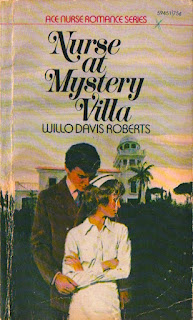
Nurse at Mystery Villa

 By Willo Davis Roberts, ©1967

Upon her arrival as new office nurse in the small California community of El Campo Calor, Chris Royce made a resolution: She would keep Dick out of her mind and heart forever. He’d never meant to hurt her, he’d said, as he told her of the girl he was giving her up for. Now she was ready to turn all her attention to her new boss, attractive young Dr. Candela. But Vic Candela wasn’t free. He was tied to the past by something everyone knew and wouldn’t forget—nor let Vic himself forget. Chris has to find out about it—even if it meant risking the loss of Vic and the new love he’d offered her.

GRADE: B-

BEST QUOTES:
“You’re just another girl. Blonde and pretty, I’ll grant you, but with the usual number of arms and legs and heads. So why do I feel you’re so special?” 

“You’re pretty enough to eat. I’m more interested in marrying you, though.”

“It is not womanly to be so strong-minded.”

REVIEW:
Nurse Christine Royce has been dumped just weeks shy of the altar, and now she’s through with men—she’s going to fill up her life with work. “If she were busy, she wouldn’t have to think about Dick,” she decides, and, oh, what a difference a capital letter makes. 

As it happens, though, she can’t keep her promise to herself, as when she’s lounging on the beach of one of the Great Lakes in Michigan, here comes hunky Dr. Victor Candela and his adorable six-year-old son Mickey. Turns out back in the day Vic had crashed her junior prom and danced with her, even though she’d been 60 pounds heavier in high school, and then he’d gone off to medical school. Meeting her again seven years later, he asks her for a date, and then if she’ll come back to California with him to be his office nurse. She agrees to both, and two weeks later she lands in the Central Valley and takes over the wreck of his practice. Once she catches up, though, the job is not too tough, as he has almost no patients—looking back through the appointments book, she notices that four months ago, after April 2, the previously busy practice had dropped into the toilet. A little snooping in the newspaper section at the library leads her to discover that his wife had died that fateful day, and that he had been suspected of murder but not convicted. So that’s why everyone in town looks at her so askance!

She’s living in the home of Vic’s dead wife’s family, with whom Vic is very close, and little hints drop like acorns on the roof—it quickly unfolds that no one had liked Alice, who was “selfish and cruel and rotten.” She’d attempted to seduce her sister’s fiancé, had little to do with her son, and apparently cheated on Vic. And she’d had multiple car accidents and lost her license, but had driven drunk after that and killed two people; the family had had to mortgage the farm to pay the settlement, a debt they are struggling to emerge from. It’s not until the end of the book, though, that it is suggested that Alice had some form of mental illness, proved by a diary she’d kept that Gramma Sophie will let no one read. “It is filled with hate, with sickness,” Gramma insists. “No one should be allowed to look into the darkness of such a mind.”

The mystery of how Alice died is made more interesting by the fact that if she was murdered, and if Vic was not the murderer—Chris “did not have the slightest doubt of Vic’s innocence,” which is a switch from most murder mystery nurse novels—then it must have been someone else in the family. Vic, who loves the family deeply, is acutely aware of this. “I won’t do anything that could possibly hurt anyone in this house in order to find out” how Alice died, he tells Chris when he finally acknowledges the truth to her—after she’d found it out for herself, unfortunately.

The problem with this particular sub-sub-sub-genre is that they are generally just lame (see, if you must, Matravers Hall, Nurse on Nightmare Island, Nurse Missing)—honestly, a Nancy Drew novel holds more interest and suspense. This is one of the better ones, though, as the heroine is not a stupid loser, and of course she is instrumental in proving Vic’s innocence. The characters are layered and interesting, the writing is moderately good, and the plot has only a few weirdnesses—Chris has a penchant for getting engaged to men after dating them for under two months—and the book even deliberately leaves a few minor questions unanswered, which makes it seem more plausible. The title is unfortunate, because the house in question is not at all mysterious, but that’s a minor sin, and likely one committed by the publisher rather than the author. So if you have a penchant for a pseudo-Gothic murder-mystery nurse romance novel, this could be just the book for you.

Monday, November 22, 2021

Nurse Incognito

By Fay Chandos
(pseud. Irene Mossop Swatridge), ©1964 
Cover illustration by Bern Smith

When a love affair between a nurse and a doctor goes wrong, the unhappiness of the situation is naturally increased if they have to go on working in the same hospital. That was why Caroline was glad to get away from St. Keverne’s … and Brandon … to a temporary job in the lovely Bahamas. It was disconcerting, though, for her to find herself in the middle of a family feud. Her first loyalty was to the old lady who employed her, but she couldn’t help liking and trusting Roland Dayler and sympathizing with his refusal to give up his children; couldn’t help, either, liking (though she didn’t trust) that “wicked” younger brother whose bad reputation was enough to make any woman look twice at him.

GRADE: B+

BEST QUOTES:
“Men are children at heart. Given the opportunity, they all grab at the fairy on the Christmas tree. It’s a wise woman’s job to lead her man firmly in the other direction, not to let him stand under the tree, gawking up at the glitter.” 

“Sparks aren’t a fire, but they can start one.”

“At my age, one rarely cares for advice, however sound.”

“Wouldn’t you like to try your hand at civilizing me?”

“‘Tis better to have loved and lost’ than to be obliged to realize that one has been played for a sucker.”

REVIEW:
Poor Nurse Caroline Whytham has pinned all her hopes on Dr. Brandon Hessare, who has been taking her out for years, and now that she is about to graduate from nursing school, they are going to announce their engagement! Unfortunately, “if she had to look out for herself, she always would be among those stranded at the bus stop. She lacked the assurance and initiative to fight her way on board.” So she misses the first car to the graduation party, which is held at the family mansion of her best friend, Clover Pontock-Pikey, and when she does arrive—could she have been more than 30 minutes behind Clover?—she discovers that Brandon and Clover have, in that narrow window, fallen in love and become engaged. 

The silver lining to her sudden freedom is that Clover’s grandmother decides to take her to the Bahamas with her, ostensibly to serve as her nurse—the battle axe has a heart condition—but also to help Mrs. P-P wrest her great-grandchildren, six-year-old twins Viola and Sebastian, away from their father, Roland Dayler, who owns a large estate. It’s kind of staggering that we’re asked to believe that the claims of a great-grandmother outweigh those of a father, even if he must be a man, but here we are, and we must make the best of it. Roland had been married to Mrs. P-P’s granddaughter Pearl, a beautiful but shallow flirt who had lost interest in her husband almost immediately after marrying him, but who had died in a water-skiing accident—while pregnant, no less, losing the baby as well. An odd detail we’re not quite sure what to do with, but there it is. Clearly the couple weren’t as estranged as all that.

Upon their arrival, sinister things begin to happen! The electricity in both Caroline and Mrs. P-P’s rooms fails, and the candles that are always stocked in the bedrooms vanish! Worse than that, someone lets a kitten loose in Mrs. P-P’s bedroom! Attention turns to the children’s nanny, Annette: “She wants to drive me away from this house. Anyone can see that,” Mrs. P-P concludes after her narrow escape from death. Though there are other possible suspects, including Roland’s brother Ruy (how do you pronounce that?), who with Annette is “allied against me,” Caroline concludes, not wanting to miss getting in on the paranoia.

Further nefarious adventures ensue: Mrs. P-P is drugged into a stupor by the children, who are obeying the orders of a mockingbird outside their window, who sounds like Annette. Caroline falls hard and fast for Roland: At their first meeting, “she was seized by an extraordinary sense of exultation—as though this was the moment she had been waiting for, half her life.” The rub is that she very much resembles Pearl—which is just creepy, though it’s not the first time we’ve encountered this trope. And Ruy, who has been in love with Annette for seven years, she herself chasing Roland, decides to complete the circle by kissing Caroline, who astonishingly decides to go for it without giving a single thought to Roland. “She couldn’t go on mourning over Brandon. That was futile and humiliating. If Ruy was trying to flirt with her, why not let him?” Because, um, Roland?

Here the book becomes part Gothic novel, part mystery, and almost not a nurse novel—as despite the fact that Mrs. P-P seems to be sinking further into a coma, Caroline cannot reveal she’s a nurse, and so leaves Ruy’s secretary Jessamy to babysit the apparently dying woman, and even when the two children also ingest the same poison and the remaining conscious adults “work on” the children all night to bring them around—Caroline, curiously, taking the less dangerously ill child—her occupation remains a secret until the last page.

It’s an odd book, with machinations and suspicions abounding, and the poisoning/attempted murder of four different people, the guilty party still roaming free on the last page, and no discussion of their being taken into custody. Author Irene Swatridge continues her affinity for alliterative names, but also unfortunately displays a tendency toward paragraphs made up entirely of questions: “Had Pearl found him a domestic tyrant? Was that why she had preferred the amenities and social life of Nassau to her home here? Or had she been bored by Roland’s pre-occupation with the estate and its crops? Had she been weighed down by him? Take away his good looks and his old-world courtesy, and what was left? Mightn’t he be singularly heavy and humorless as a husband?” Also I do wish Caroline were less of a wimp. “Roland seeks subconsciously for a gentle, loving wife who will be his complement, and content to be ruled by him. You are such a one, I think,” she is told—and even worse, she answers, “Thank you.” Not surprisingly, her nursing career seems likely as over as the book is on the last page. Still, this book is curiously compelling, as Swatridge’s books have proved to be so far (see Nurse Willow’s Ward and Jubilee Hospital). Also, there are beautiful ball gowns! And a fabulous, snidely witty grande dame in Mrs. P-P! So if it’s not Swatridge’s best, she’s still not done badly by us, her readers, at all. 

Friday, August 13, 2021

The White Jacket

By Kate Norway (pseud. Olive Norton), ©1961
Cover illustration by Paul Ann Soik 

Vivien loved her surgical work with all the enthusiasm of her temperamental nature. She had been attracted to Johnny Dysart by his even temper and sound common sense. But the arrival of a new and disturbingly attractive member of the staff changed both their lives—and indeed the lives of many of the doctors and nurses at Queen’s Hospital.

GRADE: A-

BEST QUOTES:
“Men! she thought angrily. As soon as a woman begins to think for herself they tell her she’s tired. Tired!” 

“Well, if there’s any giving in to be done, I always think it’s best to let the men have the last word, Doctor. They set a lot of store by it. Women know when they’ve won, and they don’t need to have it in black and white the way men do.”

“Nature heals and the doctor only encourages the patient while she does it.”

“Nothing worthwhile ever is simple.”

REVIEW:
It’s interesting to me that when a VNRN has a female doctor protagonist, there is often at least one more woman MD on the staff—but when the book’s heroine is a nurse, almost never do you meet a female doctor. Anyway, here we have Dr. Vivien Bromwich, who is working in an English hospital. From what I can tell she’s finishing her residency, and covers all specialties, though she spends a lot of time in surgery with Dr. Malcolm, her boss and mentor. 

She’s sort of engaged to Johnny Dysart, though it’s not “official,” whatever that means, because “I want to feel a hundred per cent sure,” she tells Johnny. I guess it really means they’re not engaged. Johnny is a cool customer: “It wasn’t easy to tell with Johnny. His comfortable cheerfulness never varied very much. Big and confident, he made her feel safe.” Safe, of course, is not always a promising feature in VNRN men.

The other woman MD in the book, Dr. Rena Todd, is a 36-year-old surgeon in training who is much discussed by the staff. “Too much ambition,” Johnny snorts. “Rena’s determined to be a Great Surgeon—and if she only knew it, she’d probably be a darn sight happier being the Little Woman to some nice chap.” Vivien, to her only partial credit, disagrees, saying, “She’s not a cabbage like me. I don’t want to be a career woman all my life.” Rena, it turns out, has been married and even had a baby, but it had died and her husband had left her. She’s now unable to have children, so she feels “I’m a failure as a woman,” and that’s part of the reason she works so hard at surgery.

On her own career front, Vivien is proving herself in the OR, and Dr. Malcolm asks her to stay on as his registrar, which I think is the British term for fellow. “Wasting your time, working with me, if you’re not going to go on with it,” he points out. When she says she might get married—the horrible inference being that she’ll quit working—he answers, “Any fool can keep house. But you can do surgery.” I love Dr. Malcolm. Discussing the invitation with Johnny, he refuses to even recognize the compliment, much less consider the offer. “I’m a man, and I have to think about having a career and providing for a family. You don’t,” he tells her. “Why can’t he let me glow, just for once?” she wonders.

In her personal life, while she’s waiting to feel 100 percent certain of Johnny—good luck with that—Vivien meets Edward Featherstone, who is working as an OR porter. “Emboldened by the perfect fit of their interlocking glances,” she starts snatching kisses with him in the autoclave room, and her secret smooching leads her to think she shouldn’t marry Johnny. But then she and Johnny are in a car crash, while he’s driving their friend Dr. Dick Clements’ car, and Johnny is badly hurt, requiring the amputation of several fingers. Now surgery as a specialty is out for him—and we’re panicking, thinking she’ll marry him out of pity, but he breaks up with her from his hospital bed. “Now I begin to live my life the way I want to live it,” she thinks, and the freedom in that sentence truly made my heart lift up.

Unfortunately, the insurance won’t pay for Dick’s car, and the book takes a turn into a mystery story. Vivien borrows $200 from Edward Featherstone and gives it to Dick for his car, but then Edward comes to Vivien in a panic and says he needs the money back immediately, as he’s leaving the area in a highly suspicious hurry! Then avuncular Dr. Malcolm is assaulted and dies of a head wound, and Edward has disappeared, and a patient has been robbed of $200, bills he had fortuitously marked in advance. Edward calls Vivien and tells her to leave the $200 in a telephone booth, and then she learns that he is wanted by the police for murdering Dr. Malcolm. While trying to decide what to do, she confides in Dick Clements, who is increasingly but gently making it clear that he has feelings for Vivien. He sends her to the hospital archives, where she learns that Edward was once signing hospital notes as Edward Featherstone Catlow MD, and that he had lost his privileges at the hospital for stealing drugs.

She and Dick go to the police, who are supposed to surveil the telephone booth after Vivien drops off a fake envelope, but they seem to have gone for doughnuts at the crucial moment because one of the OR nurses is discovered knocked out in the telephone booth and the envelope is gone. Vivien and Dick then head for the coffee shop, but it turns out that the bill Vivien uses to pay the tab is one of the stolen bills! Dick stands by her as she’s questioned by the police—who now think she was the one who knocked out the nurse. “If you’re in it, Viv, I have to be in it too, until it works out,” Dick tells her. “I’m with you.” He’s the kind of person who sees she’s troubled and pulls her aside for a talk. “His quiet strength was unbearably moving to her, the more so for its silence. He put an arm across her shoulder and waited. It was clear that he was prepared to wait all night, if necessary, for her to confide in him.” Well, I was won over!

The mystery is wrapped up, not in the way I’d imagined, but it does turn out that Vivien is innocent after all! This book is a little above the usual, with a mystery that actually is one in some places, solid writing, fine characters, and luscious ball gowns. If we are subjected to the usual sexism that the heroine doesn’t work especially hard to shrug off, she doesn’t completely accept it, either, and lives her life in an honest, forthright way—with a little help from her friends. Olive Norton, here writing as Kate Norway, is quickly becoming a trusted source for an enjoyable, pleasant read, and I am happy to have found her, and this charming book.

Monday, July 12, 2021

The Strange Quest of Nurse Anne

By Mary Burchell
(pseud. Ida Cook), ©1964
Cover illustration by Paul Anna Soik 

To Anne Weston, brought up in an orphanage, the sudden discovery of her American cousins was as astounding as it was wonderful, and when they invited her to stay with them in their Maryland home her cup of happiness was full. But as her visit went on, Anne found herself becoming filled with suspicion—and unease…

GRADE: A-

BEST QUOTES:
“Rumor flourishes more luxuriantly in hospital ground than in any other known soil.”

“Surgeons are the biggest menace in creation to susceptible girls.”

“Only dull dogs are universally loved.”

“It has changed a good deal, New York, in the years I’ve known it, and certainly not always for the better. But there’s something about it, there’s something about it. There’s champagne in the air and adventure just around the corner.”

“If anything is obscure or dreary it’s sure of excellent reviews.”

“There’s no great virtue in refraining from doing something that’s no temptation.”

REVIEW:
What could have been a truly superlative book is slightly dampened by the old trope of a VNRN heroine who is dumber than a beetle, as my grandmother would have said. Time and time again, faced with the obvious, Anne Weston, who had the brains to get through nursing school and emerge a very talented nurse, is unable to recognize it. The interesting thing here is that her character in some ways makes this stupidity feasible: Raised in an orphanage without any knowledge about her parents, Anne has had no support or family to fall back on, and has made her own way in the world, which was essentially to take a path straight from the orphanage to the hospital nursing school, where she has lived for the past three years—from one sheltered environment to another, with little exposure to the world. The unfortunate part is that author Mary Burchell has not been able to prevent us from feeling anything other than contempt for Anne’s stupidity. Though her talent as a writer is clearly evident, I wish Ms. Burchell had tried a little harder to sell us on Anne’s blind spots and make us believe her decisions a little better.

As the book opens, Anne is about to bid farewell forever to the hospital and surgeon Philip Coram, on whom she’s had a slight crush, but of course, “he could hardly have been more impersonal and was sometimes cruelly critical.” But on her way out the door, he stops her and tells her she’s one of the best nurses he’s known, asks her what her plans are—and, curiously, what her name is—and when she says she’s going into private nursing, he says he’ll ask for her for his patients.

He calls her for the job of wrestling wealthy and self-centered widowed dowager Mrs. van Elten across the ocean to New York, and it’s worth reading this book just to meet Mrs. van Elten. She’s a salty, outspoken, smart, hilarious, manipulative, and kindly grande dame, and she is Fabulous! Then, just as she’s to leave for the trip, Anne receives a letter from a long-lost cousin, Paula Weston, who has somehow tracked her down, following up the efforts of Anne’s father Donald, who had moved to Australia and died a year ago without ever locating Anne. Paula and her brother Glen live in Maryland and are eager to meet their new cousin, who now will be not as far from them when she finishes her job with Mrs. van Elten. But Anne’s best friend Karen, who “had what she called hunches,” is uneasy about the whole thing, and Anne herself catches a “deep and ominous chill” as the boat pulls out of the Southampton harbor en route for the New World. She’s warmed to the core a few minutes later, though, when she learns that Dr. Coram is sailing on the same boat, bound for medical conferences in New York!

Needless to say, Mrs. van Elton instantly divines Anne’s interest in Dr. Coram, and starts to work on the pair. “I find people intensely interesting,” she tells Anne. “My daughter says I can’t mind my own business about them. But I like to advise and praise and criticize. Particularly to criticize.” Though Mrs. van Elton warns Anne that Dr. Coram is engaged, she still schools Anne on what color dress to wear and insists that Anne stay at the dances after she herself has turned in, the better to dance with the doctor. Anne’s relationship with Dr. Coram grows organically, and soon they’re on the Lido Deck under the stars, but Anne remembers the fiancée at home and becomes chilly just when things start to heat up. After they land in New York, Dr. Coram goes way beyond the call of duty to drive Anne the five hours from New York to her cousins’ house, which is a decaying former country estate; as it turns out, the cousins’ father had gambled away most of the family fortune and they are barely able to keep the place.

Cousin Glen is a smarmy sort of fellow, and his “almost beautiful smile never touched his handsome eyes, which remained hard and curiously inscrutable.” He’s instantly all over Anne, insisting that she marry him, and tells her that Dr. Coram, who had grown up in the area, had “played fast and loose with one or two girls in Washington, it seems, and he got quite a bad name in a set where it takes really something to make people talk.” This runs completely counter to everything Anne knows about Dr. Coram, but she starts to feel less about him, the dope, when it’s completely clear what’s Glen is really up to. There are many other obvious warnings about the cousins’ ulterior motives: A letter written by Anne’s father has been “accidentally” destroyed, and—curse the postal system!—so has another letter sent to her in care of her cousins from a Sydney attorney who, Karen says, is looking for Anne to give her good news about her father’s estate. Then Anne meets the old, slightly senile man who had been a groom on the estate for 50 years, who tells her that her father was rich and that the cousins are trying to get her money. Does the penny drop? No!

When Dr. Coram arrives to bring her back to New York two days later, Anne is completely rude to him, all but slamming the door in his face, and thanks for the ride, bub. The author suggests that Anne is so enthralled with the idea of having a family at last—“it gives one a sort of confidence and security to find a place and a family where one belongs,” she tells Dr. Coram—and Anne genuinely likes Paula, who deserves it, and Glen, who does not—which sets her up to believe what is an obvious ploy to get Dr. Coram out of the picture. And then she’s deeply flattered to be the object of affection for the first time in her life: “It was so utterly wonderful to feel that someone—perhaps, above all, her big, handsome warm-hearted cousin—thought her all-important.” So it is possible, given Anne’s background, that she could be this stupid—but it’s not well-sold to the readers, who can’t help wanting to give Anne a hard shake.

But then Mrs. van Elten drops a bomb—the fiancée is just a myth she’d created to keep Anne from running after Dr. Coram, thinking that “if he were made to do the running, you were just the right girl for him,” as she explains. Fortunately, Anne has the strength of character to call up the abused doctor and apologize profusely, and the pair are restored to friendly terms. But then Mrs. van Elten goes to Florida, freeing Anne to go back to her cousins’ house, and there our suspicions of them pile up—until finally even Anne can’t deny that something terrible is afoot, and when she sneaks out of the house to visit the old retired groom again, he suggests that the cousins might kill her for the money! Finally coming to her senses, she puts on a happy face, makes a frantic call to Dr. Coram to come get her tomorrow, and goes to her bedroom to lock herself in, but the key to her bedroom door has been taken! She stuffs her money in her dress, jumps out the bathroom window, and runs away—but Glen is coming after her in the car! Oh, no!! What will happen next?!?

Overall, this is a lovely book, with a truly outstanding character in Mrs. van Elten (she reminded me of Lady Travitt in Nurse Stacey Comes Aboard, though that book does not come close to this one) and a relationship between the lovers that grows honestly. Its biggest flaw is the fact that Anne is such a dunce about people, and the tragedy is that I think that an author who has given us a book this good could, with a bit more effort, have made Anne’s gullibility more understandable, so we might have wanted to smack Anne upside the head fewer than the two dozen times I did—especially at the end, when she makes a bizarre decision about the money she’s inherited. The title and the cover illustration are both more than a little perplexing, but we can’t pin those sins on Ida Cook, here writing as Mary Burchell, who likely had nothing to do with either. But overlook the strange envelope, and you will enjoy what you find inside it, if your evil cousins don’t destroy it first.

Friday, February 26, 2021

Matravers Hall

By Elizabeth Kellier, ©1962
Also published as The Return of Nurse Maine

Julia Maine was shocked to learn of the sudden death of Gaiety Harrington, her old school friend. Happily married to Nicholas Harrington, Gaiety had never seemed the suicidal type. Now, forced to pay a condolence visit to the family at Matravers Hall, Julia was plunged into an atmosphere of fear and suspicion. Apprehensive in the gloom of the great cliffside house, Julia was disturbed by the silence with which Nicholas treated his wife’s death—and by her own awakening interest in him. As the days of her visit lengthened, Julia determined to seek out the malevolent force that had destroyed the young bridefearfully aware, that she, too, might be its victim.

GRADE: C-

BEST QUOTES:
“A person intent on murder has to take some risks.” 

REVIEW:
The original title of this book is The Return of Nurse Maine, which gave me hopes that we had here an example of a sub-sub-genre, namely the nurse gothic romance novel. Heroine Julia Maine is indeed a nurse, but alas spends no time working as an actual nurse in this book, so it may not even count as even a simple nurse novel. But since I was duped into reading it, let this review serve as a warning to others who might possibly follow. 

We immediately learn that Julia had once been in love with Nicholas Harrington and that he had proposed to her, but Julia’s mother was an invalid requiring her full-time attention, and she felt that “it would not be fair to hand such a burden on to any man.” So she had turned him down without revealing her motivation, and when her mother had died less than a year later, she ate her heart out. This loss was made apparently irrevocable by the fact that her school acquaintance Gaiety had swooped in as Julia was stepping out and snagged the eligible bachelor for herself, despite the fact that the pair were obviously ill-matched.

Now, when her Christmas card was answered with a note from Nicholas saying that Gaiety had tossed herself off a wind-swept cliff 18 months ago, Julia feels obliged to make a condolence visit. Curiously, her stay stretches out for weeks before she starts to consider heading home. In the interim, however, she thinks a lot about how all the people in the house might have done away with Gaiety, because exactly no one thinks Gaiety actually committed suicide. Gaiety is increasingly revealed as an unpleasant, unstable character who had moved out of her husband’s bedroom and was increasingly “nervous about something,” according to one of nearly fifty people Julia interviews regarding Gaiety’s death.

The list of suspects, however, is quite thin. Meet Nicholas’s sister Marjorie, unmarried at 38, “tall and muscular with a strong face and high forehead,” who has a close female friend “of the same type,” Miss Gladys Newson. Much is made of Marjorie’s lack of fortune and her disappointment in not being able to go with Miss Newson on that woman’s upcoming trip around the world. We also learn that Marjorie’s mother, essentially an invalid at the geriatric age of 59, has left everything to Marjorie in her will. To demonstrate her appreciation, Marjorie is always forcing her mother to stay in bed all day as well as unspecified tonics (sans gin, unfortunately) down her throat multiple times a day. The surprising detail is that nurse Julia demonstrates not one iota of interest in what the medication is or what Mrs. Harrington’s diagnosis might be.

What with interviewing Mrs. Harrington, the gardener, the cook, and the neighbors, three weeks fly by before Julia suggests she should be going, but Nicholas, who is becoming increasingly friendly, begs her to stay longer. “It was hopeless to deny that each time they went out together some further quickening of emotion took place. The hours passed like minutes.” When finally he sweeps her into his arms and covers her face with passionate kisses, she insists that he tell her his own story about what happened to Gaiety, because as a detective, this woman misses no opportunity—even if the obvious conclusion staring her down eludes her. Nicholas reveals that he had come across a letter to a lover Gaiety had written just ten weeks before her death, and his bizarre and completely unsupported conclusion is that the boyfriend had dumped her and she had killed herself in despair. Julia then interrogates neighbor Tony Grant, a suave fellow who drives a sports car and wears a scarf in the open neck of his white shirt, and the cad too easily admits that he had been seeing Gaiety, but that she had broken up with him due to Nicholas’s increasing jealousy. Julia, as stupid as she is inquisitive, turns to an obviously false suspicion: “All that her probing and her search for truth seemed to have done was to lead her round in a circle—so that she still came back to Nicholas.” It doesn’t cross her mind to wonder why Marjorie is pacing the ground atop the fatal cliff with her eyes glued to the ground, or why the manly spinster looks so afraid when it comes out that Julia has been riffling through Gaiety’s diary.

Mother Harrington has a “giddy attack,” and it turns out that she was diagnosed a year ago with leukemia, but Marjorie has decided to withhold this information from Nicholas and even Mother herself. Nicholas uses this news to suggested that he and Julia get married right away, so as to make his mother “as happy as possible.” Julia, “almost convinced” that Nicholas had nothing to do with Gaiety’s death, agrees, because why not marry a man you can’t exonerate from a murder? Mother is delighted, but when the pair tell Marjorie their happy news, “it was as if a cold wind had blown across the room.” What could it mean? Marjorie keeps harping on Mother’s upcoming sixtieth birthday, and the next day pulls Julia aside and insists that she postpone the wedding. Julia refuses, Marjorie is furious—and “something tangible seemed to be moving through the silence, something frightening and odious—like bat’s wing brushing against her cheek.” I’ll wait while you finish snickering.

When Nicholas decides to go to London on a business trip, Julia naturally decides to stay at Matravers and work on her trousseau, because the shopping opportunities in London are not that great. First, though, she’s got to take the dog for a walk, and heads for Gaiety’s jumping-off point. She finds a broken charm bracelet that had belonged to Gaiety, and suddenly she remembers Marjorie’s peculiar stroll along that same path. Finally the penny drops!! It must be Marjorie who killed Gaiety!! And now she probably wants to kill Julia!! As do most readers!!!! So when Marjorie suggests that Julia go out to the shed to collect the dog, Julia obligingly trots out, and is mysteriously locked in the shed just as she discovers it is on fire! She is rescued at the last minute, of course, and though she is convinced that she was set up by Marjorie, “it would be cruel” to tell Nicholas that his sister tried to murder her and also probably murdered his first wife.

There’s no point in laying out how it all turns out, because the reader has been fairly confident of where the trail is leading all along. The plot—and Julia—can be particularly stupid at times, as Julia leaps back and forth between defending Nicholas’s innocence one minute and being convinced of his guilt another, of today insisting Gaiety was in fact a victim of suicide but the next day it’s murder. Enormous power is invested in tiny items: Gaiety’s broken bracelet, for one, and in another instance, it is suggested that Marjorie had erased an exclamation point from Gaiety’s diary that somehow all by itself revealed everything about the murder plot, when Marjorie could have just tossed the entire diary in the fireplace. The relationship between Julia and Nicholas is wooden and completely unconvincing, barely even existing in the book. Last but not least of the book’s sins that I will mention here, I did wonder if the author intended for us to suspect that Marjorie is a lesbian. I must confess that I have not read any other Gothic novels, so I cannot say if the prose here is typical, but in Matravers Hall it is quite florid: “A flush, no deeper than the delicate pink of her house coat, slipped into the curve of Julia’s cheek,” and that’s just the second page. Mercifully, author Elizabeth Kellier soon forgets to keep up the purple standard, and drops into more normal way of talking. Not least, of course, I was peeved that I was fooled into thinking this was a nurse novel. So consider yourself warned, friends, and stay out of Matravers Hall.