Showing posts with label suicide. Show all posts

Sunday, March 22, 2026

A Nurse Involved

By Peggy O’More, ©1968 
Also published as Stand By Nurse

The staff of City Core Hospital was faced daily with the problem of saving the lives of would-be suicides and of trying again and again. Nurse Iva Loring had an inner drive that had taken her through school and training at top speed. She gave too much, too rapidly, to her work and was on the verge of a nervous collapse when she took time off to regain her perspective on life. Now she was easing herself back into work as a stand-by nurse. Her special empathy for the depressed and discouraged made her an ideal nurse for the suicide detail. But there was a question of whether or not she was too understanding and too involved to be effective. Iva, herself, had to examine her values and choose between the career to which she was dedicated and marriage to the devoted young hospital pharmacist who had stood by her without making any demands on her emotions. Could Iva make that choice?

GRADE: D+

BEST QUOTES:
“It is easier to forgive a thousand others than one’s own self.” 

REVIEW:
The silver lining of the dark cloud that is this particular Peggy O
’More Blocklinger book—an author who is easily one of the worst—is that it’s the last of her books on my shelves that I hadn’t read. There may be more out there in the world, but I am not planning on looking for them any time soon. 

In this book we have Nurse Iva Luanne Loring, who is given a middle name probably so that the author can engage in her penchant of making everyone’s names alliterate—Woodson Wortman, Henry Hanson, Mark Mansfield and at least four more populate these pages. Iva works at City Core Hospital in California, a medical center that seems to treat only suicide victims—we meet at least six—as well as victims of major car crashes and brutal assaults, including what may be a first in my VNRN reading, a rape (the victim is advised to change her name, join a mission service and move overseas). Iva herself is recovering from a nervous breakdown brought on by overwork, requiring that she spend six weeks on the beach—can I get one of those?—so she’s only supposed to be working part-time, though she does seem to work most days anyway. Her own psychological frailty makes her particularly hip to pop psychology and management of the crazier patients, as in typical clunky Bowman phrasing, “trying to adapt emotional feet to shoes of a contour different from those feet.”

Iva’s main problem is that she is engaged to Woody Wortman, a “druggist” at the hospital, who she hardly ever sees and never thinks of with any fondness or even, it must be confessed, at all. “With her, the goal was marriage to Woody, creating a home for him,” she believes, stating,  “Where home is the principal consideration I must forget myself and think of Woody, think of a place for him to come home to,” and doesn’t that sound like a fun life? Woody conveniently shakes her up a bit when he announces that he has purchased a drug store some distance away and plans to install his mother and aunt in one of the apartments on the second floor—a plan that the anal-retentive Woody had not mentioned until it was done. At least Iva has the sense to realize that this is not good: “He must have studied and planned this move for a long time. He would have scanned its possibilities from every angle. Yet not one word had he breathed to her!”

So while Woody is now miles away building up his new business, Iva calls a hiatus to their engagement. Fortunately she has Dr. Ben Dorsey to act as her chauffeur and luncheon companion—though she certainly does not hint at any feelings toward the man any more than she had toward Woody, and Ben himself is one of those who “has an allergy to nurses. Meaning he’s not married, and if and when has no idea of succumbing to the wiles of a white cap.” So it is shocking in a number of ways when he slips a ring on her finger as they are treating yet another suicide attempt in the Emergency Department, the romantic fool!

Here, as in most Peggy O’More Blocklinger books, we are regularly lectured with her patented psychobabble, as in, “If, as some scientists were insisting, thought was a volatile force, what a variety of poisons could be filling the air.” Yet Iva’s own psychological problems—her relentless drive to overwork—are solved on a single introspective afternoon drive in the country, and a page later she has returned whole, with the plan to go back to school to get a PhD in psychiatry. We also get the author’s tendency to use single words as sentences meant to convey pages of meaning, usually indecipherable to us—“‘Cat,’ murmured Iva, and Woodson looked at her, shocked.” Blocklinger’s prose is stilted and clunky, as in, “Food accepted and ingested,” and, “Iva believed bed was indicated.” There’s none of the hilarious stupidity as one would find with Arlene Fitzgerald’s best; this book is just plain stupid—another Peggy O’More Blocklinger novel to avoid. And please, don’t send me any more!

Friday, June 14, 2024

The Midnight Wards

By D.K. Jennings (pseud. John Glasby), ©1967
Cover illustration by Henry Fox

Throughout the world, large hospitals are much the same; exuding an aura of medicinal efficiency, men and women who supervise the lives of their patients, overseeing a hubbub of intense activity that goes on around the clock. At the old and elegant St. Stephen Hospital on the outskirts of London, it had been a fortnight of the usual minor incidents, common in such a complex of wards and isolated departments. To Veronica Devlin, just beginning her hospital work as a nurse, everything seemed much larger than life. The doctors, surgeons and ward sisters were either gods or ogres and her small mistakes were great tragedies. Then the resident surgeon, Ralph Conway, found himself facing a crisis which threatened not only his career but the whole future of the hospital, a crisis which meant he had to challenge the authority of Sir William Carruthers, the senior surgical consultant, and attempt to uproot policies and ideas which were as old and as established as the hospital itself and somehow, Veronica found herself drawn, against her will, into this personal conflict of ideologies.

GRADE: C+

BEST QUOTES:
“Someone ought to pass a law against night duty.”

“You have the makings of a fine nurse, provided you learn to keep your own emotions under tight rein and do only as you are told.”

“It seems that fate has decreed that all of the emergency cases happen between midnight and 6:00 in the morning.”

“That is the main trouble with some of the younger men who come along, wanting to become surgeons. They see themselves in white coats, walking through the wards, adored by the female patients and idolized by the young interns. But it isn’t all like that. After a while, you find that each operation takes a great deal out of you. Not until it’s over do you realize just how much.”

REVIEW:
First off, I have to tell you that this is not a nurse novel. Our nurse, Veronica Devlin, is a peripheral figure, and the story centers on Dr. Ralph Conway, hero young surgeon battling the dinosaur senior doctor who is gradually choking the life out of the prestigious hospital he runs with an iron grip. Frankly, Veronica is robbed of the credit she deserves in curing the patient central to the story, so I wondered if author D.K. Jennings was a man. Guess what—I was right!

In the first chapter a man is struck by a car and brought to the hospital, but he is suffering from amnesia—which came on before the car accident. Naturally, he is not carrying any identification. On duty in the ED are Veronica and Ralph Conway, who further clinches this book’s status as not-a-nurse-novel because he is married! Since Mr. X’s leg is broken in two places, he is likely to be stuck in the hospital for months. “In a way, it is a good thing. It may enable us to do a little detective work and try to find out who he is,” Ralph tells Veronica. 

Another patient, Sylvia Monaghan, has been admitted as a suicide attempt after taking too many sleeping tablets in the middle of the night. Ralph is convinced that she is “not the suicidal type.” But Dr. William Carruthers, the aging medico who runs St. Stephen Hospital, is convinced Sylvia is a danger to herself—not only that, but if she is not transferred to a psychiatric ward and is left on the general ward, “she could prove not only an embarrassment, but possibly a menace to the other patients,” he declares dramatically. But Ralph convinces Dr. Carruthers to leave Sylvia where she is, at least temporarily.

Meanwhile Veronica is put on night duty watching Mr. X. He is mumbling in his sleep, of course, and “she thought she caught the name Clarke repeated several times.” Ralph, going above and beyond the call of duty of a surgeon, checks with the police and finds that a jeweler named Vincent Clarke was beaten during a robbery the same night that Mr. X came in, and though the assailants were masked and Mr. Clarke has no way of identifying them, “one of them could have been our mystery patient here,” says Ralph to Veronica. So she hits the streets and starts knocking on doors, and finds an old woman who saw Mr. X walk out of an alley—and at the other end of the alley is Vincent Clarke’s jewelry shop! Back at the hospital she reluctantly reports her findings to Ralph, though she nonetheless argues that Mr. X could be innocent. Ralph wonders, “Had she fallen in love with that man?” But he does encourage her to “stick with your convictions, Veronica. I for one would not want to change them.” So he is due a little credit.

Then Veronica obtains permission from Ralph to take Mr. X out of the hospital in a wheelchair, though she does not mention her plans to bring Mr. X to the first place he remembers. Though nothing comes back to him, Mr. X directs Veronica to push him down the infamous alley, so they end up in front of Mr. Clarke’s now-boarded-up shop. He suddenly remembers being in the trashed jeweler’s shop and seeing Mr. Clarke lying inert over the counter—and the shock is too much for him and he passes out. Now Ralph is in hot water: “All of this publicity is having a bad effect on the reputation of the hospital. Some of the things he does are little too radical from my way of thinking,” says the hospital matron, though these “radical methods” are not really explained. Ralph is called on the carpet by Dr. Carruthers, and when Ralph defends Veronica, Dr. Carruthers bizarrely threatens not to give Ralph the top hospital job when he retires next year.

Undeterred, Ralph stops by Mr. X’s room, and Mr. X tells Ralph that he has remembered the names John Forrester and Redbourne. Ralph recognizes Redbourne as the name of a small village 30 miles from London, so the next day he and Veronica head there for another illicit detective trip. This book occurs so long ago that their only option is to stop in at a pub and ask if anyone knows John Forrester, and as it happens his parents live across the street! In no time flat Mr. X’s identity and backstory are laid out. “Another shock might prove sufficient to send the mind toppling over the brink of the abyss that led to insanity,” Ralph thinks, so he invites Mr. X’s mum to come back to London with them, goes straight to Mr. X and in five sentences explains all. Fortunately the shock does not prove sufficient to send Mr. X's mind toppling over the brink of the abyss; instead he remembers everything and is reunited with his mum and Veronica, so next Ralph goes to visit Sylvia Monaghan and puts to right all her psychiatric problems. Then he pops by Dr. Carruthers’ office for another enlightening chat and finally goes home to his wife, whom he is seeing for about the third time this whole book. Has anyone ever mentioned that it is really rough being a doctor’s wife? Though Ralph does try to give Veronica a little credit for Mr. X’s recovery, his wife is insistent that it is all due to him, so he smiles and leans back in his chair. I hope he doesn’t hurt himself patting his own back.

Throughout the book we do spend occasional pages with Veronica, following her concerns about Mr. X and watching the pair fall in love, though the uncertainty of his identity and past activities makes their relationship somewhat tenuous—even if we have a pretty good idea how it will turn out. But we don’t see enough of her to make this book worth reading, if it’s a true nurse novel you are looking for. It’s not a bad book in general, but without a strong, independent, female heroine to spend your time with, I’m not sure what the benefit is in reading it. But I am a little biased in that respect. Try it for yourself, if you don’t mind a rather hackneyed plot and a slightly arrogant, self-centered main (male) character, and see what you think.

Thursday, July 20, 2023

Seacliff Nurse

By Peggy O’More Blocklinger, ©1966 

What happens when a nurse is caught between true love for a noble doctor and loyalty to her own father? In Cherry Caldwell’s case, the question was doubly complicated. For Cherry’s father was a doctor, too, but a much more old-fashioned man than her beloved Dr. Robert Carter. The elder Caldwell scoffed at Carter’s Seacliff Sanitarium, where Cherry worked, as a “fantasy factory.” The situation was explosive—and Cherry could no longer postpone her decision. Which doctor would she support, and what would become of her heart?

GRADE: C-

BEST QUOTES:
“I wonder why studios bother with horror films when all one needs to do is turn to a news telecast. Right now, not in some distant country, but here, one sees potential terror.” 

“When has intelligence ever had anything to do with love and marriage?”

REVIEW:
My god, you people have no idea how this job makes me suffer. Peggy O’More Blocklinger is really one of the worst VNRN authors—not even redeemed by plot twists or turns of phrase so absurd they’re hilarious, as with Arlene Fitzgerald or Zillah MacDonald. And yet slog through her (gut-droppingly voluminous) oeuvre I must, for the greater good of the VNRN universe, making it a safer place for all, and all while trying to keep my cape from getting caught in the door.

Have you forgotten how Blocklinger loves alliterative names? Well, this book will remind you, starting with heroine Cherry Caldwell, who is a nurse at Seacliff Sanitarium, which treats—and the book really uses the phrase—psychosomatic illness. She lives with her father, Dr. Carl Caldwell, who thinks the whole business is daffy (he doesn’t know the half of it), and works on the cases of Melanie Mason, who had attempted suicide after her son was killed in Vietnam, as well as the entire Dunbar clan—father Dwight and his three sons, David, Dewey, and Dan. She works on Mrs. Dunbar, too, who is a repressed type—so repressed she doesn’t even have a first name—able to only express herself through Machiavellian manipulations. There’s also a faded Gloria Swanson type who talks endlessly about her glorious career in silent films, a woman who forced her parents to buy a car which they promptly crashed, killing them, and a 55-year-old businesswoman who had lost her job in a merger and now is “too old to start again, unable to find work of any kind.” We are told that “each had a compensating illness or physical defect. How could Seacliff show them their conditions were due to indelibly drawn thought habits which affected them physically?”

Well, Cherry gets the talker to write a book—she can’t talk when she’s writing is the actual joke—and then schemes to get the woman to watch one of her own decades-old films, convinced without evidence that the woman was a terrible actress, and that upon seeing herself on the screen the woman will be cured of her egotism. She gets the businesswoman to type up the book, because typing will be so satisfying to her! And also connects the businesswoman with another patient who has been browbeaten by his mother into making terrible business decisions that sacrificed long-term success for short-term financial gain, and now the company has been driven to the brink of bankruptcy and the man to suicidal ideation. (The successful businesswoman manages to find a solution to the unsuccessful businessman’s problem; do you think she’ll be rewarded with a cut of the deal, or just a secretarial position?) In the end, Cherry has cured pretty much everyone—including more than one woman by finding them a boyfriend, because “all of the phobias and doubts of the past were erased by the arms” of a man–but mostly because “I used a verbal scalpel on their subconscious minds.”

The psychobabble is thick and inescapable. On pretty much every page we are lectured on the link between body and mind with admonishments such as, “To touch with any force this extremely sensitive spot in memory would induce another layer of protective obliteration,” and “He who argues the loudest is he whose subconscious is refuting the conscious,” and “the inner man might consider itself starving but would promptly refuse to eat while involved in an emotional scene, for self-sustaining food could be poisoned by physical reaction.” Of course, mental health is essential to well-being, but this book suggests that the most severe mental illness can be cured with a swig of Cherry’s psychological Pepto-Bismol. And one wonders why the Sanitarium bothers hiring Dr. Bob Carter at all, since he seems to have little to do with anyone’s recovery.

Cherry’s own inclination for romance is, at the outset of the book, crippled by the fact that when she was in nursing school a man whom she didn’t love left her when she refused to marry him and move across the country, and this “left a crack in her psyche, a wound that would not heal,” though this emotional devastation, if impossible to understand, is quickly dropped without further ado halfway through the book, and she ultimately winds up with a man she has paid little attention to up until the final pages. Unless you have an indelible psychic lesion that manifests physically by forcing you to read irritating books, you should skip Seacliff Nurse—but perhaps I myself should make an appointment to discuss my suppressed neuroses.

Sunday, October 30, 2022

That Nice Nurse Nevin

By Jan Tempest, ©1963

Eight years ago Eunice Nevin had been rich and carefree. Now, her father dead in her money gone, she was a hard-working nurse. Her old home had become the hospital where she was now to work. With the love she had found for her new life be strong enough to overcome her nostalgia for the old?

GRADE: B+

BEST QUOTES:
“To be a successful beauty and heartbreaker, one has to have a certain mentality. One has to care passionately for admiration and for pleasing people. I don’t. I have to say what I think, and that doesn’t endear a girl to men.” 

“If money doesn’t talk, what’s the use of it?”

REVIEW:
Eunice Nevin is the sort of heroine it’s not hard to like. She’d been orphaned at 18 after an upper-class upbringing when her father was financially ruined making some risky investments and dropped dead from the shock. The icing on her tragic cake came when she’d been dumped by her handsome cad of a boyfriend, Eamonn Crail, so she’d moved to London and gone to nursing school. Now at 25 she has returned to her hometown and a hospital that has been established at her former home, so large and expansive were the house and grounds.

Eunice is soon drawn into the upper-crust circle of the Yaxley family, headed by social-climbing, scheming mother Shuna. Martin is the oldest child, and everyone seems to believe that Eunice is going to be the one who drags Martin to the altar, but she finds him to be a wishy-washy milquetoast who can’t stand up to his domineering mother. The younger twin girls, Tilly and Thyme, are fans of Eunice’s, as they had grown up watching her ride horses in competition—and usually win. Thyme has some sort of kidney disease and needs a transplant, while Tilly needs a transplant of her own—a spine, as she wants to pursue a career in music while her mother wants her to pursue wealthy men with royal titles, and mom is winning the battle. But behind mom’s back, Tilly has taken up with Eamonn—though he is actually in love with Thyme, who had turned him down because he is poor.

At the hospital, Eunice spars with 40-year-old urological surgeon Jupiter Janine, and it’s not hard to see where that’s headed. He appreciates her outspokenness, and kids her about the fact that she’s “known as ‘that Nice Nurse Nevin.’ Such a singularly inappropriate adjective for a personality as spicy as yours.” It’s admirable that she is such a feisty gal, but I continue to be perplexed and unsettled by the large number of Harlequin nurse novels that give the heroine away to a man more than ten years her senior—fifteen in this case.

The book is made more unique by its heavy concentration on riding, and we attend quite a few shows, ride frequently through the countryside, and admire numerous horses. As for our lead character, Eunice is also more unusual, a strong, outspoken woman, and only once declares, “it would be a real wrench to give up nursing,” but in the end plans to keep at it until she has children. The book has a good-sized cast of interesting characters (though Eunice’s girlhood best friend turns out to be a nasty, selfish witch, and it’s not at all clear why Eunice continues to interact with her), and overall the book has more than most VNRNs to make it worth reading. The writing isn’t witty or remarkable enough to push it into an A grade, but there is more than enough here to make for a nice read.

Tuesday, March 22, 2022

Princess of White Starch

By Katherine McComb, ©1963 

Nurse Flower Palmer was young, lovely, and in love. Jimmy Scott, her fiancé, was the Prince Charming of any girl’s dream—handsome, fabulously wealthy, and very much in love with her. But there were others who were determined to do something about it. Two women in the Scott mansion hated the young nurse. And there also was the dark-haired, moody, unpredictable young doctor at the hospital, whose anger and contempt and sudden passion had shaken and frightened her. When tragedy struck, all of them pointed accusing fingers at Flower.

GRADE: C+

BEST QUOTES:
“You don’t think much of women anyway, though I suppose your mother was one.” 

“Who did he think he was, anyway, one of the Kennedy boys?”

“If you weren’t my best friend I’d inject air into your veins, or something.”

“All laymen think doctors and nurses have it easy, and go into shock when they get a bill for saving their lives.”

“Are you a native angel?”

REVIEW:
How awkward to have a literal flower child for a heroine. Nurse Flower Palmer, who has been at LA County Hospital since she graduated from nursing school month ago, is “no bigger than a bar of soap after a big wash,” 5 foot 2 and 110 pounds, and “just because she was small and looked sixteen instead of twenty-three nobody ever seemed to take her seriously.” Take, for starters, Dr. Lester Dean. “I was just wondering why they sent a grammar-school babysitter to take Miss Reynold’s place,” he tells her when she shows up to work the emergency department. But he is just a cynical old meanie who wishes the suicide attempt had been successful because the patient will “try it again the next time she starts feeling sorry for herself. And she’ll probably keep on until she succeeds.” He also tells a woman whose throat is slashed her husband, “It’s the inside scars that can never been healed.” Super helpful! Even better, before the shift is halfway through, he grabs her and kisses her, “hard, bruising, demanding.” She is outraged, so much so that when he asks her out to dinner she “almost said yes before she thought. Then she remembered his rudeness and shook her head.” That’ll show him! Of course, we know how this is going to go: “She had never met such an arrogant, pick-headed person, and just when she might have started liking him.” Which she will, after a lot of sparring. 

This book, like many other VNRNs, includes a natural disaster, but here the twist is that it’s on page 25, not the penultimate chapter. During the earthquake she meets a man whose legs have been broken, but good news! His nephew, Jimmy Scott, is hunky and drives a robin’s egg blue sports car. She helps get Jimmy’s uncle home, which is an ocean-front mansion in Santa Monica, and then agrees to do some part-time nursing for the man around the edges of her regular daytime job. Of course, it takes Jimmy about ten minutes to propose, though she points out the only known each other two days and it might be a good idea to get to know each other first.

All of a sudden, Flower takes a sharp U-turn away from her usual sensible and smart attitude. “She thought again, as she had many times, about leaving the hospital.” After only a month on the job? “Of course there was one way out—she could marry Jimmy Scott.” Um, yes, that’s one way out, but aren’t there may be other, less permanent options? Two months pass in a few short pages, and she’s said yes to Jimmy and given notice at the hospital. Three years of training, and she quits in three months. “You belong to me,” Jimmy tells her, “and that’s all you need to belong to.” He gives her a huge diamond ring which she refuses to take off at work, though I expected this is a little problematic when managing a Code Brown.

The only person who isn’t happy for her is that stinker Dr. Dean. “You don’t honestly believe that Jimmy Scott will allow his wife to bathe, give enemas and carried bedpans for male patients, do you?” Which was the point, of course, so it’s not exactly the zinger he might have liked. And then he kisses her again, the cad. Six more weeks quickly pass, during which Flower moves into the family manse and wedding planning proceeds apace. Suddenly Mr. Scott has a stroke, and now the wedding is off, and Flower can keep nursing, right in the comfort of her fiancé’s own home. Conveniently, Mr. Scott’s doctor goes on vacation and turns the case over to Dr. Dean, who can come over and glare at Flower on a daily basis. Unfortunately, Mr. Scott has a few more strokes, and, one day when Flower is home alone with him, he sends her off to get lunch, and when she comes back, he’s at the bottom of the pool. Almost everyone seems to think Flower has given the old man a push—everyone except Dr. Dean, of course. How will she clear her name?

Well, that’s not really important. She does, of course, and gets a man, after a stupid little misunderstanding that we really didn’t need. Overall, this is book is somewhat mixed. Flower is delightfully spicy, and tough, to boot. One irritating visitor suggests he should have the procedure so he can have her for a nurse as well. “What do you think I could have cut out, Nurse?” Flower snaps, “Your ego,” and promptly tosses the joker out of her patient’s room. But she quits nursing at the drop of a hat, so it’s hard to have a lot of respect for her after that. (Yes, it seems she’s going back to it in the end, but still, how fickle can you be?) Some parts of the story, particularly the evil plot to frame Flower, seem quite thin—but then the description of Mr. Scott’s strokes, each one whittling away a little bit more of his vitality, seemed painfully real. There are things in this book that make it worth reading—quotations from the poet Shelley among them—but it won’t be the most delicious meal you’ve ever tasted. If it’s landed in your lap, I give you permission to have at it, but you needn’t go chasing it down.

Monday, January 31, 2022

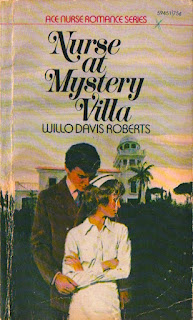
Nurse at Mystery Villa

 By Willo Davis Roberts, ©1967

Upon her arrival as new office nurse in the small California community of El Campo Calor, Chris Royce made a resolution: She would keep Dick out of her mind and heart forever. He’d never meant to hurt her, he’d said, as he told her of the girl he was giving her up for. Now she was ready to turn all her attention to her new boss, attractive young Dr. Candela. But Vic Candela wasn’t free. He was tied to the past by something everyone knew and wouldn’t forget—nor let Vic himself forget. Chris has to find out about it—even if it meant risking the loss of Vic and the new love he’d offered her.

GRADE: B-

BEST QUOTES:
“You’re just another girl. Blonde and pretty, I’ll grant you, but with the usual number of arms and legs and heads. So why do I feel you’re so special?” 

“You’re pretty enough to eat. I’m more interested in marrying you, though.”

“It is not womanly to be so strong-minded.”

REVIEW:
Nurse Christine Royce has been dumped just weeks shy of the altar, and now she’s through with men—she’s going to fill up her life with work. “If she were busy, she wouldn’t have to think about Dick,” she decides, and, oh, what a difference a capital letter makes. 

As it happens, though, she can’t keep her promise to herself, as when she’s lounging on the beach of one of the Great Lakes in Michigan, here comes hunky Dr. Victor Candela and his adorable six-year-old son Mickey. Turns out back in the day Vic had crashed her junior prom and danced with her, even though she’d been 60 pounds heavier in high school, and then he’d gone off to medical school. Meeting her again seven years later, he asks her for a date, and then if she’ll come back to California with him to be his office nurse. She agrees to both, and two weeks later she lands in the Central Valley and takes over the wreck of his practice. Once she catches up, though, the job is not too tough, as he has almost no patients—looking back through the appointments book, she notices that four months ago, after April 2, the previously busy practice had dropped into the toilet. A little snooping in the newspaper section at the library leads her to discover that his wife had died that fateful day, and that he had been suspected of murder but not convicted. So that’s why everyone in town looks at her so askance!

She’s living in the home of Vic’s dead wife’s family, with whom Vic is very close, and little hints drop like acorns on the roof—it quickly unfolds that no one had liked Alice, who was “selfish and cruel and rotten.” She’d attempted to seduce her sister’s fiancé, had little to do with her son, and apparently cheated on Vic. And she’d had multiple car accidents and lost her license, but had driven drunk after that and killed two people; the family had had to mortgage the farm to pay the settlement, a debt they are struggling to emerge from. It’s not until the end of the book, though, that it is suggested that Alice had some form of mental illness, proved by a diary she’d kept that Gramma Sophie will let no one read. “It is filled with hate, with sickness,” Gramma insists. “No one should be allowed to look into the darkness of such a mind.”

The mystery of how Alice died is made more interesting by the fact that if she was murdered, and if Vic was not the murderer—Chris “did not have the slightest doubt of Vic’s innocence,” which is a switch from most murder mystery nurse novels—then it must have been someone else in the family. Vic, who loves the family deeply, is acutely aware of this. “I won’t do anything that could possibly hurt anyone in this house in order to find out” how Alice died, he tells Chris when he finally acknowledges the truth to her—after she’d found it out for herself, unfortunately.

The problem with this particular sub-sub-sub-genre is that they are generally just lame (see, if you must, Matravers Hall, Nurse on Nightmare Island, Nurse Missing)—honestly, a Nancy Drew novel holds more interest and suspense. This is one of the better ones, though, as the heroine is not a stupid loser, and of course she is instrumental in proving Vic’s innocence. The characters are layered and interesting, the writing is moderately good, and the plot has only a few weirdnesses—Chris has a penchant for getting engaged to men after dating them for under two months—and the book even deliberately leaves a few minor questions unanswered, which makes it seem more plausible. The title is unfortunate, because the house in question is not at all mysterious, but that’s a minor sin, and likely one committed by the publisher rather than the author. So if you have a penchant for a pseudo-Gothic murder-mystery nurse romance novel, this could be just the book for you.

Monday, October 25, 2021

Nurse in London

By Jane Converse 
(pseud. Adele Kay Maritano), ©1970
Cover illustration by Bob Abbett 

“I want you, Luv,” said Lee Watson. He was the star of The Tree of Life, the top rock group in England and America, and he lay in a hospital bed, victim of a crippling motorcycle accident. In pain and despair he had clung to Nurse Holly Brooks. Now, he was going back to London to resume his career. “I love you, Holly,” he told her. “Come with me.” And Holly came because he needed her … stepping, unaware, into a frenzied, psychedelic landscape where The Tree of Life flourished, and she was a stranger.

GRADE: C 

REVIEW:
Lee Watson is the creative genius behind The Tree of Life, a rock group that “the young patients on our floor rate up along with the Beatles and the Rolling Stones,” except that this music is “country baroque. Banjo meets harpsichord.” Whatever that is. He and his band have come to the U.S. on tour, and while out for a ride one day on his donorcycle, Lee missed the curves of Topanga Canyon and went over the edge, resulting in injuries that insisted on the amputation of both legs. Though “he hasn’t lost his talent,” the accident set him back on his heels, if you don’t mind the metaphor, and he’s become reliant on Nurse Holly Brooks for his emotional as well as physical recovery. 

Interestingly, we meet here an orthopedic doctor who is concerned that his patient will become addicted to opioids (a rare species in this day and age) and who works with Holly to wean Lee off the morphine he’s been getting. “I am not so certain, not certain, at all, that our young man is unfamiliar with analgesic drugs,” he tells Holly. “We cannot risk addiction.” His solution is to administer an IV placebo, but guess what?

Lee is a volatile individual who one minute is screaming in Italics, “There isn’t going to be any tomorrow! It’s over! Can’t you stop playing your idiotic games and see that it’s all over?” and the next minute he’s going on “like a gushing fountain” about a proposal that his group give a free concert in a London park. He’s a bit manic, if you ask me, but no one else seems to have noticed. In the first scene between Lee and Holly, he tells her—hot on the heels of him rejecting the pills and begging for “a shot”—that he loves her and wants her to come back to London with him. His orthopod agrees: “To prevent him from becoming addicted to a narcotic, to keep his morale high enough so that he does not refuse to follow the routine of his exercises; this appears to be within your power,” he tells her. “Your presence at this time could mean the difference between recovery and total collapse.” But no pressure, luv. And, of course, contrary to all teachings about addiction; only the addict is responsible for their addiction. On Holly’s side, she feels “the flattery of being singled out by the exceptionally attractive idol of thousands of girls,” and has a “breathless sensation” over being invited. So off she goes, and her attitude about being able to save Lee does not bode well for either of them.

Dr. Glenn Raymond is the doctor who is taking over in England, and he quickly turns mean when Lee shouts for her in the middle of a press conference, “C’mon over and give us a kiss, pet. Give these ink-stained vultures something to write about.” Nonetheless, as Dr. Raymond continues to be “blunt, unsympathetic,” “smug and unpleasant,” Holly decides that she is falling in love with “this dictatorial, waspish man,” because nothing turns a woman on more than a man who is an asshole. Dr. Raymond suspects that Lee is on drugs, given his “mercurial” “manic-depressive” presentation. Furthermore, Lee won’t let anyone see his arms, and Glenn and Holly decide that Lee is “hooked on morphine,” provided to him by one of the groupies. They discuss getting him into drug rehab, but Holly thinks Lee will not cooperate. She wants to wait until after the big concert: “You can’t imagine what it means to him … a chance to prove that he isn’t a useless, unwanted cripple.”

The doctor stomps off, and Holly paradoxically decides that “whatever was done to save Lee had to be done quickly, and it had to be done, Holly decided, by herself alone.” She’s worried that it would be “an unforgiveable breach of ethics” because she would be “proceeding contrary to his orders,” but “all heroic acts were acts of defiance, were they not?” Lee’s monstrous egotism has apparently rubbed off on her. So she gets into a fistfight with the groupie who is dropping off the drugs. Lee’s manager stops the fight and throws out the groupie, and then a hellish night in which Lee suffers withdrawal ensues.

The next morning she summons Dr. Raymond. If Lee is not cured of his addiction that night, Holly recovers from her “arrogant conceit.” Dr. Raymond arranges to have Lee moved to rehab, but before he can accomplish this, Lee flies the coop. They tried to make him go to rehab, but he said no, no, no! He’s got to finish preparing for his big concert, see, and after that’s over, he’ll go, pinkie promise! Dr. Raymond comes over to yell at Holly some more, but after he’s done, and after he’s learned that Holly is not engaged to Lee, he warms up considerably and tells her that he’s in love with her. After some smooching, they decide to get married, because their one date and his subsequent horrible behavior have told her she needs to spend the rest of her life with him.

The concert goes off, and during the last number, Lee wheels himself offstage before the music has concluded. Holly has an ominous feeling and rushes after Lee, only to find that he’s shot himself dead in his dressing room. It’s soon revealed that Lee has left his entire substantial fortune to Holly, and Dr. Raymond trots out his Mr. Hyde personality again, accusing her of having pretended love for Lee to engaged and win his fortune. She dashes off to the airport, but it’s taking her so long to get a ticket that Lee’s manager, Bart, catches up with her. “You’re as bad as Lee, thinking you can run away from yourself!” he says, adding that Dr. Raymond had immediately realized, after hanging up on Holly, that he’d made a huge mistake, and had been trying to track her down ever since.

With a bit of time for backstory before the doctor catches up with them, Bart tells Holly that when he made his will, Lee had had to ask what Holly’s last name was, and mentions that Lee had been married twice before, the first time to an honest woman who’d had a son with him, and who had “kept hoping Lee would come around to see the boy someday. Fall in love with ’er again, if she didn’t annoy him.” Holly tells Bart that it’s was she and his Los Angeles doctor who had made an addict of Lee, but Bart shrugs that off, telling her that Lee had been high on speed at the time of his accident, and that his addiction was inevitable. By now the doc has found a parking spot and rushed into Heathrow to give her a kiss. Immediately she starts to plan “spending the rest of your life in a foreign land. Yet wouldn’t she be willing to live anywhere, for the remainder of her days, if she could be at Glenn’s side?” The terrible problem of her estate she decides to entrust to Bart to manage for her, never mind about helping out Lee’s good-hearted first wife or son, and they head off to get a wedding license and struggle with the burden of being millionaires. Poor kids.

Author Adele Maritano can crank out plenty of great sentences, but here she hasn’t given us anything for the Best Quotes section, and she’s lousy with plots, which is a tragedy for her and for us. Here she writes of addiction as if the attitude that the addict is helpless in the face of drugs is a new one; of course, in 1970 it may well have been, so we can’t blame her for that. But it’s tiresome to the more modern sensibility, especially when a professional like Holly is not with the program and falls into all the typical traps about her responsibility for Lee’s addiction or sobriety. It’s also dated in how it treats the musical genius of Lee; we are told that his brilliance endows him with “the superiority that permitted him to behave like a tyrant and get away with it.” Again, it’s not easy to swallow that perspective 50 years on or watch him abuse people who revere him. Here we have another of Maritano’s many mediocre works that offer little beyond a flashback to another time, which of itself is not really enough reason to pick up this book. There are other, better VNRNs that will take you to London (see An American Nurse in London, not to mention many of the Britain-based Harlequin nurse novels), so I advise you to turn in your ticket and catch a different flight.

Sunday, September 19, 2021

Emergency Nurse

By Peggy Gaddis, ©1963 

The nurses in the Emergency Ward were always busy. And one of the busiest was Nurse Elaine Prescott. Two doctors called for her … after working hours as well as during them. When Dr. Toby Latimer even glanced at her, her pulse did flip-flops. How odd, then, that she should be so impatient for her next date with Dr. Jay Dillard. His kind of attractiveness spelled danger … a danger she didn’t want to think about … yet …

GRADE: B

BEST QUOTES:
“I’ve never seen her in anything except operating garb. And you know what that is! Liz Taylor would look like a hag in one of those sickening green gowns and masks.” 

“I knew how much it would mean to him to look at something young and pretty. Miss Simmons and the other nurses on this ward are definitely not either!”

“Since I’ve been here, and especially since my service in Emergency, I’ve come to believe that the automobile is far more deadly than the atom bomb!”

“‘It’s a dance sensation called “the twist,”’ he explained kindly. ‘Care to try it?’
“‘I do not!’ Elaine assured him firmly. ‘I have much too much respect for my sacroiliac! Nobody over eighteen should ever attempt that sort of dance, that is, if it is a dance, which I doubt. It looks like something dreamed up in a nightmare.’” 

“If I felt any better I’d have to take something for it.”

“Parents sometimes take a whole lot of understanding, don’t they?”

“Any little thing I can ever do for you, or even any big thing like murder or arson, just let me know and consider it done.”

REVIEW:
Elaine Prescott is a nurse in an Emergency Department where every patient is brought in on the edge of death, usually from a car crash; unfortunately, the patients seems to have a mortality rate of more than 50 percent. Maybe because the staff thinks it’s a good thing when patients are thrown from car crashes, they dig out bullets and suture bullet wounds, and persuade dying patients to have surgeries that won’t cure them. Has medicine changed that much, or do VNRN authors not bother to do their homework? 

When she’s not assisting at malpractice, Elaine is usually arguing with Dr Jay Dillard or Dr. Toby Latimer. Toby is the son of a very wealthy society doctor, Fergus Latimer who, paradoxically to how these kinds of MDs are usually portrayed, is an extremely talented surgeon. Dr. Fergus holds lavish parties that his dowdy wife Ellen avoids like the plague; she prefers to volunteer in the pediatric ward or putter in the garden. Everyone assumes Toby is going to step into his father’s practice, though Toby has never made it a secret that he plans to use his trust fund to open a clinic in the slums. Dr. Fergus is very dismissive of Elaine when she attends a party at the country club with Toby and has tea with Ellen at the family manse; Ellen, for her part, tells Elaine in the kindest possible way not to get involved with Toby because Fergus is going to change Toby’s mind about both the clinic and Elaine, and then she’ll be hurt. Elaine is outraged that Ellen thinks she is “pursuing” Toby, but then Ellen “clarifies” that rather she knows Elaine is not in love with Toby, but that he is in love with her and “I didn’t want to see you hurt” by marring a man she doesn’t love. 

Elaine responds to this by accusing Ellen of child abuse: “You have bullied him and hectored him and laughed at his plans and his hopes,” she says—though when we meet Ellen earlier, we are told that “it was obvious that Mrs. Latimer hadn’t the faintest doubt of her son’s ability,” and Ellen herself says, “I think Toby is quite old enough and intelligent enough to make his own decision” about going into practice with his father. After this contradiction, Elaine adds another: “I’m not the least bit in love with Toby, nor do I think for an instant that he is in love with me.” We doubt Elaine is as impassive as all that, as on their first date “Elaine’s happy heart gave a little excited skip at the implication that this was not to be their only date.” As for Toby’s feelings, on numerous occasions Elaine is assured by the people around her that Toby is in love with her, and Toby himself has told his father that he’d like to marry Elaine “more than anything in the world.” This could be the classic VNRN denial of the obvious—a classic tactic for Peggy Gaddis—but it’s hard to know what to do with this; either the heroine is disingenuous at best or completely schizophrenic, and neither is very conducive to a happy love life, or a good story line.

As for Elaine’s other beau, Jay Latimer is planning to step into his father’s practice—but that’s OK, because his father is a general practitioner in the North Georgia mountains. Whenever this particular geography is aligned with a character in a Gaddis novel, you know that’s who we’ll be with on the final pages. But in virtually every exchange, Jay and Elaine are squabbling, usually because Jay has made some disparaging remark about Toby, and Elaine is defending him.

In between Elaine’s battles with Jay and Toby’s parents, both of whom are doing their best to keep Elaine and Toby apart—again, rather perplexing, since Toby’s mother is initially painted as a doting, underappreciated saint—a 15-year-old girl who has been groomed to be lonely by her social-climbing parents and who was almost the victim of half a suicide pact (her boyfriend shot her in the lung and then chickened out on killing himself and ran, which ends their relationship) and her story resolves happily after she delivers a lengthy and astoundingly psychologically insightful lecture to her parents about their failings. We also have the more bizarre story of a 32-year-old widow who has conjured her dead husband’s ghost, whom numerous people hear speaking to her and who drives her car, and her, into a tree. Her story also ends “happily,” we are told, when she dies: “I’m so glad she didn’t have to go on living without her husband,” says the wise 15-year-old. “She loved him so very much, and she was so alone without him.” Curiously, these two stories contradict each other—although, come to think of it, given that this is a Gaddis story, it’s not curious at all—one young woman is lucky to have lived and lost her boyfriend, while the other is lucky to have died after losing her husband.

This is the problem with Peggy Gaddis. She starts writing one story that is abruptly flipped on its head, and we are told with a straight face that everything we’ve been led to believe up to this point is false, and the opposite has been emphatically true all along. A young woman who is outraged when she is thought to be chasing one man suddenly openly pursues another with gusto; a man and a lifestyle she’s been chilly toward from book’s open, we now find she’s been “pursuing like mad ever since we first met!” When did that happen exactly?

One of the more interesting aspects of this book is that it holds an amazing prejudice toward both upper and lower classes. After her evening at the country club Elaine says, “There didn’t seem to be a serious idea among the crowd! I can’t imagine anything duller or more boring than a steady diet of such dates; or the sort of life those people live. They all looked bored and dissatisfied with themselves and the world at large.” At the same time, Toby endures an inordinate amount of disdain from his peers—Jay Latimer in particular—despite the fact that he’s an extraordinarily dedicated and hard-working doctor, because his father is a rich man. But being poor is not much better, at least being urban poor: Characters talk of the “savage brutality in the slum areas” that “springs from ignorance as much as from native brutality: people can be taught to rise above such animal-like things”—and that’s from Ellen Latimer, who has the kindly view. Dr. Fergus Latimer just calls the slum-dwellers “lazy, ignorant and shiftless, who are unwilling to lift a finger to help themselves and rush to grab anything the city or the state or the government hands out.” Curious contrast to the mountain-dwelling poor, who are painted as a holy, hard-working, noble species.

For the most part it’s a well-written story, though even urban nursing students tend toward cutesy epithets such as “Saints preserve us and forevermore!” and “Praises be!” and “For the love of Florence Nightingale.” There’s enough bizarreness in the side plots to be entertaining—what is up with the ghost???—and the contradictions of the plots are not especially irritating, partly because instead of turning into a vapid, spineless wimp who does what her man tells her, which happens too frequently in Gaddis novels, rather the opposite is true. Elaine, who shows little interest in any man for much of the book after her first and only date with Toby, in the end puts her feelings on the line—up to a point. “I’ve gone so far as I intend to go! After all, this is supposed to be partly your job, you know. You really shouldn’t expect me to drop on my knees and put my hand on my turbulent heart and beg for your hand in marriage!”—and by saying this, she is making it clear that she would like it if he did the same. The good news is that, once safely betrothed, Elaine insists on waiting a miserably long six months for the wedding, because “we have been alone only in the cafeteria, and neither of us has ever had enough time off at the same time to get really to know each other.” So that’s a smart move we can all get behind, even if we feel confident that to get engaged after only one date seems a bit foolhardy. Peggy Gaddis is a bit frustrating as a VNRN author because as good a writer of sentences as she is, her themes and plots are not infrequently off-putting, and she has a penchant for lazy writing mechanics. But in Emergency Nurse she does better than usual and gives us a book we can largely enjoy.

Monday, July 5, 2021

Pam Green Rehabilitation Nurse

By Patti Carr
(pseud. of William Neubauer), ©1966
Cover illustration by Bob Abbett 

Pam Green was one of Buttrick Hospital’s best nurses—capable, dependable, the perfect choice for out-patient works at the rehabilitation center. But the day Pam’s romance with Dr. Sam Flint came to an abrupt end marked the beginning of some startling changes in the beautiful brunette’s life—the most startling being Joe Budd, the ruggedly handsome and notorious labor leader. Everyone warned him against him, but he made the perfect rebound date. After all, she could not possibly fall for a man who offered everything but love. Or could she? It was absurd ... but suddenly her idea of fun on the rebound had turned into a dangerous game that she had to keep playing, a game that threatened to destroy the career she had planned for a lifetime.

GRADE: A-

BEST QUOTES:
“The dress lent her a nice primness, and primness was a useful armor when you were not sure of a fellow you’d picked up in the first place.”

“Overlook the bad temper, please. I guess it’s this dress. I hate prim and prissy girls, I really do.” 

“Like all nurses, I’m starving.”

“Ginny here is the daughter of the Haskins who’s one of the governors of Buttrick, Pam. Very posh family, tons of money, blood so blue you could use it for ink. If from time to time she snubs you, you’ll understand why.”

“Pam found her arm being taken companionably, and the hand gripping that arm piloted her quite expertly through a nonexistent lobby crowd, through a quite negotiable doorway, and into a Marine Room that was neither dark nor boobytrapped with obstacles.”

“I think women ought to make themselves useful. They’re particularly lovely when they’re doing womanly things at table.”

“The longer I live, the more I thank God for creating these comical characters we call men. They always talk with such authority you have to believe they really think they are authorities. That’s the funniest thing of all.”

“I find women potent medicine.”

REVIEW:
Pam Green works at Buttrick Hospital in Hardin City, California, the same location for Patti Carr’s book TV Nurse—but I was disappointed to find out that the star of TV Nurse does not appear in this book, and Pam Green has no cameo in TV Nurse, either, which seemed like a lost opportunity for Ms. Carr. But anyway, Pam’s just been transferred out of Ward P, a rehab floor, to a department that seems to be case management for outpatients. Pam is assigned to a case, Miss Coolidge, who had been in a car crash and had to have both legs amputated—as well as her first name, it seems, since she never has one in this book. When Pam meets her, Miss Coolidge is in jail for panhandling, and though Pam gets her sprung, Miss Coolidge vows to go back to her former corner and resume her efforts. When Pam points out it’s not exactly a career with great upward mobility, Miss Coolidge retorts that she is unable to get a traditional job, since no one will hire a double amputee in a wheelchair. “There’s no law, you know, that says a business establishment must hide its handicapped people in the offices or stockrooms. We all do, however,” says the department store manager who refused to take Miss Coolidge back after her accident. “Ask us to hire a handicapped person, and the first thing we worry about is how it’ll look to our customers. Hide the horrible face or horrible lump on the back or the twisted legs or arms or even the emptiness where legs or arms should be.” This book was obviously written before the passage of the Americans with Disabilities Act (which only came into effect in the shockingly recent 1990). 

In her new role as a nurse-cum-social worker, Pam gets Miss Coolidge an apartment and a job working for the labor leader called by many “a Neanderthal goon,” Joe Budd, who is everything a union boss is painted up to be, with an expensive-looking cigar, diamonds in his cuff links, and the build of a guy who’s whacked a few slobs on his relentless climb to the top. Somehow, though, when the big lug tears up over a firefighter who has lost the use of an arm while on the job, she feels that he’s more than his stereotype.

She’s not so sure about the man she’s actually dating, Dr. Sam Flint, who “would not remove a cataract from his own mother’s eye unless she paid him a whopping fee.” And he’s not even that great a doctor, albeit a good-looking one. Sam has just made the acquaintance of Sally Banes, of the Baneses, and is impressed by her “money, plus beauty and intelligence,” he lists in order of importance. When Sally drops in on one of their dates to invite them to a party, Sam goes, and Pam goes home—to call Joe and ask him to dinner. There Joe convinces her to go to an amusement park with him, which wasn’t too hard a sell, because “as it happened, in those emerald green eyes there was an interesting challenge that she couldn’t resist.”

Eventually, though, Pam learns that Joe’s job for Miss Coolidge is not meant to be permanent, because her position allows her to learn a lot of information about how he runs the union, and this might endanger his power. She confronts him, he admits it, and she stops seeing him. Meanwhile, poor little rich girl Sally Banes has fallen in love with Sam Flint—who’d lost it when she called the mansion he’d worked so hard to buy a “cottage,” and now they’re not seeing each other, either. Sally is looking pretty raw about it, and in trying to clean up her life she asks her father to hire handicapped people, starting with Miss Coolidge, and he agrees. Sally’s beneficence goes too far, though, when she asks Miss Coolidge to come to dinner at her house, and Sally’s father says something rude, and Miss Coolidge chews him out, and Mr. Barnes fires her again. Miss Coolidge, on her way out the door, tells Sally that “it was no wonder to her that nobody who amounted to anything in Hardin City wanted Sally Banes around.”

Sally responds to this mess by slashing her wrists, which naturally brings Sam to his senses, and he tells Pam he’s going to marry Sally. He also tells Pam that her zeal for Miss Coolidge is misplaced, because Miss Coolidge is unemployable. “People can’t have everything on their own terms,” he tells her. “You have to learn to put up with things you don’t like. You need self-discipline. She lacks it.” And Pam has to admit he’s right. So the next day she goes to Miss Coolidge’s apartment to pack her up and deliver her to a “home for unemployables” run by the state of California. Pam’s parting gift, before she peels out of the driveway, is a lecture about how many people tried to help her, “And all for what? You can’t be helped, Miss Coolidge, until you help yourself.” It turns out, though, that Miss Coolidge is only to be kept there for three months, which she doesn’t know, and Sally Banes is footing the bill. Joe Budd learns a lesson, too, and decides that his ambition isn’t worth what it costs him, particularly when he has a pretty good setup where he’s at. And Pam also decides that social work isn’t for her, but maybe Joe is, after all.

Patti Carr is a very perplexing author. Her other two works (TV Nurse and A Nurse to Marry) earned her a C- and a D+ respectively. But here we have a fairly charming, brisk, interesting, witty novel that easily snagged a top mark. Pam is smart, strong, independent, and hard-working, and the supporting characters are not completely dull, either. Its theme is also intriguing: Miss Coolidge ultimately wasn’t a failure because of her handicap, but because of her attitude. And it’s certainly rare to meet a character in a VNRN who doesn’t turn over a new leaf when assisted by the hands of the capable RN in the end, though it must be admitted that her eventual success is hinted at, even if we don’t get to witness it. This book bears more than a passing similarity to the writing of William Neubauer, between the union boss with a heart of gold, the machinations of hospital politics that have Pam transferred all over the hospital, the scheming mind of Pam herself, and the witty writing: “‘I love your dress, Pam,’ Sally said. Pam wanted to burn the dress on the spot.” I have wondered over the years if a VNRN was not actually written by the person whose name is on the cover, and this one does make me scratch my head, because not only is it the only book of Patti Carr’s worth reading, it’s also head and shoulders above most other VNRNs.

NOTE: After writing this review, I discovered that Patti Carr is actually a pen name of William Neubauer, so my hunch proved accurate. 


Shop this title, offered again by
Nurse Novels Publishing!


Friday, February 26, 2021

Matravers Hall

By Elizabeth Kellier, ©1962
Also published as The Return of Nurse Maine

Julia Maine was shocked to learn of the sudden death of Gaiety Harrington, her old school friend. Happily married to Nicholas Harrington, Gaiety had never seemed the suicidal type. Now, forced to pay a condolence visit to the family at Matravers Hall, Julia was plunged into an atmosphere of fear and suspicion. Apprehensive in the gloom of the great cliffside house, Julia was disturbed by the silence with which Nicholas treated his wife’s death—and by her own awakening interest in him. As the days of her visit lengthened, Julia determined to seek out the malevolent force that had destroyed the young bride—fearfully aware, that she, too, might be its victim.

GRADE: C-

BEST QUOTES:
“A person intent on murder has to take some risks.” 

REVIEW:
The original title of this book is The Return of Nurse Maine, which gave me hopes that we had here an example of a sub-sub-genre, namely the nurse gothic romance novel. Heroine Julia Maine is indeed a nurse, but alas spends no time working as an actual nurse in this book, so it may not even count as even a simple nurse novel. But since I was duped into reading it, let this review serve as a warning to others who might possibly follow. 

We immediately learn that Julia had once been in love with Nicholas Harrington and that he had proposed to her, but Julia’s mother was an invalid requiring her full-time attention, and she felt that “it would not be fair to hand such a burden on to any man.” So she had turned him down without revealing her motivation, and when her mother had died less than a year later, she ate her heart out. This loss was made apparently irrevocable by the fact that her school acquaintance Gaiety had swooped in as Julia was stepping out and snagged the eligible bachelor for herself, despite the fact that the pair were obviously ill-matched.

Now, when her Christmas card was answered with a note from Nicholas saying that Gaiety had tossed herself off a wind-swept cliff 18 months ago, Julia feels obliged to make a condolence visit. Curiously, her stay stretches out for weeks before she starts to consider heading home. In the interim, however, she thinks a lot about how all the people in the house might have done away with Gaiety, because exactly no one thinks Gaiety actually committed suicide. Gaiety is increasingly revealed as an unpleasant, unstable character who had moved out of her husband’s bedroom and was increasingly “nervous about something,” according to one of nearly fifty people Julia interviews regarding Gaiety’s death.

The list of suspects, however, is quite thin. Meet Nicholas’s sister Marjorie, unmarried at 38, “tall and muscular with a strong face and high forehead,” who has a close female friend “of the same type,” Miss Gladys Newson. Much is made of Marjorie’s lack of fortune and her disappointment in not being able to go with Miss Newson on that woman’s upcoming trip around the world. We also learn that Marjorie’s mother, essentially an invalid at the geriatric age of 59, has left everything to Marjorie in her will. To demonstrate her appreciation, Marjorie is always forcing her mother to stay in bed all day as well as unspecified tonics (sans gin, unfortunately) down her throat multiple times a day. The surprising detail is that nurse Julia demonstrates not one iota of interest in what the medication is or what Mrs. Harrington’s diagnosis might be.

What with interviewing Mrs. Harrington, the gardener, the cook, and the neighbors, three weeks fly by before Julia suggests she should be going, but Nicholas, who is becoming increasingly friendly, begs her to stay longer. “It was hopeless to deny that each time they went out together some further quickening of emotion took place. The hours passed like minutes.” When finally he sweeps her into his arms and covers her face with passionate kisses, she insists that he tell her his own story about what happened to Gaiety, because as a detective, this woman misses no opportunity—even if the obvious conclusion staring her down eludes her. Nicholas reveals that he had come across a letter to a lover Gaiety had written just ten weeks before her death, and his bizarre and completely unsupported conclusion is that the boyfriend had dumped her and she had killed herself in despair. Julia then interrogates neighbor Tony Grant, a suave fellow who drives a sports car and wears a scarf in the open neck of his white shirt, and the cad too easily admits that he had been seeing Gaiety, but that she had broken up with him due to Nicholas’s increasing jealousy. Julia, as stupid as she is inquisitive, turns to an obviously false suspicion: “All that her probing and her search for truth seemed to have done was to lead her round in a circle—so that she still came back to Nicholas.” It doesn’t cross her mind to wonder why Marjorie is pacing the ground atop the fatal cliff with her eyes glued to the ground, or why the manly spinster looks so afraid when it comes out that Julia has been riffling through Gaiety’s diary.

Mother Harrington has a “giddy attack,” and it turns out that she was diagnosed a year ago with leukemia, but Marjorie has decided to withhold this information from Nicholas and even Mother herself. Nicholas uses this news to suggested that he and Julia get married right away, so as to make his mother “as happy as possible.” Julia, “almost convinced” that Nicholas had nothing to do with Gaiety’s death, agrees, because why not marry a man you can’t exonerate from a murder? Mother is delighted, but when the pair tell Marjorie their happy news, “it was as if a cold wind had blown across the room.” What could it mean? Marjorie keeps harping on Mother’s upcoming sixtieth birthday, and the next day pulls Julia aside and insists that she postpone the wedding. Julia refuses, Marjorie is furious—and “something tangible seemed to be moving through the silence, something frightening and odious—like bat’s wing brushing against her cheek.” I’ll wait while you finish snickering.

When Nicholas decides to go to London on a business trip, Julia naturally decides to stay at Matravers and work on her trousseau, because the shopping opportunities in London are not that great. First, though, she’s got to take the dog for a walk, and heads for Gaiety’s jumping-off point. She finds a broken charm bracelet that had belonged to Gaiety, and suddenly she remembers Marjorie’s peculiar stroll along that same path. Finally the penny drops!! It must be Marjorie who killed Gaiety!! And now she probably wants to kill Julia!! As do most readers!!!! So when Marjorie suggests that Julia go out to the shed to collect the dog, Julia obligingly trots out, and is mysteriously locked in the shed just as she discovers it is on fire! She is rescued at the last minute, of course, and though she is convinced that she was set up by Marjorie, “it would be cruel” to tell Nicholas that his sister tried to murder her and also probably murdered his first wife.

There’s no point in laying out how it all turns out, because the reader has been fairly confident of where the trail is leading all along. The plot—and Julia—can be particularly stupid at times, as Julia leaps back and forth between defending Nicholas’s innocence one minute and being convinced of his guilt another, of today insisting Gaiety was in fact a victim of suicide but the next day it’s murder. Enormous power is invested in tiny items: Gaiety’s broken bracelet, for one, and in another instance, it is suggested that Marjorie had erased an exclamation point from Gaiety’s diary that somehow all by itself revealed everything about the murder plot, when Marjorie could have just tossed the entire diary in the fireplace. The relationship between Julia and Nicholas is wooden and completely unconvincing, barely even existing in the book. Last but not least of the book’s sins that I will mention here, I did wonder if the author intended for us to suspect that Marjorie is a lesbian. I must confess that I have not read any other Gothic novels, so I cannot say if the prose here is typical, but in Matravers Hall it is quite florid: “A flush, no deeper than the delicate pink of her house coat, slipped into the curve of Julia’s cheek,” and that’s just the second page. Mercifully, author Elizabeth Kellier soon forgets to keep up the purple standard, and drops into more normal way of talking. Not least, of course, I was peeved that I was fooled into thinking this was a nurse novel. So consider yourself warned, friends, and stay out of Matravers Hall.

Saturday, February 20, 2021

There Came a Surgeon

By Hilda Pressley, ©1964

Another child’s toy, another girl’s boy, it was all the same to Elvira. Whatever Alison had, Elvira had to try and snatch it from her—even to the extent of becoming a nurse in Alison’s hospital. And Alison never realized how much she minded Elvira until Steven Hartley joined the hospital staff …

GRADE: B

BEST QUOTES:
“Even knowing the worst is better than not knowing at all, and worrying about it.” 

“When you were in love you did all manner of foolish things.”

“You women often have the same blind spots about hats that you have about men.”

“There was very little to a kiss these days. It didn’t mean anything.”

REVIEW:
This fairly simple book gives us the slow story of nurse Alison Lynwood, who at book’s outset is mad about Dr. Johnny Crowther, but “Johnny’s the type who can make you feel you’re the one girl in the world for him one minute and let you down the next,” says Alison friend’s Norah. “The trouble is with Johnny, he doesn’t want to settle down, doesn’t want to tie himself down to one woman.” On her side, Alison is in love with Johnny, and so spends a lot of time sighing by the silent phone—until Dr. Steven Hartley moves to town. Suddenly she has someone to dance with at the hospital ball while Johnny is whirling another gal around the floor. Alison gets the bright idea of dating Steven so as to make Johnny jealous, but the catch is that she really likes Steven. “How nice he is, she thought, not for the first time. He was such a restful person to be with. He was a much nicer person than Johnny. The thought brought her up with a jerk, but she realized it was true.” 

Over the ensuing pages, the volume turns down on Johnny—who, miffed, calls Alison even less than usual—and up on Steven, until “she was no longer in love with Johnny. As a man he could not hold a candle to Steven.” The rub here is that Alison’s cousin Elvira turns up, chasing Johnny actually, as she’d met him at Alison’s home one time and become instantly smitten. She’s enrolled in the nursing school and starts taking up Johnny’s spare time, but when she notices that Alison’s eyes have turned to Steven, suddenly she wants that man, too. Knowing 19-year-old Elvira as we do, though, it seems hard to believe she’s going to tempt a solid type like Steven. “Elvira was so ruthless,” Alison thinks. “She could lie, cheat, scheme or even steal to get her own way. That she had good looks and a superficial charm and could to thse things without the slightest compunction made her a most formidable enemy.” But she is very transparent, tossing herself in Steven’s path or passenger seat with flirtatious lies that even a cad like Johnny could see through and tire of.

Eventually Steven kisses Alison, but with all the gossip going around the hospital—Alison is not the type to dump poor Johnny as a friend, and still has dinner with him on occasion though it’s clear to him that she has cooled—and with the usual misunderstandings and jealousies, the usual inability to just say how you feel, it takes numerous chapters to sort things out. In the interim, there’s a suicidal patient to talk in off the roof, among other adventures, but after this one, Steven tells her, “I couldn’t—wouldn’t have done it without you, Alison. I kept remembering things you had said in our conversations when we had been out together.” There are Alison’s attempts to befriend and understand Elvira, which result in that young woman climbing out on the roof, too, and Alison takes the lead there, saying, “Don’t you know that you can’t force love? The only way you can win anyone’s affection is by being loving. You could be an absolutely wonderful person, the kind of girl no one could help loving. Do you realize that?” Somehow this does the trick, and Elvira decides she really does love nursing and regrets all her bad-girl antics and wants to be Alison’s friend. Their lifelong rivalry, which has been made much of throughout the book, which has been totally unexplained—poof!—is gone. Alison is tucking Elvira into the spare bedroom in her apartment when Johnny drops by to see how Elvira is, and says he’ll take her out next week. “Do you know what I’ve discovered about Johnny? He loves women most when they’re in need of him,” Alison says slyly, though it does not ring true with us readers. Steven turns up a few minutes later to have his turn with Elvira, brushing her tears away and giving her a hug and a sleeping pill. Elvira can’t understand why everyone is so nice, but Alison lies blatantly: “We’re all being nice to you because we love you,” and not a word is said about this abrupt switch in story line, either. As Alison is seeing Steven out the door, she’s finally able, in the slightest way possible, to suggest her feelings for him when she whispers, “Steven, don’t go—” and this is all it takes to break down the misunderstandings.

I am a complete sucker for the young woman hanging out with her friends in her apartment—somehow a scene in which everyone is sitting around the living room with cocktails in their hands laughing at a joke just slays me. This book has these scenes by the handful, and its relaxed, simple tempo is soothing. Maybe the book is a smidge too simple, and the wrap-up of the conflict between Elvira and Alison is way too forced (a copy-cat would-be suicide? We love you?? Really???), but Alison is a smart, outspoken character we can admire, and on the whole this sweet book is pleasantly enjoyable.