Showing posts with label character - gold digger. Show all posts

Saturday, December 6, 2025

Society Nurse

By Jane Converse
(pseud. Adela Maritano), ©1975
Cover illustration by Allan Kass 

Love sick. That’s what pretty Nurse Nina Bateman was, though she knew handsome, wealthy, dedicated Doctor Mark Danover was way out of her league. Then Mark asked her to take a private case, caring for a beautiful young heiress, Cindy Calvert, who happened to be Mark’s next-door neighbor. Was he looking for a competent nurse, or, as his manner suggested, was there something more behind Mark’s request? Everything seemed wonderful, until Nina met Cindy and her domineering mother. Nina realized before introductions were over that she couldn’t stand the haughty Mrs. Calvert. And what was worse, Mrs. Calvert made it obvious she thought Mark would make the perfect husband for Cindy! How could Nina compete for her heart’s desire against the ambitious scheming of her lovely young patient’s overpowering mother?

GRADE: A-

BEST QUOTES:
“I’m surprised at you. I thought that line went out with starched collars and the five-cent cup of coffee.” 

“A man who told you that he loved you should also believe in you.”

“I was furious. Hurt and furious about you letting that creep make a pass at you.”

REVIEW:
Some authors inspire certain feelings the minute you pull one of their books off the shelf. Jeanne Judson inspires a contented smile, Peggy Gaddis an exasperated sigh, and Jane Converse an anticipatory giggle. And when we have her Society Nurse open before us, we will giggle aplenty. Nurse Nina Bateman lives with her unloving mother in a rundown section of Chicago’s North Side, where she works at a clinic for the downtrodden.  There, two glorious afternoons a week, the godlike Dr. Mark Danover, who lives in a different sort of North Shore suburb, comes to work for free at the clinic, but he is not the sort to brag; “He was doing something he wanted to do and saw no reason to be praised for doing it.” So yes, Nina is in love with Dr. Mark, but “there was no encouragement to be found in his warm smiles, his thoughtful gestures, or even from his complimentary remark,” because “he was uniformly pleasant to everyone.” A rare find in a VNRN, a love interest who is genuinely a good man. Sigh … 

One day, though, Nina and Mark get to talking after a long, hard day, when she reveals she is one of the kids from the ’hood, and that she spends most of her evenings home alone with a book. “Nina thrust her chin up in the air. ‘I happen to like good books.’” And I happen to like Nina! Naturally Mark seems to, too, and asks her out to dinner—and then ruins it by saying he wanted to talk to her about a private case he’s hoping she’ll take on because the patient is a 17-year-old girl with diabetes, and Nina is so well-versed in endocrinology. Also, the patient is a very special friend of Mark’s, and his next-door neighbor. Of course she agrees, thinking she’s likely to see him more often—but the case turns out to be more than she expected.

Poor little rich girl Cindy Calvert is the sweetest little naif with a penchant for saying things like, “Oh, wow, Miss Bateman!” Cindy also has a penchant for Dave Tolson, another poor kid who is putting himself through medical school by mowing Dr. Mark’s lawn—how quaint! But Cindy’s mother Faye is one of those classic divas with “dark eyelashes that were too long and too upswept to belong to their present owner,” who “surveyed Nina as though she were examining a somewhat questionable pot roast.” The only reason Nina gets the job is that she is recommended by Dr. Mark, and Faye has her eye on Dr. Mark as the future Mr. Cindy Calvert, though he clearly has nothing but avuncular feelings for the young girl almost half his age.

So in moves Nina, where she has front row seats to witness Faye’s attempts to “keep Cindy in a state of perpetual childhood,” forbidding her to leave the house, exercise, see friends or especially that Dave Tolson, all because of her disease. “Yet, if anyone who lived here was sick, it was the woman who had made a bright, aesthetically lovely, completely lovable girl see herself as a burden—someone to be ashamed of.” Nina spends her days counting the calories in Cindy’s diet, measuring out and delivering insulin shots, testing blood sugar, and trying to instill a spine into sad, brainwashed Cindy, who is gushingly grateful to the mother who is trying to convince her that she’s “a burden, she should be grateful that people cared about her at all. It had taken years of conditioning to make the girl accept this self-effacing state; the results would not be undone in a few short conversations with a newly engaged R.N.” But liberate Cindy is what Nina cannot help but try to do, and spends afternoons giving her pep talks about her rights.

Needless to say, Nina soon tangles with the imperious Faye, who has told the household staff to tell Cindy’s beau Dave that she’s not available when he calls, but Nina has answered the phone and passed it to Cindy. Summoned to Faye’s lair for a scolding, Nina tries to explain that relationships are good for Cindy, but Faye calls out Nina (somewhat rightly) for overstepping what she knows to be the rules in a house where she is only an employee. Nina, bless her, stands up for herself, saying, “I don’t consider myself a member of your household staff, Mrs. Calvert. I have a degree in nursing. I’d like to be respected as a professional.” Unfortunately, the conversation goes south from there, as Faye calls Nina “common, cheap, conniving” and Nina shouts, “You’re the coldest, the cruelest, the most selfish excuse for a human being I’ve ever met!” And guess who is walking through the door at that moment?

Mark is appropriately shocked. “Frankly, I’m astonished. Name calling! It seems so beneath you,” he tells Nina, but to keep Cindy from falling to pieces at losing one person in her life who cares about her, he convinces the shouting women to give it another try. “If I make any radical changes now, Cindy is liable to run off with that absurd thing with the freckles,” acquiesces the gracious Faye. But it isn’t long before the ladies are back at it, as Faye starts preaching the gospel that her young, gold-digging boyfriend, Reverend Ronald Perry, espouses—that you can cure disease with your mind. (The ever-sassy Nina remarks, when he attempts to sell her his snake-oil theories, “You don’t mind if they keep the surgical wards at County open? A ruptured appendix can be such a nuisance to someone who doesn’t know all you do.”) Faye follows this up by insisting that Nina reveal her true colors—that she’s angling to win Mark for herself. Nina has just admitted that she’s in love with Mark when the man himself walks in—what a knack he has for showing up at awkward moments! He asks Nina if it’s true, and good for her, she replies, “That I love you? I’m not ashamed of that. What if I do?”

Of course it turns out that he loves her too, and there’s a lot of smooching then. But true love never sails smooth in a vintage nurse romance novel, and soon the boyfriend Ronald is assaulting Nina just as Faye walks in—obviously taking lessons from Mark about when to make an entrance. Ron, unphased, tries to salvage what woman he can by insisting, “You must have enjoyed that as much as I did,” to which Nina replies, “I haven’t been so thrilled since my dentist told me I’d have to have root canal work.” But Faye runs straight to Mark, who refuses to hear what Nina has to say about what happened, and she is promptly fired by the cold-faced pair.

Then she’s back working at the old clinic when a stricken Dave Tolson turns up, telling Nina that Mark is out of town at a conference and he is sure that Faye has fired the new nurse and embarked Cindy on a faith-healing treatment plan prescribed by Ronald, and he’s certain that Cindy has lapsed into a diabetic coma. Off sprints Nina to the rescue—will she get there in time? And if she manages to save Cindy, can she cure Mark of his stupidity as well?

Of course she can—she’s a smart, strong, spicy Jane Converse heroine. The writing is sprinkled with Jane Converse’s excellent bon mots, and the characters are enjoyable. If Faye Calvert is too easily dismissed as “whacked out” and insane—it would have been less simplistic and condescending to deal with her as what she is, a deeply troubled, insecure woman who would imperil her daughter to try to keep her man, and there are plenty of people like that in the world—that’s the biggest flaw of an otherwise thoroughly enjoyable book.

Saturday, August 23, 2025

Send for Nurse Alison

By Marjorie Norrell, ©1965
Original title: Only Time Will Tell

Alison Gray wanted so much to forget the unhappiness of her last weeks at St. Hilda’s Hospital that it seemed providential when Merlin Bleckworth asked her to come as industrial nurse in his father’s factory. But was Merlin only interested in her professional ability?

GRADE: C

BEST QUOTES:
“Too much agreement is as bad as too much argument.” 

“Life’s not too bad. It’s a great deal what we make it, and the unexpected turning up—like your theoretical thunderstorm—can often be a challenge and quite interesting. It depends how we tackle things.”

REVIEW:
Alison Gray was training to be a nurse when she fell hard for the young cad Dr. Graham Hoyland, who never returned her affections and ended up marrying the daughter of a rich patient. From her tragically broken heart Alison recovered, throwing herself into her studies so that now, a year later, she’s graduated with top honors and is able to work alongside Graham in the ED with nary a flutter to her healed heart. Nonetheless, when the hospital matron out of the blue tells her, “I feel it is important for you to get away for a time,” suggesting Alison take a job in a hospital far away and giving her no reason why this is “the best course for her to take,” Alison curiously is suddenly certain that this is what she should do so that “she need never again have to come into contact with Graham Hoyland or his wife-to-be.” That afternoon she tells her friend Lisa she’s resigning, with no plan for what she’ll do next, only “the strangest feeling everything in my life is being arranged for me.” How convenient!

So she and Lisa head off for a three-week vacation—can you imagine such a thing?—when Alison leaves her job, and when that’s over, as she’s driving out for an interview for a  job she doesn’t want, she sees a small boy fall off a cliff—he and his brother are hunting for gull’s eggs, yum yum—and rushes to his aid. Another car, “a big, opulent estate car,” pulls up, and handsome young Merlin Bleckworth bounds out, assists with the rescue, and helps drive the young victim to the hospital. From there it’s only natural that he should take Alison to dinner, learn she is a nurse, and offer her a job caring for the workers at his family’s industrial manufacturing business.

They drive to his house that night, where Alison is welcomed as one of the family—subjected to frank, heart-to-heart conversations with the housekeeper, his sister, and his mother, all of whom hint to varying degrees that Alison should stay and marry Merlin. When she doesn’t run screaming from the building, they pop her in the old nurse’s suite—the last nurse they had, now leaving to get married, lived in the house—and the next day driver her out to the factory. There she immediately aids with a young worker who has crushed his foot to a jelly, doses an anxious man with a toxic medication no longer in use, diagnoses him with too much stress from living with his in-laws who won’t let him work in their garden, and suggests to Merlin’s father Joseph, the owner of the firm, that he build housing for his factory workers. Then she flies everyone back to the family manor in her invisible jet.

This all having taken half the book to cover, now pretty much nothing else happens. We meet a new character, Dr. Ian Meltham, whom Alison immediately identifies as “a philanderer.” He incessantly pesters Alison for a date, though she never once agrees, except for the time they meet by accident in a department store, where Alison’s ability to say “no” departs her, and she is coerced into having tea with him—and the ensuing scandal requires pages of maneuvering to recover from! Merlin’s would-be girlfriend, the “tall, extremely slender, elegant girl with jet black hair and slanting green eyes,” falls for Dr. Meltham halfway through the book and is therefore completely wasted as one of those evil, scheming gold diggers out for our heroine’s man—though she does show up at the house to ask Alison in a “deadly quiet tone” if she is in love with Dr. Meltham, and Alison randomly decides the woman is on the verge of a “hysterical attack” and diagnoses her with bipolar disorder and calmly talks her out of what we are told is mania, but the description reads more as if she’s just upset and under a lot of pressure from her family to marry Merlin.

Truthfully from this scene on it seems that Alison is the one who has lost her mind, as, realizing she is in love with Merlin, “she would make no plans, no special moves, to draw him towards her,” so she plans to move out of the area that very afternoon without telling anyone because she decides she’s not going to be dumped again, a sentiment that has not haunted her one bit through the year after Graham picked someone else and all the time she’s been at Merlin’s home. Of course there’s an accident that rights everything again, but all through the book runs the theme of trust, and after this very bizarre stunt of Alison’s, It’s hard to believe anyone would ever trust her, again much less propose marriage to keep her from sneaking off. I, on the other hand, having been disappointed and blindsided by the wild leap of her otherwise sturdy character, was not sorry to see the back cover close on Nurse Alison.

Friday, July 5, 2024

The Nurse and the Crystal Ball

By Florence Stuart
(pseud. Florence Stonebraker), ©1969

When Sue Whittier unpacked her suitcase, 3000 miles away from the nurses’ dormitory in Maryland, she found a fortune-teller’s crystal ball under her nylons. It was a friend’s idea of a joke, but Sue—who didn’t believe in such things—wished it could tell her what she was letting herself in for. She had driven to California to be with Dave Harding, the man she had walked out on seven years ago just before their wedding—a dying man now who had written, begging her to come. And she had … Even though seeing David would mean seeing his half-brother, Marv, too—the secret reason Sue had broken the engagement. Still, she was prepared for that. What she wasn’t prepared for was finding another old love of Dave’s at his bedside: Gloria, the blonde he had married on the rebound, the wife who had deserted him two months later and has now returned—with a son she claimed was his. But was it true …? Sue didn’t need a crystal ball to tell her that here was a woman who could not be trusted …

GRADE: C+

BEST QUOTES:
“I am going upstairs to Mr. Harding. If you try to stop me—well, like most nurses, I know a few judo tricks.” 

“In my young years I was never a juvenile delinquent. But it’s never too late to start, even at my ripe old age. So how about us having a little snort?”

“Love and money! She sighed to happily and kept smiling to herself. What more could woman ask for?”

“Just to prove that she was a woman of patience and strong will, Gloria did not box his ears as she longed passionately to do.

REVIEW:
When you find a book with a title like this, you can’t help but get your hopes up. So much potential for rollicking, campy fun! Florence Stonebraker can certainly deliver the goods, too, but it must be confessed that the quality of her work is erratic. So my optimism was guarded. And this turned out to be warranted. 

Sue Whittier has left her job and driven 3,000 miles to La Jolla because the man she dumped seven years ago has leukemia and is at death’s door. He had written to her, begging her to come care for him in his final weeks, so sure! But things are little complicated. First of all, there is a crystal ball in her suitcase under a stack of nylons. Remember nylons? I hope you don’t. Secondly, the first person she runs into is Dave’s half-brother Marv, who is actually the reason why Sue left Dave—right before her wedding “she went down to the beach with another man. And that other man took her in his arms. And her dream of forever and ever love with Dave was forever blasted.” Upon her return, she and Marv immediately get into a rather strange argument in which Marv tells Sue to leave but will not tell her why, and then finally, as she is stomping off, he tells her, “I have never stopped loving you.”

Next she meets the surprise guest, Dave’s wife Gloria. He had picked her up on the rebound during a wild few months “with a crowd who spent their time drinking, smoking marijuana, driving to Vegas to gamble over weekends, swimming in the nude,” but Gloria didn’t last very long either. Now, learning somehow that Dave is about to kick off and has a large fortune to dispose of, Gloria is back at the family mansion and has somehow installed herself as supreme ruler over Dave’s mother and Dave himself. The trick is that she has a six-year-old boy in tow named Bobby, who she claims is Dave’s son. Gloria and Bobby are quite the pair—Gloria is a vicious, scheming vixen out to sabotage Sue, while Bobby is an angry, uncontrollable wrecking ball. “It is not as if he were retarded or anything like that, sweetie,” Gloria explains. “Actually, Bobby is unusually bright for his age. His only problem is that he is inclined to be a psychopathic liar, and that needn’t bother you.” OK! But everyone else in the house is kind to Bobby, who transforms under their supervision into a friendly, gentle boy. Sue even gives him the crystal ball, and he starts talking about seeing his dead parents in it. Um, what?

Meanwhile, Gloria has hired a doctor to care for Dave, but Sue suspects the man is a quack. He is prescribing no end of medications for Dave, and has even given a prescription to Dave’s mother Martha, who had seemed fairly healthy until she had started taking the pills as ordered, but woke up feeling dizzy, strange, unable to speak clearly or even walk without falling. Sue advises Martha to “hold the prescription pills under her tongue until Gloria left the room.” Why she cannot just refuse to take the medication outright is unclear, but once Martha starts dumping the meds in the toilet she is feeling spry and energetic again. Dave keeps taking his medication, and is getting worse and worse.

Marv, meanwhile, is trying to kiss Sue, usually after a loud argument in which he grabs her arms painfully, but she is fighting him off and running, at least for now. He keeps exerting everyone in the house to “play it cool” with Gloria, but is not sharing his long-term plan with anyone, so soon naturally decides without any evidence whatsoever that Marv is in cahoots with Gloria, plotting to inherit Dave’s money.

Suddenly Dave decides he is going to make a new will and locks himself up with Marv, who happens to be a lawyer, to create the thing. Exactly two nights later Dave “simply fell asleep, after taking the pills which Gloria made a nightly rite of putting into the tiny plastic box—and he did not wake up.” The rest of the book plays out pretty much as you know it will, including one character going stark, raving mad—a Florence Stonebraker specialty.

There are a lot of irritating aspects to this book. One is the constant suggestion that there are deep secrets at work here: For example, on her first day, Marv inexplicably tells Sue “I don’t feel free to tell you” why he wants her to leave immediately, though the reason is obvious the minute she walks through the mansion door. Marv, brooding in his room after an argument with Sue, “could not figure in exactly what way this money-greedy woman could hurt Susan,” when the obvious answer is that she can’t. When Bobby starts seeing his parents in the crystal ball, Martha declares, “there’s more to his story than meets the eye. We haven’t enough sense to understand what it is.” Yet the most egregious mystery—did Gloria kill Dave?—is left completely unanswered. Is it fair play for an author to throw out a bone that huge and then walk away from it? I spent some time thinking this question over and concluded that the answer is usually no, though I might accept it from an author so gifted that it actually worked (see A Series of Unfortnate Events by Lemony Snicket). So in this case, no. Even the eponymous crystal ball has no impact on the story. I will always have a deep fondness in my heart for Florence Stonebraker, so her failure in this book makes me doubly let down. If you would prefer to avoid philosophical quandaries and disappointment, you won’t need a crystal ball to tell you that you should probably avoid this book.

Sunday, January 28, 2024

Nurse Jane and Cousin Paul

By Valerie K. Nelson, ©1964

From what her dear friend Jeremy had told her, Nurse Jane Ashley had the worst possible opinion of his cousin Paul. What a hard, managing old man he must be, she thought, to try and force Jeremy to study for a career which did not interest him. “Sometimes you remind me of Paul,” Jeremy told her. “Like him, you’re fifty years behind the times. It’s that hospital and all those Florence Nightingale sentiments. I must get you away from it, double quick.” Then, Nurse Jane met Paul—and began to think that, if he was fifty years behind the times, it was not a bad place to be!

GRADE: C-

BEST QUOTES:
“You’re not going to faint or anything, are you? But perhaps that’s another of the Victorian fashions which is coming back again.” 

“Oh, you know what men are, my dear. So brief in their explanations that they’re positively maddening.”

“I thought nurses were always hungry.”

“Ordinary-looking people very often have some unsuspected depths.”

REVIEW:
This book has taken all the most overused VNRN tricks and thrown them into one package: Orphaned heroine? Check. Wimpy, shallow boyfriend nobody could possibly like? Check. Angry, domineering man more than a decade older than her? Check. Spunky heroine fighting constantly with the arrogant bastard and suddenly discovering she’s in love? Check! If all of this sounds appealing to you, then this is the story for you!

If at this point you have any interest in learning more about this story, by all means, press on: 19-year-old Nurse Jane Ashley is in love with a shallow cad named Jeremy who is clearly lying to her left and right. She is in her first year of nursing school in London—so she does not even qualify as a nurse—when she is persuaded by Jeremy to get a job “nursing” his aunt, Meriel Darling, an imperious, wealthy hypochondriac who lives in a manor far out into the country. She sets out for the interview that has been arranged by Jeremy, only to find the house empty and a severe rainstorm coming on. Drenched to the bone with a cold coming on—and concerned that the woman she has been told is an invalid might be lying out cold on the bathroom floor—she gets in through a back door. While investigating the premises, the doorbell rings, and she opens it to start her first fight with 31-year-old Paul Rowfield (a creepy 12 years her senior, if math isn’t your bag). He literally drags her around the house with a hard “hurting grasp” on her wrist and accuses her of being the local burglar. Naturally, “he affected her in such a strange way … a different way from which she’d ever been affected before. When he looked at her, her heart began to beat faster, and she seemed to tingle from head to foot.” Sigh.

She lands the job—turns out she herself has weak lungs and needs six months in the country to recuperate—though Meriel doesn’t need any nursing and Jane is really just a maid. She continues to be bossed around by Paul, and Jeremy shows up now and then for clandestine, brief meetings in the garden in which he spoon-feeds her endless lies and she gobbles them up like they’re warm scones with homemade strawberry jam and clotted cream. “A man who wants to meet you on the sly hasn’t really much use for you,” advises Paul, who for once is making sense.

The local doctor, Robert Eccles, who had cared for Jane during her illness, has a sister Nina—a jealous wench with her hopes pinned on Paul, who recognizes a rival when she sees one—as well as a brother Ray, invalided at 26 by a severe heart condition. She also meets an ill woman named Iris Eccles, who suggests she is married to Robert, and a man named Brian Draper who “happens” to be on hand when Iris swoons from illness in a café and helps Jane cart Iris back to her shabby flat. Now there’s a number of mysteries to solve—who are Iris and Brian really? Who is burglarizing the neighborhood? Does Jeremy really love her?—shenanigans of Jeremy’s that Jane attempts to put right with little success, plus a very cold and businesslike proposal of marriage from Paul in which he completely fails to express in the most ardent language the violence of his affections, yet Jane can’t even turn him down flat and agrees to think it over. Toward the end of the book she comes to her senses as far as Jeremy is concerned, but that doesn’t stop her, oddly, from flying to meet him in the garden at every possible moment, never once putting off his tepid assurances.

Ultimately—and I hope you will not be too upset at the spoiler—Paul again insists they marry, telling her, “you must, you know. I announced our engagement an hour ago,” in “the same arrogant voice, but undershot with a world of tenderness.” Which makes it all better, of course, that he has essentially bullied her into marrying him—and has been scheming to do so from the very beginning: “From the moment I’d met you, I’d been quite determined that you were going to stay. I’d got Bob Eccles to see that you were given the post with Mrs. Darling, while I waited to get in touch with your guardian to gain his consent to our marriage. I’d thought we might wait until you were twenty, but now I’d decided that waiting was a waste of time.” Instead of screaming in horror and fleeing the county, Jane meekly agrees. Ugh!

The ultimate climax of the book involves some secret relationships and crimes that I found difficult to follow, leaving Jane locked in a lighthouse, possibly to starve to death or be assaulted (she decides she’d rather leap to her death rather than have the man “put a caressing hand on her,” such a delicate reference to rape)! But in the end, she’s found less than an hour later, and feels “unutterably depressed” by her hysteria upon first being imprisoned. I shared the feeling, actually, to a lesser degree, upon reaching the end of this long, mediocre, insulting book that has little respect for its heroine and less for its readers if it thinks that this is what we all would appreciate in a love interest. And it’s not even really a nurse novel, since Jane has quit nursing school and is not working as one! The last straw! So with that, I can give you no reason whatsoever to spend any time with either not-a-Nurse Jane or Cousin Paul.

Thursday, December 7, 2023

Nurse at Shadow Manor

By Sharon Heath
(pseud. Norah Mary Bradley), ©1966
 

To forget the pain of a tragic romance, Nurse Frances Kimpton journeyed to Shadow Manor to act as companion to its elderly mistress. In that quiet countryside she would try to achieve peace of mind. But the peace she sought turned out to be a will-o’-the-wisp as Frances found when she learned the secret of the manor’s other woman—the young and willful niece of her employer. That secret meant danger and trouble. Frances turned to the attractive Dr. Ralph Grant for help. It was well that she did so. For, together, they were able to thwart a plot that could have ended in murder.

GRADE: C

BEST QUOTES:
“I was expecting a she-dragon in a starched uniform who would glare at me. But this one’s well disguised, apparently!” 

REVIEW:
To have a bad heart fifty years ago seems to have meant to be confined to a virtual prison. Poor Miss Caroline Eldridge, wealthy and only in her 70s, isn’t allowed to do much for herself and spends most of the day knitting, and everyone sneaks their life around behind her back, because “any sudden shock—mental, not physical—could be fatal.” Unfortunately, there’s a very elaborate network of lies and scheming occurring all around her, and it’s up to Nurse Frances Kimpton to protect the poor woman, even as she participates in and even furthers the intrigue.

The story starts implausibly enough when Frances is dragged in off the street to witness a wedding between a pretty, spoiled-looking woman and a weaselly looking man with a thin moustache. She’s en route to her job at an isolated mansion called Shadow Manor to look after Miss Eldridge, a sweet lady who has taken in an ungrateful niece, Eve Garner. You will not be at all surprised to learn that the mystery bride turns out to be none other than Eve, who has left her honeymoon and groom to return to Miss Eldridge’s mansion with nary a word of her recent nuptials. Eve is mean to everyone and seldom home, never saying where she’s going or when she’ll be back, but Miss Eldridge obtains sweet revenge when she decides to rewrite her will, saying that Eve will not get any inheritance until she turns 30 if she marries a man of whom Miss Eldridge does not approve. Fireworks ensue when Eve hears the news!

For her part, Frances, recovering from a heart broken after her fiancé was killed, is clearly over that lad and now has her wily eye on Miss Eldridge’s doctor, Ralph Grant, who is casually friendly. Then Frances happens to be on hand when Eve meets up with her new husband, Leon Josephs, in a whispered but brief sidewalk conversation—super secret! That night, when Frances offers to set out in the dark rainy night to search for the cat, she stumbles and scrapes her hands. She takes the opportunity of her minor mishap to invite herself to Ralph’s cozy cottage to tell him of her suspicions: that she had tripped over a wire slung across the walk put there intentionally to frighten her, and bless his heart, Ralph takes this statement entirely seriously. And now “the memory of this intimate, tranquil time was something she knew she would always treasure,” the little vixen. Wouldn’t it be fabulous if Frances turned out to be a psychotic manufacturing drama to lure in a man she has a yen for? When “no trace of string or wire had been found on or near the drive,” my hopes leapt!

I hate to disappoint you, dear reader, but alas, it was not the case, as author Sharon Heath has chucked that delicious opportunity for something much more implausible: that Leon for some insane reason is out to murder Frances by the most bizarre methods that turn out to be remarkably deadly. For Leon’s next act, he walks brazenly into the house, identifying himself to Miss Eldridge as a window cleaner, and cuts almost through the cord on the sash of a window in Frances’ bedroom. The very next day, Frances opens the window and decides to stick her arm out of it just as the cord breaks and the window comes slamming down! “Which might have been fatal, she thought, had she been leaning out the window!” Leon must be psychic as well as homicidal!

Next Mike Dering, an old boyfriend of Eve’s who had been too poor at the time to propose, turns up, now gainfully employed, and after spending an hour with the young man, Miss Eldrige invites him to stay at the house and tells Frances she hopes Eve will marry him. Ooops! Even if Eve were single she might not have the chance, because the brakes on her car fail and she drives straight into the river, saved by Mike, who happens to be loitering at the bottom of the hill (is Mike psychic too?). Suddenly Eve is a new person, confessing that she’s been changed all along, that she’d “got really fond” of Miss Eldridge, though she’d never bothered to show her anything of the sort. Furthermore, with just one word from Mike, “headstrong, self-willed Eve subsided at once.” Oy.

Frances, seeing another opportunity to flirt with Ralph, tells him he must come to the house that night but that Miss Eldridge must not know it, and Ralph again proves to be either the greatest sport ever or completely daft. After he sneaks into the house; frantic antics unfold! “I just told Miss Eldrige it was a friend of Mike’s who wanted to see him urgently. Miss Eldridge suggested you should have your talk in the morning room, but, if I leave you there and go to fetch Mike, she may take it into her head to come and have a look at this ‘friend.’ Perhaps you’d better come out with me, instead. Only I hope she won’t look out of the drawing room window just as we pass!” How complicated can these shenanigans get!

While they are tiptoeing through the shrubbery, Ralph tells Frances that he is going to hire a private detective to look into Leon’s past. A week later the detective turns up a game-changing fact, but when Frances races to tell Ralph, who is arriving at the manor, he chastens her: “‘I came here to see my patient,’ he reminded her, and she had to admit he was right.” It turns out that Leon was already married, and his wife is as psychic as she is, having determined Leon’s plans for Eve, found him in England, learned he was blackmailing Eve (though nobody knew except Eve), and gotten a job at the garage where Eve was dropping her car for repairs. She’s also an excellent (if nefarious) mechanic! And the pair is lucky too—ultimately Ralph and Frances decide that if they go to the police with this amazing story, the shock (of finding out her healthcare team is bonkers?) would kill Miss Eldridge.

Author Sharon Heath has given us several other gentle, sweet if not stellar books with A Vacation for Nurse Dean and The Sunshine Nurse, but this book is more of an unwitting and dopey comedy. The characters and their motivations are inexplicable: Ralph is not especially attractive, Frances comes across as a loopy dingbat, and why would Leon want to injure, of all people, the nurse? Wouldn’t it be better to off the wealthy matriarch first, and then his second wife to win the fortune, since murdering Eve first would put him out of the running permanently? But it doesn’t pay to examine stupidity closely, so all I can suggest is that you leave Nurse at Shadow Manor on the shelf and move onto something—anything—else.

Monday, October 9, 2023

Nurse in Rome

By Jane Converse
(pseud. Adele Maritano), ©1967

For Ginny, Rome would mean Ilario—forever. Eleanor came to Rome for Ben—and was found by Ricardo. “He’s just a gigolo,” they said. But to Eleanor he offered thrills, glamour, and himself. He also offered escape from the memory of Dr. Beniamino Rossi, the man she had loved too well … and too late. Ginny Newhart and Eleanor Hill held the winning ticket to an adventure in Rome and took a trip that challenged their careers—and changed their lives.

GRADE: B-

REVIEW:
Eleanor Hill has the best roommate ever—which means Ginny Newhart is smart, sassy, funny as hell, and homely. And, in this case, in possession of a winning lottery ticket that entitles the bearer to a three-week luxury vacation for two in Rome. So off the pair go! In a complete coincidence, Eleanor had been dating Dr. Ben Rossi, a native Roman, when he was in the U.S. for his fellowship year. “Love was as serious a matter with him as his profession. He had wanted to marry Eleanor,” but she was a farm girl loose in the big city for the first time and not ready to settle down. So she refused to commit and dated around because “he scared me, talking about marriage and a home and a family. I didn’t know how much he meant to me until it was too late,” and Ben went back to Italy to practice medicine alone. 

Arriving in Rome, the gals spend a few days touring the hot spots while Eleanor works up the nerve to call Ben. When she does call, it doesn’t go well. He’s put off by the fact that she took three days to phone, and lets her know he’s too busy to take her sightseeing. Brokenhearted, she plans to have dinner alone in the restaurant when she is approached by a suave gentleman named Ricardo Lienzo, who claims to be a rich member of a motor oil family overcome by her beauty. He wines and dines her—then discovers he’s left his wallet in the glove box, so could she pay for this ridiculously expensive meal he ordered? Sure she can! Gulping, she pays “a bill that would probably curl the hair of the Junior Auxiliary’s bookkeeper,” which comes to about $55. The dinner included a bottle of wine and one of champagne, so when she is staggering out of the restaurant on Ricardo’s arm at 3 a.m., Ben, who is lurking in the lobby in an attempt to apologize for his rudeness, decides not to bother and stomps off.

Meanwhile, Ginny has found herself an architecture student named Ilario and fallen hopelessly in love. Unfortunately, Ilario’s English is quite poor, and we are forced to endure a horrific accent: “Whatta you say we stop-a make-a da secrets, an’ we go, eh?” is just the first sentence that drops from his lips, and it gets worse from there (he cannot get the genders correcthe calls men “she” and women “heand cannot learn the difference, curious for a speaker of a language in which every noun has a gender). We also meet an Italian film director, Michael Orsini, who unfortunately monologues a lot in an equally terrible accent. It turns out Michael knows Ricardo, but as Eleanor continues to go around with the shallow, selfish, obviously phony cad, she keeps forgetting to ask Michael for a character reference.

In the meantime, Ilario introduces the ladies to a very poor family, neighbors of his, whose young daughter has been essentially catatonic since witnessing the death of her young brother. This is the excuse Eleanor has for reaching out to Ben again, who reluctantly agrees to treat young Anita. Eventually it is revealed that Anita’s illness is—surprise!—psychological, but Ben locates some top-notch psychotherapy for the girl, and on Anita’s road to recovery Eleanor and Ben manage to thaw out a bit; Eleanor even grovels a fair amount, pleading for his understanding and telling him that she is in love with him, just didn’t realize it until after he had left. When he tells her he has seen her with Ricardo and that he believes “you hadn’t changed a bit,” she retorts with a stinging tirade, calling him a self-righteous martyr who enjoys wallowing in self-pity. Still, she cant get over Ben; later that night, when Ricardo kisses her and asks her to marry him, “she felt wooden in Ricardo’s embrace.” But she remembers that Ginny has suggested that Eleanor is “the naïve victim of a slick gigolo” who is trying to marry his way to American citizenship, and this ironically somehow convinces Eleanor to accept the cad’s proposal.

Ginny, meanwhile, has accepted a proposal herself and is planning to marry Ilario and move to Italy until he completes his studies. Their engagement party is to be a picnic in the woods, with Ricardo as Eleanor’s date and Anita’s young brothers also in attendance. A simple countryside meal is not Ricardo’s best foil, and neither are the boisterous boys, and during the hours Eleanor suddenly realizes the obvious: that Ricardo is “a conceited phoney, a bore.” Then Dr. Ben drops by to say hello, and a disaster strikes … and another character stages a surprise …

There’s not much armchair travel in this book, but it is entertaining. Fortunately, apart from bad grammar, the Italians in the book are intelligent, hard-working people, and this may be the first VNRN I’ve read in which a female character actually marries a non-American man. I appreciated that Eleanor made no effort to hide her feelings from Ben, no matter how painful it was for her to be honest, as too many VNRN heroines simply wait around with poker faces, hoping the man will put the moves on; here she is truly the agent who brings on her own success. Overall this book is reasonably pleasant—again, if you can tolerate the truly awful accents. It was a tough slog for me, I have to confess, so depending on how tough your stomach is, you may wish to skip it. But if you can soffer through thee ogly diaologo withouta meesery, you mighta lika thees book.

Sunday, July 30, 2023

A Nurse Called Happy

By Peggy Gaddis, ©1963

“We have a date to fall in love,” Dr. Norman Hewatt said softly.
“I haven’t forgotten,” Nurse Happy answered, but she couldn’t meet his eyes.
“I’ve been thinking about you and that Rustin fellow.” Dr. Norm’s voice was suddenly bitter. “Don’t you know better than to fall for that line of his?” Before Happy could answer, Dr. Norm caught her in his arms and kissed her—hard and thoroughly. “That’s what love is all about,” he said huskily and walked away.
Happy stood there, her face over her hot face, trembling from the force of his kiss. And shaken to the depths of her being …

GRADE: B-

BEST QUOTES:
“I would stop being a nurse, Norm, if I didn’t think of my patients as people and worry about them.” 

“Some day soon, she promised herself, she’d have a much larger office and her own secretary and she would work at her desk wearing a hat—the status mark for women executives.”

“Women are funny critters, son.”

“There are strait-jackets waiting for men who try to understand women!”

REVIEW:
Nurse Hallie Gibson is known by the nickname Happy, but she’s having a crying jag on the Florida pier because yet again she has interfered overmuch in her patients’ lives, in this case bringing one newborn baby that is to be put up for adoption (because his show-biz parents are too busy to raise a baby) to a woman who has lost her third child and all hopes of having another, and suggesting that the woman adopt the baby herself. Happy’s “good friend” Dr. Norman Hewatt, hearing of this incident, only says, “Your intentions are always of the very best, but you are impulsive.” The fact that she manages to keep her job at all is frankly shocking, but apparently they’re hard up for nurses at Gulfside Memorial. 

The plot hinges on an accident that is brought in: Elderly Ethel Kingsley tripped when stepping off the curb and fell in front of a car driven by Vernon Rustin, who does not appear to have actually struck the woman, but she’s going to need two weeks in the hospital to recover from those scraped knees. Vernon is sincerely devastated by his nonexistent part in the accident and pays for all Ethel’s hospital and visits with her and her husband Josiah daily—and keeps old Josiah company outside of visiting hours. Soon he’s smitten with the folksy and kind Kingsleys, and wants to “adopt them as the parents I never had,” he declares. Soon he’s calling them Mom and Dad and deciding that in that old folks’ home where they live, “they have nothing to do and nothing to hope for,” which he plans to remedy.

But the problem is the Kingsleys selfish, driven daughter Jennie-Sue, now going by Janine (and who could blame her?), who persuaded her parents to sell the farm and move into that old folks’ home, where they’re not allowed to chat when the TV is on, so she could buy a junior partnership in the advertising agency where she works. She’s a beautiful but cold young woman whose only concern is that the hospital bills are paid by someone else, and the poor emotionally crippled lass can’t bring herself to be cordial even when she discovers that they will be. (One does wonder, if the Kingsleys are so great, how they managed to raise such a horrible child.) But when Vernon finds a new home for the Kingsleys, an island hunting lodge in need of caretakers, where he proposes to set them up and live there with them himself forever and ever, Happy’s friend Dr. Norm is, not unreasonably, suspicious. “I would like to know why a man his age should be wiling to bury himself here on this lonely, isolated island just to provide a home for two old people who are nothing to him,” he says to her. “Hadn’t you realized what a perfect spot it might be for a man who wished to cut himself off from unpleasant, maybe even criminal activities?”

Janine shows up on the island intent on marrying Vernon, though she can’t bring herself to even smile or offer one pleasant sentence, so it’s hard to believe she is going to pull that off, though she threatens her parents that she won’t “allow” them to live on the island, and the fact that Ethel and Josiah are competent adults who don’t need her permission to do anything is utterly ignored.

It turns out Norm is wrong about Vernon—you see the truth coming a mile away—who is actually fairly wealthy, but Norm is justifiably jealous because Vernon takes no more time to fall in love with Happy than he did with the Kingsleys. Norm has decided that when he has a little more time and money he will become involved with Happy. “Some day you and I have a date to fall in love—remember?—the first chance we get when we have a few hours off,” he says.

But Happy calls out Norm on his hypocrisy, saying, “I don’t think I care very much about that kind of love; the kind that wants to tuck me into a corner of a mind that will be busy with other things and just has a minute to fling at me once in a while. Doctors aren’t supposed to be human enough to fall in love without setting certain times and places and being sure that romance won’t interfere with their practice?” But when she finally receives a proposal of marriage, she is only furious that it occurred in the hospital cafeteria. “How dare you say that here in a room filled with people? Where’s your sense of romance? Where’s your instinct for building memories that will last all our lives?” Several stupid pages of absurd bickering ensue, and then everything is wrapped up.

That’s about all there is to this book, and it’s not often you find a book with so little plot, but then author Peggy Gaddis is known in these electronic pages for work that is generally mediocre at best and alarming at worst. Here she is not equal to her best books—that would be Nora Was a Nurse, Hurricane Nurse, and The Doctor’s Wifebut we also escape her penchant for racism and hypocrisy. A win for us! But overall not really enough of a reason to bother with A Nurse Called Happy.

Monday, October 31, 2022

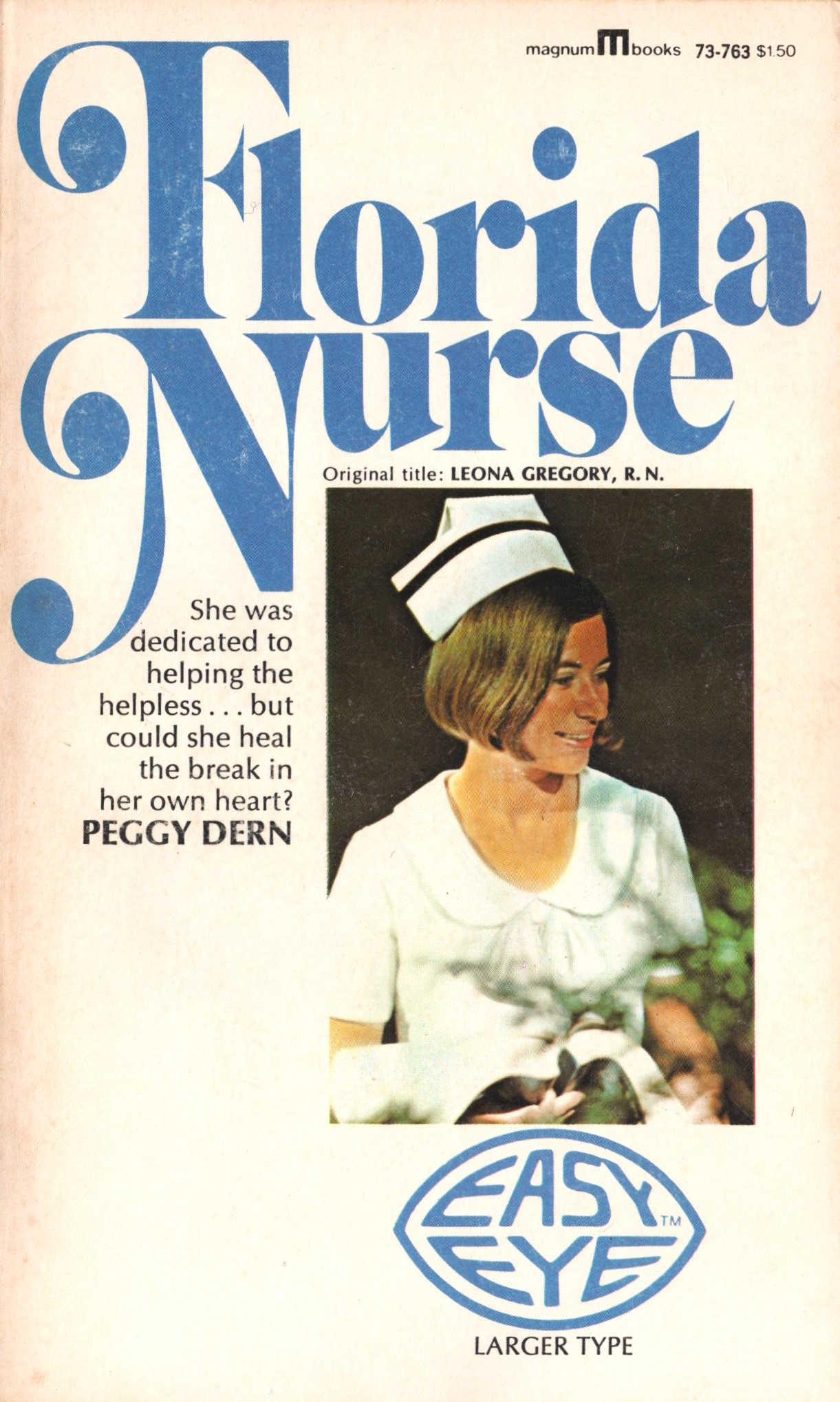
Florida Nurse

By Peggy Dern
(pseud. Peggy Gaddis), ©1961
Also published as Leona Gregory, R.N.

The daughter of a doctor, Leona Gregory had known since earliest childhood that she wanted to be a nurse. She had always thought that that would mean working with her father. But now that Dr. Gregory had married a young wife, Leona felt out of place in the household. The young R.N. gratefully accepted a position in a hospital in Cypress City on the Gulf Coast, even though she was afraid it would cut her off from everything she had known. Meeting the cold, beautiful supervisor of nurses, Paula Ingram, and the stern disciplinarian, Dr. Foster, who headed the hospital, seemed to confirm her fears. But Leona also found an opportunity for service she could not have had elsewhere. Then too, there was the handsome, charming senior intern, Cole Jordan … and, working with him, Leona began to feel that her heart might find wings again.

GRADE: C-

BEST QUOTES:
“Nothing is as inevitable as canned peaches in the hospital dining room.” 

“Well, well, so you’re going to be my special nurse. I feel a bad relapse coming on. I may be here for months.”

“When people are sick or hurt, a nurse’s uniform or a doctor’s is just about the most beautiful thing in the world.”

REVIEW:
It’s entirely possible that it took author Peggy Gaddis, here writing as Peggy Dern, less time to write this book than it did me to read it. The continuity and logic failures are numerous, and Gaddis frequently uses conspicuous words more than once in the same paragraph. Furthermore, this is not the first Gaddis heroine we have met named Leona (see also Nurse in the Shadows). 

Here, Leona Gregory is leaving the “brutal winters” of—not Chicago or Buffalo—Atlanta! a climate so inhospitable that to stand on the doorstep and ring the doorbell is to court pneumonia. Though she tells her father that it’s the frigid temperatures that are driving her to abandon the dream that they have held since she was nine—she was to work as a nurse in his office—the real fact is that it’s Leona herself who is bitterly cold. Her father remarried two years ago to a lovely woman named Irene who attempts repeatedly to befriend Leona only to the rebuffed again and again, and finally Leona is packing her bags and huffing off in a jealous pout for the Florida Coast.

Arriving, apparently not having bothered to interview for the job before signing a one-year contract, she is stunned to find that the head nurse and the chief doctor are unfriendly and militant disciplinarians. She befriends nurse’s aide Alma Pruitt, who appears to have bipolar disorder given the way she caroms between hysterical laughter and hysterical tears from one paragraph to the next. She also meets Dr. Cole Jordan, the up-and-coming surgical resident who always insists on commenting on Leona’s looks; bachelor number two is Bruce McLain (also spelled MacClain), who recently inherited a very lucrative ranch in town. Carol Decker is the daughter of the housekeeper on Bruce’s ranch, and though the original owner of the ranch left Carol and her mother well off, Carol has her sights set on Bruce’s larger fortune.

With three women and two men, it’s a game of the musical chairs to find out who is going to end up alone—and with Carol acting the part of the “weirdie,” “mental case,” and “spiteful malicious cat,” she is clearly the one we are not supposed to like. But honestly none of the women are terribly attractive—there’s Leona’s inexplicable animosity toward her lovely stepmother Irene, and Alma Pruitt herself engages in quite a few unattractive games to snare a man, such as pretending she has a fiancé in Tampa; her wild mood swings are also alarming, as she is usually in tears at some point in every scene in which she appears.

So what’s the plot? I mean, beyond thin and implausible? Well, Bruce has been thrown from his beloved horse and saved from paralysis when Dr. Foster plucks a miniscule bone fragment from his spine, and now Bruce has to lie in the hospital for weeks. But Leona is assisting in the surgery and hears Bruce mumble just before he’s going under, “Don’t let anything happened to Starlite.” So when Carol vows to have the horse shot, Leona peels off her scrubs and flies out to the ranch to prevent the murder because “it’s part of the nurse’s job to catch the faintest whisper from the patient and try to do what he asks,” apparently even if it means abandoning her shift. I hope one of my patients will ask me to make a Starbucks run.

Now the thwarted Carol is gunning for Leona—and soon the sheriff turns up at the hospital to arrest Leona because the horse has gone missing, and based on this accusation alone, the sheriff plans to toss Leona in jail. It seems a rather flimsy basis for legal system, but then this is Florida. Out on bond, Leona decides that Carol “will continue to harass me and the hospital as long as I am here.” So despite the fact that Dr. Foster has not agreed to release Leona from her contract, she decides she is quitting—Dr. Foster has better grounds for lawsuit than Carol does, but never mind about that.

Leona goes to tell Bruce goodbye, that she is going back to Atlanta to work with her father after all. “Her father would be overjoyed; and she and Irene would be friends!” This shocking transformation of character, we are told, occurs because “when I fell in love with Bruce, I suppose I sort of grew up.” Here’s surprise number two—she and Bruce, who had spent exactly two afternoons together, are madly in love and will be married the minute Bruce leaves the hospital! And Leona will be leaving her career too, because even though Bruce has expressed no opinion on the matter—and never mind about Leona’s pesky contract—“I’m going to do whatever Bruce wants me to do, always.” Irene tries to talk sense into Leona by saying, “In a successful marriage there is no necessity for a boss. It’s a partnership; an equal partnership; fifty-fifty all the way.” Nonetheless, though she has declared that nursing is vitally important to her, Leona insists on quitting a hospital so short-staffed that “there simply isn’t time for any of us to sit down and hold the families’ hands or soothe them.”

Ultimately this is a carelessly written book with stupid characters, compounded by a large helping of bigotry against the local Seminole population and the poor whites in town as well. (There’s another penitential donation going to the American Indian College Fund from the White Doctor Foundation.) Dr. Foster shouts at a family reluctant to put their five-year-old daughter to surgery for a possibly benign tumor based only on his say-so—in a conversation held in the hospital lobby, no less—and the head nurse explains the doctor’s shocking rudeness (not to mention privacy violation) by saying, “he simply has not the patience or the time to put up with ignorant, stupid creatures”—and Leona is shocked that the nurse thinks Leona might be critical of this approach.

Peggy Gaddis always wants to have everything both ways—Leona couldn’t possibly criticize a doctor for calling it “nonsense” to explain a surgery (these days it’s called “legal consent”), but we are supposed to like Dr. Jordan a lot more because he does. Some characters say some really appalling things about the Seminoles, and these remarks pass without comment, but Indians competently staff the hospital and ranches in town (and ultimately save Bruce’s horse). Women are strong, competent workers who manage large farms and hospital wards, but they chuck it all to land a man. Alma schemes to lure in her crush, including lying about a fiancé and flirting with men in whom she has no interest, but Carol is the one who is called a “scheming cat” for her desire to win Bruce. Alma never has a kind word to say about Carol but completely denies intending to hurt Carol’s feelings when Carol take offense. Every leading male character tells a woman at least once that he ought to “turn you across my knee and whale the daylight out of you!” Need I go on?

I’m ultimately not sure what author Gaddis herself thinks about her characters, but it seems clear to me that she does not have a high regard for women. That being the case, it’s hard for me to have a high regard for Peggy Gaddis or her books, and especially not this one.

Sunday, October 30, 2022

That Nice Nurse Nevin

By Jan Tempest, ©1963

Eight years ago Eunice Nevin had been rich and carefree. Now, her father dead in her money gone, she was a hard-working nurse. Her old home had become the hospital where she was now to work. With the love she had found for her new life be strong enough to overcome her nostalgia for the old?

GRADE: B+

BEST QUOTES:
“To be a successful beauty and heartbreaker, one has to have a certain mentality. One has to care passionately for admiration and for pleasing people. I don’t. I have to say what I think, and that doesn’t endear a girl to men.” 

“If money doesn’t talk, what’s the use of it?”

REVIEW:
Eunice Nevin is the sort of heroine it’s not hard to like. She’d been orphaned at 18 after an upper-class upbringing when her father was financially ruined making some risky investments and dropped dead from the shock. The icing on her tragic cake came when she’d been dumped by her handsome cad of a boyfriend, Eamonn Crail, so she’d moved to London and gone to nursing school. Now at 25 she has returned to her hometown and a hospital that has been established at her former home, so large and expansive were the house and grounds.

Eunice is soon drawn into the upper-crust circle of the Yaxley family, headed by social-climbing, scheming mother Shuna. Martin is the oldest child, and everyone seems to believe that Eunice is going to be the one who drags Martin to the altar, but she finds him to be a wishy-washy milquetoast who can’t stand up to his domineering mother. The younger twin girls, Tilly and Thyme, are fans of Eunice’s, as they had grown up watching her ride horses in competition—and usually win. Thyme has some sort of kidney disease and needs a transplant, while Tilly needs a transplant of her own—a spine, as she wants to pursue a career in music while her mother wants her to pursue wealthy men with royal titles, and mom is winning the battle. But behind mom’s back, Tilly has taken up with Eamonn—though he is actually in love with Thyme, who had turned him down because he is poor.

At the hospital, Eunice spars with 40-year-old urological surgeon Jupiter Janine, and it’s not hard to see where that’s headed. He appreciates her outspokenness, and kids her about the fact that she’s “known as ‘that Nice Nurse Nevin.’ Such a singularly inappropriate adjective for a personality as spicy as yours.” It’s admirable that she is such a feisty gal, but I continue to be perplexed and unsettled by the large number of Harlequin nurse novels that give the heroine away to a man more than ten years her senior—fifteen in this case.

The book is made more unique by its heavy concentration on riding, and we attend quite a few shows, ride frequently through the countryside, and admire numerous horses. As for our lead character, Eunice is also more unusual, a strong, outspoken woman, and only once declares, “it would be a real wrench to give up nursing,” but in the end plans to keep at it until she has children. The book has a good-sized cast of interesting characters (though Eunice’s girlhood best friend turns out to be a nasty, selfish witch, and it’s not at all clear why Eunice continues to interact with her), and overall the book has more than most VNRNs to make it worth reading. The writing isn’t witty or remarkable enough to push it into an A grade, but there is more than enough here to make for a nice read.

Thursday, July 28, 2022

Nurse Lister’s Millstone

By Marjorie Norrell, ©1968

Elizabeth Lister had unexpectedly inherited an immense fortune—but, far from making her happy, it only had the effect of becoming a millstone round her neck!

GRADE: B-

BEST QUOTES:
“Don’t let all the good times slip past your fingers, child. When you get to my age you can catch up on all the chores of living.” 

“Most Americans like to tour around a lot and see as much as possible in the shortest possible time, a few historic old ruins, places of literary interest and some very beautiful scenery.”

“Never act foolishly and pretend a compliment means nothing to you. Accept it as graciously as you would a gift of flowers or chocolates. Don’t give way to that foolish habit of disparaging yourself, just because you think it’s the right thing to do. Such an attitude only embarrasses the giver of compliment or gift.”

REVIEW:
Elizabeth Lister is an extraordinary nurse. She is so dedicated to her work that when her Uncle Harry unexpectedly leaves her $250,000—apparently a staggering fortune and not just a drop in the bucket toward your kids’ college educations—instead of quitting her job and enjoying the “lolly,” she continues to work, and considers how she might use her inheritance to “accomplish much to help mankind.” (It is curious, and perhaps due to a British sensibility, that leads almost everyone to conclude that Elizabeth is going to give away a substantial portion of her fortune.) Unfortunately, as soon as her friends hear about her good luck, they immediately shun her, “as though I’d some infectious complaint and they were afraid of catching it!”

The answer to this problem is, of course, for her to take a new job far away from her current situation, where no one knows about this “millstone,” which is how she refers to her money. There she meets Dr. Frank Tyler, who believes—the silly man—that “emotional involvement of any kind was definitely out so far as he was concerned for some years to come.” He’s planning on going into research, investigating leukemia, and has plans to apply for a grant from a pharmaceutical company, though that would mean all his discoveries would become the company’s property, to be sold for a profit. Elizabeth quickly decides she will use her money to build a clinic with a lab for the hot young doctor, no .

When he hears about this plan, Frank is overjoyed and deeply grateful! Oh, actually, no, I lied—in true VNRN fashion, he is outraged and cuts off their budding romance with little explanation, only later explaining, “I want to get to the top. But I aim to get there under my own steam.” It’s a ridiculous attitude, of course, because what is the grant that he is hoping to win but a gift? And isn’t every person’s success dependent on others—teachers, advisors, investors—who helped along the way? He compounds his hypocrisy by adding, “If you’d been anyone else, I might have accepted.” Elizabeth’s best friend points out that “he’s think himself doing the right thing, I suppose, if something horrible had happened and you’d asked him to share that!” These men can be so stupid, you wonder why you bother.

But it turns out that it doesn’t take long to convince Frank to accept the plan, though it still means they can’t be together, even though he loves her, but because he does not have “even a remote hope of being able to give you things, wealth, position equal to those you now have in your own right.” What a sexist snob!

The second half of the book is Elizabeth’s persistent efforts to win Frank over, which you know are preordained to succeed, though it takes the quintessential car crash combined with the old jealousy ploy to bring him around. The book is a pleasant read, even if it hinges on this ludicrous plot device. The characters are enjoyable, if not anyone I’d care to spend any extra time with. You could do worse, and it won’t be a complete waste of time, but it is likely to pass out of your head about as quickly as the money would have slipped out of your bank account if you had been the recipient of Nurse Lister’s fortune.

Monday, February 21, 2022

Behind Hospital Walls

By Ruth Dorset
(pseud. William E. Daniel Ross), ©1970
 
Also published as Head Nurse

Lena Mitchell’s life changed when her younger sister Jan came to work for her at Middleboro General. Jan was blonde, lovely, vivacious—but also, Lena knew, lacking the dedication she expected from her staff. When a patient of Jan’s died, Lena could find reason to excuse her—for the responsibility may well have belonged to an older doctor kept at Middleboro by political intrigue. Lena had vowed to aid young Dr. Jim Porter in his efforts to save the hospital from such corruption. To the last, she hoped for Jan’s help. Until Jan turned on her—and made a play for the man she loved.

GRADE: C

BEST QUOTES:
“Lena made a quick check of his condition and confirmed the fact that he was in a coma.” 

REVIEW:
Nurse Lena Mitchell works the night shift at Middleboro General, which is located in Massachusetts, 90 miles north of Boston—and never mind distance actually puts you well into New Hampshire. She has a problem in her younger sister Jan, who also went to nursing school, and who is “giddy and anything but a dedicated nurse. ‘I don’t intend to be one of those self-sacrificing nurses who wear their flat heels out on a hospital floor for fifty years. I’m going to marry me a rich doctor or patient, whoever offers first, and retire just as soon as I can,’” the lovely blonde had confessed on the day of her graduation from nursing school. So when Jan calls Lena, who is the charge nurse of her floor, and asks for a job, these qualities—even more than the minor issue of nepotism—should keep Lena from agreeing. “She really hadn’t had much choice,” we’re told, so Jan gets a job—and upon moving to Middleboro persuades Lena to move into a bungalow with her. Can you say bad idea

Premonitions prove accurate when, upon arriving in Middleboro, Jan immediately puts the moves on Dr. Jim Porter, a “young” man with graying hair who had just lost “a beloved wife” to cancer. Jim, who had been dating Lena, is soon paying Jan a great deal of attention, which does make you think a lot less of him, both for preferring looks to character and for moving on so quickly. And a third of the way into the book he’s proven himself to be even more fickle, dumping Jan to go back to Lena, just days after he’d asked Jan to marry him.

Jan doesn’t exactly help her cause; when she has skipped work to date a former patient who owns a club that is rumored to be “a rendezvous for underworld characters,” instead of firing her, Lena flat-out lies to Jim about Jan’s new boyfriend and tries to convince him to stay with Jan—but the next minute she’s kissing him. When Jan walks in on them, he tells her, “I make no apologies,” but then adds, “you should be wise enough not to enlarge on the meaning of what you saw,” suggesting that Lena means nothing to him. What a guy! Can he have one sister and kiss the other? Jan, anyway, knows a liar when she sees one and promptly moves out of the bungalow, leaving Lena in a lurch with now twice the living expenses to cover. Who saw that coming?

Elsewhere in the plot, Jim has been trying to convince the mayor to allocate funds to improve the hospital, but he is convinced that the mayor is so deeply embedded in corrupt schemes that there is no city money left over for the hospital. Then Lena, on her way to work, comes across a car crash at which the young female passenger flings a suitcase at Lena and runs away, and Lena finds the driver dead. Turns out the man is the assistant mayor, and the suitcase is full of cash—which is promptly stolen out of Lena’s locker at the hospital. How can she and Jim prove the graft that was not really evidenced by the now-missing money? Oh, and narcotics have been going missing for the past few months—could that be tied in? Only marginally, and there’s another bald spot on the tires of this bus.

It’s a fairly predictable storyline that wraps up unsatisfactorily. There’s the unsuccessful attempt on Lena’s life, but she’s had years of professional training to keep cool during emergencies, so she responds by screaming a lot. Then Jan turns out to be even more of an evil louse, but in the end she’s really sorry, because “I didn’t dream it would lead to this; that they’d try to kill you,” she says; she’d just been intending for her generous big sister to eat her heart out as a lonely spinster her whole life. “Can you forgive me?” Lena “smiled up at the pretty sister. ‘Of course,’ she said,” and that might be the worst, except that Jim implies Lena will be giving up nursing, as he tells her, “From now on I have other duties in mind for you.” I’m no fan of William “Dan” Ross, who has a habit of creating shallow, unlikeable heroines (see Five Nurses and Resort Nurse, for two egregious examples). This isn’t his worst book ever, but unfortunately that’s the best I can say about it.

This book was also published under
the provocative title Head Nurse
but with an equally hideous cover 


Monday, August 2, 2021

Special Duty

By Arlene Hale, ©1970 

When Dr. Taylor assigned her to special duty, lovely, auburn-haired Margo McKim felt a sense of pride—and also relief. Perhaps if she poured all her energy into her work, there would be no time left to brood over a love that was lost … but not forgotten. But the assignment only created new problems. Because the patient was famous folk singer Jedd Buckley, the case was kept secret. And his illness itself was shrouded in mystery. What had really caused Jedd’s breakdown? Why was his manager Steve so hostile towards Margo’s help? Why had the handsome, cool-headed Dr. Taylor insisted on her for assignment? Whatever mysterious motives lay behind this case, it was soon no secret that Jedd, Steve, and even Dr. Taylor all were looking at Margo not only as a nurse … but as a woman. She had thought that work would help her run away from love—was she actually running towards it?

GRADE: C

BEST QUOTES:
“Being late is just a form of being dishonest, you know.” 

REVIEW:
Dr. Alex L. Taylor has just relocated to White Hill Hospital from Topeka, Kansas, and the man “has a way of walking by people as if they were sticks of furniture. Did you ever see him smile? … It was inconceivable that he knew any of them by either their first or last name. They were simply women in white. When he wanted one of them, he crooked a finger and expected her to follow obediently behind him, do what he ordered.” Naturally, every nurse in the place is hot for him. 

Except for Nurse Margo McKim. Sure, he’s handsome, but “that holier-than-thou attitude is for the birds,” she thinks. So she’s the one he calls up, arrogantly insisting she meet him at the Oasis Club, to discuss a private duty job he wants to hire her for. He’s got a top-secret patient whose “nerves are shot,” or so the official diagnosis goes. “You have a good figure. You’re also a pretty woman,” he says to Margo. “Just exactly the kind of nurse I’m looking for.” He even asks her if her auburn hair is real, if you can believe it, which of course is what makes for a good RN.

She agrees to take the job, which is to nurse rising folk singer Jedd Buckley out of his stupor. Manager Steve Ryan is extremely concerned about Jedd’s mental health: “You’ve got to have him on his feet in time for Dick’s Discotheque opening,” he insists. “Big deal. Big money. Big publicity. You’ve got to have him ready for it. He sure isn’t ready to crack up! I can just hear what talk that would cause—he might even lose some juicy contracts.” How sweet!

Almost immediately after arriving at Jedd’s mansion, she regrets taking the job when Steve snaps at her, “What I say, goes. And whether you agree or not, I know what I’m doing, and I know what’s best.” But her reward, outside of a big paycheck, is that Dr. Alex is going to see her every day, and he ends his first visit with a kiss. “I’m not just a cold fish after all. There’s hot blood in my veins,” he tells her. So hot that he starts their first real date by assaulting her in the car. She slaps him, and “he reached for her again and he kissed her until she struggled free.” She jumps out of the car and starts walking back to the house, but Alex says he’s really sorry, so she gets back in the car, they have a lovely picnic, and she kisses him back for real when he drops her off at the end of the day. I really don’t understand why it’s so common in VNRNs for women to end up dating, often happily, a man who’s assaulted her.

Back at the mansion, Margo slowly warms up Jedd, whose recovery is aided by numerous pills, because “tranquilizers will help him get a grip on himself.” Eventually he opens up enough to take her on a walk in the woods to meet Zeke, who is the father of a woman he’d been in love with back home, but whom he’d left behind to be a star. Of course, it’s obvious that Sallie Mae is the reason why Jedd has gone into this funk, but it takes everyone else 75 pages and a crisis in which Jedd grabs a rifle and holes himself up in a cave to figure this out.

At this point in the book, everyone, including Jedd’s oldest friend Charlie, who has stood by him through it all, is revealed to have had a fiscally related motive for pushing Jedd to succeed as a performer. Even Margo falls into the pattern of treating Jedd like a show pony who just needs to be whipped a little harder when she tells Alex, “Jedd shouldn’t be allowed to throw in the towel on his career. He has far too much to offer!” Curious that in all this book, no one once asks Jedd what he wants, even in the explosive crisis.

Thank goodness, though, for Nurse Margo, who runs up to the cave with Jedd’s bullets whizzing past her ears to tell him that she’s directed Steve to fly to Tennessee and pick up Sallie Mae on a chartered jet, so hadn’t he better get back home and shave? Everything is quite predictable after this point, though to be honest, it was predictable from the first mention of Sallie Mae’s name. For Margo’s love life, there is a limp red herring in the form of Steve, who has a turn at assaulting Margo and then asking her to be his girl. She mulls it over for about three seconds, and spends twice as long considering Greg Walters, the first man she ever loved, who broke her heart and rendered her an iron maiden, and who makes no actual appearance in the book. But in the end she’s cured of her frigidity as easily as Jedd is cured of his dystonia and homicidal ideations. All you need is the right person in your life!

It’s more than a little disconcerting that not one person in the book puts Jedd’s well-being above his potential as a star; we never hear a single word from Sallie Mae, so we have only the fact that she’s from the sticks and knew Jedd before he was successful to vouch for her character. But Charlie had those same credentials, and look how he turned out! As Jedd pulls himself together and wows them at Dick’s, all the leading players in his crackup express remorse at how selfish they’ve been, but it rings false to hear their regrets only after their own admittedly juicy slice of the pie has been reassured.

The treatment of Jedd in this book as a commodity to be jollied into giving up what everyone wants is not far removed from how the men treat Margo, so that’s a disturbing narrative twin in this book—again, not something that’s ever discussed. The story and the writing are ordinary and serviceable, neither being especially interesting, and the characters are no better. Arlene Hale is not my favorite writer, having garnered a less-than-C+ average in 21 reviews, and unfortunately for me, she was as prolific as she was ordinary. So if it is my duty to read her books, they are seldom special, and Special Duty is true to form.