Showing posts with label Florida. Show all posts

Wednesday, April 2, 2025

Nurse in Danger

By Maisie Greig, ©1955

The steward laid a small table for them in the cabin and set silver and a pink-shaded lamp upon it: the white cloth reflected the soft light so that suddenly Jane felt she was in some exclusive nightclub. It really was very romantic. As the boat dipped gently she could see through the porthole the silver-crested waves, the moonlight cutting a path through the dark waters … but how could one feel romantic, when dining with a man who obviously intended to murder you at the first possible opportunity?

GRADE: B-

BEST QUOTES:
“You talk as though you were a Commie.” 

“If you don’t have a pretty fair opinion of yourself, what’s the good of going on living?”

“You have spunk, Jane, as well as a fertile imagination, and those qualities I admire in a woman. That and a nice little body.”

“You lack complete understanding of other women, Jane. They like to be hit about, they like to grovel. It’s the slave complex.”

“Perhaps in the last analysis you can take anything for yourself, it’s only when you see others punished and humiliated before your eyes you finally revolt.”

REVIEW:
Jane is another orphan nurse who has landed the lucky job of caring for a wildly wealthy young widow, Elsa Spiegal. Well, mostly she’s just a companion, but “in case she had another of those wretched heart attacks she wanted Jane to be along.” So Jane relocates from England and follows Elsa everywhere: “the Colony, Sardis, the Algonquin, the 21 Club.” And she’s hot, too! “She had slim and shapely legs, one of the reason many of the weary habitués of the Stork Club or the El Morocco half turned in their chairs and watched her samba.” Which unfortunately isn’t working out well: “That may have been one of the reasons why Mrs. Spiegal seemed to have turned rather cool towards her lately, almost to resent her.”

Or maybe it’s the fact that Professor Dick Creswell seems to like her. “Reputedly he was a mineralist and geologist of distinction,” but he had also inherited a lot of money and is hosting this fabulous party on his yacht. But instead of flirt with Dick, she is forced to listen to Mrs. Palmer cry, because her three-year-old was kidnapped more than two weeks ago, and no one at this silly party cares at all! They don’t: “We’re all very sorry for her and all that, but she is becoming a bit of a pest,” snorts Dick, earning his name. But Jane is able to shrug off his callousness and accompany him to his cabin where he shows Jane and Elsa his jewelry collection. Elsa, “reputed to have one of the finest collections of diamonds in the whole of the United States,” exhorts Dick to lend her a diamond watch for an exhibition, and then casually details her entire security arrangement, including the fact that Jane knows the combination to the safe and will be home alone for a week while Elsa is away. Now Jane demonstrates more sense, appreciating an “atmosphere she’d been conscious of when she’d first stepped on to the yacht, a disturbing, even a frightening undercurrent of suspicion, it might even be danger.” Well, we know it’s danger, since it says so right there on the cover!

She meets a young seaman on board who ridicules the other guests, pointing out their callousness toward others, Mrs. Porter being a case in point, and Jane reluctantly agrees—well, they’ve been so kind to her! He’s caught talking to Jane by Dick, who tells her that the man is an attempted thief whom he has hired in an attempt to set him on the straight and narrow with hard, honest work. Then he tells her that Elsa is wildly jealous because he is attracted to Jane and kisses her in the moonlight, the cad. Now the young innocent nurse is tortured about her own feelings for him, and his for her, when we savvy VNRN readers know the truth! Guess who enters Elsa’s apartment days later on the aforementioned day when Jane is there alone, sporting a small automatic pistol? He empties the safe, and kidnaps Jane, making it look like she herself was the thief. “Her only hope of fighting him was to pretend to acquiesce and, the chill though struck into her heart again, her only hope of living.” He drags her on board his yacht again, setting sail for who knows where? There she meets the sailor again, and he scorns her as a cheap tramp who has come on a cruise unchaperoned with a man she’s just met. She doesn’t dare to set him straight since Dick has suggested that she will “be a good girl” or be killed, and she interprets this as not telling anyone she’s a prisoner.

The seaman does warm to Jane, even kissing her before she even knows his name, and enlists her help in a scheme. He somehow manages to make Dick fall down a staircase, breaking his arm, and Jane injects him with some drug that knocks him out for 24 hours. While he’s out, she pokes around in his room and finds a child’s book that she recognizes as belonging to poor Mrs. Palmer’s kidnapped daughter Sally! Now we have question marks sprinkled across every page like ants at a picnic. They’re usually stupid questions Jane is asking herself repeatedly, though if she gave things an actual minute of thought she could likely figure out the answer. Now that Dick is her patient, though, he’s a lot more sympathetic toward her, and she convinces him that she’d been casing Mrs. Siegel’s jewelery collection a lot longer than he had, and he owes her half his profit from the heist. And it turns out that Jane is quite the actress! “He was beginning to be afraid that there might come a time when his emotions might interfere very seriously with his cool judgment” when it came to Jane.  Then she’s off to hide behind the life boats with Jaspar, kissing him “in the throes of her first big love affair.” That was fast! “They were in grave danger of their lives, but they were young and they were in love, and for that moment nothing else seemed to matter.”

We do get into some interesting philosophical discussions regarding wealth and its distributions, ideas that have more relevance in this day and age. “Why should a stupid woman like Elsa Spiegal have some of the world’s best jewels?” asks Dick. “What has she done to deserve them? What has she given to the world?” He, working as a professor, “contributed much to the world’s knowledge,” but had only a “pittance.” I have to admit I agree with his position—tax wealth, not work!

More philosophy ensues when a man is thought to have attempted to signal a passing ship, and Jaspar is ordered to throw the man overboard to the sharks. Now Jane is arguing with herself because she is still in love with Jaspar. “What a madly illogical thing love was,” she thinks. “Sometimes you hated yourself for living, and yet there it was, the strongest force in life that throbbed through your veins and blood. It couldn’t be killed by disillusion, however bitter; and while you despised yourself there was something in your heart that still sang with joy.” I don’t think love is quite as immortal as she would make out, otherwise the divorce rate might be a bit less than it is. But Jane seems to have some odd ideas about love; in the climax of the book Jaspar is rather vicious to several of the villains, but Jane decides that Jaspar is a “savage brute,” but “Savage brute or not, I’d die if I wasn’t going to be married to him!” He shows up at just that moment and she tells him she thinks he’s a brute, “and now hgis hard, blunt-fingered hands gripped Jane’s shoulders. ‘I’ll show you how much more of a brute I can be when I’m married to you, my girl,’” he answers, and shakes her. Stunningly, she neither runs screaming nor calls off the engagement, but says, “I don’t care if you beat me up every day, so long as you keep on loving me.” Just wow.

Overall the writing is engaging, though it does indulge in way too many rhetorical questions. The book’s biggest flaw is that Jane as a character is utterly bipolar. One minute she is coolly lying her head off to get out of a dangerous situation with the Professor, and then she’s shrieking hysterically during an escape in which the slightest sound could get them caught. Her over-the-top feeling for Jaspar based on a total of ten minutes in his company is completely unbelievable, and then when he is increasingly proved to be alarmingly domineering, her unswerving devotion to a future as an emotionally if not also physically abused wife is baffling. Author Maysie Greig’s lovely Doctor’s Wife had given me high hopes for her work, but now three additional books all written in the 1950s and lacking that book’s charm makes me think that early work, written in 1937, exhausted her genius. There seems to be another half-dozen nurse novels by Ms. Greig, so time will tell, but I’m not making any bets they’ll get much better.

Sunday, July 30, 2023

A Nurse Called Happy

By Peggy Gaddis, ©1963

“We have a date to fall in love,” Dr. Norman Hewatt said softly.
“I haven’t forgotten,” Nurse Happy answered, but she couldn’t meet his eyes.
“I’ve been thinking about you and that Rustin fellow.” Dr. Norm’s voice was suddenly bitter. “Don’t you know better than to fall for that line of his?” Before Happy could answer, Dr. Norm caught her in his arms and kissed her—hard and thoroughly. “That’s what love is all about,” he said huskily and walked away.
Happy stood there, her face over her hot face, trembling from the force of his kiss. And shaken to the depths of her being …

GRADE: B-

BEST QUOTES:
“I would stop being a nurse, Norm, if I didn’t think of my patients as people and worry about them.” 

“Some day soon, she promised herself, she’d have a much larger office and her own secretary and she would work at her desk wearing a hat—the status mark for women executives.”

“Women are funny critters, son.”

“There are strait-jackets waiting for men who try to understand women!”

REVIEW:
Nurse Hallie Gibson is known by the nickname Happy, but she’s having a crying jag on the Florida pier because yet again she has interfered overmuch in her patients’ lives, in this case bringing one newborn baby that is to be put up for adoption (because his show-biz parents are too busy to raise a baby) to a woman who has lost her third child and all hopes of having another, and suggesting that the woman adopt the baby herself. Happy’s “good friend” Dr. Norman Hewatt, hearing of this incident, only says, “Your intentions are always of the very best, but you are impulsive.” The fact that she manages to keep her job at all is frankly shocking, but apparently they’re hard up for nurses at Gulfside Memorial. 

The plot hinges on an accident that is brought in: Elderly Ethel Kingsley tripped when stepping off the curb and fell in front of a car driven by Vernon Rustin, who does not appear to have actually struck the woman, but she’s going to need two weeks in the hospital to recover from those scraped knees. Vernon is sincerely devastated by his nonexistent part in the accident and pays for all Ethel’s hospital and visits with her and her husband Josiah daily—and keeps old Josiah company outside of visiting hours. Soon he’s smitten with the folksy and kind Kingsleys, and wants to “adopt them as the parents I never had,” he declares. Soon he’s calling them Mom and Dad and deciding that in that old folks’ home where they live, “they have nothing to do and nothing to hope for,” which he plans to remedy.

But the problem is the Kingsleys selfish, driven daughter Jennie-Sue, now going by Janine (and who could blame her?), who persuaded her parents to sell the farm and move into that old folks’ home, where they’re not allowed to chat when the TV is on, so she could buy a junior partnership in the advertising agency where she works. She’s a beautiful but cold young woman whose only concern is that the hospital bills are paid by someone else, and the poor emotionally crippled lass can’t bring herself to be cordial even when she discovers that they will be. (One does wonder, if the Kingsleys are so great, how they managed to raise such a horrible child.) But when Vernon finds a new home for the Kingsleys, an island hunting lodge in need of caretakers, where he proposes to set them up and live there with them himself forever and ever, Happy’s friend Dr. Norm is, not unreasonably, suspicious. “I would like to know why a man his age should be wiling to bury himself here on this lonely, isolated island just to provide a home for two old people who are nothing to him,” he says to her. “Hadn’t you realized what a perfect spot it might be for a man who wished to cut himself off from unpleasant, maybe even criminal activities?”

Janine shows up on the island intent on marrying Vernon, though she can’t bring herself to even smile or offer one pleasant sentence, so it’s hard to believe she is going to pull that off, though she threatens her parents that she won’t “allow” them to live on the island, and the fact that Ethel and Josiah are competent adults who don’t need her permission to do anything is utterly ignored.

It turns out Norm is wrong about Vernon—you see the truth coming a mile away—who is actually fairly wealthy, but Norm is justifiably jealous because Vernon takes no more time to fall in love with Happy than he did with the Kingsleys. Norm has decided that when he has a little more time and money he will become involved with Happy. “Some day you and I have a date to fall in love—remember?—the first chance we get when we have a few hours off,” he says.

But Happy calls out Norm on his hypocrisy, saying, “I don’t think I care very much about that kind of love; the kind that wants to tuck me into a corner of a mind that will be busy with other things and just has a minute to fling at me once in a while. Doctors aren’t supposed to be human enough to fall in love without setting certain times and places and being sure that romance won’t interfere with their practice?” But when she finally receives a proposal of marriage, she is only furious that it occurred in the hospital cafeteria. “How dare you say that here in a room filled with people? Where’s your sense of romance? Where’s your instinct for building memories that will last all our lives?” Several stupid pages of absurd bickering ensue, and then everything is wrapped up.

That’s about all there is to this book, and it’s not often you find a book with so little plot, but then author Peggy Gaddis is known in these electronic pages for work that is generally mediocre at best and alarming at worst. Here she is not equal to her best books—that would be Nora Was a Nurse, Hurricane Nurse, and The Doctor’s Wifebut we also escape her penchant for racism and hypocrisy. A win for us! But overall not really enough of a reason to bother with A Nurse Called Happy.

Monday, October 31, 2022

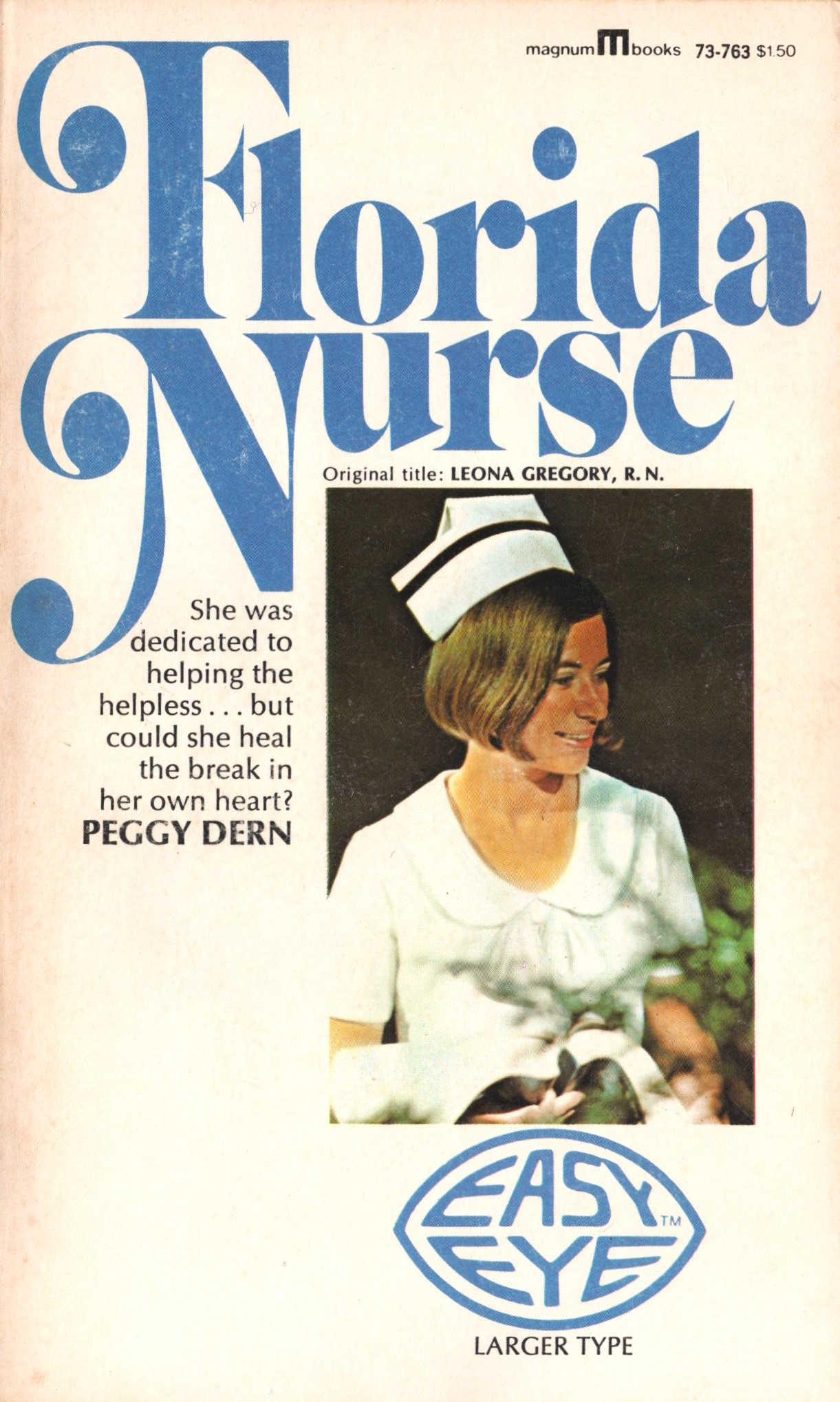
Florida Nurse

By Peggy Dern
(pseud. Peggy Gaddis), ©1961
Also published as Leona Gregory, R.N.

The daughter of a doctor, Leona Gregory had known since earliest childhood that she wanted to be a nurse. She had always thought that that would mean working with her father. But now that Dr. Gregory had married a young wife, Leona felt out of place in the household. The young R.N. gratefully accepted a position in a hospital in Cypress City on the Gulf Coast, even though she was afraid it would cut her off from everything she had known. Meeting the cold, beautiful supervisor of nurses, Paula Ingram, and the stern disciplinarian, Dr. Foster, who headed the hospital, seemed to confirm her fears. But Leona also found an opportunity for service she could not have had elsewhere. Then too, there was the handsome, charming senior intern, Cole Jordan … and, working with him, Leona began to feel that her heart might find wings again.

GRADE: C-

BEST QUOTES:
“Nothing is as inevitable as canned peaches in the hospital dining room.” 

“Well, well, so you’re going to be my special nurse. I feel a bad relapse coming on. I may be here for months.”

“When people are sick or hurt, a nurse’s uniform or a doctor’s is just about the most beautiful thing in the world.”

REVIEW:
It’s entirely possible that it took author Peggy Gaddis, here writing as Peggy Dern, less time to write this book than it did me to read it. The continuity and logic failures are numerous, and Gaddis frequently uses conspicuous words more than once in the same paragraph. Furthermore, this is not the first Gaddis heroine we have met named Leona (see also Nurse in the Shadows). 

Here, Leona Gregory is leaving the “brutal winters” of—not Chicago or Buffalo—Atlanta! a climate so inhospitable that to stand on the doorstep and ring the doorbell is to court pneumonia. Though she tells her father that it’s the frigid temperatures that are driving her to abandon the dream that they have held since she was nine—she was to work as a nurse in his office—the real fact is that it’s Leona herself who is bitterly cold. Her father remarried two years ago to a lovely woman named Irene who attempts repeatedly to befriend Leona only to the rebuffed again and again, and finally Leona is packing her bags and huffing off in a jealous pout for the Florida Coast.

Arriving, apparently not having bothered to interview for the job before signing a one-year contract, she is stunned to find that the head nurse and the chief doctor are unfriendly and militant disciplinarians. She befriends nurse’s aide Alma Pruitt, who appears to have bipolar disorder given the way she caroms between hysterical laughter and hysterical tears from one paragraph to the next. She also meets Dr. Cole Jordan, the up-and-coming surgical resident who always insists on commenting on Leona’s looks; bachelor number two is Bruce McLain (also spelled MacClain), who recently inherited a very lucrative ranch in town. Carol Decker is the daughter of the housekeeper on Bruce’s ranch, and though the original owner of the ranch left Carol and her mother well off, Carol has her sights set on Bruce’s larger fortune.

With three women and two men, it’s a game of the musical chairs to find out who is going to end up alone—and with Carol acting the part of the “weirdie,” “mental case,” and “spiteful malicious cat,” she is clearly the one we are not supposed to like. But honestly none of the women are terribly attractive—there’s Leona’s inexplicable animosity toward her lovely stepmother Irene, and Alma Pruitt herself engages in quite a few unattractive games to snare a man, such as pretending she has a fiancé in Tampa; her wild mood swings are also alarming, as she is usually in tears at some point in every scene in which she appears.

So what’s the plot? I mean, beyond thin and implausible? Well, Bruce has been thrown from his beloved horse and saved from paralysis when Dr. Foster plucks a miniscule bone fragment from his spine, and now Bruce has to lie in the hospital for weeks. But Leona is assisting in the surgery and hears Bruce mumble just before he’s going under, “Don’t let anything happened to Starlite.” So when Carol vows to have the horse shot, Leona peels off her scrubs and flies out to the ranch to prevent the murder because “it’s part of the nurse’s job to catch the faintest whisper from the patient and try to do what he asks,” apparently even if it means abandoning her shift. I hope one of my patients will ask me to make a Starbucks run.

Now the thwarted Carol is gunning for Leona—and soon the sheriff turns up at the hospital to arrest Leona because the horse has gone missing, and based on this accusation alone, the sheriff plans to toss Leona in jail. It seems a rather flimsy basis for legal system, but then this is Florida. Out on bond, Leona decides that Carol “will continue to harass me and the hospital as long as I am here.” So despite the fact that Dr. Foster has not agreed to release Leona from her contract, she decides she is quitting—Dr. Foster has better grounds for lawsuit than Carol does, but never mind about that.

Leona goes to tell Bruce goodbye, that she is going back to Atlanta to work with her father after all. “Her father would be overjoyed; and she and Irene would be friends!” This shocking transformation of character, we are told, occurs because “when I fell in love with Bruce, I suppose I sort of grew up.” Here’s surprise number two—she and Bruce, who had spent exactly two afternoons together, are madly in love and will be married the minute Bruce leaves the hospital! And Leona will be leaving her career too, because even though Bruce has expressed no opinion on the matter—and never mind about Leona’s pesky contract—“I’m going to do whatever Bruce wants me to do, always.” Irene tries to talk sense into Leona by saying, “In a successful marriage there is no necessity for a boss. It’s a partnership; an equal partnership; fifty-fifty all the way.” Nonetheless, though she has declared that nursing is vitally important to her, Leona insists on quitting a hospital so short-staffed that “there simply isn’t time for any of us to sit down and hold the families’ hands or soothe them.”

Ultimately this is a carelessly written book with stupid characters, compounded by a large helping of bigotry against the local Seminole population and the poor whites in town as well. (There’s another penitential donation going to the American Indian College Fund from the White Doctor Foundation.) Dr. Foster shouts at a family reluctant to put their five-year-old daughter to surgery for a possibly benign tumor based only on his say-so—in a conversation held in the hospital lobby, no less—and the head nurse explains the doctor’s shocking rudeness (not to mention privacy violation) by saying, “he simply has not the patience or the time to put up with ignorant, stupid creatures”—and Leona is shocked that the nurse thinks Leona might be critical of this approach.

Peggy Gaddis always wants to have everything both ways—Leona couldn’t possibly criticize a doctor for calling it “nonsense” to explain a surgery (these days it’s called “legal consent”), but we are supposed to like Dr. Jordan a lot more because he does. Some characters say some really appalling things about the Seminoles, and these remarks pass without comment, but Indians competently staff the hospital and ranches in town (and ultimately save Bruce’s horse). Women are strong, competent workers who manage large farms and hospital wards, but they chuck it all to land a man. Alma schemes to lure in her crush, including lying about a fiancé and flirting with men in whom she has no interest, but Carol is the one who is called a “scheming cat” for her desire to win Bruce. Alma never has a kind word to say about Carol but completely denies intending to hurt Carol’s feelings when Carol take offense. Every leading male character tells a woman at least once that he ought to “turn you across my knee and whale the daylight out of you!” Need I go on?

I’m ultimately not sure what author Gaddis herself thinks about her characters, but it seems clear to me that she does not have a high regard for women. That being the case, it’s hard for me to have a high regard for Peggy Gaddis or her books, and especially not this one.

Saturday, February 5, 2022

Nurse Julie

By Mary Mann Fletcher, ©1967

When lovely, blond Julie Blake saved the life of young Rammie Wynant—the frail, neglected son of millionaire Bram Wyant—even the arrogant Dr. Ben Foreman had a few words of praise for her. Certainly Julie was a brilliant nurse. But she was also a woman, and she soon found herself hoping that Dr. Foreman was gazing at her with more than professional interest. And when Julie suddenly found herself being courted by a mysterious stranger, the doctor’s jealous reaction suggested that his interest was not just her imagination. What were Ben Foreman’s true feelings toward Julie? And who was this enigmatic stranger who claimed to be just a beachcomber … but whose sophisticated manner suggested much more? A near tragedy revealed the truth about both men. Now Julie had to discover the truth about herself.

GRADE: C

BEST QUOTES:
“Any night of the week in emergency rooms of hospitals all over the world brings grief and heartache and harrowing sounds of pain and despair, but Saturday night brings more misery than has a right to exist.”

“Ben Foreman gives me a trachelodynia—that’s a pain in the neck, as if you didn’t know.” 

REVIEW:
I really do not understand why there is such a firmly established trope in nurse romance novels in which a moody, mean, distant man is exactly the guy our heroine tumbles for. Why is that a thing? It makes absolutely no sense, and yet here we are, for the hundredth time, meeting “easily the most unpopular doctor at Hope Hospital with the nursing staff, because of his rough manner and abrupt way of talking” and “black moods and general surliness,” Dr. Ben Foreman. One night, alone in the ED, Nurse Julie Blake oversteps her scope of practice and suctions a choking nine-year-old boy. Brusquely shoved aside when Dr. Foreman shows up, she talks to the housekeeper who’d brought the boy in and learns that he’d been eating peanuts, and suggests to the doctor that the kid likely aspirated one. Turns out she’s right, but Dr. Foreman can only chastise her for having taken off her regulation stockings in the hot Florida night. “But somehow every time she was around him, she found her heart beating faster and she had trouble keeping her mind on her work.” It’s hard to understand why a talented, intelligent woman doesn’t think she deserves better.

We are allowed into Dr. Foreman’s crabbed little mind, only to discover a personality deeply in need of therapy. He’s an orphan who had fought hard to succeed but was sponsored in medical school by a single rich man who essentially adopted him—so he certainly could have had it a lot worse. Ben has decided to be an “open-heart” surgeon, and “would have years and years of study ahead of him, as well as additional years of residency. He never thought of girls, never dreamed of marriage—he couldn’t afford such a luxury, not for at least another five years. His hatefulness toward Julie in the emergency room was a defense mechanism,” because he seems to believe that he can have either his career or a girlfriend, but not both. Come to think of it, this is exactly the choice the women are often forced to make: career or marriage? Except that for Ben, it’s a temporary sacrifice, whereas for the women, it’s permanent.

So throughout most of the book, we watch Ben being angry, hostile ass, and we watch her waffle: One minute she’s mooning over him and the next deciding that “she actually didn’t enjoy being with Ben—he was much too disagreeable to her, too likely to cut the ground from under her with a word or a look.” “Why should she be so anxious to please a man who either ignored her or insulted her?” Good question! And one that, unfortunately, we will never find a satisfactory answer.

A hundred pages into this fairly dull book, out of nowhere Ben walks Julie to the bus stop and kisses her goodnight. She’s struck starry-eyed, but the next day she’s off for the weekend to the home of the choking boy from the opening chapter, Rammie Wyant, invited by the housekeeper while Rammie’s father Bram is away on a business trip—a bizarre situation, completely unprofessional for both women. While sunning herself by the beach cabana, Julie meets a beachcomber and spends the afternoon frolicking in the sun with him, then out for a luxe date—“My goodness, twenty dollars for two dinners!” she exclaims. “What are you anyway—a millionaire?” Of course, the answer is yes, he’s Bram, hoping to get Julie to like him for himself, not his money.

Initially it seems like Bram will succeed, but then there’s a hurricane, and Ben and Julie are trapped in the hospital, caring for a house full of patients on a short staff—and even on a good night, Julie and one other nurse manage 17 patients (today, six patients for a night nurse is usually the max). The hospital, which in a side plot is on the verge of being closed down by cold, unfeeling real estate developers eyeing the hospital’s prime location on the Florida coast, is eventually saved as you knew it would be, but by an out-of-left-field bizarre coincidence that felt completely lame. In their joy, Ben and Julie start kissing on the sun porch, and somehow this is meant to signify that “it was Ben that she wanted, had wanted all along,” so there’s another disappointing ending, in which she discards a kind, thoughtful man who is happy to be with her for one who is an unmitigated jerk through much of the book. Author Mary Mann Fletcher seems to like horrible men, as she created several in the D-rated Psychiatric Nurse, a book so bad it might be worth reading. I’m not sure, though, that I find this C-grade book a step up, because in the end I can’t really recommend you spend any time on Nurse Julie.

Wednesday, August 12, 2020

Jane Arden Registered Nurse


Book 2 of 7
By Kathleen Harris, ©1956
Cover illustration by Victor Kalin

For three years Jane Arden had put her career before the only man she’d ever wanted. And now, when she was ready to combine the two, she discovered that this high-flying jet pilot had his head in the clouds, and his eyes on another girl. Jane had always claimed that a nurse was also a woman. Now she would have to prove it …

GRADE: C

BEST QUOTES:
“As you must know, your sister is employed. Most commendable in one so beautiful.”

“There’s no reason why she should slave, when she’s so ornamental.”

“I thought from the first minute we met that I wouldn’t mid dying if little Jane could be  my nurse and I could die in her arms.”

REVIEW:
As we pick up with Jane Arden, she has just completed her training and is looking around the world to decide what to do next. Her longtime young man, David Hyatt, is in Florida flying jets for the military, and it happens her haughty, self-centered older sister Roberta, who works as a model, lives in Miami, so Jane decides to surprise David by going to visit Roberta for a two-week vacation, and popping in to visit. David had never been wild about Jane enrolling in nursing school, feeling that he should be her “job”—so you not will be shocked to find out that he is also not pleased to find that Jane is in town, and he tells her that he has no time to see her. This gives Jane some pause about her relationship with David, but nowhere near enough.

In the meantime, Jane is hanging out with Nicky Powers, an artistic gadabout who is the nephew of millionaires, on whose estate the three are living. He’s actually the most interesting character in the book, and by far the most witty—all the Best Quotes above are from his lips; his only serious flaw is that he unfailing calls her “little Jane.” Jane, her heart mistakenly committed elsewhere, has no interest in Nicky but does like him a lot—and he of course is in love with Jane. To help pass Jane’s time, Nicky’s aunt Julia Friedmont has a convenient stroke, so Jane can step in to manage her care, extending her vacation indefinitely. Eventually David condescends to see Jane, and is cool to her, but Janes continues her unswerving and unexplained devotion to David; though “David had grown more and more surly,” “her heart seemed almost bursting with love.” Go figure.

David is working hard at his own career, which includes dating his commanding officer’s daughter, and he has failed to mention to that young lady that he’s engaged to Jane. After many, many pages of bad behavior from David—indeed, we see him demonstrate not one admirable quality—Jane and her friends drive out to see him, who based on the afternoon’s visit finally decides that Jane is the gal for him, and insists that they get married immediately. “She did hesitate, but only for a moment. Why should there be any uncertainty about her own love?” Well, any reader who’s been paying a modicum of attention could outline a goodly number of reasons why she should run screaming—and to add to the list, he demands “harshly” that she give up nursing. “I have to come first with the girl I marry,” he says. Jane thinks, “David would never be able to understand that nursing  meant as much to her as flying did to him,” and then agrees to marry him as soon as he gets back from this cross-country flight he has to make on an experimental aircraft, which I am absolutely positive is going to go off without even a hint of turbulence. “She must never let him know how big a sacrifice she had made,” she decides, and basically pins all her hopes on his eventually changing his mind: “Given time, he might come to see how important her nursing was to her and that it had nothing to do with her love for him.” Good luck with that. Even Roberta, who is never really kind on a day-to-day basis but comes through when the boys are treating her kid sister badly, is concerned that Jane is rushing into marriage with a man who has treated her “pretty shabbily.”

Back at the mansion, though, she’s realizing she has no time to plan a wedding that is so soon that her own parents can’t make it, and she’s having second thoughts—121 pages after the reader has seen the writing on the wall. She ponders whether she should tell David that she won’t give up working? No, let’s not get totally crazy. Instead she decides she will tell David they need to postpone the wedding and have a serious discussion of their plans, and that she’s going home and he must transfer to a base closer to her. Before she has a chance to demonstrate that she really can stand up for herself, even in this limited way, she is given the easy way out when David’s plane crashes and he is killed. Two pages later she’s headed home, with Nicky flying her there on his own plane (he’s a military veteran himself)—and that’s the end, to be continued in Jane Arden, Staff Nurse, and four more Jane Arden novels after that.

It’s hard to imagine that there is going to be all that much more to say about Jane Arden, who at this point in her life has proven herself to be shallow and immature with a shocking lack of self-knowledge, incapable of personal growth. In fact, we instead hear a lot about Jane’s promise to David, made as she was starting nursing school, “not to change”—despite the fact that “three years had changed him” into a “new David whom she felt she scarcely knew,” a “snob.” “If David were really like that, he could not be the man she wanted to marry, or the kind of man she could love”—the man she did with little hesitation agree to marry in the penultimate chapter. In this book Jane has proved herself to be thoroughly stunted as a human being, and the reader is left with all the frustration inherent in following such a person as they fail again and again to know their own mind, let alone say what they really think and follow through with action. There are five more Jane Arden books to go, and at this point I’m not optimistic they are going to improve.

Jane Arden Head Nurse

Book 5 of 7
By Kathleen Harris, ©1959

When Jane Arden took over as Head Nurse at the Friedmont Hospital, she knew that the job had many pitfalls. But it was an exciting challenge in a field she loved. Then she met Jeff Wallace, the young, outspoken Chairman of a strife-torn Hospital Board. Jane needed his support and his friendship. She saw him more and more. At first when people started to talk she didn’t care. But she had enemies who wanted to get rid of her any way they could. Suddenly Jane realized that her whole career was threatened—as well as her growing love for Jeff. Was it already too late?

GRADE: D

BEST QUOTES:
“A good-night kiss didn’t necessarily mean anything; in fact, it was not much of a compliment to a girl when a man didn’t want to kiss her good night after such a pleasant evening.”

“A man liked to do the pursuing, and Tony, more than most men, got scared off when the women pursued him.”

“Too much time, I sometimes think, is spent over charts when it’s the patient that needs the nurse’s time.”

REVIEW:
On some things we can completely depend: Death, taxes, and that Jane Arden is an infantile, heartless borderline psychopath. Here in the fifth volume (good news! only two more to go!) to chronicle her endeavors to jerk around as many men as possible, we find that she has returned to Florida, the site of the previous unpleasantness in Jane Arden Registered Nurse, but to inland “farming territory known as the Glades,” because she was too embarrassed about her appalling behavior to return to West Palm Beach. No, that’s not it—she is as clueless and self-righteous as ever and dives right in with her usual rapidly shifting realities as pertains to her men friends: On the second page she is only “tentatively engaged” to Dr. Anthony Gray, the NYC surgeon she has left behind for a year to work as head nurse and director of a children’s hospital (though she has maybe three years tops experience as a nurse, none of it in peds). Why the waffling? Either you’re engaged or your not—and Jane can’t decide which version of reality is more expedient.

First she claims that bastard Tony “was almost too willing to wait that long to get married and had never actually asked her again” after his first proposal after the phone—but how many proposals do you need? And what about that time at the airport when he’d said, “Don’t go, Jane. Let’s get married right away and the heck with everything!” Well, that doesn’t count, and neither does her own lack of commitment—“Jane had been the one to insist that they wait before making their engagement absolutely positive.” She hasn’t even told her parents about Tony’s existence, much less that they’re engaged, and somehow she can’t bring herself to mention him to Jefferson Wallace, farmer and hospital board chair, whom she dates in what is on her side an allegedly entirely platonic guise, because “it seemed silly” to mention it. Besides, “telling him about Tony might spoil their friendship,” based as it is on the lie of her relationship status. “Why spoil the evening—and take the risk of spoiling others that might follow?” thinks the narcissistic and manipulative Jane. And if Jeff doesn’t know about Tony, Tony certainly knows about Jeff, as Jane brings him up every time she writes or calls, because “she didn’t want him to be too sure of her, after all!” “If Tony didn’t want Jane to see too much of someone else—Jeff for instance—he ought to come visit her in Florida,” though he is a very busy surgeon and she could far more easily pop up to New York for the weekend. With fiancées like Jane …

Even her acceptance of the position at the children’s hospital is bipolar as well: On one hand she and Tony “had agreed that it was best for Jane to obtain a little more nursing experience” before she is married, though “that would mean abandoning her beloved nursing career,” so it’s not clear why she needs more experience. But one page later we find “she had had to accept this new position because so much pressure had been brought to bear on her; it would have been next to impossible to turn down the offer.”

Anyway, after she arrives in Florida and scores a free ride to the hospital from Jeff“when I start taking money from women—well, that will be the day,” he chivalrously declares—she allows him to think she’s visiting her sick child, never correcting his assumptions, though his own brusque, bossy and rude demeanor might justify her disinclination to engage more than necessary with the boor. Imagine her shock, and his, when she discovers he’s chair of the board, and he finds she’s the new director! He’s unduly pissy about it, feeling he’s been made a fool, and she’s unduly nasty back, likely because even if “she looked just like the Angel of Mercy men dreamed about waking up to find holding their hand and smoothing their fevered brow,” “here was one man not affected that way. Jane might just as well have been ugly and old and fat,” as if it’s justifiable to treat anyone rudely—but that’s not the point! How dare he! So when he eventually apologizes after the board meeting where they are officially introduced, “Jane’s response was cool and reserved; she had no intention of meeting him halfway, or showing that his apology was accepted.” When he asks if she minds if he smokes, “Jane did not mind in the least. But just to be perverse, she said that if she did not mind, she would prefer that he didn’t smoke. It amused Jane to have the upper hand even in such a small incident.” I really hate Jane Arden.

Though the warning signs are writ large, Jeff asks Jane out on Christmas, even though she’s promised to wait by the phone for Tony to call. New Year’s Eve finds them out together again, and soon Mrs. Griffin, shrew member of the board, is warning Jane that she’s being “indiscreet” by dating Jeff, though I’m not sure exactly what the objection is, but it appears that it’s having a personal life that’s objectionable. “It never pays for a young woman to get herself talked about. It is so easy for a girl to lose her good name. Men don’t always consider that they may be placing a young woman in a difficult situation so it is up to the woman to protect her good name. Then there is the good name of the hospital to be taken into consideration.” The morals police really go ballistic when Jane brings Tony to her sister Roberta and her husband Nicky’s house for the weekend. (Jane, true to her narcissistic form, takes complete credit for Nicky’s transformation: “She had turned a playboy into a man” when “she had been the one to encourage him in his art an insist that he take it up in earnest.” The truth being, as usual, not that at all: Jane had jerked Nicky around for a while, trying to decide if she should marry him even though she didn’t love him, eventually dropping him for the bird in the hand that was Dr. Tony, and now her insistence on their “brotherly-sisterly attachment” smacks a bit of sour grapes, since it was her sister who snatched him up after Jane kicked him to the curb.)

All but calling Jane a slut, Mrs. Griffin insists that Jane resign at once. However, encountering a crazed father sporting a sawed-off shotgun in the hospital one night, Jane saves the day and the entire hospital from a senseless massacre by karate-chopping the gun out of his hand. Now the town hero on top of local darling (after a newspaper article touts her finer points, which appear to be the facts that she is descended from Revolutionary War-era ancestors and that her brother in law is worth millions), Jeff pulls out his testosterone and “spoke in the masterful masculine way that his Jamaican houseboy had said a woman liked her man to use.” (And with this, continuing the pledge I made after reading White Doctor, I mailed off a check to the NAACP.) Jeff insists that Jane take to her bed after the incident, and “what could … a gal do when a man was as masterful as Jeff?” So when Masterful Jeff proposes, “now was the time to tell him about Tony,” but nope, instead she agrees, realizing that he’s the first of her string of unlucky beaux who feels she should keep nursing, and so she suddenly finds “a love she had never known before; a mature love,” though it can’t be that mature, a word we would never associate with Jane, because she decides she’s not going to tell him about Tony, “not now,” and though she decides she would have given up nursing if Jeff had asked her—having it both ways—in response to his proposal of marriage, she replies, “I think we should have three.” Children, that is. Jeff, rather than bolt for the nearest exit, seems stunned but remains rooted to the spot, so he’s stuck for now, until the next book and the next sap hoves into view. I count myself one such sap, since I’ll be there to witness Jane’s next infuriating adventure.

Jane Arden Space Nurse


Book 6 of 7
By Kathleen Harris, ©1962
Cover illustration by Lou Marchetti

As Jane embarked upon the most exciting adventure of her career, she was forced to postpone her marriage to handsome Jeff Wallace. Jane had no way of foreseeing the personal crisis that would confront her as a “space nurse.” Nor could she have anticipated the lasting impact of the two attractive astronauts she met at Cape Canaveral. Fascinating Clyde McLaren, a strong candidate for the moon shot, was brilliant and quite friendly. —Or did he want more than friendship? And what of the dashing continental Lieutenant who made it clear that he was more than interested in her? —Just where did his interest lie?

GRADE: C

BEST QUOTES:
“Any daughter of mine is going to devote her full time and attention to looking after me.”

“It sounded fantastic to Jane; she did not think such a project as setting up medical centers in space could happen soon—but then, not many people had though there would be television, jets, atomic bombs, missiles, wonder drugs for most fatal diseases—all the miracles of this Space Age.”

“I like your independence—it’s a challenge to a man. Every man prefers to do the chasing.”

“This whole affair was given so much publicity that a lot of suspects—enemies of our country—will be rounded up.”

“I imagine any man—anyone in pants—would do for the fair Jane. She likes to dangle all the scalps she can at her belt.”

REVIEW:
Nurse Jane Arden, who in previous books in this series had been assiduously striving to nail down the top berth on the Worst VNRN Heroines list, has in Jane Arden Space Nurse not been putting in the same superlative effort we’ve seen on our past encounters. I’m not quite sure how I feel about this. On one hand, I have avoided the usual indignation and ire that Jane Arden usually inspires. On the other, this fairly bland, obvious story is like a bowl of tepid oatmeal, arousing little emotion at all apart from the rare eyeroll. Is it better to spend an hour with a book that at least gives you the moral satisfaction and mental exercise of picking apart all the hypocrisy, lies, and infantile behavior that in past books made up the bulk of Jane’s character, or to sleepwalk through a book you won’t remember in an hour? That is the question! Who knew nurse novels could inspire such heady philosophical debate?

Anyway, here we have Jane, of all the nurses in the country, summoned to Washington to take a post supporting the space program at Cape Canaveral during the race with Russia to put a man on the moon (indeed, during this story, Jane watches the takeoff of Gus Grissom’s suborbital flight, America’s second, on July 21, 1961). I’m sure it was Jane’s training in surgery and pediatrics that made her a top candidate.

She boldly accepts the job without asking the permission of—or consulting, even—her fiancé, Jeff Wallace, the latest in Jane’s string of toys. But he and her family “had come to accept the fact that Jane’s career as a nurse had to be given first consideration,” though she’s been perfectly willing to chuck it for her first two fiancés. What this really means is that Jane does whatever she wants with little regard for anyone’s feelings, which we certainly have seen again and again in past books.

“It does seem to me you could have waited until we talked it all out before you went off into space,” Jeff pouts, but Jane reminds him that girls don’t go into outer space, silly! It’s her “obligation as a patriotic citizen” that compels her to accept, so off she goes to Florida to engage in duties so secret that even the reader hears little of them, apart from acting essentially as doting maid to heartthrob astronaut Clyde McLaren, cooking his breakfast, following him around all day while he undergoes strenuous workouts, and checking his blood pressure afterward.

While she’s waiting for Clyde to finish his day in the mock capsule, Jane accidentally blunders into a top secret conference room to relax in the big cushy chairs there, but is found by a Marine captain and bawled out. Later, out of the blue, she tells Clyde that she saw someone else in that room, Lt. Seth Zboski—“don’t look so startled; he’s a Czech”—who happens to be her roommate Nancy’s boyfriend, thought that doesn’t stop him from putting the moves on Jane, or giving her “The Look” every time he sees her. Clyde urges Jane to tell the Top Brass (a phrase that here is always capitalized) what she’s seen, and after doing so, she is chewed out by another captain. After this experience, “she resolved that if she ever saw anything else that looked suspicious, she would keep it to herself. She wouldn’t even tell Clyde, her best friend at the base.” If you see something, for Pete’s sake, don’t say something!

Months pass and Jane and Clyde’s friendship deepens, and there begins to be a little talk around the base—and Jane’s reputation is not enhanced by the one weekend when Jeff comes to visit. They go on a weekend driving tour of Florida, and the pair are scandalously forced to stay in the same hotel, in separate rooms “at least twenty-some other units in between,” so Jane decides “there really was nothing wrong in Jeff’s staying at the same motel where she was registered.” Wrong-o! A bunch of the guys are also staying at that hotel and see them having breakfast together the next morning, and now Seth Zboski is slandering her all over the base: “A man seldom marries a girl so free with herself,” he sneers, likely wishing he were in on the action. So Clyde is assigned to a different nurse and Jane is asked not to see Clyde at work or outside of it. Clyde, upset that Jane is suddenly giving him the cold shoulder—because no one has bothered to clue him in—drags her out on the beach to ask her what the hell, and true to form Jane lies, saying that it was her idea because they’ve been seeing too much of each other. When he responds by saying that she’s cold and uncaring, she tacks back again: “She could not let Clyde think she was like that, insincere, shallow”—in short, the truth. But their conversation is cut short by a thunderstorm and they are forced to shelter, clutching each other desperately, under a sand dune: “not intentionally, she was sure, he gathered her closer. Nor did she mean to cling to him.” Now Clyde proves himself the biggest person in the entire series, for as the rain clears away he agrees, “We cannot be friends,” and when he adds, “I could have loved you, Jane,” we are relieved for his narrow escape.

Then on to the big climax, when Seth Zboski is driving erratically all over the base in the middle of the night and Jane is the only one who notices, and “maybe it was her woman’s curiosity that led Jane’s feet toward the building and inside” to, you guessed it, The Top Secret Room, and watches him sneak out with a briefcase.  Since she’s decided not to report anything suspicious, she goes back home and to bed, because if she reports anything again, “the Marine captain could have her dismissed in disgrace by manufacturing some cooked-up story against her character.” If the captain has been reading these books too, he won’t have to cook up anything, and Jane’s poor judgment in this situation is more fuel to the fire. The next morning, Nancy tells Jane that Seth has given her something to hold for him, and he is going to stop by tonight to pick it up. “Jane had decided there was nothing she could do about it,” so she spends the entire day cleaning the house, and just when Seth is likely to stop by, she starts snooping in Nancy’s bedroom, finding the case just as Seth walks in. A struggle ensues in which clever Seth pulls out a bottle of clear liquid: “What fiendish thing did he have in mind?” Well, first of all, it’s his monologue, which starts out, “You ought to thank me for putting you out of a world gone mad—a world that will be destroyed before long, anyway, wiped out by a single nuclear bomb.” Just as Seth is forcing the liquid down her throat, the door is broken in by Clyde, who’s been spending the day outside Jane’s apartment, mysteriously convinced that something was going down, and had seen Seth grabbing Jane through the window. Seth escapes, but is eventually found stabbed in the  back—not by the Army, but “some of his own people who caught up with him. I suppose when he didn’t turn over the papers he’d stolen, there was nothing for them to do but put him out of the way. That’s the way these Commies operate, you know,” explains Jeff, remarkably in the know for a civilian. Not to worry, though, if the enemy is clever enough to get into secret places, because they’re also “usually, in the end, dumb enough to pull something wrong.”

The only flashes of indignation this book inspires are dulled by the fact that statements in this book do not accurately portray Jane’s appalling past behavior: We hear that Jane’s sister’s husband Nicky “had thought, for a brief period of their friendship, that he was in love with Jane, although she had known all along that theirs could never be anything more than a brother-and-sister relationship”—completely ignoring how Jane had toyed with Nicky and never relieved him of the impression that he was obligated to propose to her when he returned from his studies in Paris in Jane Arden Surgery Nurse, only dumping him when she had a better prospect in hand, some doctor guy she was sort of engaged to for about ten minutes.

My favorite part of the ending was the part where Jane vows, “From now on, she wouldn’t keep anything from Jeff. And this was one resolution she meant to keep.” And immediately breaks it by deciding that she won’t mention near miss with Clyde. “Later, she would tell him about Clyde.” I also enjoyed how in the end Nancy hooks up with trainee Carl, who has dated Jane already, and was dismissed as “not much of a conversationalist. Carl never had anything to say; he kept in the  background. In Nancy’s opinion, he was something of a droop.” As a discard of Jane’s, Jane is very happy to “thoroughly approve of her roommate’s choice.”

The best news of all is that there is only one more book to go in the Jane Arden series. Even though I’m starting to think that, as the heroine I love to hate, I might actually miss the infuriating, hypocritical, lying, shallow, manipulative Jane Arden.

Thursday, September 19, 2019

Frightened Nurse


By Arlene Hale, ©1976

When Nurse Gwen Powell arrived at Tampa airport she caught sight of Dr. Reece Ramsey, who’d hired her for her new post. He left his car, smiling warmly, hands outstretched in greeting. A wild, sudden thought leaped unbidden into Gwen’s mind: some day she was going to marry this man! It wasn’t long before they arrived at the palatial home of the Nordykes. Introductions to the family members took place quickly. And then Gwen met her patient, the elderly Henry Nordyke. But—almost from the first—strange, freakish problems occurred in Henry’s case … accidents … overdoses of medicine … and Gwen became uneasy. Then there was a night of terror as Gwen, thoroughly alarmed by still another incident, rushed to the room of her patient. Her hand shook uncontrollably as she turned the knob. She knew then that someone was trying to kill Henry Nordyke.

GRADE: C-

BEST QUOTES:
“Gwen knew she shouldn’t be eavesdropping like this, but the conversation was too fascinating to pass by.”

“I had no idea when I came down here from Chicago I was going to get into a nest of intrigue!”

REVIEW:
This book would have been better named Mildly Perturbed Nurse, so bland is it that fright is much too strong an emotion to be experienced by any character in it, much less anyone reading it. Gwen Powell is a Chicago-based nurse whose fiancé Ted had been killed in a car crash six months ago. She’s still  heartbroken, not surprisingly, and so decides she needs to leave town to recover. She’s accorded that opportunity when Reece Ramsey, an old friend of her fiancé’s, invites her to Florida to serve as a private nurse to business magnate Henry Nordyke, who has suffered a stroke at age 75. He’s a stubborn, cantankerous old goat, so naturally in no time flat Gwen has him eating out of her hand as she rubs his fuzzy ears.

The other members of the house and family prove to be more troublesome. There’s son Kevin, who is a painter: “ ‘I’m an artist,’ he shouted. ‘Do you hear, an artist! Not a bookkeeper or office manager, not a seller of foods!’” He even defaces canvas from time to time to prove it, resides in the garret and mopes constantly about the fact that dad won’t pay for him to go live in Paris, though no fewer than four major characters in the book point out that Kevin could just get a job and earn the money himself—indeed it’s acknowledged that he has gotten apparently significant sums from his father in the past. “I’ve advanced you money from time to time, over and above the trust fund that was set up for you. What do you do with it all?” asks Dad. “That’s my business,” Kevin snaps, and that’s the end of that.

Daughter Carol has married boozer frat boy Howard Dane, who has another crazy scheme to make money that involves investing large sums that he doesn’t have, and the pair drop by almost daily to harangue Henry into giving them some. Crazy aunt Flora, Henry’s sister, is a joint owner of Henry’s business, but seems to have a tenuous grip on reality—yet still is given the responsibility of caring for Henry when Gwen has evenings and Sundays off. Lyle Thelman, Henry’s business partner, feels Henry’s business is about to go under but could be saved by a merger that Henry refuses to agree to, so Lyle waylays Gwen on the beach several times to urge her to use her influence on Henry. She declines and he tries bribery instead, which is equally unsuccessful.

Now this is the frightening part! Or might be if the plot and writer were much, much better. Gwen comes home from a bad date with Kevin in which he forcibly kisses her and calls her a “moody little witch” when she fights him off, to find that Henry is barely breathing because somehow he’s taken an extra sleeping pill! A determined night of pouring coffee into him and chafing his wrists and he’s back to normal, but who could have tried to kill Henry? And what kind of drug is nearly fatal with a second dose? The mild intrigue masquerading as a mystery continues when Gwen goes to check on Henry one night to discover the window has been left wide open. “Had someone slipped in here while he slept and opened it? Had someone wanted him to lie sleeping in a draft?” There must be a homicidal maniac on the loose! Next, Henry wheels his chair out onto the patio one night in a driving rainstorm and is locked out; who was he meeting out there? “None of your business,” he snaps, a common refrain among these Nordykes, but somehow he survives this deadly encounter with the weather, likely due to the hot bath and medicinal cup of tea that Gwen treats him with.

Then a car follows her and Kevin on their next date—of course there is one, despite his deplorable behavior on the last one, because “she could not help but find him attractive” and soon is “returning his kiss and enjoying it.” And Gwen sees a man on the lawn watching the house, though of course the police are not called. Then! The golf cart brakes fail while Gwen and Henry are out for a ride, but Gwen turns off the motor and the golf cart, hurtling down the sidewalk at a breakneck 10 mph, dwindles to a stop. “There was something very strange going on here and had been ever since she’d come. She wasn’t sure she was up to much more of this!” Her anxiety takes hold of her in the middle of the night and she rushes to check on Henry. “He was all right!” Nonetheless, “she couldn’t shake the feeling that everything was coming to a head, that they were just marking time until zero hour. When something horrible was going to happen!” Are you scared? Maybe someone will leave a banana peel on the top stair!!!

Eventually one of her midnight checks on Henry uncovers a man in Henry’s bedroom who has a heavy object in his hand “and then it came crashing down on her head”!! Next thing we know, she’s waking up to learn that the evil schemer behind all the shenanigans was Howard Dean—who’d not been at the house the night of Henry’s overdose or of the ruthless open window incident, and the patio episode is never explained. His brush with death averted, Henry undergoes a complete personality change and gives the lazy bum Kevin $30,000 to go to Paris, money well spent to get the lout out of the house. He also accepts the merger deal as well as his daughter back into the house, as she’s divorcing Howard, but given the fact that Howard’s now in jail, it’s not clear why she can’t remain in her own home. Gwen finally succumbs to the smooth moves of Reece Ramsey and seems poised to embark on a relationship with him, though it’s not clear why she suddenly prefers Reece to Kevin—but then, it was never clear why she preferred Kevin in the first place, so  maybe I shouldn’t be too demanding.

This dull book has little to recommend it: The writing is ordinary, the characters insipid and dislikeable, and the plot is boring—an even worse crime than usual since author Ms. Hale is apparently attempting to give us a thriller. I have never enjoyed Ms. Hale’s books, giving the 17 books of hers that I’ve read an average grade of C+ (unfortunately for me she’s written at least another 20! Insert chagrined emoji here), and I continue to be amazed that she was able to get so many of her works published. A sad commentary on the VNRN market, and on my future reading list.

Wednesday, December 10, 2014

Resort Nurse

By Diana Douglas
(pseud. Richard Wilkes-Hunter), ©1969
 
When lovely Elizabeth Spencer, R.N., made up her mind to escape the narrow confines of hospitals and see for herself what went on in the outside world, she never expected anything like her job at Key Sud—the luxury Florida hotel where female attributes seemed more important than nursing qualificiations. She also never expected to be working with a doctor as handsome as Kimball Brown—nor with a nurse’s aide who was a very rich, very pretty, seventeen-year-old hippie with much too grown-up ideas. But the biggest surprise of all was James Scott Haldane, the savagely good-looking author who threw Elizabeth the curve of her life … and forced her to wonder whether she was ever meant to be a nurse at all.
 
GRADE: D
 
BEST QUOTES:
“With her legs pressed together, she was feeling uncomfortable in the overly short uniform the management had insisted even the hotel nurse should wear.”
 
“You’re an intelligent girl, Elizabeth, and very, very attractive. I’ll be surprised if you remain a nurse for very long.”
 
“It was her eyes that fascinated him—those glorious, golden-brown, slightly slanted eyes. He had seen Eurasian girls with eyes shaped like that, but with most Eurasians there was an impenetrability behind them. These eyes were different—vital, utterly feminine, and full of changing expressions. And they were wholly American.”
 
“Women should only hide their eyes behind sunglasses if they have very pale, mean, blue eyes. Or if they have a squint.”
 
“You’re still a kid until you marry.”
 
“Rita was rather a plain girl with mousy hair and pale blue eyes, but she was cheerful and efficient, and beneath her mini-skirt she had perfect legs which, as far as the men on the staff were concerned, more than compensated for her face.”
 
“She was twenty-five years old, and she supposed it was time she thought of marriage with the right guy. But how did a girl go about finding the right guy? At one time she had thought that if he were tall, dark, and handsome, and two or three years her senior, that would be sufficient. But now she knew that this was not enough. A lot of other things came into it. Love and marriage should be for keeps, and that meant a great deal more than just physical attraction in a man.”
 
“I don’t believe any drug can put into the mind what isn’t there. The impulse must already be present, whether the addict knows it or not. But he or she has been told that this is what the drug will do, and, because they want to feel that particular way, they take it, and suggestion does the rest.”
 
“A doctor friend once told me that the difference between an heroin addict and an alcoholic is that the alcoholic gets high and goes home to beat his wife, but a heroin addict goes home and his wife beats him.”
 
REVIEW:
I don’t pick up a Diana Douglas/Richard Wilkes-Hunter book with any eagerness whatsoever, and Resort Nurse is yet another reason why. They—and this—are superficial, stupid, patronizing, and perfunctory. And a little creepy; the heroines are usually ridiculously beautiful with “slim, high-breasted figures,” and in the case of Elizabeth Spencer, R..N., brains and personality—or so we are told, though we see little evidence of either in any of the pages that follow. Exhibit A: Elizabeth has left her job at a hospital because she’s decided “to escape the narrow confines of hospitals and to see for herself, for a while, a little more of what went on in the outside world. Life owed her that, she had decided, and this had been the argument she had used to escape, no matter how briefly, from discipline and routine. She had tried private nursing, at first, but had found the patients demanding and irritable.” So right off the bat, Elizabeth comes across as a lazy whiner.
 
She’d seen an ad for a nurse at a resort in Key Sud, Florida, and now she’s in Miami, being subjected to an unnerving interview with her boss, who insists, “When we’re alone, call me Marvin. That’s one thing you learn in the hotel business. People in high places come to detest formality, Elizabeth. They have too much of it in their work. Success is a lonely thing. It’s made me a lonely man. That’s why I want you to call me Marvin.” Next thing he’ll be telling her that his wife doesn’t understand him. When she finally shakes him off, she can’t get a cab, and when a handsome hotel guest offers her a ride in his “powerful white sports car,” she hops right in. It turns out that her escort is James Scott Haldane, a very successful novelist. She immediately dissects his latest play, which she didn’t like at all, and when he drops her off, “she had been ready to refuse an invitation to dine with him—or at least to go out with him again. Now she felt frustrated and angry: He hadn’t asked her at all. He hadn’t even bothered to ask her name!” So when James Scott Haldane calls her later to ask her out for a drink, she gets all pissy and hangs up on him. The next day she heads to the beach for an early swim and is “indignant” when he doesn’t show up, angry when he doesn’t call her. “Not that it mattered, she told herself, because neither did she have the slightest interest in James Scott Haldane.” Clearly.
 
But while in Miami, she inadvertently stumbles into a club for a cup of coffee and finds out it’s a drug den, with a couple of stoned teenaged hippies dancing in the back. Now we get a pages-long lecture about how evil LSD is and how it causes genetic defects and “leukemia-like symptoms of cell abnormality” (it doesn’t). Ham-handed foreshadowing is a specialty of the author, so I shouldn’t be surprised, but it’s still irritating.
 
Once Elizabeth reaches the hotel, she is working with Dr. Kimball Brown, who “was not at all like James Scott Haldane.” Their biggest medical concern is Mrs. Connell, a pregnant woman with a heartrate of 42 and hyperemesis gravidarum, which the good doctor tells the patient, is “primarily caused by a neurotic influence, so you see how important it is for you to try to control your vomiting and not worry.” He asks her to “help us by trying not to expect to be ill every time you eat something.” His treatment is bed rest in a darkened room, codeine for sedation, and—the obvious treatment for someone who is bradycardic and vomiting excessively—fluid and diet restriction. He tells Elizabeth privately that hyperemesis gravidarum is “one of the toxemias”—an older term for pre-eclampsia (it is not)—and that “left untreated it could have led to dehydration,” so again, one does wonder why the doctor has ordered fluid restriction. Elizabeth is also told to position Mrs. Connell in bed “so she can’t inhale any vomitus while she’s under heavy sedation.” God help this poor woman, because the doctor obviously won’t.
 
After Mrs. Connell is soundly mismanaged, the next person to walk into the clinic is a 17-year-old girl in a “brief mini-skirt, a white sweater that accentuated her young, pert breasts, and she wore the pale makeup that kids seemed to find attractive.” And so I recalled with further dismay that Wilkes-Hunter never described a woman without mentioning her breasts. Sharon Miller asks about the “dangerous drug cabinet”—where could that possibly be going?—and then, “How much of a drag is it? Learning to be a nurse, I mean.” Elizabeth quickly assures the teen that “nurses have boyfriends they go out on dates with, the same as anyone else,” and adds, “I guess one of these days I’ll get married and that will be the end of my nursing career.” The more this book progresses, the less I like Elizabeth Spencer, R.N. Sharon asks if she can help out in the clinic, “as a sort of nurse’s aide,” to decide if she wants be a nurse in the same mold as Elizabeth: “Where I worked wouldn’t matter as long as I don’t have to be ‘dedicated.’ I could work until I got tired of it or wanted to marry some guy.” The ugly mirror Sharon is holding up to Elizabeth passes, needless to say, unnoticed.
 
It isn’t long before Sharon asks Elizabeth to “give me one of those pep pills,” and helpfully suggests amphetamine, or, when Elizabeth balks at that, “benzedrine then.” Elizabeth gives her a lecture instead, but decides Sharon’s interest in drugs “was not important,” and assigns Sharon to sit up all night with and dispense medication to pregnant Mrs. Connell, who is vomiting, hopefully while positioned on her side, despite the codeine. Poor Mrs. Connell’s prospects of surviving her medical treatment are growing increasingly dim.
 
Outside of work, Elizabeth is just full of bright ideas: She goes on a date in Miami with her lonely boss, Marvin, and between the two of them they consume a magnum of champagne. Amazingly still consious after this, she has him drive (!!!) her back to the seedy club for coffee, where they spot a girl who looks like Sharon Miller, apparently the same hippie stoner Elizabeth had seen gyrating wildly the last time she’d dropped in. Rather than try to chase the girl down, they convince themselves that it isn’t really Sharon and drive back to the hotel, Sharon’s head “pillowed carelessly on Marvin’s shoulder,” and nevermind the four or five times she’s hoped he wasn’t going to make a pass at her; she gives him an “almost sisterly kiss.” At this point I am wondering if the author wants us to hate Elizabeth in particular or if he hates all women in general. (Actually, I’ve read enough of his books to believe it’s the latter.)
 
One can only hope it’s a massive hangover that impairs her judgment and not her basic lack of sense when, the next day, Elizabeth asks Sharon to count the drugs in the drug cabinet. You will be shocked to find out that some amphetamines go missing—as does Sharon, who had gone to Miami for the evening. Does the penny drop? Not for our idiot heroine. She innocently asks Dr. Brown if someone might have stolen the drugs, but he is outraged at the insinuation that Sharon might have taken them, no doubt because he liked the tiny little bikini Sharon wore when he went surfing with the teen earlier.
 
Now Elizabeth is called to the penthouse suite, only to find—James Scott Haldane! Who finally gets around to asking Elizabeth’s name! She tells him about the missing drugs and kid, and he convinces Elizabeth that the two might be related: “She’s in the age group with too much money and too much freedom to do as she pleases. On top of that, she’s bored with her parents and is ripe for all that talk about middle-class Freudian hang-ups, indifferent parents, escapes, and so on.” The man missed his calling; he should have been a psychiatrist. So the pair climb into his powerful white sports car and head back to the club, where they chat with a groovy lad wearing a red-and-blue-striped coat and a stovepipe hat, who tells them Sharon has run off with a heroin addict named Roger. Hot on their trail, Elizabeth and James Scott Haldane find their dilapidated hideaway, break in, kick open bedroom doors, shine a flashlight around although the hall light had worked perfectly well, and find Sharon, buck naked and unconscious, on a blanket with needle marks on her “white thighs—which, along with her breasts, contrasted vividly with the rest of her suntanned body.” Next scene, it’s a few hours later and James Scott Haldane is inviting Elizabeth up to the penthouse for a drink and a little conversation, which entails his ordering her to quit her job and come to his ranch in Nevada with him, after they’re married in Miami. Ugh.
 
The constant references to women’s breasts; Elizabeth’s unbelievable stupidity and shallowness; the obvious, overly moralistic plot; the automatic and distasteful marriage proposal on the penultimate page—this book’s faults are many and egregious. It’s frankly insulting that the author should think Elizabeth is a heroine that we should like, although to be fair, there really isn’t one single likeable character in the book, so maybe he hates everyone—though his particular disrespect for women is quite apparent. As it happens, the book’s readers will most likely be women, and it’s usually a bad idea to insult your target audience. And so I suggest you refuse to allow Wilkes-Hunter to talk down to you and decline to open his books.