Showing posts with label character - crazy woman. Show all posts

Wednesday, June 25, 2025

Nurse of Spirit Lake

By Dorothy Brenner Francis, ©1975 

Ellen Ferris was aghast at her first sight of Scarlet Point Lodge. Never had Aunt Madeleine mentioned that the hotel she had recently purchased on the shores of Iowa’s Big Spirit Lake was in fact a run-down four-story monstrosity with a red tile roof and Gothic-arched Spanish belfry towers. Even more astonishing was Aunt Madeleine’s revelation that she had only four guests—really five, she carefully explained, if you counted sandy-haired Doug Cooper, the young writer who helped out with odd jobs in exchange for his room and board. But Aunt Madeleine had plans—ambitious intentions of restoring the lodge to its former graciousness—and she had hired Frank Welborn, an architect with blond hair and deeply tanned skin, to supervise the renovation. Resignedly Ellen tried to concentrate on setting up a first-aid station for the lodge’s four elderly guests. It was for this purpose that the blue-eyed nurse had come to spend the summer at Spirit Lake. And she had welcomed the invitation, because it afforded her time to ponder the problem that had arisen during her last semester of teaching at a California nursing school. Before long, however, Ellen’s problem was eclipsed by the thornier ones involved in running Scarlet Point Lodge—and in managing her own unpredictable heart. And then the odd occurrences began …

GRADE: C+

BEST QUOTES:
“No matter how far a guy travels there’s nowhere to look for subject matter except within oneself.” 

“Good food can distract almost anyone from unpleasantness.”

“Sincere compliments for work well done never spoiled anyone.” 

“History is a crop that sometimes gets plowed under.”

“Every place in the world is special, but life moves so fast that it takes a magician, or an artist, to make people stop and notice the uniqueness right at their doorstep.”

REVIEW:
Ellen Ferris had never wanted to be a nurse, but had been forced into it by her Aunt Madeline, who had raised her after she had been orphaned at 15. But she’d gotten her way in the end, becoming a teacher at a nursing school after she had obtained her RN. Now she’s again doing her aunt’s bidding by coming to Scarlet Point Lodge, the run-down hotel on the shores of Spirit Lake in Iowa, to serve as staff nurse for the whopping four guests at the lodge who seem to be staying all summer as well. She’s in a bit of a pickle at school: A wealthy man’s daughter is flunking Ellen’s class, and if she flunks the student, the father is going to change his mind about the endowment he’s planning to give the school. So Ellen is hoping this little sojourn away from school will help her figure out if she’d rather keep her principles or her job.

Before long strange things start happening: food is going missing from the pantry, and Ellen finds a hair ribbon on the third floor, which is closed to guests. And someone has used the rowboat! Aunt Madeleine also demonstrates some erratic behavior such as standing on the railing of the third-floor belfry and becoming too frightened to get down, not to mention staffing and stocking out a first aid station for a meager four guests when she has better things to do with her money, as her hotel is literally falling apart and the lawn isn’t even mowed. But that doesn’t seem to bother Ellen as much as the hair ribbon does.

Meanwhile there are two young men to compete for Ellen’s hand in marriage, because it is a truth universally acknowledged, that a heroine of a nurse novel must be in want of a husband. There’s Doug, a writer with a gloomy outlook—he obsesses a lot about the history of Native American massacres in the area, constantly calling Ellen’s attention to the site of this attack or that one—and he has some odd ideas: “I believe there’s a universal thought bank that’s made up of every thought and every idea that has ever existed. And I believe that each individual mind is an inlet that’s in some mysterious way connected to this huge thought bank,” he tells her, adding that he’s tapped into this thought bank, because “even if I’d never read a word about the Spirit Lake massacre, I know I would have sensed a feeling of death when I visited this area. It’s all around us.” Because no one anywhere else has ever died. She likes him anyway, but does think “there was an unrest about him that troubled her, interested her.”

The other young man, Frank Welborn, is the architect that Madeleine has hired to spruce up the hotel. He’s “a sleek type who might have stepped from a clothing advertisement in a slick magazine,” and we first meet him when Ellen discovers him in her room, allegedly measuring the space for future renovations. She dates him too, even though he uses the adjective “super” in about every other sentence, but on the plus side he’s never even heard of the Spirit Lake massacre and “never cared much for local history,” so he’s not bringing up dead people all the time. He tells Ellen to pass her student and move to New York City with him. “You aren’t afraid to try making it in a big city, are you?” Luckily he decides they should head out on the dance floor before she’s obliged to continue this “uncomfortable conversation,” but there she decides, apparently based on Frank’s smooth dance moves, that “Frank was a man a girl could build a dream around.”

When she’s not kissing boys, there’s lots of other action at Scarlet Point Lodge for Ellen to get involved in. There’s a huge storm in which the 77-year-old guest decides to go for a walk and a tree falls on him, giving him a head laceration, which Ellen treats with sedatives and then sends him off to bed, possible concussion or brain bleed be damned! The fireplace chimney gets blocked and smokes out the ground floor, causing one of the guests to have a severe asthma attack and vows to check out immediately. “Madeleine Ferris is an idiot,” he pronounces, having only just arrived at a conclusion that would have been painfully obvious from the first minute on the place. But Ellen shows who the idiot is when she distracts him from his idea with a buttered muffin. Then she finds a runaway girl, 12-year-old Lori Wilde, who has run away from a foster home while her mother serves six months in jail for shoplifting food. Lori, intent on not being seen, is shining a light around the dock and singing along to a radio in the middle of the night when Ellen timidly ventures out to see who is making all the ruckus. Lori might not be as dopey as her hiding skills make you think, as right away she asks Ellen, “Why are you bothering to ask me dumb questions?”

Janey van Allen, the young woman who Ellen caught cheating on the exam, turns up after driving 1,500 miles and tells Ellen that the reason she cheated on the exam, though she is otherwise an A student, is that she had been caring for her 7-year-old sister with severe tonsillitis for the previous three days and hadn’t had time to study. She begs for forgiveness and swears she will never cheat again. It’s curious that this story hadn’t surfaced weeks earlier, at the time of the actual incident, but hard-hearted Ellen is unimpressed. Then Doug proposes, but he’d just gotten a letter from someone named Julie Jackson and doesn’t explain it to Ellen, and then she sees Frank holding Janey’s hand and there’s lipstick on his cheek, so there go both of her men, as easy as they came. Only a hotel fire will put everything to rights!

Honestly, you’d swear Ellen is jinxed the way one calamity after another happens to her. She herself is a confusing character, as she is determined to do the “right” thing by expelling her student from school but herself repeatedly fails to report the runaway child, leaving the girl to sleep in the woods for days. She also doesn’t seem to have much sense as she navigates the world, freaking out about Doug getting a letter from a woman and swooning for the asinine Frank. Overall this book and a number of its characters, Aunt Madeleine in particular, are a bit perplexing. Failure of logic and inconsistent characters are two of the most common problems VNRNs have, and Nurse of Spirit Lake has both in abundance, so you might want to save your time and pick a different book.

Friday, July 5, 2024

The Nurse and the Crystal Ball

By Florence Stuart
(pseud. Florence Stonebraker), ©1969

When Sue Whittier unpacked her suitcase, 3000 miles away from the nurses’ dormitory in Maryland, she found a fortune-teller’s crystal ball under her nylons. It was a friend’s idea of a joke, but Sue—who didn’t believe in such things—wished it could tell her what she was letting herself in for. She had driven to California to be with Dave Harding, the man she had walked out on seven years ago just before their wedding—a dying man now who had written, begging her to come. And she had … Even though seeing David would mean seeing his half-brother, Marv, too—the secret reason Sue had broken the engagement. Still, she was prepared for that. What she wasn’t prepared for was finding another old love of Dave’s at his bedside: Gloria, the blonde he had married on the rebound, the wife who had deserted him two months later and has now returned—with a son she claimed was his. But was it true …? Sue didn’t need a crystal ball to tell her that here was a woman who could not be trusted …

GRADE: C+

BEST QUOTES:
“I am going upstairs to Mr. Harding. If you try to stop me—well, like most nurses, I know a few judo tricks.” 

“In my young years I was never a juvenile delinquent. But it’s never too late to start, even at my ripe old age. So how about us having a little snort?”

“Love and money! She sighed to happily and kept smiling to herself. What more could woman ask for?”

“Just to prove that she was a woman of patience and strong will, Gloria did not box his ears as she longed passionately to do.

REVIEW:
When you find a book with a title like this, you can’t help but get your hopes up. So much potential for rollicking, campy fun! Florence Stonebraker can certainly deliver the goods, too, but it must be confessed that the quality of her work is erratic. So my optimism was guarded. And this turned out to be warranted. 

Sue Whittier has left her job and driven 3,000 miles to La Jolla because the man she dumped seven years ago has leukemia and is at death’s door. He had written to her, begging her to come care for him in his final weeks, so sure! But things are little complicated. First of all, there is a crystal ball in her suitcase under a stack of nylons. Remember nylons? I hope you don’t. Secondly, the first person she runs into is Dave’s half-brother Marv, who is actually the reason why Sue left Dave—right before her wedding “she went down to the beach with another man. And that other man took her in his arms. And her dream of forever and ever love with Dave was forever blasted.” Upon her return, she and Marv immediately get into a rather strange argument in which Marv tells Sue to leave but will not tell her why, and then finally, as she is stomping off, he tells her, “I have never stopped loving you.”

Next she meets the surprise guest, Dave’s wife Gloria. He had picked her up on the rebound during a wild few months “with a crowd who spent their time drinking, smoking marijuana, driving to Vegas to gamble over weekends, swimming in the nude,” but Gloria didn’t last very long either. Now, learning somehow that Dave is about to kick off and has a large fortune to dispose of, Gloria is back at the family mansion and has somehow installed herself as supreme ruler over Dave’s mother and Dave himself. The trick is that she has a six-year-old boy in tow named Bobby, who she claims is Dave’s son. Gloria and Bobby are quite the pair—Gloria is a vicious, scheming vixen out to sabotage Sue, while Bobby is an angry, uncontrollable wrecking ball. “It is not as if he were retarded or anything like that, sweetie,” Gloria explains. “Actually, Bobby is unusually bright for his age. His only problem is that he is inclined to be a psychopathic liar, and that needn’t bother you.” OK! But everyone else in the house is kind to Bobby, who transforms under their supervision into a friendly, gentle boy. Sue even gives him the crystal ball, and he starts talking about seeing his dead parents in it. Um, what?

Meanwhile, Gloria has hired a doctor to care for Dave, but Sue suspects the man is a quack. He is prescribing no end of medications for Dave, and has even given a prescription to Dave’s mother Martha, who had seemed fairly healthy until she had started taking the pills as ordered, but woke up feeling dizzy, strange, unable to speak clearly or even walk without falling. Sue advises Martha to “hold the prescription pills under her tongue until Gloria left the room.” Why she cannot just refuse to take the medication outright is unclear, but once Martha starts dumping the meds in the toilet she is feeling spry and energetic again. Dave keeps taking his medication, and is getting worse and worse.

Marv, meanwhile, is trying to kiss Sue, usually after a loud argument in which he grabs her arms painfully, but she is fighting him off and running, at least for now. He keeps exerting everyone in the house to “play it cool” with Gloria, but is not sharing his long-term plan with anyone, so soon naturally decides without any evidence whatsoever that Marv is in cahoots with Gloria, plotting to inherit Dave’s money.

Suddenly Dave decides he is going to make a new will and locks himself up with Marv, who happens to be a lawyer, to create the thing. Exactly two nights later Dave “simply fell asleep, after taking the pills which Gloria made a nightly rite of putting into the tiny plastic box—and he did not wake up.” The rest of the book plays out pretty much as you know it will, including one character going stark, raving mad—a Florence Stonebraker specialty.

There are a lot of irritating aspects to this book. One is the constant suggestion that there are deep secrets at work here: For example, on her first day, Marv inexplicably tells Sue “I don’t feel free to tell you” why he wants her to leave immediately, though the reason is obvious the minute she walks through the mansion door. Marv, brooding in his room after an argument with Sue, “could not figure in exactly what way this money-greedy woman could hurt Susan,” when the obvious answer is that she can’t. When Bobby starts seeing his parents in the crystal ball, Martha declares, “there’s more to his story than meets the eye. We haven’t enough sense to understand what it is.” Yet the most egregious mystery—did Gloria kill Dave?—is left completely unanswered. Is it fair play for an author to throw out a bone that huge and then walk away from it? I spent some time thinking this question over and concluded that the answer is usually no, though I might accept it from an author so gifted that it actually worked (see A Series of Unfortnate Events by Lemony Snicket). So in this case, no. Even the eponymous crystal ball has no impact on the story. I will always have a deep fondness in my heart for Florence Stonebraker, so her failure in this book makes me doubly let down. If you would prefer to avoid philosophical quandaries and disappointment, you won’t need a crystal ball to tell you that you should probably avoid this book.

Tuesday, October 24, 2023

Nurse Lucie

By Georgia Craig (pseud. Peggy Gaddis), ©1964
Also published as Nurse at Guale Farms

Nurse Lucie Hatcher walked headlong into another world when she arrived at the small Georgia clinic at Guale Farms, eager to work with the skilled Dr. Wesley Warren. Lucie didn’t plan to get involved with the handsome young doctor, nor with the rich owner of the experimental farms, Perry Latham. But she did … with both. Then suddenly, women from Wesley’s and Perry’s lives appeared and disrupted Lucie’s paradise. Could she give Wesley up to the mysterious woman from his past? Could she fight the powerful and jealous Latham family for Perry’s love? Lucie’s paradise soon turned into a nightmare …

GRADE: B+

BEST QUOTES:
“You’re much too pretty to be working at a grim job like this.” 

“A job? My dear girl! That’s a nasty word. Go immediately and wash your mouth out with soap and water.”

“The one end and aim of every woman is marriage and a home of her own.”

“She’s really a looker, isn’t she, now that we’ve got her dried out and all?”

REVIEW:
Lucie Hatcher has left Atlanta to come work in a small rural town, and a good number of the local folks are bewildered as to why she—or he—is willing to “bury herself in a place like Lathamtown. It’s just about the most lonesome place anybody ever heard tell of.” But it’s well paying, and she’s always wanted to experience life in the country, as she’s been a city gal her whole life, and now that she’s arrived in her “silly scrap of a yellow pillbox hat” she’s here to stay, dammit! 

She’s offered a ride from the bus station to the clinic by the pathologically angry schoolteacher Jane Berner, who warns Lucie that she’s to keep her mitts off Gareth Latham, who has just returned home after getting kicked out of college yet again. He’s the stepbrother of Perry Latham, who runs a large experimental farm in nearby Lathamtown and “doesn’t want anything that would bring tourists this way. He doesn’t want Graysville to install drive-in movie theatres, or taverns, or beer-and-wine package stores, or pin-ball machines; anything that might lure the young of Lathamtown astray. He’s not going to allow such devices within easy reach of his people.” Lucie lets this description of an oppressive local dictator pass with little comment or musing about how one person could possibly prevent the development of a whole town, and when she actually meets the tall, very good-looking man with a lean, sun-bronzed face, any further reference to this alarming aspect of Perry’s character drops away and is never mentioned again. As long as he’s cute, who cares if he’s fascist? It’s not long, of course, before he’s kissing her goodnight.

Perry has a stepmother, Belle, and she and Gareth “will never let Perry marry any woman.” When Lucie rightly expresses her incredulity that a grown man, especially a fascist, will be led around by his stepmother, she is told that Belle will “go after the girl. Once Belle gets the idea that Perry is seriously interested in any girl, she’ll sharpen up her knives until they’ll make every scalpel in the clinic seem dull.” Lucie also starts to question, when Jane puts the idea in her head, why “a doctor as young as Dr. Warren is and as skilled would be working in a small rural clinic instead of setting up a fine city practice somewhere or specializing in doing research.” But Dr. Warren is described as a local authority to whom other area doctors regularly consult, so his practice does not seem unsatisfying, if one is interested in primary care for an underserved community—and it’s curious that such a practice, today considered noble, would be scorned.

But Dr. Warren’s practice takes a considerable hit when Leonore Arnold, his fiancĂ©e, shows up in a rainstorm. It turns out the woman has gone insane after seeing her mother murdered by home invaders and has been committed to an institution—but has improved enough from her previously catatonic state to learn where Dr. Warren is, escape and find her way 20 miles to his door. Dr. Warren immediately tries to resign because when the town hears that “there’s a mental case here, the story will be built up that she’s a lunatic and her presence here makes everybody unsafe.” Perry insists that he stay, and that Leonore is sure to get well, even if she must never, ever remember that horrible incident again, because “her love will restore her to complete sanity.” Sure it will! Also, remember that since only the clinic personnel know she’s there, the secret won’t get out, “because nurses aren’t allowed to discuss their patients with outsiders.” Lucie, however, immediately lets drop in a packed waiting room that the doctor in charge of the sanitorium has arrived in the clinic to see a patient, and tells Belle that the patient “is no maniac,” just “a girl who is mildly ill mentally.” (And, it must be pointed out, she repeatedly tells anyone who asks about numerous other patients under her care.) So much for keeping a secret. 

Soon patients stop coming to clinic or calling for Dr. Warren’s services, and everyone, including Lucie, is perplexed as to how word got out, interestingly enough. Unfortunately, Leonore herself is one of those classic Peggy Gaddis characters, a beautiful, “bright-eyed, inquisitive child” who has no personality or brain whatsoever, and flings herself at poor Dr. Warren whenever he’s near, pleading, “Please, please, darling, let me stay here with you! I’ll die if I have to be taken away from you!” Not surprisingly, Dr. Warren at one point admits to Lucie that he no longer loves Leonore, but since the nutty shrinking violet is utterly helpless, he is soon declaring his love to her face and insisting they be married immediately. Another thorny issue raised and then perplexingly dropped completely.

Then Belle pops in to threaten Lucie, as promised, that she must not marry Perry, though she has absolutely no weapon to use against Lucie. Perplexingly, Lucie—who is now in love with Perry—tells Belle that she has no interest in Perry but plans to marry Gareth, which sets Belle back on her heels a bit, but then Lucie reverses course and says, “I wouldn’t marry either of the Latham men, even if they were the last men in the world!” Guess who has just come in the door behind her? The only possible way the pair could be reconciled is if Leonore, whose mental illness has mysteriously rendered her unable to walk, takes off into the swamp in her wheelchair and the rest of the gang is somehow unable to find her, and the overwhelming stress of the situation sends Lucie straight into Perry’s arms. The good news is that Leonore is found in a coma suffering from concussion, and the prognosis of her mental illness improves enormously because “a mild concussion might be helpful in restoring her mind. Perhaps when the concussion heals, she may be able to recall the past.” A couple of x-rays—a highly sensitive test for diagnosing mild brain injury (not)—“had been most satisfactory,” whatever that means, and a week later Leonore wakes from her coma!

The overwhelmingly bad medicine in this book is actually comical if you have any actual medical training or ever watched a few episodes of “Grey’s Anatomy,” and it’s hard to understand why Peggy Gaddis, who wrote what feels like thousands of nurse novels, never bothered to learn anything about the subject. Her penchant for raising difficult problems—like a man whose leg is amputated after he is attacked by an alligator and whose wife leaves him because he’s “a cripple,” though Lucie indignantly protests that the young woman is only in shock and will come to her senses and return (she doesn’t)—and then utterly abandoning them unresolved is also infuriating. But overall this is far from the worst Peggy Gaddis novel I’ve met (that would be Dr. Merry’s Husband, which rated a D-), ranking in the top third of the 34 novels of hers I’ve reviewed to date (God help me, I’ve at least that many more to read before I can rid myself of Peggy Gaddis forever). So if you enjoy the occasional novel that you can chuckle at (not with) without suffering overmuch from aggravating writing and characters, this may be a good bet for you.

We can always count on Valentine
for a hideous cover illustration.


Sunday, July 9, 2023

Nurse Julie and the Knight

By Jeanne Judson, ©1965
Cover illustration by Edrien King 

Women’s Hospital had been founded by women and was staffed by women, and Julie Sheridan, who had wanted to be a doctor but was forced to give up the dream because she must educate her younger sister, found it infinitely satisfying to work there. Everyone in the hospital was talking about the beautiful and wealthy Alice Danver, who had just lost her baby. Mrs. Roger Danver had a grown son, and this baby had been looked forward to with joy by Alice and her second husband. Mrs. Danver was a VIP—not only was she a member of the board, but she was a granddaughter of one of the founders—and most of the nurses would have been delighted to be selected as the nurse to accompany Alice Danver home. Not so Julie, who was bent on learning all that she could about her chosen profession. The Danvers lived in a luxurious town house on New York’s fashionable East Side, but Julie soon found that the household was presided over by an evil genius in the person of the housekeeper, Hetty Brown, who dominated everyone there, including Alice and Roger Danver. Life in the Danver home would have been unbearable for Julie had it not been for Leo Cross, Alice’s son by a previous marriage. Leo Cross didn’t really look like a knight in shining armor, but in Julie’s eyes he was even more than that. Only Leo dared to stand up to the formidable Hetty. It was Leo who precipitated the storm that finally freed the Danvers of Hetty’s morbid dominance, and it was Leo who helped when Julie’s frivolous young sister presented a problem too big for Julie to handle alone.

GRADE: B+

BEST QUOTES:
“May changes her young men as often as she does her hairdo.” 

“So long as you don’t marry a doctor, you’ll be all right. Marrying a doctor is a fate worse than death. If he’s poor, a girl has to turn into an office nurse, and if he’s successful, she never knows where he is.”

“I don’t want her to marry an actor. Unless they’re very successful, it’s chickens today and feathers tomorrow.”

REVIEW:
Nurse Julie Sheridan is another orphan who has been taken in by her kindly but impoverished Aunt Maud, and now is working to put her younger sister May through college. No good deed goes unpunished, as unfortunately May doesn’t seem like much of a student, and there’s the constant worry that May will get married and drop out of school. Julie doesn’t have any boyfriends, but no worries, she has a married nurse friend who is determined to marry her off, because “you need a knight in armor to protect you. I really mean it. They don’t come riding on white horses anymore. They come in expensive cars.” The one she wants to pair her off with, George Mitchell, drives a Lincoln-Continental, but he’s clearly no knight; he immediately starts acting the creepy stalker, telling her, “I always know what I want and then I go after it. You’re the girl I’m going to marry. You may not think so now, but I’ll make you see it.” 

The most interesting thing is that Julie “was almost afraid of him.” Clearly she is made of sterner stuff than me; I’d be racing to the police station to file a restraining order, and those remarks were just what he said at the start of their first date, never mind all the times he forces himself on her, even taking her to a club in the country where he gives a false name and suggests they spend the night there, saying “What difference would it have made, when we’re going to be married just as soon as you stop being stubborn?” (She is ready to walk in the rain until she finds a cab, so he drives her home and then grabs her and kisses her while she squirms and tries to decide if she should kick him in the shins.)

At work, she is caring for Alice Danver, who has just lost a baby after a C-section, and is sent home to the woman’s house on East 76th Street in Manhattan to care for her. There she encounters Hetty the housekeeper, who is the one who should be named Danver, so close is she to the evil, scheming Mrs. Danvers in Rebecca by Daphne du Maurier. Hetty has created a shrine in the empty nursery, complete with burning candles, and encourages Alice to go in multiple times daily and mourn. This is meant to be seen as morbid and creepy, as everyone else thinks Alice should just pretend nothing has happened, but Hetty commits other sins, such as feeding Alice “pep pills” and insisting, “You can always depend on me to protect you. You don’t need a nurse. All the care you need I can give you. There’s no one loves you like I do.” So if the grieving aspect is not so egregious by today’s standards, Hetty does actually cross some legitimate lines.

Julie tells Alice’s husband Roger about the nursery, but Roger is disinclined to stand up to Hetty, so Julie turns to Alice’s 24-year-old son by her first marriage, who is an important historian and university professor (presumably at NYU, since he lives in the East Village). Leo does demonstrate more of a backbone, arranging to have the room cleared out without discussing it with his mother or stepfather. He even steps up to help when May drops out of college and runs off with a beatnik poet, tracking them down at a loft on Vesey Street. There’s a little hiccup in their too-easy stroll to the altar when Julie fears that Leo has lost interest after Hetty snarls a nasty lie about Julie’s relationship with George within Leo’s hearing. So when Julie leaves the finally recovered Alice to head back to the hospital and May (now safely betrothed to a man without facial hair and no longer in need of financial support), Julie plans a solitary life for herself in which she will be useful, decides to pursue her early dream of becoming a doctor, and “went to sleep full of ambition and noble resolutions.” There’s a nice little twist that puts a sweet bow on a small problem at the hospital, and then she’s free to find Leo waiting for her at the foot of the hospital steps, with another very agreeable surprise at the end.

This book is classic charming Jeanne Judson, with quiet humor evidenced in lines like, “‘I think sometimes he cooks his own meals.’ She said this as if it were the last word in deprivation.” Julie as a heroine, though, is a bit flat, mostly because she does not really have much to do outside of firmly resisting Hetty’s efforts to feed Alice dumplings and gravy. Julie worries more about offending the friend that set her up with the psychopath George—and even George himself—than standing up for her right not to be assaulted. The other characters in the book are not especially memorable, either, except for the kindly Aunt Maud and of course the dragon Hetty, who gets her comeuppance in the end, though to my mind not enough of one. But overall it remains a calm, sweet book, enjoyable and pleasant, and worthy of standing on the shelf alongside Jeanne Judson’s best works.

Monday, October 31, 2022

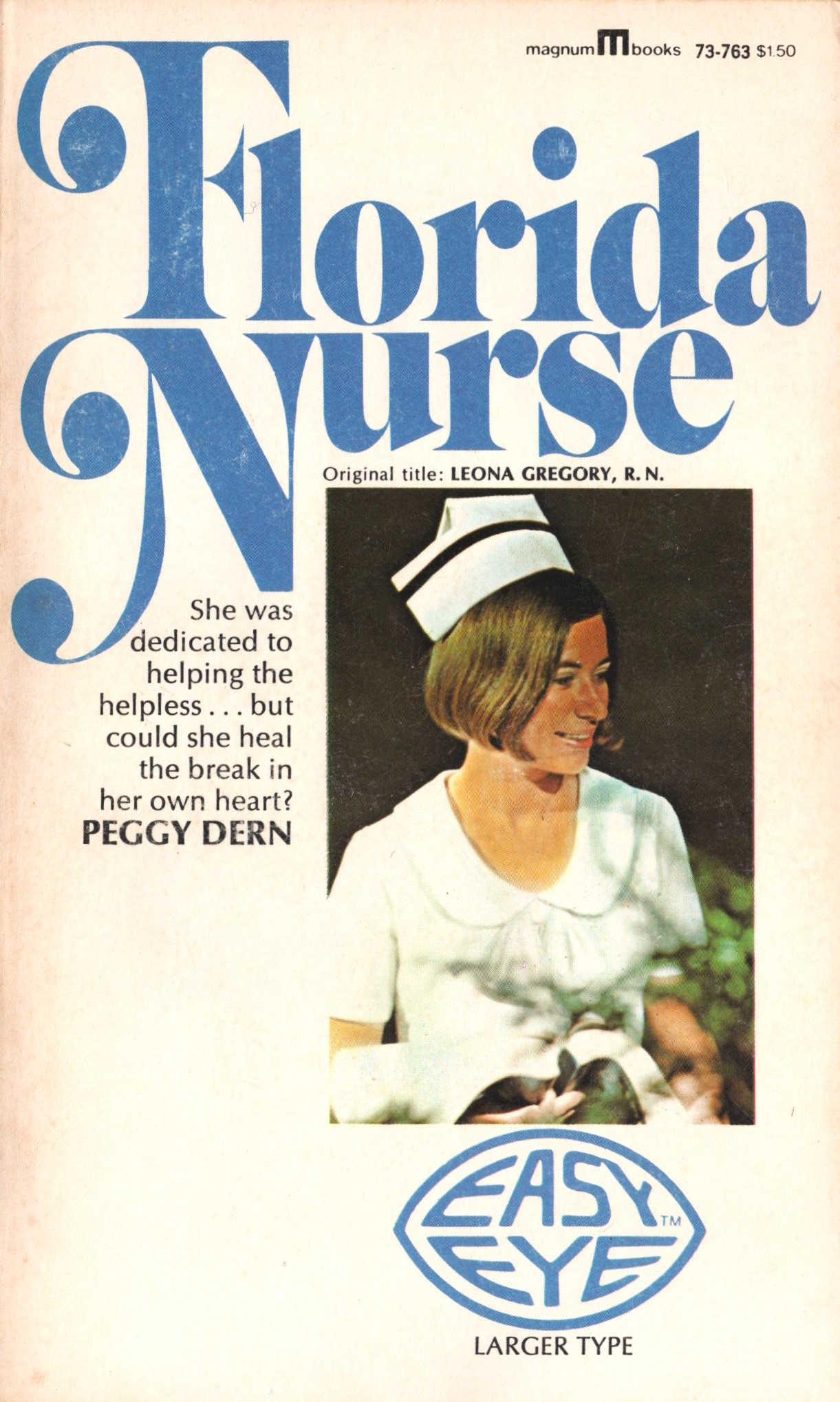
Florida Nurse

By Peggy Dern
(pseud. Peggy Gaddis), ©1961
Also published as Leona Gregory, R.N.

The daughter of a doctor, Leona Gregory had known since earliest childhood that she wanted to be a nurse. She had always thought that that would mean working with her father. But now that Dr. Gregory had married a young wife, Leona felt out of place in the household. The young R.N. gratefully accepted a position in a hospital in Cypress City on the Gulf Coast, even though she was afraid it would cut her off from everything she had known. Meeting the cold, beautiful supervisor of nurses, Paula Ingram, and the stern disciplinarian, Dr. Foster, who headed the hospital, seemed to confirm her fears. But Leona also found an opportunity for service she could not have had elsewhere. Then too, there was the handsome, charming senior intern, Cole Jordan … and, working with him, Leona began to feel that her heart might find wings again.

GRADE: C-

BEST QUOTES:
“Nothing is as inevitable as canned peaches in the hospital dining room.” 

“Well, well, so you’re going to be my special nurse. I feel a bad relapse coming on. I may be here for months.”

“When people are sick or hurt, a nurse’s uniform or a doctor’s is just about the most beautiful thing in the world.”

REVIEW:
It’s entirely possible that it took author Peggy Gaddis, here writing as Peggy Dern, less time to write this book than it did me to read it. The continuity and logic failures are numerous, and Gaddis frequently uses conspicuous words more than once in the same paragraph. Furthermore, this is not the first Gaddis heroine we have met named Leona (see also Nurse in the Shadows). 

Here, Leona Gregory is leaving the “brutal winters” of—not Chicago or Buffalo—Atlanta! a climate so inhospitable that to stand on the doorstep and ring the doorbell is to court pneumonia. Though she tells her father that it’s the frigid temperatures that are driving her to abandon the dream that they have held since she was nine—she was to work as a nurse in his office—the real fact is that it’s Leona herself who is bitterly cold. Her father remarried two years ago to a lovely woman named Irene who attempts repeatedly to befriend Leona only to the rebuffed again and again, and finally Leona is packing her bags and huffing off in a jealous pout for the Florida Coast.

Arriving, apparently not having bothered to interview for the job before signing a one-year contract, she is stunned to find that the head nurse and the chief doctor are unfriendly and militant disciplinarians. She befriends nurse’s aide Alma Pruitt, who appears to have bipolar disorder given the way she caroms between hysterical laughter and hysterical tears from one paragraph to the next. She also meets Dr. Cole Jordan, the up-and-coming surgical resident who always insists on commenting on Leona’s looks; bachelor number two is Bruce McLain (also spelled MacClain), who recently inherited a very lucrative ranch in town. Carol Decker is the daughter of the housekeeper on Bruce’s ranch, and though the original owner of the ranch left Carol and her mother well off, Carol has her sights set on Bruce’s larger fortune.

With three women and two men, it’s a game of the musical chairs to find out who is going to end up alone—and with Carol acting the part of the “weirdie,” “mental case,” and “spiteful malicious cat,” she is clearly the one we are not supposed to like. But honestly none of the women are terribly attractive—there’s Leona’s inexplicable animosity toward her lovely stepmother Irene, and Alma Pruitt herself engages in quite a few unattractive games to snare a man, such as pretending she has a fiancĂ© in Tampa; her wild mood swings are also alarming, as she is usually in tears at some point in every scene in which she appears.

So what’s the plot? I mean, beyond thin and implausible? Well, Bruce has been thrown from his beloved horse and saved from paralysis when Dr. Foster plucks a miniscule bone fragment from his spine, and now Bruce has to lie in the hospital for weeks. But Leona is assisting in the surgery and hears Bruce mumble just before he’s going under, “Don’t let anything happened to Starlite.” So when Carol vows to have the horse shot, Leona peels off her scrubs and flies out to the ranch to prevent the murder because “it’s part of the nurse’s job to catch the faintest whisper from the patient and try to do what he asks,” apparently even if it means abandoning her shift. I hope one of my patients will ask me to make a Starbucks run.

Now the thwarted Carol is gunning for Leona—and soon the sheriff turns up at the hospital to arrest Leona because the horse has gone missing, and based on this accusation alone, the sheriff plans to toss Leona in jail. It seems a rather flimsy basis for legal system, but then this is Florida. Out on bond, Leona decides that Carol “will continue to harass me and the hospital as long as I am here.” So despite the fact that Dr. Foster has not agreed to release Leona from her contract, she decides she is quitting—Dr. Foster has better grounds for lawsuit than Carol does, but never mind about that.

Leona goes to tell Bruce goodbye, that she is going back to Atlanta to work with her father after all. “Her father would be overjoyed; and she and Irene would be friends!” This shocking transformation of character, we are told, occurs because “when I fell in love with Bruce, I suppose I sort of grew up.” Here’s surprise number two—she and Bruce, who had spent exactly two afternoons together, are madly in love and will be married the minute Bruce leaves the hospital! And Leona will be leaving her career too, because even though Bruce has expressed no opinion on the matter—and never mind about Leona’s pesky contract—“I’m going to do whatever Bruce wants me to do, always.” Irene tries to talk sense into Leona by saying, “In a successful marriage there is no necessity for a boss. It’s a partnership; an equal partnership; fifty-fifty all the way.” Nonetheless, though she has declared that nursing is vitally important to her, Leona insists on quitting a hospital so short-staffed that “there simply isn’t time for any of us to sit down and hold the families’ hands or soothe them.”

Ultimately this is a carelessly written book with stupid characters, compounded by a large helping of bigotry against the local Seminole population and the poor whites in town as well. (There’s another penitential donation going to the American Indian College Fund from the White Doctor Foundation.) Dr. Foster shouts at a family reluctant to put their five-year-old daughter to surgery for a possibly benign tumor based only on his say-so—in a conversation held in the hospital lobby, no less—and the head nurse explains the doctor’s shocking rudeness (not to mention privacy violation) by saying, “he simply has not the patience or the time to put up with ignorant, stupid creatures”—and Leona is shocked that the nurse thinks Leona might be critical of this approach.

Peggy Gaddis always wants to have everything both ways—Leona couldn’t possibly criticize a doctor for calling it “nonsense” to explain a surgery (these days it’s called “legal consent”), but we are supposed to like Dr. Jordan a lot more because he does. Some characters say some really appalling things about the Seminoles, and these remarks pass without comment, but Indians competently staff the hospital and ranches in town (and ultimately save Bruce’s horse). Women are strong, competent workers who manage large farms and hospital wards, but they chuck it all to land a man. Alma schemes to lure in her crush, including lying about a fiancĂ© and flirting with men in whom she has no interest, but Carol is the one who is called a “scheming cat” for her desire to win Bruce. Alma never has a kind word to say about Carol but completely denies intending to hurt Carol’s feelings when Carol take offense. Every leading male character tells a woman at least once that he ought to “turn you across my knee and whale the daylight out of you!” Need I go on?

I’m ultimately not sure what author Gaddis herself thinks about her characters, but it seems clear to me that she does not have a high regard for women. That being the case, it’s hard for me to have a high regard for Peggy Gaddis or her books, and especially not this one.

Monday, May 9, 2022

Hope Wears White

By Florence Stuart
(pseud. Florence Stonebraker), ©1961
Cover illustration by Martin Koenig

Nurse Barbara Ritter looked up into Dr. Wade Fulton’s eyes. “Say you love me, darling. Say it once, please,” he pleaded. She turned her head away. “Oh, let me alone. Don’t talk any more about it. What does it matter how I feel about you? You’re going to be married to another girl.” She had lost her heart to a man who belonged to somebody else. Would time heal the hurt? Barbara found the answer to her question in this moving novel of love, friendship and dedication to a notable profession. 

GRADE: A-

BEST QUOTES:
“If I had my teeth in, I’d bite you, honey.” 

“Later they drove down to the village to look at the bright lights, all five or six of them.”

REVIEW:
I’ve been feeling a little burned by Florence Stonebraker in recent years. She has written some amazing books, no question about it—five of her books have earned A-grade reviews—but she has also gotten seven C’s, so you never know if you’ve got a gem in your hands or a dud. The result is that now, as I read her books—and Hope Wears White is my 19th—if it starts out well, I am nervously waiting for the point where the story tanks. Fortunately, this book sparkled from beginning to end—but apprehension marred my enjoyment somewhat; these are the bitter side effects of this job, but I hope my work here can spare you the stinkers and deliver you only the best. 

Barbara Ritter is a nurse from the very tiny town of Springdale, Arkansas, population 2,734, where she was adopted by the local doctor and his wife. Unfortunately, she played the Cinderella to her younger sister Fern, the pair’s biological daughter: “Fern had always gotten the best of everything, while Barbara did the work of two or three servants.” Barbara has turned out all right in the end, though; after her father died, Mrs. Harriet Hope, a wealthy local widow, loaned Barbara tuition money for nursing school. Now, after four years away from home, Barbara is returning to show everyone her success. (It’s a flimsy excuse, but there it is, and we have to live with it.) Fern has not fared so well: “She acts very strange of late. She is moody: up in the clouds one minute; down in the dumps the next,” explains Mom, while others are less kind, stating simply that “Fern has some deep-seated neurosis and is seriously in need of psychiatric help.” Fortunately, there is a new psychiatric hospital in town, endowed by Harriet and run by Dr. Wade Fulton, who is quite the hunk.

Harriet has insisted that Dr. Wade hire Barbara to work at the hospital, and her first interview with Wade starts off very well, despite the fact that “I hadn’t counted on anyone quite so ornamental,” as he says, since everyone tells Barbara that she looks like Elizabeth Taylor. Barbara displays a fair amount of sass: “Do you suppose I’ll be safe, working day in and day out with this irresistible male?” she asks fellow Nurse Kitty Standish. When Wade tells Barbara he is engaged to a woman back in New York, she slyly asks him how often he writes her, saying, “I’ll bet the poor gal is all aquiver with excitement, waiting for those cards to arrive.” But the interview quickly sours, and later Kitty declares that Wade is “afraid that he’ll fall in love.” In short order Wade all but admits this to be true: Apologizing that they got off on the wrong foot, he touches her arm, and the sparks fly.

Meanwhile Fern has developed a huge crush on Wade, and is sending him love letters and turning up in his office to bat her eyes at him. One evening Barbara goes to the family house to discuss Fern’s behavior, telling her that its less than rational. She suggests that Fern seek professional help, and Fern completely wigs out. Screaming that she will kill Barbara or herself, she slams out the door and hops in the car. Barbara, for some equally insane reason, climbs in with her, and before too long Fern has driven them off a cliff. Miraculously they both survive—and Wade confesses his love, while simultaneously declaring that he cannot marry her because he is engaged to this New Yorker.

Unfortunately, there can be no easy happiness for the Barbara and Wade, because Wade is one of those annoying martyr types “whose inner strength was also his great weakness. It was unthinkable for him to let down someone who depended on him.” And so, rashly engaged years ago to a woman who has turned out to be not at all suitable for him, “it was his duty—Wade’s absolute duty” to stick with Helene Robbins, even though she has refused to marry him until he gives up his job in Arkansas and returns to New York to take up a posh practice, which he has refused to do.

Sadly, Barbara accepts the situation with little of the spine she has demonstrated to date, but she does have two feisty friends in Kitty and Harriet, both of whom exhort her to fight for her man. “No man makes up his own mind when it comes to affairs of the heart,” declares Harriet. “The girl has to make it up for him. You have to.” Barbara doesn’t, though, because she has a sister who truly hates her. Realizing where Wade’s affection lies, the scorned Fern writes a letter to Helene in New York, telling her that Wade is being seduced by the tramp he works with and is about to wriggle off the hook. Instantly jetting to Arkansas, Helene declares she will go through with the wretched wedding even though she does not love Wade, because “like every girl with good sense, I want to be married to a man worth marrying,” she frankly tells Barbara. “Wade is a successful doctor, he’ll make a name for himself, he’ll make good money—once I get him back to New York where he belongs.”

It’s not hard to imagine how this scenario is going to wrap up, though the specific details were a surprise and even funny. The writing is smart, crisp, entertaining, and often amusing, if not of the sort of humor that translates well for the Best Quotes section. I’ll acknowledge that the plot is not completely logical, and it was disappointing that Barbara, who started out with so much starch and fire, completely wilted. But the supporting cast is built of admirable characters who are very enjoyable to watch as they chew the furniture and toss off fabulous lines, such as the time Kitty scolds Barbara for working so hard in her new job: “What are you trying to prove? That you’re ten women? Or simply that the rest of us nurses are lazy slobs who should get vitamin shots to jazz up our metabolism?” We do get a good handful of Florence Stonebraker’s go-to tricks: the unloved adopted daughter, the psychotic woman, the murder attempts, the Ozark setting, the names Fern and Kitty. Here, luckily for us, she serves them up with panache and freshness, giving us a book worthy of the hope any reader has when she picks one up.

Monday, April 18, 2022

Nurse in Danger

By Fern Shepard 
(pseud. Florence Stonebraker), ©1963
Cover illustration by Rudy Nappi

“Be careful, Anne. This is a serious mental case we’re up against. We’re all in danger as long as she’s allowed to run around loose,” Dan said. Nurse Anne knew it was true. Margaret Slater was not a normal person. She was beautiful and rich and she was a destroyer. Sooner or later she would succeed in destroying someone—some helpless victim of her irrational, jealous fury … but who would the victim be? When would she strike? Margaret needed help—psychiatric help. Brad Portner was a wonderful psychiatrist, but love was blind … he was planning to marry Margaret!

GRADE: B-

BEST QUOTES
“I can’t marry you, love, as long as you insist on working at that loony pit.” 

“Psychos rarely make sense, you know that. That’s what makes them psychos.”

“You had this twenty-four hour virus. Too bad the love virus doesn’t disappear as fast.”

REVIEW:
I would give a lot to know why author Florence Stonebraker was so obsessed with psychiatrists and lunatics; of the 19 books I’ve reviewed, more than half revolved around an insane character. So once again, here we have the Stonebraker classic: beautiful Margaret Slater is engaged to psychiatrist Brad Portner, despite the fact that from early on everyone declares she is “sick and needed help. Her parents should have taken her to a psychiatrist years ago.” And that’s just on page 32; before too much longer, they’re worrying that “we’re all in danger as long as she’s allowed to run around loose.”

But she is, of course! Margaret is literally insanely jealous of her adopted sister Sherri, whom at book’s open she’s assisted in a suicide attempt by providing the bottle of benzos. It’s not Margaret’s first attempt at ending Sherri’s life; as a child she’d tried to drown Sherri. Now she’s beside herself that Sherri has become a patient at Brad’s hospital and rages around the campus screaming tirades about Sherri and Brad’s nurse, Anne, who actually is in love with Brad but on the verge of quitting so as to escape daily confrontation with her unrequited love. But the scenes soon prove too much for Brad, and he attempts to break up with Margaret, who in a drunken rage drives them both off a cliff at 100 miles per hour. Miraculously, Brad escapes without a scratch, and Margaret only has one—to her face, which destroys her incredible beauty, and now righteous Brad decides “he must marry her as a matter of honor” because of this devastating injury. Now it’s just a question of what happens to push Margaret into gong “berserk,” as the book calls it, and whom she will attempt to murder, and what the collateral damage will be to Nurse Anne, and whether Anne ends up with the doctor or the longtime beau she does not love.

The book is written better than some Stonebraker novels (Stop Over Nurse) but nowhere near the level of her best (City Doctor, Doctor by Day). I just never felt any real interest in any of the characters, except an occasional second look at Margaret on occasion, such as when she “had flung herself on the couch. She wore a soft blue wool dress with a chinchilla cape-jacket. Her golden hair glistened.” But even the climactic scene is dull: Anne’s danger is played essentially offstage, as it’s told from her point of view—but she’d taken two tranquilizers at bedtime and slept through the whole thing. So in the end, Nurse in Danger is not really dangerous, it’s just dull.

Monday, January 31, 2022

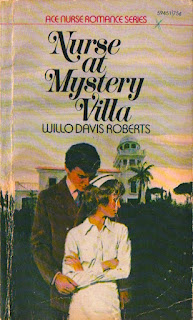
Nurse at Mystery Villa

 By Willo Davis Roberts, ©1967

Upon her arrival as new office nurse in the small California community of El Campo Calor, Chris Royce made a resolution: She would keep Dick out of her mind and heart forever. He’d never meant to hurt her, he’d said, as he told her of the girl he was giving her up for. Now she was ready to turn all her attention to her new boss, attractive young Dr. Candela. But Vic Candela wasn’t free. He was tied to the past by something everyone knew and wouldn’t forget—nor let Vic himself forget. Chris has to find out about it—even if it meant risking the loss of Vic and the new love he’d offered her.

GRADE: B-

BEST QUOTES:
“You’re just another girl. Blonde and pretty, I’ll grant you, but with the usual number of arms and legs and heads. So why do I feel you’re so special?” 

“You’re pretty enough to eat. I’m more interested in marrying you, though.”

“It is not womanly to be so strong-minded.”

REVIEW:
Nurse Christine Royce has been dumped just weeks shy of the altar, and now she’s through with men—she’s going to fill up her life with work. “If she were busy, she wouldn’t have to think about Dick,” she decides, and, oh, what a difference a capital letter makes. 

As it happens, though, she can’t keep her promise to herself, as when she’s lounging on the beach of one of the Great Lakes in Michigan, here comes hunky Dr. Victor Candela and his adorable six-year-old son Mickey. Turns out back in the day Vic had crashed her junior prom and danced with her, even though she’d been 60 pounds heavier in high school, and then he’d gone off to medical school. Meeting her again seven years later, he asks her for a date, and then if she’ll come back to California with him to be his office nurse. She agrees to both, and two weeks later she lands in the Central Valley and takes over the wreck of his practice. Once she catches up, though, the job is not too tough, as he has almost no patients—looking back through the appointments book, she notices that four months ago, after April 2, the previously busy practice had dropped into the toilet. A little snooping in the newspaper section at the library leads her to discover that his wife had died that fateful day, and that he had been suspected of murder but not convicted. So that’s why everyone in town looks at her so askance!

She’s living in the home of Vic’s dead wife’s family, with whom Vic is very close, and little hints drop like acorns on the roof—it quickly unfolds that no one had liked Alice, who was “selfish and cruel and rotten.” She’d attempted to seduce her sister’s fiancĂ©, had little to do with her son, and apparently cheated on Vic. And she’d had multiple car accidents and lost her license, but had driven drunk after that and killed two people; the family had had to mortgage the farm to pay the settlement, a debt they are struggling to emerge from. It’s not until the end of the book, though, that it is suggested that Alice had some form of mental illness, proved by a diary she’d kept that Gramma Sophie will let no one read. “It is filled with hate, with sickness,” Gramma insists. “No one should be allowed to look into the darkness of such a mind.”

The mystery of how Alice died is made more interesting by the fact that if she was murdered, and if Vic was not the murderer—Chris “did not have the slightest doubt of Vic’s innocence,” which is a switch from most murder mystery nurse novels—then it must have been someone else in the family. Vic, who loves the family deeply, is acutely aware of this. “I won’t do anything that could possibly hurt anyone in this house in order to find out” how Alice died, he tells Chris when he finally acknowledges the truth to her—after she’d found it out for herself, unfortunately.

The problem with this particular sub-sub-sub-genre is that they are generally just lame (see, if you must, Matravers Hall, Nurse on Nightmare Island, Nurse Missing)—honestly, a Nancy Drew novel holds more interest and suspense. This is one of the better ones, though, as the heroine is not a stupid loser, and of course she is instrumental in proving Vic’s innocence. The characters are layered and interesting, the writing is moderately good, and the plot has only a few weirdnesses—Chris has a penchant for getting engaged to men after dating them for under two months—and the book even deliberately leaves a few minor questions unanswered, which makes it seem more plausible. The title is unfortunate, because the house in question is not at all mysterious, but that’s a minor sin, and likely one committed by the publisher rather than the author. So if you have a penchant for a pseudo-Gothic murder-mystery nurse romance novel, this could be just the book for you.

Monday, May 31, 2021

Crystal Manning, Maternity Nurse

By Nan Lowry (pseud. of Ruth MacLeod), ©1964
Cover illustration by Lou Marchetti?

As the young head nurse of the busy maternity ward, Crystal Manning often went beyond the call of duty to bring compassion to her patients. Then one of her kind gestures backfired. She was accused of kidnapping a new-born baby. Nurse Manning needed all the help she could get at this crucial time, particularly from the two men who loved her: Lloyd Norris, a successful attorney; and Mike Dorand, the friendly young doctor with whom she worked. As a nurse, she knew that she would have to clear her name or neither man would want her for his wife.

GRADE: D 

BEST QUOTES:
“There is nothing coy or coquettish about you. Sometimes it’s discouraging.”

“She did not want him to think she was the cheap sort of floozie who casually concluded her dates with a bit of heavy necking.”

“A psycho can behave most intelligently at times.” 

REVIEW:
If you were looking for one-stop shopping for all the grotesque stereotypes of the past, you would have to go a long way to find a single book more stocked with insensitivity than Crystal Manning, Maternity Nurse, in which we meet a family with a developmentally delayed son and visit a Chinese restaurant—I will spare you from how the book portrays these situations—meet a couple who refuse to adopt a baby from an agency because “we don’t want some little tramp’s discarded bastard,” and watch the nurse tell a woman whose newborn has died, “That’s no excuse for being such a cry baby.” Of course, I haven’t even started on the usual misogyny: A husband needs to sign consent for his fully alert and competent wife’s surgery, and a wife’s blaming herself for her husband’s walking out on her and their six children.

We are also subjected to a handful of the usual VNRN tropes. Nurse Crystal is dating Lloyd Norris, an attorney ten years her senior who “had an endearing, proprietary manner with her, calling her ‘doll’ and ‘darling’ in a way that made her feel like a cherished child.” Ew. We are not surprised that she does not love him, though he is wild about her and is pressuring her to marry him. She’s actually hot for Dr. Mike Dorand, in his last year of residency, and knows she will never love Lloyd the way she does Mike. But Mike runs hot and cold, so she naturally concludes that he doesn’t have any interest in her, and tries to convince herself that she should accept Lloyd’s proposal. “He was sweet, he was a fine, wonderful man and he loved her. Few women were so fortunate. So why couldn’t she grab her luck while she had the chance? Some day, when it was too late, she might wish in sorrow and desperation that she had.” Because any marriage would be better than none, apparently. “She wondered which sort of marriage brought a woman the greatest happiness and satisfaction. One in which she fulfilled a man’s deepest needs—as it would be if she married Lloyd? Or one in which she was forever striving to fulfill her own emotional needs through love for a man like Mike?” I’m not sure why the latter is apparently being held up as something wrong.

An interesting point in the plot is that when Lloyd and Crystal are kissing, “as the pulsing warmth of his embrace stirred some inner dormant fire, she was lost in a wild urge to respond. For timeless moments her heartbeats rioted as her lips answered the pressure of his.” Lloyd is thrilled by her physical response, insisting that “it’s there, the love and passion to make our marriage wonderful.” The idea that if she has a sexual urge she must be in love is curious; I doubt anyone would make this mistake about a man.

There’s also the question of whether she should give up her career for marriage. Early on, of course, she loudly protests, “Marriage couldn’t make me not be a nurse.” Adding to his charms, Lloyd tells her, “I wouldn’t demand that you give up nursing altogether, or right away. I’d like to hope that gradually you to become so happy and occupied as my wife that it would fill all your needs.” Instead of running, she proves herself a hypocrite by deciding, “If I really loved Lloyd I could give it all up to share his life completely.” This makes no sense, particularly since she’s already pointed out to Lloyd that he wouldn’t ever not want to be an attorney. And when Lloyd continues to present his feelings to her on the subject, asking her, “Honeychild, when are you going to let me take you out of all this and provide the kind of life a doll like you is made for?” she is not repulsed, either by his demeaning choice of endearments or his obvious intent for her to stop working if she marries him.

Beyond all the alarming biases, there is a plot here: Mrs. Perkins, saddled at home with five kids, has just had a sixth, and Mike diagnoses the newborn with phenylketonuria, which will cause the little girl to have brain damage if she’s given food containing excessive phenylalanine. This diet is going to be very expensive for the dirt-poor Mrs. Perkins, whose husband has left her because she refuses to put five-year-old developmentally delayed Joey in an institution, where, we are repeatedly told, “he’ll have the care he needs, and the other children will have a better chance to develop normally, unhampered by his presence.” Eventually, though, she decides she’d rather have her husband than Joey, so when Mr. Perkins finally shows up, they’re a happy couple once more with still just five kids at home.

Meanwhile, Susan Carter has lost her baby and her uterus, possibly because Dr. Leslie Hampton, who even the orderlies think is “scared to do cesarean sections,” stalled performing that surgery until Mrs. Carter’s uterus ruptured. Crystal, attempting to help the grieving, childless woman realize “your adjustment to it will strengthen your character,” tells her about poor Mrs. Perkins’ plight. Susan immediately decides that she will adopt Baby Girl Perkins, and breaks every rule in the book trying to make this happen—and Crystal breaks quite a few herself in acting as intermediary between the two women, even though she feels (and repeatedly says to Mrs. Perkins) the baby should stay with its biological mother, mostly because Mrs. Perkins might change her mind later on.

When Susan Carter finally kidnaps Baby Perkins, which you saw coming a mile away, Crystal’s gross irresponsibility is rightfully made much of by the hospital superintendent, the police, and Susan’s husband Neil. “I should think that one of the first things you would have learned in your hospital training was not ever, under any circumstances, to gossip with one patient about another’s problems!” shouts the superintendent, and suspends her. She spends the next day at the Perkins farm helping take care of the kids and the chores, and when she gets home, a cop is waiting to take her down to the station—the kidnaped baby has turned up in Crystal’s own bed, and she’s under suspicion for the crime. But never mind about that, the superintendent brings her back on the job the following morning, because things have been crazy in obstetrics on her one day of suspension! And it’s probably that crazy Susan who did it, who’s been found nearly psychotic and is refusing to speak!

Suddenly it’s two weeks later, and Mike tells Crystal he’s decided to go back to school to study public health. Crystal is upset because this means he might decide he’s too poor to marry, and in attempting to convince him otherwise, the dime finally drops for Mike, and twenty seconds later they’re engaged. The chief of obstetrics walks in as they are clinching the deal, and tells them to save it for their time off. Unbelievably, Crystal shouts, “You have no right to sneer at our love! It’s perfectly proper and decent—which is more than you can say about your clandestine affair with Marilee Gifford!” Marilee is Crystal’s own roommate, who has been secretly in love with the married Dr. Hartford for many years, and who has repeatedly assured Crystal—who always nags her hypocritically that she shouldn’t chase after a man who shows no interest in her but should go out with men she’s not interested in—that they are not having an affair at all. I tell you, seldom have I been so shocked by a VNRN as when I read Crystal’s complete betrayal of her best friend.

Dr. Hartford responds by suggesting that he could have Crystal fired, and Mike, apparently having acquired a few unfortunate tendencies from his horrid fiancĂ©e, tells Dr. Hartford that if he fires Crystal, he will order an investigation into two cases of Dr. Hartford’s that had bad outcomes. Dr. Hartford remarkably manages not to order them both out of the hospital immediately but instead calmly explains the two cases and why he is not to blame for them, and Mike is forced to agree. The whole nasty situation doesn’t end there, but has dark repercussions in Dr. Hartford’s marriage and his relationship with Marilee—and Crystal again decrees that Marilee’s decisions, startlingly like her own (a fact she completely fails to recognize) are “terribly wrong” and “lacked integrity.” So she decides she’s going to set up her now-dumped ex-boyfriend Lloyd and Marilee, believing Marilee will go out with Lloyd for no other reason other than that she has dared Marilee to do just that. Mike sees Crystal with Lloyd in his car when she’s wheedling him to ask Marilee on a date, and Mike speeds off. Now Crystal is frantic that Mike thinks she’s still seeing Lloyd and that it’s over between them, but Mike at least has learned something from all these explosive situations and tells Crystal the next day that he trusts her to make good decisions of her own. He clearly does not know Crystal very well.

Crystal Manning is one of the more alarming heroines I have met in a VNRN. She never learns to stop her own stupid mouth, and she suffers no consequences for any of her many very bad decisions. Marilee never learns of Crystal’s betrayal, so Crystal gets off scot-free with that backstabbing, and a one-day suspension hardly seems a fitting punishment for all her ethics-stomping involvement with the Perkins baby—not to mention that at the time she was under suspicion for kidnaping. Instead she lands the man she wants, who gives her the benefit of the doubt that she never gives anyone else, a point that is utterly lost on her. Finally, we have the copious bigoted attitudes as the cherry on the top of this poison, if you needed any further inducement to stay far away from Crystal Manning, Maternity Nurse.

Alternative cover, from the
second printing in 1966


Saturday, April 20, 2019

Beth Lloyd, Surgical Nurse


By Jane Converse, ©1970
Cover illustration by Allan Kass

Nurse Beth Lloyd had just broken with the man she loved, the brilliant young surgeon Dr. Paul Bryant. She was heartbroken when he accused her of trying to push him into a marriage he felt would hinder his career. Suddenly into their lives came Jimmy Ladue, critically in need of a heart transplant. And Paul’s conservative senior partner, Dr. Weston, so strongly opposed to the new techniques, was for some mysterious reason willing to perform the operation. It was to be a transplant that would transform all their lives. For in its wake a desperate secret would emerge—a secret to threaten the reputation of two fine surgeons and bring Beth Lloyd heartbreakingly close to the man she was trying so hard to forget.

GRADE: C-

BEST QUOTES:
“The chic ex-songstress could be seen puffing an endless chain of cigarettes in the coronary care reception room.”

REVIEW:
Beth Lloyd is a surgical nurse desperately in love with the cardiac surgeon she works for, who proves true to type and is an angry, arrogant jerk who dates Beth but refuses to offer more than vague expressions of interest, a setup that author Jane Converse has employed to equally poor effect in Heartbreak Nurse. Beth, needless to say, can’t seem to shake the loser. “Any opportunity to be with Paul, even a stodgy dinner at the Westons’,” thinks our pathetic masochist, “was better than staying in her own apartment, thinking about Paul, wondering why, apart from a few almost platonic goodnight kisses, he avoided any meaningful involvement with her … gave out no hope that their relationship would progress beyond its present stalemate.” Not surprisingly, at the end of chapter one, they get into an argument in the cafeteria when he gripes that the senior surgeon he works with, Dr. Merrill Watson, and his stuffy, high-society wife Lois are trying to pressure him into marrying Beth and settling him into a “smooth, proper, unchanging” life, which he implies is a “trap” worse than death—and then starts shouting when Beth, feeling rightfully insulted, questions whether his desire to perform a cardiac transplant in a small-town Indiana hospital, likely unprepared to handle such a complex patient, is due to his relentless and single-minded drive to make what he himself calls “some valid contribution to surgery” instead of enjoying life.

Paul Bryant’s partner, the stodgy Dr. Weston, is adamant that they will never do a cardiac transplant—until he turns up with 23-year-old  Jimmy Ladue, a talented artist imported from Paris with his trampy mother Sara, a former lounge singer who stalks the hall in her stilettos trailing cigarette smoke. Jimmy is dying from chronic ventricular fibrillation, and now the surgeons are planning their transplant. Even when things are going his way, Paul continues to demonstrate his “tense, almost paranoiac” streak: When Beth offhandedly mentions that the transplant could give a second chance to “a wonderful, talented, valuable person”—well! “Your attitude disgusts me!” Paul erupts, outraged that Beth isn’t “thinking of the advancement this operation may mean in cardiac surgery” and he bizarrely insists that her appreciation of this one patient means she doesn’t care about “old, untalented, unvaluable people”—though of course no doctor in their right mind would do a cardiac transplant on an old unhealthy person unlikely to survive the rigors of surgery. “All the pressure that had caused Paul to use Beth as a target tonight,” Beth thinks, means that “his violent reaction could have been triggered by almost any statement.” No wonder she’s so hopelessly in love.

Now the surgical team is on hold until a suitable donor presents—and after a couple of weeks, a healthy bum who has been beaten to the edge of death wheels in, conscious enough to sign the consent to give his heart to Jimmy Ladue—and conveniently dies on the OR table. Now the team is scrubbing for the cardiac transplant, when a nurse bursts in and cries out that Dr. Weston has died in a car crash on the way in. Dr. Paul proceeds with the surgery, which goes off swimmingly—but now the newspapers are asking why Dr. Weston was going forward with a surgery he had previously disavowed, and how the donor patient turned up so conveniently. Dr. Paul is promptly labelled Prime Suspect #1. The police are closing in when out of the blue the obvious story—one worthy of a Florence Stonebraker novel, actually—emerges and the insane murderer comes forward. It’s not nurse Beth, though you could attribute her with madness when at the end she falls into Paul’s arms and agrees to marry the bastard.

This is a mediocre book in which Jane Converse has fallen back on all her old tricks without putting in the least effort to sprinkle any spice on them. It’s resemblance to Heartbreak Nurse is quite uncanny, and it’s not even as good as that fairly lame book. If your alternative for the afternoon is watching paint dry, this might be a better choice, but on the other hand, you could in that time conjure up without too much difficulty a far better book than this one.

Thursday, February 9, 2017

Homecoming Nurse

By Rose Dana 
(pseud. William E. Daniel Ross), ©1968

When Jane Weaver’s marriage ended unhappily, she decided to work as a nurse on Boston rather than return to the small town where the romance had begun. But then her father’s hospital in Whitebridge was threatened by a lack of funds and Jane, out of loyalty, went home to help. She had to risk many things – reminders of her past, the censure of her friends, a meeting with Steve Benson, the man she had jilted. But also, Whitebridge itself had changed. A new black doctor had introduced the racial question, people had grown subtly different, and Jane found not the threads of her old life but a new challenge to her heart.

GRADE: B-

BEST QUOTES:
“Then your marriage did turn out as badly as everyone predicted?”

“ ‘Stay away from all that thinking,’ was his advice. ‘Let me do the planning for us.’ ”

“I wish I’d had the good sense to find myself a husband when I was your age.”

“Poor Dr. Davis has lots of ability, even if he is colored, which I’m sure he can’t help. But it does make some of the patients uneasy with him.”

“She looked the mental case she was.”

REVIEW:
This book has more taboos—divorce! racially exclusive country clubs! mental illness! chasing married men! Jello molds!—than any other VNRN I’ve encountered. Unfortunately, that’s about the only thing that sets it apart from the others.

Jane Weaver RN is returning home to Whitebridge, NH, after a two-year stint at the Peter Bent Brigham in Boston. Seems the New Hampshire hospital her father, Dr. Graham Weaver, has championed, is on the brink of being closed by the town council. A larger hospital just an hour’s drive away is siphoning off their patients, and the stress of keeping the hospital afloat is allegedly sapping her father’s health, so she is lured back to care for him.

She’s nervous about seeing her father again, after her marriage to a handsome but alcoholic golf pro, of which he had disapproved from the start, had fallen apart after eight months, but she suffers little from this, apart from some a few catty remarks from the locals and Jane’s feelings that “I have to expect to suffer for my stupidity, no one really seems to care. And speaking of uncaring, once home, Jane spends little time with her reportedly failing father—who seems tired but otherwise well, actually—and doesn’t pay much attention to how he’s feeling, so it’s a little unclear why she would chuck her former life.

Jane’s best friend in Whitebridge, Maggie, is not really dating Dr. Boyd Davis, which is a good thing, because even if he is a polite, competent doctor, the scandal is that he’s black, so his “friendship” with Maggie, clearly a love affair, cannot be called such. Jane is concerned that, should they marry, Dr. Boyd’s practice will be shunned. As it is, the local country club bars Dr. Boyd from the dining room, which doesn’t prevent the town mayor, Jane, Dr. Boyd’s medical colleagues, or even his apparent girlfriend from dining there. “I was going to turn in my membership card,” says Maggie. “But then I realized what a foolish, futile gesture that would be. Everyone would know I did it because I feel as I do about Boyd. They’d pity me, but they wouldn’t change their minds.” All I can say is that it’s a good thing Rosa Parks and Martin Luther King didn’t share her apathy.

You will not be at all surprised to learn that a serious accident occurs in which the victim requires immediate surgery and cannot be transported to the larger hospital in time. In an interesting dramatic turh, the patient undergoes surgery in the Whitebridge hospital and dies nonetheless, and with her any hope for keeping Benson Memorial open. As Dr. Boyd and other medical colleagues of Dr. Weaver’s flee New Hampshire for warmer pastures and the hospital winds down, will some miracle solution pop up and save the day?

This book offers more to chew on than the usual VNRN. Though the attitudes are extremely dated, the problems with Dr. Boyd and Maggie, and the small hospital’s relevance in the modern era are not presented as obvious one-sided arguments. Apart from that, though, and a couple of wild scenes with the books’ more outrageous vixens, it’s a fairly bland story without much zip to it. Dan Ross, writing here as Rose Dana, has never been one of my favorite authors (witness his cumulative C average over six books). Here he manages to avoid his most outrageous sins (relentlessly referring to characters as “the dark girl,” for one) but can’t really pull off a good book even with more complex themes than usual. If I am compelled by my mission to read his books, you, fortunately, have other options.