Showing posts with label character - arrogant doctor. Show all posts

Saturday, April 18, 2026

Saturday’s Child

By Betty Neels, ©1972 

Abigail was a true ‘Saturday’s child’; she worked very hard for her living. And it looked as if she could expect to go on earning her own living, for no one seemed to be in any great hurry to marry her—least of all Dominic van Wijkelen, who admired her as a nurse but who seemed to have no personal feeling for her at all—except dislike!

GRADE: A-

BEST QUOTES:
“Abigail took off her gloves and unwound her scarf and went to find the kitchen, small and a little old-fashioned, with a gay gingham frill round the mantelshelf above the small electric cooker and a row of pot plants on the windowsill.” 

“There was no doubt at all that pretty clothes did a lot for a girl.”

“Happy times are for remembering.”

REVIEW:
This is the fourth VNRN by Betty Neels that I have read, and all the usual ingredients are here: The plucky 24-year-old orphan, here called Abigail Trent, with few friends and no family, a hard worker who never complains—the book’s title being a reference to an English verse, the book explains: “Saturday’s child has to work for her living, and Abigail was a term used some hundreds of years ago to denote a serving woman.” She thinks herself “not in the least pretty,” failing to understand that her kindness, honesty, and smile (not to mention a new pink dress) render her quite beautiful, indeed. She’s hired to work in Amsterdam caring for an English woman with a gastric ulcer, and there she meets Neels Standard #2, Professor Dominic van Wijkelen, a “giant of a man,” handsome and 40, “arrogant and ill-humored,” always treating our stalwart heroine “with the cold courtesy she had come to believe was the only alternative to his ill-humor.” But she refuses to be overly intimidated by the man and occasionally throws some sass his way, which clearly rocks his world view but makes him take more notice of her as an independent woman not interested in chasing his skirts. 

Next is the Neels Standard Plot: Though he is nearly relentlessly mean to her, occasionally he is kind, and soon—here on page 54—“somewhere behind that forbidding manner must be the man she had fallen in love with.” And though “the professor was as likely to fall in love with her as the moon would turn to cheese” (wensleydale?), he does keep finding work for her that keeps her in Holland and him visiting her (patients) every day. Neels is likely to toss in a dance that he invites her to after which he kisses her and tells her, “You have almost restored my faith in women,” hinting at a broken heart that has kept him bitter and alone. There will be at least one child in the story, here Dominic’s three-year-old niece Nina, who requires expert nursing that he witnesses with extreme gratitude as she works tirelessly—sometimes around the clock—to encourage the lovable muffin back from the brink of death.

In this iteration of the Neels classic, we are lucky to meet two delightful elderly characters, both much beloved by Dominic and who need nursing by Abigail. She brings another elder to the table, a former employee of Abby’s family before her parents died, when they were better off, and to whom she is extremely devoted, planning to support for the duration of her career; Dominic hires the old man to be a gardener and odd-jobs man. These three we can see have wisely assessed the hurdles the relationship between Dominic and Abigail must clear and are working behind the scenes—sometimes literally, as we are not always witnesses to what we can easily believe to be their gentle hands on the wheel—to assist the would-be lovers to an understanding.

Ultimately it becomes harder for me to know what to do with Betty Neels. Though this is, on its own, an excellent book, it shares so many similarities with the three preceding books I have reviewed that it’s hard not to feel like I am getting the same whole cloth I have had before, just with a few different patches sewn on to differentiate it for the sake of the copyright laws. It’s a great book easily worth recommending, but I just wish I wasn’t closing the cover feeling that I’ve read it all before.

Tuesday, June 11, 2024

A Nurse’s Strange Romance

By Arlene Hale, ©1964

Meredith Michaels, R.N., had three loves in her life: nursing, and two young doctors. Dark-haired, intense Ryan Quinn she had loved since they first began training together. Steve Baxter, big, blond, full of the joy of life, had been the perfect balance for the inseparable threesome. Now they had the chance to open private practice together with Meredith as office nurse—and life seemed complete. Meredith, in fact, was engaged to Ryan. But something happened. Ryan became steeped in gloom, and even Steve’s former gaiety seemed forced. Meredith was distraught. But then, in the middle of the crisis, and with the wisdom she never dreamed she possessed, she grasped on a solution that had been staring her in the face.

GRADE: C- 

BEST QUOTES:
“The hospital frowns upon interns and nurses smooching in the hallways.”

“That blush makes you different from any nurse on the floor. You are the only one that seems to respect some old-fashioned chastity!”

“Long may she walk with her cute little wiggle!”

“What a tasty looking neck!” 

“Maybe it’s not as exciting to diagnose old Mrs. Cleaver’s arthritis as it is to make smears for some important test in a research lab but it is important! At least to Mrs. Cleaver.”

REVIEW:
The author of this very stupid book, Arlene Hale, is something of a thorn in my side. She was ridiculously prolific—I’ve reviewed 27 of her VNRNs so far and she has written at least a dozen more—but her average grade over those 27 books is a pathetic C+. Here we have yet another snoozer—well, it might be a snoozer if the leading man weren’t such an ass, but as it was it just made me mad. Meet Ryan Quinn, a “deep, dark, secretive” driven type who, though the author tries incredibly hard to depict him as a misunderstood soul, is borderline psychotic. As we open the book, Ryan and his best friend Steve Baxter are four months from completing their residencies, at which point they will go into practice and start earning an actual salary. But “payment is being demanded,” Ryan tells Meredith. “I will have to quit and go out and find a job, pay them off.” I am not even going to start on how absurd this situation is, but it’s definitely indicative of how the rest of the book is going to go.

To wit: Nurse Meredith Michaels, who has been dating Ryan Quinn for years now and is all but holding her breath until he drops on one knee and opens the tiny velvet box, has magically inherited a tidy sum from a deceased aunt. Her first inclination is to quit her nursing job and go back to school to become a teacher. Is this her long-denied dream finally coming true? No! Meredith loves nursing! But Steve and Ryan have bizarrely been badgering her to trade her nurses cap for blackboard chalk. “You are a pure descendent of Florence Nightingale, no doubt. But they need teachers too. Desperately,” Steve tells her, because nurses are just a dime a dozen! (And the financing of her nurse’s degree remains a secret.)

Ryan’s misfortune turns out to be Meredith’s salvation, as now she can give her money to Ryan and remain in the career she loves best! Ryan, the selfless wonder, hesitates less than ten seconds before accepting. Then he has the balls to tell her that he is “too honorable to make plans to be married until every penny had been paid on his debts,” and furthermore he is accepting a research position that pays very little, so its likely to be years before that happens. Of course, if he married Meredith, his debt would be expunged, but that point is overlooked by everyone, even Meredith.

Alas, this is not the end of Ryan Quinn’s perfidy. He leaves for a new job far from Meredith and does not ask her to come work at his new hospital with him, so she remains at City Hospital with Steve, who takes every opportunity to kiss her and make wildly inappropriate remarks to his best friend’s girlfriend. For Ryan’s part, immediately upon arriving at his new hospital, he instantly falls in love with Dr. Carol Simmons and dates her for months, taking her out to restaurants he cannot afford (when he had been too poor to go anywhere with Meredith except to her house, where he had eaten dinners she had cooked for him, and presumably paid for as well). Naturally Ryan does not bother to tell either woman about the other, and it’s nearly Christmas before he fesses up to Carol. He has the nerve to be flabbergasted when she is jealous, but placates her by promising to spend Christmas with her, even though he has already promised the day to Meredith. Then the swell guy is unable to tell Meredith that he won’t be coming home after all—much less that he doesn’t love her and is seeing someone else—until the day before Christmas, when he calls her and lies to her about a patient who he claims needs his attention through the holidays.

As it turns out there is such a patient, Betty Walters, a lonely, pathetic waif with leukemia, and now Ryan drags this poor woman into his miserable clutches as well. He starts to pay “special attention” to her: “At odd moments, he would drop in to see her and say a few words to her, tease her gently and lay the foundation for a relationship that went beyond the normal one of patient and doctor.” Betty, who has only months to live, falls in love with Ryan, and her bullying, equally psychotic brother Bruce blackmails Ryan into marrying Betty: If he refuses, Bruce is going to assault Carol, and if Ryan goes to the police about it, Bruce will have one of his friends do it. Paralyzed with fear, Ryan lets the situation ride for weeks. Eventually Carol hears hospital gossip that Ryan is spending too much time with Betty.  When she confronts him, he insults her: “You’re being female. Jealous! It doesn’t become you.” Just wow. At least Carol has the sense to break up with Ryan—Meredith is still home waiting by the phone.

Steve, clearly pining for Meredith, decides to open a clinic and invites Ryan and Meredith to join him. Bizarrely, Ryan agrees—and when he moves back home, he kisses dopey Meredith, and she’s thinking, “He hadn’t said he loved her. He hadn’t asked her to marry him either. But it was all there in undertones and she could wait. She had already waited this long.” And she is going to wait a lot longer. Because he’s sneaking back to see Carol to tell her what he never told Meredith, that he loves her. Then he heads over to see Betty, kisses her, too, and asks her to wait a little longer to be married to him, thinking, “He did not really want Betty to die and yet her death would mean his own freedom.” I cant believe author Arlene Hale thinks this guy is a reasonable love interest. 

Ryan flees back to his hotel room, but Bruce follows him and beats him to a pulp. This finally convinces him that Bruce really means business, so Ryan—this guy just never stops—calls Meredith, tells her hes been in a car accident and asks her to wire him $500, which he then uses to pay for the wedding, which goes off the next day. The cake is not even crumbs before he has fled back home, where he goes straight to Meredith’s apartment and tells her he loves her and wants to marry her! When she says, “I am not sure I believe you anymore, Ryan,” for the first time showing some actual sense, he says “Darling, you must! You have always trusted me, always believed in me. Don’t stop now. Don’t you know I need you, that I’ve always needed you? Don’t doubt me now. I couldn’t endure it! We’ll be married whenever you say.” To which she replies, “Darling, let’s be married on my birthday. Next week!” And now he is back to hoping that Betty dies in the next few days so he won’t become a bigamist. So to atone for the huge mess hes in, he goes straight to Carol’s house where he kisses her—and then tells her he is being married to Meredith.

Meredith breaks the news to Steve the next day, and now Steve is going to pieces. “His idea was to take the bull by the tail and spin him until he crashed into the wall and broke it down, or a woman by the hair and—” and now he is racing to Meredith’s apartment, bursts in, grabs her and kisses her though she beats at him and protests, “but he would not let her go,” instead telling her that he loves her, too. Guess what—she suddenly realizes that it’s Steve she is in love with.

Honestly, I just can’t go on. Let me just say that Meredith Michaels is a pathetic sap, Ryan Quinn is a self-absorbed psychotic, and Steve is a self-absorbed, domineering bully. Don’t waste your time with this trio. You might take them as an object lesson not to waste your time on any more Arlene Hale books, either, and I wouldn’t fault you in the slightest.

Friday, March 22, 2024

The Nurse with the Silver Skates

By Virginia B. McDonnell, ©1964
Cover illustration by Lou Marchetti

Inga Larsen, showing a newborn babe to its father, a baby she had helped to deliver …Inga Larsen, soaring through the air on ice skates amid the gasps of thrilled spectators …
Which was she, student nurse or rink champion? And which was the right man for her? Scott Marshall, ice-skating master, idol of her childhood, or Dr. Thor Eriksen, whom she had secretly loved for three years? Inga Larsen just did not know, and both men were not making it any easier for her to find out!

GRADE: C

REVIEW:
One of my absolute least-favorite tropes is the nurse in love with a jerk. Here we have a Class-A example of Jerk Thor Eriksen, who has apparently never once been kind to Nurse Inga Larsen. “Thor Ericksen was the one man Inga could have loved deeply and personally and forever. It didn’t even matter that Thor Ericksen disliked her as a person.” How can that not matter? The man “bullies” her (Inga’s word), never has anything nice to say, and constantly criticizes her nursing ability and how she spends her free time (like it’s his business), and questions her dedication— “Perhaps if you knew a little less about skating you’d know more about nursing. The time you spend skating every day might be better used in studying,” he snaps—never mind that “the nursing staff considers you one of the top students”—because exercise is so bad for you! She understands that he’s way off base, at least, thinking, “Nursing’s a serious profession but you need relief for a few minutes each day. Otherwise you’d either become hardened to suffering or you’d be so torn up inside that you’d have no strength to give your patients.”

Anyway, right on page 10 she shows how wrong he is when she identifies a comatose patient as Scott Marshall, one of the best figure skaters in the world—she would know, because she’s a former junior national champion, coached by her father, but she gave up top-level skating to pursue nursing. Scott’s been in a car crash, and somehow landed at her tiny hospital in Wisconsin. Who is going to nurse him back from the edge of death?

Well, one morning when she utilizes the reflection pool in front of the hospital for a practice rink and is spotted by a local reporter. Now there’s a big article about her—somehow the press knows she’s the one who identified Scott—and she’s in hot water for bringing publicity to the hospital and making nurses look frivolous. Plus it puts a national spotlight on the fact that the doctors have not been able to bring Scott out of his coma! Curiously, after reaming her out for the article, the nursing supervisor makes her a special nurse for Scott, in the event that she can talk to him about skating and perk him up. “She just couldn’t win,” she thinks, and she is right.

She leaves her skates tied to the foot of Scott’s bed, talks to him of his past successes—and is “dreaming, just a little, of his opening his eyes, seeing her, falling in love with her? Wouldn’t it be the realization of a long buried wish?” But overnight Scott wakes up, sees the skates, and tries to slash his wrists with the blades. Now she’s in even more hot water, and off the Scott Larsen case—but the papers are now declaring that Inga and Scott are going to be married.

Meanwhile, Scott’s former skating partner, Cindy Meredith, calls Inga and asks for a meeting—she’s quit skating because she got married and her husband won’t let her work with Scott anymore because he’s “terribly jealous.” Honestly, the men in this book just make you want to become a nun. Scott wakes and asks for Inga—he’s paralyzed from the waist down, of course, though there’s no organic cause for his paralysis. So she’s back on Scott Larsen’s case, and trying to urge him to recover by talking about skating—and Thor again knocks her down, saying, “There’s not much point in your urging him to hope for that. If he can walk, that should suffice.” Then Scott starts moving his foot—and to celebrate he grabs Inga and kisses her. Then, with Inga to lean on, he is miraculously able to walk across the room!

Now he is bullying Inga, telling her, “If you walk out on me too I’ll wish I’d died back there in the crash. I can’t do it without you.” Inga, the dope, totally falls for it, thinking, “If she failed him now he might be lost for good.” So she takes a leave from nursing to become Scott’s skating partner, because he’s able to go from complete paralytic to a world-class skater with a woman who hasn’t skated except for fun in three years, with the aid of Inga’s father as their coach. She’s only in it out of obligation, and she is convinced that “a skating partnership would lead almost inevitably to another more permanent alliance.” It doesn’t take much to push these people into marriage, it seems.

The morning of the Sectionals competition—two weeks after they started practicing together—Inga’s dad tells them their skating lacks joy, so Scott proposes, and Inga agrees, because “I can help him, I can give him his heart’s desire, the championship. I have already given him back his reason for living. If I can help him that much I can love him.” Sure! Guess what—they win sectionals, and now they’re on to the Nationals and the Olympics—and there’s a guy from Hollywood offering a movie contract! But every now and then she stops and thinks, “She had only agreed to compete this one time. No one listened to her.” But she agrees to a test film—a live television event—on the reflecting pool in front of the hospital, which will be a benefit event for the hospital as well. She and Scott are giving the performance of their lives when Inga gets a phone call from Thor. He’s across the lake, and needs surgery supplies to perform a C-section or the mother and baby will die, and she’s—get this—the only person in an entire small town in Wisconsin who can skate the supplies over and assist in the surgery.

The ending is pretty much a foregone conclusion, with Thor being kind to Inga for the first time in 120 pages, giving the pair exactly 6½ pages to kiss, get engaged, and save Inga’s career as a nurse and the hospital to boot. The whole story is absurdly riddled with implausibilities—but the worst of it is how Inga time and again subverts her own feelings for everyone else’s. It’s hard to imagine how a woman at the top of her nursing school class can be so amazingly dumb, and how she can be in love with an ass like Thor. The descriptions of skating are beautiful—the only reason to consider reading this book—but at the end, it’s just not enough. Leave these skates hanging in the closet.


Thursday, November 23, 2023

Hope Farrell Crusading Nurse

By Suzanne Roberts, ©1968 

Two nurses had quit the job at Doc Brady’s Appalachian clinic the year before, quit in what Hope’s supervisor back at Community Hospital described as “anger, disgust, and plain sorrow.” Hope didn’t understand … then. She was beginning to understand now. There was so much to be done … and so much that could be done … a new clinic, a library, a school … to fight the misery on the mountain. And Hope was ready to lead that fight, but she was blocked first by the mountain people who seemed to have no desire to change anything; then by Doc Brady who long ago gave up trying to make them change; and finally by his sone, young Dr. Steve, whom she loved but who gave her a cruel choice: stay on the mountain and break her heart trying to help those who wouldn’t help themselves, or give up and come away with him …

GRADE: C-

BEST QUOTES:
“How can he tell me how pretty my eyes are in one breath and then start talking about thrombophlebitis?” 

“A lot of clear thoughts can come to a man while he’s eating squirrel stew.”

REVIEW:
Nurse Hope Farrell has just graduated from nursing school, and look out, world! “She came from a family of crusaders, and all that remained was to choose a geographical area where a nurse was needed, and where changes and progress could be made through hard work and dedication.”  She’s really looking forward to making her mark on the simple folk of rural Kentucky, but in the usual trend, when she is waiting in the tiny town café with a kindly proprietor who has bad teeth, a man shows up late and treats Hope with rudeness and scorn, not even helping her with her bags! He drives dangerously, and he needs a shave. “What if he’s feeble-minded or dangerous?” Hope worries, but guess who he turns out to be? Her new boss, Dr. Dan Brady, who has no interest in being welcoming or even kind to his idealistic, unrealistic nurse. “What’d you expect, some white-coated M.D. with Hero written all over him?” Well, he’s certainly not that: He exhorts Hope not to waste her time trying to improve everyone, telling her, “you can’t get that big, beautiful dream of something better by giving them free vitamins.” 

Well, Hope doesn’t agree, and on her first day, assisting at the birth of a woman’s 11th baby in one of the mountain shacks, she tells the gathered crowd that the mother and baby should be in a hospital, not in their home, because “the baby could still get sick in there in that cabin. If we had a new hospital, when our women had babies things would be 50 percent safer!” She doesn’t understand why everyone gives her the cold shoulder after that. No doubt it’s because they are skeptical about how she arrived at her statistics.

Nonetheless, “Each morning she was filled with lovely ideas about how to stimulate people into wanting to do something about a new clinic, a library, more jobs, better food, better living conditions—” but that mean old Dr. Brady is “the biggest stumbling block” to her dreams. She won’t give up, though! When the illiteracy rate indeed turns out to be quite high, she decides to build a library, and once she’s done with that, she’s going to build a new clinic—though it’s not clear what’s wrong with the old one, apart from the fact that Hope decries its peeling paint and old curtains.  

Dan’s son Steve, a doctor on summer break from a fancy Boston hospital, shows up, and Hope is immediately convinced that Dr. Steve is going to “spark them to get going and change their whole way of living and thinking!” But he’s a chip off the old block, telling Hope, “Don’t try to sit in some ivory tower and dream up foolish dreams about a beautiful new clinic and a library and all these people suddenly wanting polio shots for their kids and lots of good books to read, because it isn’t going to work out that way.” Steve grumbles that “nobody wants to learn; nobody gives a darn about what’s happening in the outside world. They don’t even bother to take a newspaper so they can find out!” If they can’t afford food and can’t read, why should they buy a newspaper? Though she fights endlessly with Drs. Dan and Steve, getting exactly nowhere, she suddenly decides “she had fallen hopelessly in love with this angry, arrogant young man,” as you knew she would.

Then she enlists the help of some local teens to start building a library—though how a room full of books is going to improve the illiteracy rate remains unclear; wouldn’t a local teacher be more helpful?—and the kids show up at her house with scavenged bricks and lumber, and spend hours discussing the plan. But then the ringleader of the kids, Darrell, tells Hope that the kids aren’t going to help her anymore because their parents think it’s weird that they’re hanging out at the house of this single woman who goes driving alone. “No girl ever goes out by herself on this mountain,” he tells her—and that’s not all. “You’re tellin’ them that everything they’ve done for over a hundred years is all wrong. It’s like—well, like folks have lived and died and raised families and got by all right, and then somebody like you—a young girl from somewhere else, comes up here and stays a few weeks and tells them they’re nothin’.” He has a point.

Hope, finally giving up, decides to quit her job—but on her way out of town, the alarm goes out that a young girl has gotten trapped in the old abandoned mine and that Dr. Dan has gone in after her—and Steve follows after both of them, because doctors are super expendable, and all these out-of-work miners couldn’t possibly be of assistance. Standing outside and nibbling her nails, Hope decides that “even if this mountain and its people were going to give her a hard time, try to force her out, try to ridicule and hurt her, still—she belonged there and she was staying.” It’s not hard to figure out that Dr. Dan is not coming out, and Hope decides he went into the mine because “he felt so guilty at not having changed things.” She decrees, “Doctor Brady had died in a desperate attempt to make up to these people for what he had stopped trying to give them, hope and courage and a kind of inner strength to forge ahead and make their lives better and more meaningful. He had known he had failed them, and in that last moment he had wanted to do something good for them. That was why he had crawled into the mine to save little Candy.” Furthermore, she suddenly decides that “she’d come to love” and “given all of herself to Appalachia and its people.” Hope has seriously lost all touch with reality.

And now, suddenly, the people are forcing milk on their children and buying ice for the ice box even if it’s expensive and they don’t have any money and half of the ice has melted by the time they get it home and most of them don’t have cars to get to town to buy it. But “that’s what Doc Brady always wanted us to do,” And now they’ve decided to do everything he wanted! Hooray!

This book is simplistic and stupid, basically declaring that no one need be poor if they don’t want to be, “if we only had the gumption.” Where the jobs and money—much less the teachers—are going to come from is breezily ignored. None of the characters are admirable; the two doctors’ angry relentless pessimism is no more believable than Hope’s angry relentless optimism. The worst stubborn ignorance in the book is Hope’s, and it’s difficult to watch her win in the end when she does not deserve it; she has not grown or adapted or attempted to understand or even befriend anyone on the mountain. The Crusades were religious wars in which Christians invaded and conquered other countries that didn’t agree with their beliefs, and Hope has the same take-no-prisoners attitude in her own crusade. It wasn’t pretty then, and it’s not pretty now.

Tuesday, June 20, 2023

Theatre Nurse

By Hilda Pressley Nickson, ©1960 

Catharine Manton was beautiful and efficient, and “her” operating theatre was perfectly run. Why, then, did the new R.S.O. declare that he couldn’t possibly work with her, even if it meant that he—not she—would have to leave the hospital?

GRADE: B

BEST QUOTES:
“True greatness did indeed go hand-in-hand with humility.”

“Some surgeons are like that. They love to dramatize.”

REVIEW:
Catharine Manton is a young but highly skilled nurse, so much so that she’s been promoted to Theatre Sister, which in the UK means she is the head nurse in charge of the OR. She’s kind, efficient, organized—and also, of course, very beautiful. This is a big problem—when the new chief surgeon, Dr. Peter Wingate, shows up, there is big trouble! He pales the minute he claps eyes on her, and “there was no mistaking the scorn in his eyes now, and the look of bitter contempt.” He declares that he cannot work with such a young nurse, apparently having nothing against her except her youth and looks—and possibly also that he first came across her in the arms of Dr. Ray White, staff anesthesiologist, whom she’s known since she was a girl and has no romantic inclinations toward. It is a curious feature in nurse novels that the heroines frequently go on dates and kiss men in whom they frankly state they have no interest.

By a huge coincidence, the biggest slacker nurse in the hospital, Sylvia Cleveland, is transferred to the OR the day before Dr. Wingate arrives, and soon it becomes clear—eventually widely known—that the pair are very close, engaged even! This makes Catharine’s ability to discipline Sylvia, and leads to more trouble, but the whole story of Peter’s animosity is unclear; we overhear him moaning to Sylvia that Catharine looks “so incredibly like Evelyn,” and soon he’s given notice that he will leave the hospital. Unfortunately, he must stay a month or two until they find a replacement—how will the pair be able to work together in that time?

In the meantime Catharine dates Ray, much to the increasing consternation of her best friend Nurse Sue Hickey, and also steps out with another surgeon, Sir John Watkins. Too early in the book, we are suddenly told that Catharine is in love with Peter. He has been nothing but mean, prejudiced and even slanderous of Catharine, but all of a sudden, literally dropped from the blue into a paragraph, we learn that “she had fallen in love with a man who could barely stand the sight of her. What could be more ironical, more heartbreaking?” Stupid plot twists rank high in heartbreak, but even I must admit are not worse than that.

Now, driven by Peter’s accusations that she’s a silly flirt—and Sue’s increasing hostility toward her, which stems from Catharine’s continuing to go out with Ray when he tells her he’s in love with her—she finally decides to stop seeing anyone at all. Then, driven by her curiosity, she heads off for a surgery conference at the same hospital that Peter had come from, and there meets a friend who had once been on the staff at her current hospital. The friend tells Catharine that Peter the previous year had done a nephrectomy during which the patient died, and that he had blamed himself for being distracted by surgery nurse Evelyn Kilster, with whom he had been engaged, even though it turned out that she was a mean, cruel person.

Then she heads back to the hospital and waits around for Peter’s term to expire. Meanwhile she grows increasingly fond of nurse Sylvia, whose prior claims have ruined her hopes, and Peter even kisses her “cruelly” a few times—another plot device that is not a good one, and is in fact rather creepy, particularly since after the first time, he snarls, “I hope that satisfies you. That’s what you wanted, isn’t it? You, with your soft words and your limpid blue eyes. I hate and despise you!” This man needs therapy—and she needs a restraining order.

Of course, everything and everyone is sorted out in the end. Catharine, with her sturdy professionalism and faith, assists Peter in a nephrectomy in which no one dies or is distracted and his confidence is restored, and there’s a little twist in regards to Sylvia and Peter. Unfortunately, there are a number of loose ends that never get tucked away—Catharine is convinced she’s seen Sylvia somewhere before, and how the initial nephrectomy patient actually died or why Peter thought he had killed them, but we never learn the answers to these questions. Overall the book isn’t badly written, and I did enjoy some of the characters and relationships. But the falling in love out of nowhere with a man who doesn’t deserve it is one of my least favorite tropes. So I just couldn’t love Theatre Nurse, either.

Saturday, May 6, 2023

The Nurse and the Star

By Peggy Gaddis, ©1963

Star Disappears after Romantic Fiasco Exposed: Hollywood – The Eve Stacy-Rix Blake romance fell apart “live” on coast-to-coast TV last night. In an unexpected bit of audience participation, Blake’s wife rushed on stage and claimed her man. Miss Stacy left quickly and her mysterious whereabouts are still unknown … Where was Eve Stacy? There were fantastic stories, lies, rumors. Everybody guessed, but nobody knew for sure—nobody except Kay Harrell, R.N. Deep in the tropics, Kay thought she was rid of “Eve Stacy” forever. But how long could she hide her glamorous past when the handsome, cynical Dr. Fleming was more than just curious?

GRADE: C-

BEST QUOTES:
“How’d we ever luck onto anybody that looks like you to work in this Back o’ Beyond?” 

“What a perfectly loathsome get-up! You should go on strike against wearing such hideous garb. It’s revolting!”

“The big shots who are so important, swaying vast companies, throwing their weight around, shattering empires with their lightest word. But strip ’em down to a hospital gown and tuck ’em into bed, and they are sniveling babies, as any nurse knows.”

“Being in love is not a gloriously happy experience.”

REVIEW:
Nurse Kay Harrell is one of numerous VNRN heroines who’d had the accursed luck of being noticed by a Hollywood director and become, briefly, a rising starlet. This detour is not one that readers will understand, because it doesn’t sound like anything Kay had especially wanted or enjoyed: “She had been like a creature molded of wax, pulled and pushed and twisted this way and that. Often, after the wardrobe department had finished with her, she looked in the mirror and felt quite sure that the seductive, alluring creature that looked back at her couldn’t possibly be Kay Harrell. And of course she wasn’t.” But she hadn’t been alone; the publicity department had fabricated a romance for her with also-rising Rix Blake, and we are given no hint of Kay’s feelings toward him except that when his heretofore unknown wife turns up, Kay had fled Hollywood and taken a job at Mercy Hospital on an unnamed Caribbean island (possibly the Dominican Republic).

Here she instantly develops a deep, boundless hatred for Dr. Anson Fleming, who absolutely deserves it. Aware of her past (despite the lying cover lines), he is convinced that she has come to the island with no other purpose in mind except to seduce Dr. Richard Marston, the wealthy hospital chief who happens to be married. It might help that Valerie Marston is an unbelievably horrible person half his age, one who despises the hospital and the island, and appears to have a severe untreated personality disorder, screeching during her introduction to Kay, “I hate it here! I hate it!s And I’m beginning to hate you!” before falling tear-stained into her husband’s arms and whimpering, “I didn’t mean that, Lover! I adore you! I couldn’t live without you, even if you do keep me locked up in this horrible place with all these horrible natives.”

Kay could never interest Dr. Marston, we are told, because the man is hopelessly devoted to his wife: He “just worships the ground she walks on” even if everyone admits she is “a child,” mentally about 16, who “lives in a dream world she created herself and is very cross if anyone tries to slip in a faint hint of reality.” Valerie is also the most frighteningly racist character I have ever encountered in a VNRN (I cannot reprint the truly despicable lines she utters in this book) who has somehow managed to convince her “Mammy,” who is a native of this country, to come with her and suffer her patronizing insults and serve as housekeeper and cook, finally proving satisfactory after months of training: “Now she does what she is told,” Valerie triumphantly reports. Another success for the patriarchy.

Dr. Fleming—who casually lets drop early on that he was in prison for a year for malpractice, a startling detail that is immediately dropped, never to be seen again—takes every opportunity to all but call Kay a slut every time she passes Dr. Marston a kelly clamp or goes for a walk alone at night, even threatening her “unless you’d like to have your neck broken, stay away from the chief!” Pretty much everyone at Mercy Hospital is insane—as is Kay for continuing to work there.

Dr. Fleming concocts a weird idea that he and Kay should pretend they are in love so that Dr. Marston won’t leave his wife; somehow it seems he believes that Dr. Marston would not trespass on another man’s woman even if he has no qualms about straying from his own wife. It only takes Kay 40 pages to let everyone know this is not true. Then there are vague mentions of voodoo, about the only explanation of which we are given is that it is “a very real and very filthy evil” and somehow the hospital is battling voodoo with modern medicine. Then a woman shows up with her husband, who has been cursed by Old Nick, the local witch doctor, who tied a rope around the man’s leg that no one bothered to remove so now gangrene has set in and the man dies. Old Nick starts hanging around the hospital in a mask at night, apparently after the man’s wife, and now half the staff has fled in fright. Valerie’s “mammy” Maria departs as well, but not before delivering a sound telling off to Kay: “You come here, you treat us like dirt. This is our country. You come here and want to make slaves of us again. Did we ask for your help? Did we send for you? Did we ask you to treat us like we are not humans? You come, you force your ways on us. You tell us all that we do, all that came before you were here, the way we live, is wrong. No, we did not send for you. Go away and leave us to our own ways.” Maria is the smartest, most honest, and most clear-eyed character in the book.

But everyone Kay tells this to only sneers or laughs that probably most of the natives are glad for the help. They wouldn’t know because they never asked—nor are they likely to start inquiring now—but what a shocking thing for the outrageous old biddy to say! “Why the blazes don’t we get out and let them wallow in their poverty and disease and superstition?” snaps one doctor’s wife—and then she decides to train the wife of Old Nick’s deceased victim to become Dr. Marston’s new maid. “She’s so eager to learn and grateful to all of us. So why don’t we give her Maria’s job? She’d take loving care of the chief.” Another problem with ungrateful staff solved!

Kay eventually breaks down and tells the unbalanced Dr. Fleming that she loves him, so at best she wins points for assertiveness, but there’s absolutely no reason why she should love such a dangerously unstable person, any more than she had for loving Rix, or abandoning Hollywood in such an extreme fashion just because a fake romance was publicly revealed as exactly that. The only thing that could possibly make any sense of Kay’s flight and Dr. Fleming’s horrible treatment of her is if, in an earlier draft of the book, Kay had actually had an affair with Rix and was fleeing the scandal when she ran off to the ends of the earth, and if Dr. Fleming had known of it, in which case his concern for Kay’s interference in Dr. Marston’s marriage would be legitimate. But who knows?

But the truly horrifying racism that a number of characters—including Dr. Fleming, who snarls that the locals “breed like flies”—exhibit is even more unacceptable when the other characters vainly try to knock it down (one local doctor points out to Dr. Fleming in the “shocked silence” that follows his remark, that they also “die like flies” and that “it is our job here to cut down on the death rate rather than the birth rage,” but his wife immediately apologizes for her husband’s “impertinent” remark. Why would author Peggy Gaddis have Maria and the local doctor make such excellent points against racism only to have the main characters dismiss them so cavalierly, and without any acknowledgement of their complicity and participation in a racist system, and continue on unrepentant with their own racist attitudes? It’s utterly bewildering—but not unexpected from Ms. Gaddis, who enjoys a large sprinkling of racism in her novels, and who also likes to play both sides of every argument without choosing one side or the other. And so as I urge you to give this very bizarre and disturbing book a solid chuck into the trash, another donation from the White Doctor Foundation goes into the mail.

Saturday, February 4, 2023

Private Hospital

By Arlene Hale, ©1969 

Lovely, vibrant Lesley Allen, R.N., had always enjoyed her work at Seton Memorial Hospital—that is, until young Eric Seton took over. Almost unwillingly she was attracted to the startlingly handsome doctor—yet every time they met, they would end up fighting. He disturbed her. His romance with wealthy Coleen Snyder disturbed her. Most disturbing of all was that he seemed to be running the hospital into financial trouble from which it might never recover. Did she love this man? Did she hate him? She wasn’t sure. Confused by the logic of her mind and the longings of her hearts, it wasn’t until the hospital situation reached crisis proportions and a human life was at stake that Lesley was forced to make the decision … the one decision she knew would change her life forever …

GRADE: B-

BEST QUOTES:
“Right when I’m supposed to take my break, everything happens.” 

“It gives a doctor pause when it comes to cutting out a man’s heart.”

REVIEW:
Lesley Allen is a small-town girl from Hillsdale, where the old Seton Memorial Hospital has been a local institution for half a century. But now the facility, where she’s been working as a nurse for years, is starting to crumble financially along with its brickwork. Old Dr. Sam Seton, who founded the hospital, has turned over the reins to his handsome grandson Eric, who word has it has condescended to put his plans to join a fancy city hospital on hold for a short time to come prop up the old institution, though it seems only a few short months before Eric pulls the plug on the hospital, which is hemorrhaging money. 

Eric’s a handsome blond on the move, apparently away from Seton as soon as he can shutter the old place, or so the rumor goes. In the interim, he’s snippy, aloof, and smug. Naturally, Lesley has been in love with him from the moment she first clapped eyes on him. “Even when he found fault over nothing, when he greeted her coolly and pointedly would not engage her in a conversation, she had been attracted to the man. How could it be?” Good question! They only argue when they meet—he’s telling her that “a good nurse stays unemotional” when she expresses concern about a patient, and she retorts, “a good doctor has compassion and warmth!”—so Lesley is convinced that Eric will never see her as more than an efficient machine in white oxfords.

One of their patients, Julia Garrett, has a bad heart and two young children, and is permanently installed on Lesley’s floor with a fatal case of the dwindles, as one of the doctors I work with calls it. But Eric has a gleam in his eye and a burning ambition in his belly, and after he’s heard that a heart transplant has successfully performed in South Africa (this is actually true, occurring in 1967), it’s not difficult to guess what is going on in his feverish brain. He persuades Lesley’s brother Bob, a local veterinarian, to perform a heart transplant on a canine patient of Bob’s. Then there are pages of speculation about why Eric is so interested in assisting in veterinary surgery, when a kindergartener could guess what’s about to happen.

And it’s no surprise what’s going to happen between Eric and Lesley, although after Eric kisses Lesley and she tells him she loves him, he pitches a fit because he thinks that his grandfather has picked out Lesley for him. “Forget me, Lesley. Forget this happened! Because I’m not going to be bent into Grandfather’s mold!” he shouts before stomping off. Um, sure, buddy. Overall it’s not the worst book Arlene Hale has written, but she’s given us the classic love interest who’s an ass, and the “mystery” that’s anything but, and the book drags along for 156 pages before all the plot threads are nicely tied up as they so obviously would be. The only actual surprise is who the human heart donor turns out to be, but that’s not enough to bother reading this book.

Monday, October 31, 2022

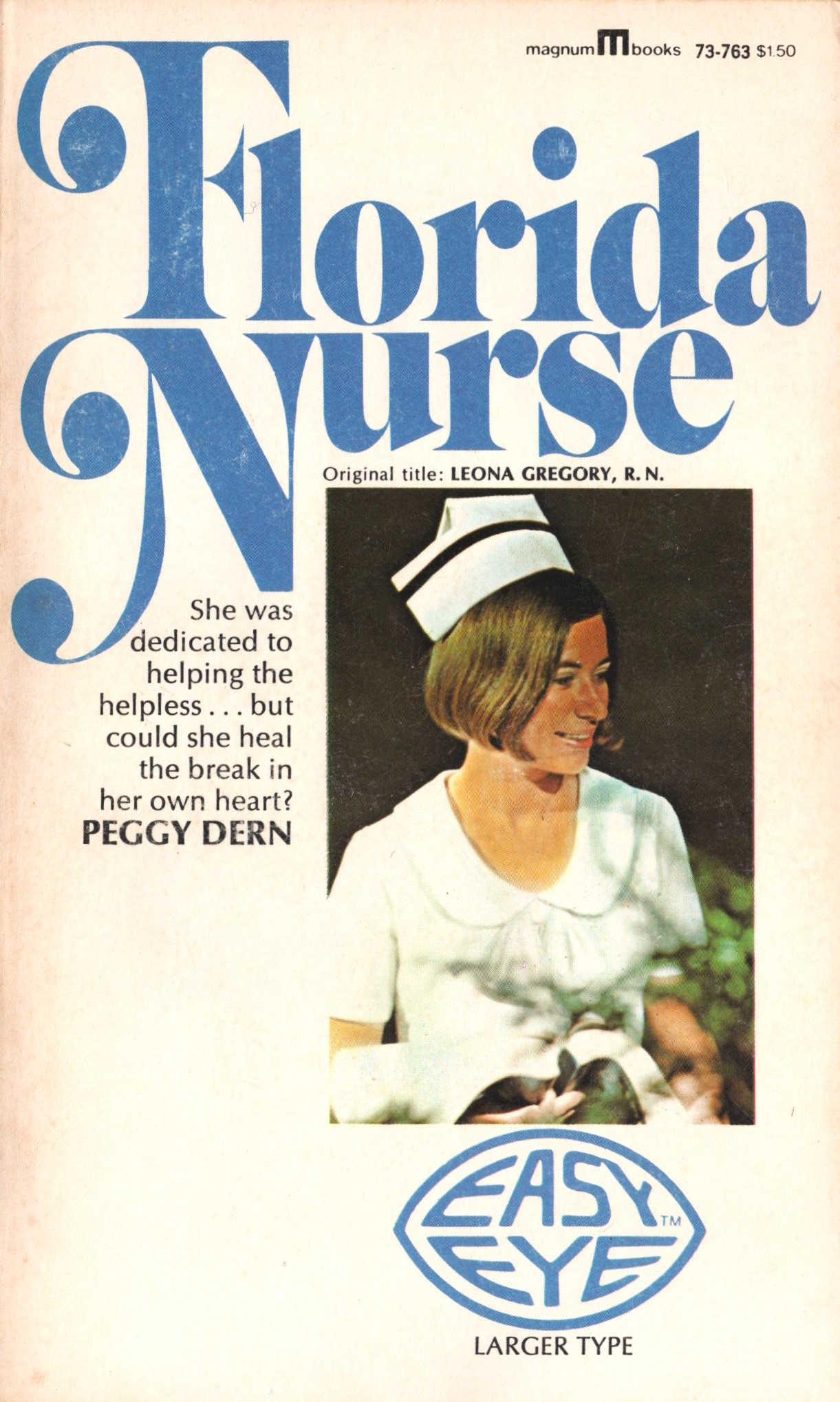
Florida Nurse

By Peggy Dern
(pseud. Peggy Gaddis), ©1961
Also published as Leona Gregory, R.N.

The daughter of a doctor, Leona Gregory had known since earliest childhood that she wanted to be a nurse. She had always thought that that would mean working with her father. But now that Dr. Gregory had married a young wife, Leona felt out of place in the household. The young R.N. gratefully accepted a position in a hospital in Cypress City on the Gulf Coast, even though she was afraid it would cut her off from everything she had known. Meeting the cold, beautiful supervisor of nurses, Paula Ingram, and the stern disciplinarian, Dr. Foster, who headed the hospital, seemed to confirm her fears. But Leona also found an opportunity for service she could not have had elsewhere. Then too, there was the handsome, charming senior intern, Cole Jordan … and, working with him, Leona began to feel that her heart might find wings again.

GRADE: C-

BEST QUOTES:
“Nothing is as inevitable as canned peaches in the hospital dining room.” 

“Well, well, so you’re going to be my special nurse. I feel a bad relapse coming on. I may be here for months.”

“When people are sick or hurt, a nurse’s uniform or a doctor’s is just about the most beautiful thing in the world.”

REVIEW:
It’s entirely possible that it took author Peggy Gaddis, here writing as Peggy Dern, less time to write this book than it did me to read it. The continuity and logic failures are numerous, and Gaddis frequently uses conspicuous words more than once in the same paragraph. Furthermore, this is not the first Gaddis heroine we have met named Leona (see also Nurse in the Shadows). 

Here, Leona Gregory is leaving the “brutal winters” of—not Chicago or Buffalo—Atlanta! a climate so inhospitable that to stand on the doorstep and ring the doorbell is to court pneumonia. Though she tells her father that it’s the frigid temperatures that are driving her to abandon the dream that they have held since she was nine—she was to work as a nurse in his office—the real fact is that it’s Leona herself who is bitterly cold. Her father remarried two years ago to a lovely woman named Irene who attempts repeatedly to befriend Leona only to the rebuffed again and again, and finally Leona is packing her bags and huffing off in a jealous pout for the Florida Coast.

Arriving, apparently not having bothered to interview for the job before signing a one-year contract, she is stunned to find that the head nurse and the chief doctor are unfriendly and militant disciplinarians. She befriends nurse’s aide Alma Pruitt, who appears to have bipolar disorder given the way she caroms between hysterical laughter and hysterical tears from one paragraph to the next. She also meets Dr. Cole Jordan, the up-and-coming surgical resident who always insists on commenting on Leona’s looks; bachelor number two is Bruce McLain (also spelled MacClain), who recently inherited a very lucrative ranch in town. Carol Decker is the daughter of the housekeeper on Bruce’s ranch, and though the original owner of the ranch left Carol and her mother well off, Carol has her sights set on Bruce’s larger fortune.

With three women and two men, it’s a game of the musical chairs to find out who is going to end up alone—and with Carol acting the part of the “weirdie,” “mental case,” and “spiteful malicious cat,” she is clearly the one we are not supposed to like. But honestly none of the women are terribly attractive—there’s Leona’s inexplicable animosity toward her lovely stepmother Irene, and Alma Pruitt herself engages in quite a few unattractive games to snare a man, such as pretending she has a fiancé in Tampa; her wild mood swings are also alarming, as she is usually in tears at some point in every scene in which she appears.

So what’s the plot? I mean, beyond thin and implausible? Well, Bruce has been thrown from his beloved horse and saved from paralysis when Dr. Foster plucks a miniscule bone fragment from his spine, and now Bruce has to lie in the hospital for weeks. But Leona is assisting in the surgery and hears Bruce mumble just before he’s going under, “Don’t let anything happened to Starlite.” So when Carol vows to have the horse shot, Leona peels off her scrubs and flies out to the ranch to prevent the murder because “it’s part of the nurse’s job to catch the faintest whisper from the patient and try to do what he asks,” apparently even if it means abandoning her shift. I hope one of my patients will ask me to make a Starbucks run.

Now the thwarted Carol is gunning for Leona—and soon the sheriff turns up at the hospital to arrest Leona because the horse has gone missing, and based on this accusation alone, the sheriff plans to toss Leona in jail. It seems a rather flimsy basis for legal system, but then this is Florida. Out on bond, Leona decides that Carol “will continue to harass me and the hospital as long as I am here.” So despite the fact that Dr. Foster has not agreed to release Leona from her contract, she decides she is quitting—Dr. Foster has better grounds for lawsuit than Carol does, but never mind about that.

Leona goes to tell Bruce goodbye, that she is going back to Atlanta to work with her father after all. “Her father would be overjoyed; and she and Irene would be friends!” This shocking transformation of character, we are told, occurs because “when I fell in love with Bruce, I suppose I sort of grew up.” Here’s surprise number two—she and Bruce, who had spent exactly two afternoons together, are madly in love and will be married the minute Bruce leaves the hospital! And Leona will be leaving her career too, because even though Bruce has expressed no opinion on the matter—and never mind about Leona’s pesky contract—“I’m going to do whatever Bruce wants me to do, always.” Irene tries to talk sense into Leona by saying, “In a successful marriage there is no necessity for a boss. It’s a partnership; an equal partnership; fifty-fifty all the way.” Nonetheless, though she has declared that nursing is vitally important to her, Leona insists on quitting a hospital so short-staffed that “there simply isn’t time for any of us to sit down and hold the families’ hands or soothe them.”

Ultimately this is a carelessly written book with stupid characters, compounded by a large helping of bigotry against the local Seminole population and the poor whites in town as well. (There’s another penitential donation going to the American Indian College Fund from the White Doctor Foundation.) Dr. Foster shouts at a family reluctant to put their five-year-old daughter to surgery for a possibly benign tumor based only on his say-so—in a conversation held in the hospital lobby, no less—and the head nurse explains the doctor’s shocking rudeness (not to mention privacy violation) by saying, “he simply has not the patience or the time to put up with ignorant, stupid creatures”—and Leona is shocked that the nurse thinks Leona might be critical of this approach.

Peggy Gaddis always wants to have everything both ways—Leona couldn’t possibly criticize a doctor for calling it “nonsense” to explain a surgery (these days it’s called “legal consent”), but we are supposed to like Dr. Jordan a lot more because he does. Some characters say some really appalling things about the Seminoles, and these remarks pass without comment, but Indians competently staff the hospital and ranches in town (and ultimately save Bruce’s horse). Women are strong, competent workers who manage large farms and hospital wards, but they chuck it all to land a man. Alma schemes to lure in her crush, including lying about a fiancé and flirting with men in whom she has no interest, but Carol is the one who is called a “scheming cat” for her desire to win Bruce. Alma never has a kind word to say about Carol but completely denies intending to hurt Carol’s feelings when Carol take offense. Every leading male character tells a woman at least once that he ought to “turn you across my knee and whale the daylight out of you!” Need I go on?

I’m ultimately not sure what author Gaddis herself thinks about her characters, but it seems clear to me that she does not have a high regard for women. That being the case, it’s hard for me to have a high regard for Peggy Gaddis or her books, and especially not this one.

Friday, August 12, 2022

Nurse Jenny

By Margaret Howe, ©1958
Cover illustration by Harry Bennett 

Jenny Dawson was pretty, young and blonde, but she had absolutely made up her mind to dedicate herself to her nursing career and to the little nephew who was left in her care … Then, in her new job at the famous Merriman Memorial Hospital, she met—Dr. Peter Hurley—broad-shouldered and serious-minded … and Jack Merriman—handsome, wealthy, debonair … The story of a lovely and courageous nurse who finds that  life can be very complicated indeed when one is devoted to a demanding career, and much more so when one is young, beautiful, and admired by two very attractive and eligible men …


GRADE: C-


BEST QUOTES:

“The knowledge that Jimmie would never be a mental case cheered her.”


“Jack told me I was silly not to have a pretty nurse. It’s bad enough to be here, without having to watch a homely woman for hours.”


“A pretty girl like you shouldn’t dedicate her future to a crippled child.”


“We’d better get out of here before the hospital gossips start a rumor that they caught me necking with a nurse.”


REVIEW:

I have said before that a C grade is really the worst possible grade for a novel: not so awful that it engenders at least some emotion, not laugh-out-loud bad, and certainly not enjoyable, it plops squarely into the category of books that there is absolutely no reason to read.


Nurse Jenny Dawson has inherited her nephew, Jimmie, a four-year-old with cerebral palsy, from the boy’s mother Belle, after the father, Jenny’s brother, died in a truck accident; “how callous and indifferent Belle had been from the moment Jimmie was born. She hated him. She would have put him in an institution.” So Jenny had taken him, then depleted her savings and abandoned her job to travel around the country to see various specialists to try to get him care. Merriman Clinic has gotten her one remaining dime for “this last attempt to find someone who could help,” and sure enough, Dr. Peter Hurley agrees that Jimmie has the potential to learn to talk, possibly even walk. In return for his treatment, Jenny takes on a job as nurse at the next-door hospital, caring for demanding matriarch Nora Merriman, whose money has endowed the hospital, and who has broken her hip in a fall and “might easily become a cripple” without proper nursing care.


Nora’s son Jack is a cad, flirting with everything but settling on nothing, encouraged by his mother, who feels that nothing is good enough for her boy. He starts chasing Jenny, who goes on dates with him and appreciates his charm, but she is put off by his lack of seriousness. At the other extreme is Dr. Peter, who is nothing but serious: “He doesn’t seem to get a kick out of anything but his profession,” observes Jack.


Well, his profession … and Jenny, whom he repeatedly asks out for coffee, even starts hugging and kissing her, all the while telling her, “I can’t allow my emotions to trick me into anything which might endanger my ambition to be a successful doctor.” That’s why he likes Jenny, he tells her, because she “expects no more than I can offer.” What a tease!


Eventually Jenny’s savings are wiped out and she worries she will have to take Jimmie out of the clinic, where he now receives round-the-clock care and therapy three times a week, which has somehow brought him to a vocabulary of ten words from none. But Dr. Peter contacts some wealthy philanthropists who offer to fund Jimmie’s treatment as long as Jimmie’s mother Belle agrees. Belle smells the money that could be made off Jimmie, as Dr. Peter and the investors are thinking of starting a national charity to benefit kids with cerebral palsy and starring Jimmie on posters to draw public attention. (It’s a little weird that either by coincidence or deliberate rip-off, the author has hijacked the story of the Jimmy Fund, which began a decade before this book was written by utilizing a 12-year-old cancer patient to raise funds and awareness, even down to using the same name for the boy with CP.) Now Jack, Peter, and Nora are all working to save Jimmie from Belle’s clutches, all to win Jennie for themselves, as a nurse or a wife. Who will succeed? Well, you won’t be shocked to learn that it isn’t Nora.


The curious parallel between Jimmie and Nora Merriman is only briefly touched on, when Nora wails, “It’s the prospect of a future as a cripple that appalls me.” When Jenny reminds Nora of Jimmie’s deficits, Nora replies, “Thinking about others doesn’t make it easier for me to face the future,” and flops back into her satin pillows and eiderdown quilts.


In the end, Jimmie is saved from his mother, who is essentially bought off, and Jenny wins the man you know she will in the final three lightning-fast paragraphs. The characters are flat and the writing is wooden, which is surprising, given that Margaret Howe has put her name on the cover of 2011 Top Ten VNRN Visiting Nurse—though she also claimed three other mediocre books (Special Nurse, Debutante Nurse, and The Girl in the White Cap). The best thing about this book is the Harry Bennett cover, even if on my copy of this book the printing register is out of alignment, making it look blurry and alien. But what’s inside the cover is off as well, so that may be fittingly appropriate.

Monday, January 10, 2022

First Year Nurse

By Diane Frazer
(pseud. Dorothy Fletcher), ©1964
Cover illustration by Harry Bennett

“You’re leaving us, Dr. Troy?” Taffy closed her eyes and took a deep breath. “You let me know if there is an opening in your hospital, Doctor.”
Dr. Troy stared at her. It was the stare of a boy seeing all the toys he had wanted under the Christmas tree. There was a silence that seemed to last forever. “No need to check,” he said hoarsely. “I know there’s an opening.”
“Is there?” she said, and looked directly into his brown eyes. What happened next was completely her doing. It wasn’t possible that she had put her arms up to his shoulders and put her mouth on his. It wasn’t possible. But there she was in his arms, which had promptly wrapped themselves around her, as if he been waiting for her to do exactly that. And maybe he had been waiting, waiting a long time. 

GRADE: B

BEST QUOTES:
“The doctors, as usual, were running off at the mouth, spouting their learned phrases. Doctors never lowered their voices. They seemed to try to outdo each other in pedantry.” 

“She knew that to find someone who would ask you to give up your career, you must first have a career.”

“No, I had no special plans. Nothing that couldn’t be arranged, anyway. Eddie Fisher wanted to take me to the New York Hilton for dinner, but I put him off. Some other time, I told him. He was terribly disappointed, but never let it be said I let a colleague down.”

“If I blush now I’ll kill myself, Taffy thought. I’ll go out and buy a gun.”

REVIEW:
Perhaps the best thing about First Year Nurse is that it features a cameo by Lily Sorenson Carlton, the starring RN in Nurse Lily and Mister X, a sparkling, witty nurse novel that Frazer/Fletcher wrote in 1961. Unfortunately, while this novel has some admirable qualities, it is not of the same caliber as Nurse Lily.

Here Lily is on the OB ward to deliver her first child, cared for by Nurse Elizabeth Powell, unfortunately nicknamed “Taffy,” apparently because of her hair, but I hope not. She is crushing on obstetrician Dr. Ben Troy, who is as shy as he is handsome; in an early elevator scene we peer into the thoughts of each to realize that they like each other, but each completely misreads the other’s sentences in the worst possible light so as to remain oblivious to the other’s interest. So for most of the book, they pass in the halls and exchange clipped words that continue the hurt feelings.

The book follows various patients and their obstetrical courses, some for better and some for worse. It trails Taffy on her dates with Ernie Browder, a PhD pharmacist who chafes for opportunity and the riches he feels that will bring; they have many bizarre conversations in which he urges her to chase after more lucrative opportunities with the suggestion that her successes will somehow benefit him, though it’s not clear why that might be the case, even if they were to marry. Unfortunately, his influence leads Taffy into the 20th floor office of a wealthy father-to-be one late evening, lured by the promise of a high-paying job in his firm. Well, that’s not actually what the man wants, and in a creepy scene in which he’s locked the office door, he tells Taffy, “I’m not in the habit of attacking young girls, but I’m also not in the habit of wasting my time. This office is virtually a prison and only I have the key. There’s nobody around at all.” Only the mention of Taffy’s relationship with his wife opens the door. It also opens her eyes to what she really wants in life, which had been eluding her up to that point. “Everyone wanted to be rich. Of course. But it shouldn’t eat you up inside,” she decides, realizing that her nursing career, which had previously seemed a bit dull, is “my natural element. This is where I belong. Why, it’s my life.”

Then, in a February blizzard during which only those staff members living within walking distance of the hospital are able to staff the place for three days, Taffy and Ben become friendly. Taffy offers to accompany a stressed mother into the OR during her C-section, and when it’s over, she passes out in the scrub room, and Ben staggers off with her in his arms to find her an empty hospital bed. “How much do you weigh, anyhow? It seemed like about two hundred pounds,” he gripes. The scene’s conclusion should come as no surprise to anyone who’s read a nurse novel before, or the back cover of this novel.

The book itself is somewhat modern in that I think it’s the first time in more than 400 VNRNs that I’ve encountered the word “rape”; when one of Taffy’s roommates staggers in completely distraught, and Taffy asks her, “Nothing really bad happened to you, did it?” the roommate replies, “You mean nobody raped me, did they? Isn’t that what you mean?” (Nobody did.) In addition, to demonstrate how shallow the pool of eligible men in New York is, Taffy recalls a former beau: “It took three dates to find out that he was a homosexual,” possibly another first mention for a VNRN. Working on the maternity ward, Taffy is a first-hand observer of the results of passion; labor, and babies, are “the price to be paid for pleasure, for love.” She thinks of one 19-year-old patient who hemorrhaged during the delivery of her baby: She “had danced at the St. Regis Hotel and fallen in love, made love, and then died from it.” It’s not all grim, though; the book has some of the razor-sharp humor we expect from Dorothy Fletcher, just not as much as we would like. In addition there’s not much plot to this book—certainly not enough interaction between the leads to warrant their apparent engagement in the final pages. You could certainly do worse than this book, but it’s sad to know that author Dorothy Fletcher could easily have done better.

Saturday, December 25, 2021

Doctor Chris

by Elizabeth Seifert, © 1946

When the new doctor arrived at Lakeside Hospital, the reaction was lively. Nobody had expected Dr. Chris Metcalf to be a girl. The nurses were not pleased, for another young woman meant keener competition for the attention of the handsome Chief of Staff. The Chief of Staff himself was not pleased, for he believed that medicine was for men alone. So Chris had something to fight against, as well as a lot to learn during her year of hospital life. It was anything but a dull year, however, what with this vigorous opposition, with sabotage in an Army Ordnance plant nearby, and with the personable young lawyer in town who appreciated Chris as a woman rather than as a doctor. In her latest novel Elizabeth Seifert shows the development of Chris Metcalf is a person and as a doctor, and adds a vivid new story to her popular group of novels about doctors and the drama of their work. 

GRADE: B+

BEST QUOTES:
“Just so I’m the biggest something in your life, sweetheart.”

REVIEW:
Poor Dr. Chris Metcalf is a 24-year-old intern, having just graduated from medical school, and is arriving at Lakeside Hospital somewhere in Missouri. Of course, the initial joke is that with the nickname of Chris, everyone thinks from her resume that she is a man. What fun when she arrives wearing a skirt! Well, maybe not fun, as she gets the fisheye from multiple mossbacked and/or jealous nurses and doctors, including her new chief, 40-year-old Dr. Key Edmons. (I know, “Key” is about the worst name ever, but it’s not the first time we have met one, and probably won’t be the last, unfortunately.) But Chris is not intimidated: “I’m not frightened of you, and you don’t shock me,” she tells him. “Another thing you can count on, I won’t bother you by falling in love with you.” That shows him! Except maybe not, as he has an exceptional amount of prejudice to overcome, and she is perennially smacking into that wall. Frankly it gets more than a little tiresome to continually encounter remarks such as, “There is something you’re going to have to learn, Dr. Metcalf, though I’m damned if I think you can learn it. Because you’re a girl!” Or, “You didn’t handle the father, and the reason you didn’t is the same reason we have against your trying to be a doctor. You’re a girl.” Honestly, Chris is never going to experience any gender confusion, she is reminded so frequently of hers, though it seems likely that she has progressed through puberty and actually qualifies as a woman.

She does not have much spare time, being an intern and all, but soon Chris has hooked up with a local playboy, 35-year-old attorney Allan Gifford, who is apparently about to be engaged to one wealthy socialite while also having an affair with the chief OR nurse. If that doesn’t make him enough of a catch, he, too, is ridiculously prejudiced against women doctors. “Why should a pretty little girl like you go into anything so gruesome as the practice of medicine?” he asks her when they first meet. He repeatedly pressures her to marry him, but is very open about his insistence that she quit medicine if she does, so she doesn’t really take him seriously.

The book rolls along and we watch Chris tackle with varying degrees of success various medical situations, always carrying the weight of her entire gender on her back. I will say she is a bit on the wimpy side and does have a tendency to break into tears, but the pressure of one’s intern year combined with the accompanying lack of sleep might do that to anyone. She is fierce in her regular and ongoing battles with Dr. Edmons about her capabilities, I will give her that: “Don’t you dare say that’s why I have no business doctoring,” she snaps at him when he tells her that women can’t be doctors because they have “a tender heart.” “Men have tender hearts, too. Don’t they? Don’t they?” (Dr. Edmons, who is obviously falling in love with Chris, begrudgingly admits she may be right.)

Two of the more interesting cases that Dr. Metcalf encounters involve reproductive rights: a young woman, pregnant by a bounder, who asks for an abortion—Chris refuses because it’s illegal and she is only an intern without the requisite skills; it’s not clear which is the bigger obstacle—and in another case a woman who is having her appendix out asks to have her ovaries removed as well. Dr. Edmons refuses to do it because the ovaries are not diseased, but Chris replies that they would take out healthy ovaries during a hysterectomy. The argument is dropped before it progresses, but it is curious that author Elizabeth Seifert introduces these weighty topics in such an offhanded manner.

Eventually, as you knew there would be, there is a case of serious sabotage at the nearby Army ordnance plant in which a plane crashes into it, and Chris and Dr. Edmons work all night to save the burned men. Chris than deduces who the scurrilous foreign agent is—the only character with a German accent (*eyeroll*)—and plays a large role in bringing the criminal to justice, with the help of Allan Gifford, who turns out to be FBI! Unfortunately, “all the glamour Cooper and Hoover have given to the G-men, the aura of Sherlock Holmes—all glimmered about Allen’s big, homely person” and now she thinks she is in love with him and accepts his ring, “the badge of submission, of subordination.” Well, that sounds lovely! Then he is injured in a shooting accident and she saves his life, proving to everyone that she is a “real” doctor—but also to herself that she is not in love with Allan: “Have I got so hard, so unfeeling that I could have done what I did for Allan, if I really loved him—the way I should love him?”

Overall, this is a low-key, satisfying book by an excellent author. It’s not especially exciting or unique, but it is well-written and has a quiet humor in several instances that unfortunately doesn’t translate to the Best Quotes section. It certainly is a slice of life of a young woman trying to forge her way through a career that is difficult today, much less 75 (!!) years ago, and if the incessant prejudice is trying for us to endure, I imagine it was a great deal more so for the brave women who actually lived through it. If this gentle book isn’t the most memorable, it has a pleasant competence that makes it worth reading about Dr. Chris.