Showing posts with label arrest. Show all posts

Monday, October 31, 2022

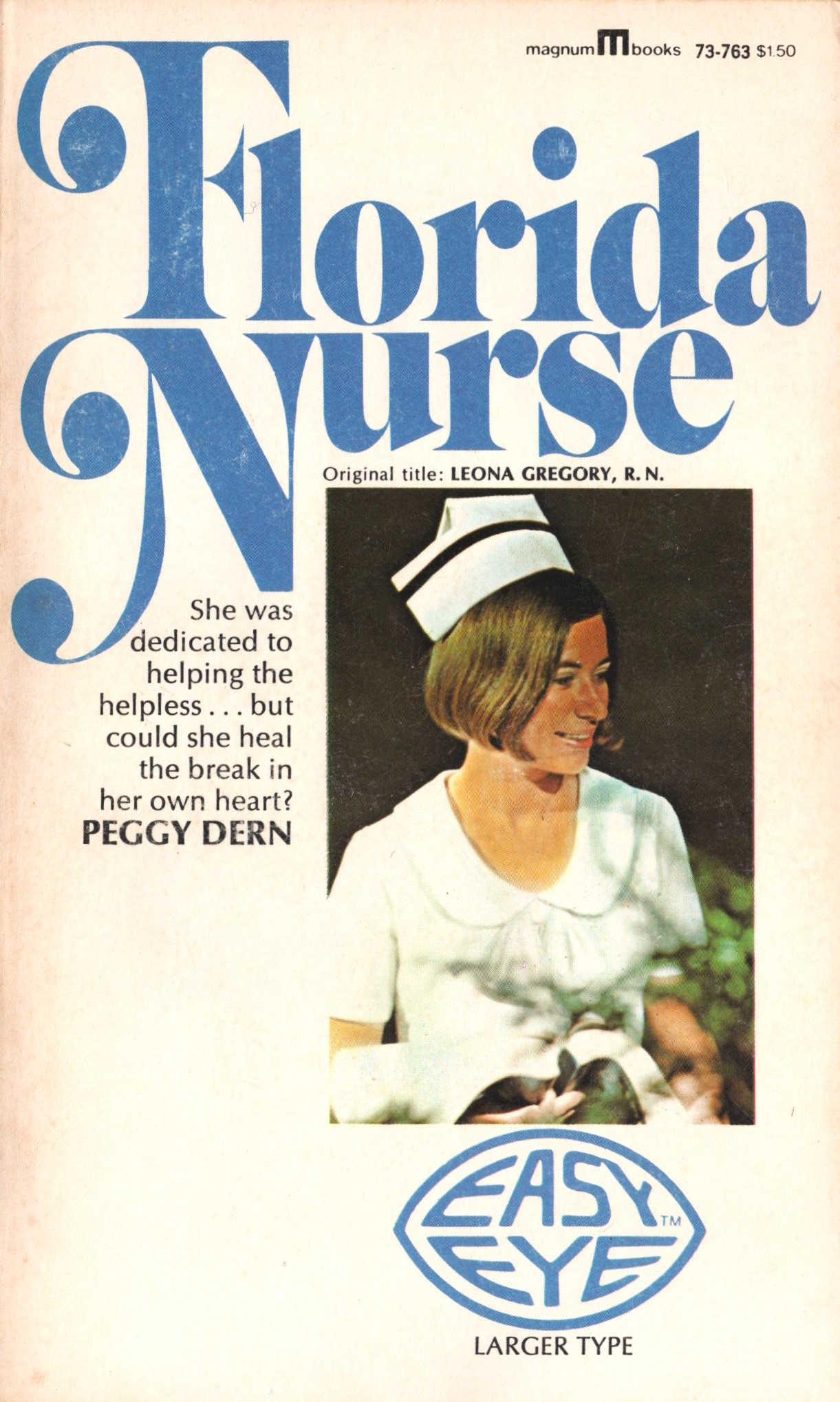
Florida Nurse

By Peggy Dern
(pseud. Peggy Gaddis), ©1961
Also published as Leona Gregory, R.N.

The daughter of a doctor, Leona Gregory had known since earliest childhood that she wanted to be a nurse. She had always thought that that would mean working with her father. But now that Dr. Gregory had married a young wife, Leona felt out of place in the household. The young R.N. gratefully accepted a position in a hospital in Cypress City on the Gulf Coast, even though she was afraid it would cut her off from everything she had known. Meeting the cold, beautiful supervisor of nurses, Paula Ingram, and the stern disciplinarian, Dr. Foster, who headed the hospital, seemed to confirm her fears. But Leona also found an opportunity for service she could not have had elsewhere. Then too, there was the handsome, charming senior intern, Cole Jordan … and, working with him, Leona began to feel that her heart might find wings again.

GRADE: C-

BEST QUOTES:
“Nothing is as inevitable as canned peaches in the hospital dining room.” 

“Well, well, so you’re going to be my special nurse. I feel a bad relapse coming on. I may be here for months.”

“When people are sick or hurt, a nurse’s uniform or a doctor’s is just about the most beautiful thing in the world.”

REVIEW:
It’s entirely possible that it took author Peggy Gaddis, here writing as Peggy Dern, less time to write this book than it did me to read it. The continuity and logic failures are numerous, and Gaddis frequently uses conspicuous words more than once in the same paragraph. Furthermore, this is not the first Gaddis heroine we have met named Leona (see also Nurse in the Shadows). 

Here, Leona Gregory is leaving the “brutal winters” of—not Chicago or Buffalo—Atlanta! a climate so inhospitable that to stand on the doorstep and ring the doorbell is to court pneumonia. Though she tells her father that it’s the frigid temperatures that are driving her to abandon the dream that they have held since she was nine—she was to work as a nurse in his office—the real fact is that it’s Leona herself who is bitterly cold. Her father remarried two years ago to a lovely woman named Irene who attempts repeatedly to befriend Leona only to the rebuffed again and again, and finally Leona is packing her bags and huffing off in a jealous pout for the Florida Coast.

Arriving, apparently not having bothered to interview for the job before signing a one-year contract, she is stunned to find that the head nurse and the chief doctor are unfriendly and militant disciplinarians. She befriends nurse’s aide Alma Pruitt, who appears to have bipolar disorder given the way she caroms between hysterical laughter and hysterical tears from one paragraph to the next. She also meets Dr. Cole Jordan, the up-and-coming surgical resident who always insists on commenting on Leona’s looks; bachelor number two is Bruce McLain (also spelled MacClain), who recently inherited a very lucrative ranch in town. Carol Decker is the daughter of the housekeeper on Bruce’s ranch, and though the original owner of the ranch left Carol and her mother well off, Carol has her sights set on Bruce’s larger fortune.

With three women and two men, it’s a game of the musical chairs to find out who is going to end up alone—and with Carol acting the part of the “weirdie,” “mental case,” and “spiteful malicious cat,” she is clearly the one we are not supposed to like. But honestly none of the women are terribly attractive—there’s Leona’s inexplicable animosity toward her lovely stepmother Irene, and Alma Pruitt herself engages in quite a few unattractive games to snare a man, such as pretending she has a fiancĂ© in Tampa; her wild mood swings are also alarming, as she is usually in tears at some point in every scene in which she appears.

So what’s the plot? I mean, beyond thin and implausible? Well, Bruce has been thrown from his beloved horse and saved from paralysis when Dr. Foster plucks a miniscule bone fragment from his spine, and now Bruce has to lie in the hospital for weeks. But Leona is assisting in the surgery and hears Bruce mumble just before he’s going under, “Don’t let anything happened to Starlite.” So when Carol vows to have the horse shot, Leona peels off her scrubs and flies out to the ranch to prevent the murder because “it’s part of the nurse’s job to catch the faintest whisper from the patient and try to do what he asks,” apparently even if it means abandoning her shift. I hope one of my patients will ask me to make a Starbucks run.

Now the thwarted Carol is gunning for Leona—and soon the sheriff turns up at the hospital to arrest Leona because the horse has gone missing, and based on this accusation alone, the sheriff plans to toss Leona in jail. It seems a rather flimsy basis for legal system, but then this is Florida. Out on bond, Leona decides that Carol “will continue to harass me and the hospital as long as I am here.” So despite the fact that Dr. Foster has not agreed to release Leona from her contract, she decides she is quitting—Dr. Foster has better grounds for lawsuit than Carol does, but never mind about that.

Leona goes to tell Bruce goodbye, that she is going back to Atlanta to work with her father after all. “Her father would be overjoyed; and she and Irene would be friends!” This shocking transformation of character, we are told, occurs because “when I fell in love with Bruce, I suppose I sort of grew up.” Here’s surprise number two—she and Bruce, who had spent exactly two afternoons together, are madly in love and will be married the minute Bruce leaves the hospital! And Leona will be leaving her career too, because even though Bruce has expressed no opinion on the matter—and never mind about Leona’s pesky contract—“I’m going to do whatever Bruce wants me to do, always.” Irene tries to talk sense into Leona by saying, “In a successful marriage there is no necessity for a boss. It’s a partnership; an equal partnership; fifty-fifty all the way.” Nonetheless, though she has declared that nursing is vitally important to her, Leona insists on quitting a hospital so short-staffed that “there simply isn’t time for any of us to sit down and hold the families’ hands or soothe them.”

Ultimately this is a carelessly written book with stupid characters, compounded by a large helping of bigotry against the local Seminole population and the poor whites in town as well. (There’s another penitential donation going to the American Indian College Fund from the White Doctor Foundation.) Dr. Foster shouts at a family reluctant to put their five-year-old daughter to surgery for a possibly benign tumor based only on his say-so—in a conversation held in the hospital lobby, no less—and the head nurse explains the doctor’s shocking rudeness (not to mention privacy violation) by saying, “he simply has not the patience or the time to put up with ignorant, stupid creatures”—and Leona is shocked that the nurse thinks Leona might be critical of this approach.

Peggy Gaddis always wants to have everything both ways—Leona couldn’t possibly criticize a doctor for calling it “nonsense” to explain a surgery (these days it’s called “legal consent”), but we are supposed to like Dr. Jordan a lot more because he does. Some characters say some really appalling things about the Seminoles, and these remarks pass without comment, but Indians competently staff the hospital and ranches in town (and ultimately save Bruce’s horse). Women are strong, competent workers who manage large farms and hospital wards, but they chuck it all to land a man. Alma schemes to lure in her crush, including lying about a fiancĂ© and flirting with men in whom she has no interest, but Carol is the one who is called a “scheming cat” for her desire to win Bruce. Alma never has a kind word to say about Carol but completely denies intending to hurt Carol’s feelings when Carol take offense. Every leading male character tells a woman at least once that he ought to “turn you across my knee and whale the daylight out of you!” Need I go on?

I’m ultimately not sure what author Gaddis herself thinks about her characters, but it seems clear to me that she does not have a high regard for women. That being the case, it’s hard for me to have a high regard for Peggy Gaddis or her books, and especially not this one.

Monday, May 30, 2011

Nurse at the Fair

By Dorothy Cole 
(pseud. Frances Y. McHugh), ©1971 
Cover illustration by Allan Kass 

Pretty, auburn-haired Merilee Maxwell was happy in her position as nurse and in her love for tall, red-haired Dr. Kendall Ryder to whom she was secretly engaged. But suddenly the serenity of her world was threatened when TV-Western star Tex Howard was admitted to the hospital after being injured in a mysterious accident. Tex was dangerously attractive, and the way he set about working his charm on Merilee was enough to turn any girl’s head. It wasn’t until she was caught in an explosive incident at the local fair that Merilee realized just how dangerous was her relationship with the handsome singing cowboy. She had followed her heart and it had led her into trouble. Had she gone too far to turn back ... ? 

GRADE: A- 

BEST QUOTES: 
“She had hurried so, she knew her perky nurse’s cap was at a rakish angle on her bright auburn curls and that her face could use some powder.” 

“They never dared to look at each other when they were on duty for fear they would show how they felt toward one another—for they were deeply in love, an ecstatic state they had been in for the past two months.” 

“Complimenting a pretty nurse helped a man to feel that he was still a man, even though he was flat on his back in a hospital.” 

“When you have a good-looking woman patient who isn’t married, I can’t sleep nights.” 

“A man feels differently about his horse from the way he does his wife.”
 
“Is this where you came last evening after you got me out of jail?” 

“The hot dog, cotton candy and popcorn booths all contributed their special smells to the atmosphere. Merilee hated to think what the pollution count must be and found herself holding her breath.” 

“Ever since the riot at the fair, Mrs. Rogers had been very cool toward her, even though everyone who had been arrested that night had been released the following day without being brought to trial.” 

REVIEW: 
I have not quite decided whether this book is flat-out brilliant or just so dumb that it appears so. It is, after all, a fine line between clever and stupid. One one hand, we have hilarious lines like, “Merilee felt her heart plummet down into the sensible shoes she’d put on to walk around the fair grounds.” On the other hand, in between jewels like these, we have plodding passages such as, “Merilee hurried along the corridor lined with rooms on either side, each with one, two, three and four patients in it. At the corner, she turned into another corridor, similar to the longer one she had just left. At the far end of that corridor, to the right, was the emergency room, close to the door where the ambulance stopped.” But even if this book is consistently moronic, does it really matter? If part of its fun is its stupidity, does the stupidity make the book less fun? 

Philosophical arguments aside, Merilee Maxwell is a nurse in a perky cap engaged to a manly would-be family doctor, Kendall Ryder, who also performs surgery on a regular basis. They have been dating for about six months, and he’d proposed on the first date because, as he told her at the time, he’d worked with her in the hospital for a few months and everyone thought well of her. He already has her picking out the furniture for their new house, which he is in the process of buying when the book opens. If people in the 1960s rushed into marriage with the alacrity of the couples in VNRNs, it’s no wonder everybody’s parents are divorced. 

But—and there’s always a big but—then Robert Blakely is wheeled into the ED. He is badly injured, and Merilee and Dr. Ken get right to work cleaning off his face and legs. Only when he is sparkling clean, apart from the broken nose and at least three bleeding gashes on his face, is he wheeled into x-ray to see if he might actually be dying of a ruptured spleen or something. First things first. Dr. Ken has recognized the man as the star of a TV western who goes by the name Tex Howard. Tex has a horse ranch nearby and claims he was injured riding a horse, but Dr. Ken doesn’t believe it. He knows that Tex has a wife “somewhere,” though Tex had told Merilee he had no family; this news made Merilee’s “heart feel unusually heavy.” There’s trouble brewing in Crystal Springs. 

She’s obsessed with Tex, and pesters Dr. Ken for details of his injuries when he comes over later that night for the usual VNRN fare of a martini, steak, baked potato, and tossed salad. She’s upset that Tex has been put in a room with Mr. Oldfield, who hollers all night, and thrilled that she will be his nurse tomorrow. But when she’s checking on him the next day, after she’s questioned poor Tex relentlessly about his wife, someone fires a gun through the window. Merilee, who is either very brave or very dim-witted, immediately runs to it to see who it is. Is the author’s overwhelming disregard for human nature intentional or ignorance? In any case, the shooter is not discovered, and the incident quickly fades in the rear-view mirror. 

After he gets out of the hospital, Tex invites Merilee to come to the eponymous fair to hear him perform, and despite Dr. Ken’s insistence that she stay away from Tex, off she goes. For his opening number, Tex sings a new composition called “Marilee, Where Are You?” and is about to play it again when “a shot rang out, and Tex crumpled to the floor of the stage.” Maybe someone just can’t bear to hear that song again. The audience takes this in stride and taps their feet as red-coated musicians, who immediately rush on stage to block the view of Tex, break into a lively tune. Then there’s an explosion, apparently set off by the hippies sitting in front of Merilee, and this is finally too much for the crowd, which immediately erupts into a riot and begins throwing punches en masse. 

Merilee, who is even slower out of the gate than the audience, watches for a while longer, until the announcer pleads with the crowd to leave quietly. This request has the opposite effect on Merilee, who freaks out and tries to push her way to the stage but is sucked into the riot, where she starts hitting people. The fuzz finally arrives and drags her off to the police station, where she is booked by friendly Seargent Rosetti, whom she had nursed through a recent bout of appendicitis. She’s freed on bail by long-suffering Dr. Ken, who is understandably chilly, though she doesn’t seem to understand and is hurt when he doesn’t want to chat about Tex on the way home or come in for a visit. Tex vanishes after the shooting, but Dr. Ken knows where he is and takes Merilee with him to change the bandages, as Tex has been shot in the “fleshy part” of the shoulder. Merilee suppresses an unprofessional gasp when she realizes that “if the bullet had gone a few inches lower, it would have penetrated his heart,” which is apparently located between his nipple and his armpit. 

At this point, a mystery breaks loose. There’s a photo of Tex’s wife in Tex’s bedroom that one of Tex’s horse trainers wants Merilee to get for him, but it’s gone missing. The book finally starts to wonder about who is trying to kill Tex, how he landed in the hospital, and what the story is with his wife. Through it all, Merilee maintains a complete inability to comprehend the effects of her actions. Ken’s long-lost sister shows up, and when Ken spends the evening with his sister instead of with Merilee, she wonders, “Was the pleasant pattern of her relationship with Ken going to be spoiled because of the sudden arrival of his sister?” Of course, it’s already been spoiled because of her intense infatuation with Tex, but apparently that hasn’t occurred to her. 

This sort of overwhelmingly blatant stupidity is rampant throughout the book. Initially I found it irritating, but it was so pervasive that I actually started to wonder whether it was intentional. Can the author really be unaware that her book’s situations so consistenly run contrary to common sense and human nature? The amusing quotes—e.g. “his lips were firm yet able to smile easily”—are as dopey as they are funny. The book is not so over the top, not so obviously campy, that I can be certain that it’s deliberate, and this did detract somewhat from my enjoyment of it. But this book is easily so dumb that it’s a good read, an absolutely worthwhile way to spend an afternoon.