Showing posts with label theme - failure to communicate. Show all posts

Monday, July 4, 2022

The Hospital World of Susan Wray

By Anne Lorraine ©1965 

Susan became aware that the doctor was watching her. He leaned back in his chair, studying her small office, the bookshelves laden with medical books, and, slightly incongruous amongst such technical matter, a row of brightly covered detective novels. He noted the vase of flowers on the mantel, the only apparent concession to feminine love of decoration. “It’s a good room,” he told her suddenly, unexpectedly. “A good place in which to forget hospital existed. It’s like an oasis, right in the heart of suffering and fear. It reminds me somehow of you, sister. There is something strong, unshakable, a quiet serenity about it, such as you carry with you in your work.” Susan stared at him, her eyes dark with surprise. This—the moody, intractable Dr. More? He had always seemed oblivious of her presence, yet evidently such had not been the case. She felt confused and embarrassed at his words. Thus begins to story of a nurse and doctor whose personal and professional lives are to merge.

GRADE: B

BEST QUOTES:
“Young folk are afraid of truth, because it hurts, it hurts like the devil. It’s only when you’re old and tired, like me, that you know it’s the only decent thing in the world—is truth. You learn to love it, then, you let it stick into your heart, and you don’t even feel the pain.” 

“‘Want to hear about the abscess now?’ he inquired, and she forced a look of interest into her face.”

“We demand so much from life—we expect to marked off our minds into little water-tight compartments—this much for my work, this much for my love, this much for the world in general—we get hurt and upset when we discover that our minds are not water-tight, any more than are our emotions.”

“So many of you doctors approach the patient in the same way as a butcher would approach a delectable carcass, and with about as much visible feeling!”

REVIEW:
Susan Wray begins her book with two common tropes around her neck: (1) Her fiancĂ© Jimmie Preston is paralyzed from a car crash, and (2) her younger sister Dinah is a flighty, undedicated nurse working under her supervision at a small English country Hospital. Susan herself is an outstanding nurse, with “a bottomless well of human understanding and tolerance,” loved by patiens and nursing students alike, who speaks “quietly,” “serenely,” “imperturbably,” “softly,” “carefully,” “gently,” or “calmly” on every page. She is incomprehensibly devoted to Jimmie, whom she visits without fail for a couple hours every week, when she begs him to marry her, and he refuses. “I wanted to devote my life to him, to work day and night to bring health and strength back to him,” she explains to a patient. “I could make him well.” But Jimmie refuses to marry until he can walk again, per usual. 

Sister Dinah became a nurse only after their parents died and Susan, it seems, forced her to, but she hates it! Then up turns the mysterious Dr. David Wright, exiled to their back-water hospital because of some terrible mistake he’s made. “I she’ll never touch a knife again as long as I live,” declares the once-famous brain surgeon, and one assumes he won’t be ordering anything less than fillet mignon for dinner, less it be too tough for his fork to handle. In his presence, however, Dinah goes to pieces, and David also pales—and it takes a while for their secret to out: They once worked together, and he had a tricky postop patient whom he left in her care—but she had a date and ran down to the nurse’s station to ask if someone to cover for her, and the patient died in the five minutes she was out of the room. The patient’s unattended death was such a scandal that Dr. Wright was sent packing—a ludicrously implausible story, not improved by Dinah’s eventual confession that she’d been asked to monitor the patient, which somehow completely exonerates Dr. Wright and gets him his old job back.

Enter trope #3: We meet Dr. Jonathan More, who is an amazing physician but who is always irritated; Susan calls them “the most cynical, work-absorbed, uninteresting, dull man.” Despite her vows to have as little to do with him as possible, you will not be shocked to discover the cold automaton is soon feverishly clasping her hands and declaring in a hoarse whisper, “It’s you I love, understand?” But after their passionate embrace in the garden, he reveals he is married! Who will Susan and up with in the end?

In the interim, there is the story of a woman OB, Dr. Teresa Drake, who thinks her husband has fathered an illegitimate child and who agrees to adopt a baby based on the village gossip, bizarrely deciding never to ask her husband if the rumors are true. Along the same vein of never seek out the truth no matter how hard it is pounding on your door, Susan also shuts down poor Dr. More every time he tries to tell her about his wife, who clearly does not live with him. What we have here is a failure to communicate.

We are also given conflicting messages about women’s roles: Dr. Drake tells Susan repeatedly how wrong she was not to have had children. “A woman is never completed, or utterly happy, until she has produced a child her own.” Since Dr. Drake ends up adopting, we can assume that her declarations of how happy she is are untrue, since she did not produce the child in question. For her part, Susan decides that “only by sacrificing her career could she ever prove to Jimmie that she loved him,” and when she has finally settled on a man, she tells him, “If you would prefer me to give up my work—I’ll give it up.” (To his credit, the gentleman in question is shocked, and answers, “Your heart has always been in this work, and I’m willing to share your heart with your work, might dear—more than willing.”

If it’s a mostly pleasant, meandering tour of the relationships in Susan Wray’s life, this book doesn’t offer much that’s new or interesting; rather the opposite, I’m afraid, and it’s therefore mildly annoying to watch the same old story lines play out as predictably as they usually do. If only the plotting were better, Susan Wray’s hospital world would be a place worth spending your time.


Monday, January 31, 2022

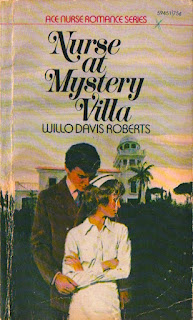
Nurse at Mystery Villa

 By Willo Davis Roberts, ©1967

Upon her arrival as new office nurse in the small California community of El Campo Calor, Chris Royce made a resolution: She would keep Dick out of her mind and heart forever. He’d never meant to hurt her, he’d said, as he told her of the girl he was giving her up for. Now she was ready to turn all her attention to her new boss, attractive young Dr. Candela. But Vic Candela wasn’t free. He was tied to the past by something everyone knew and wouldn’t forget—nor let Vic himself forget. Chris has to find out about it—even if it meant risking the loss of Vic and the new love he’d offered her.

GRADE: B-

BEST QUOTES:
“You’re just another girl. Blonde and pretty, I’ll grant you, but with the usual number of arms and legs and heads. So why do I feel you’re so special?” 

“You’re pretty enough to eat. I’m more interested in marrying you, though.”

“It is not womanly to be so strong-minded.”

REVIEW:
Nurse Christine Royce has been dumped just weeks shy of the altar, and now she’s through with men—she’s going to fill up her life with work. “If she were busy, she wouldn’t have to think about Dick,” she decides, and, oh, what a difference a capital letter makes. 

As it happens, though, she can’t keep her promise to herself, as when she’s lounging on the beach of one of the Great Lakes in Michigan, here comes hunky Dr. Victor Candela and his adorable six-year-old son Mickey. Turns out back in the day Vic had crashed her junior prom and danced with her, even though she’d been 60 pounds heavier in high school, and then he’d gone off to medical school. Meeting her again seven years later, he asks her for a date, and then if she’ll come back to California with him to be his office nurse. She agrees to both, and two weeks later she lands in the Central Valley and takes over the wreck of his practice. Once she catches up, though, the job is not too tough, as he has almost no patients—looking back through the appointments book, she notices that four months ago, after April 2, the previously busy practice had dropped into the toilet. A little snooping in the newspaper section at the library leads her to discover that his wife had died that fateful day, and that he had been suspected of murder but not convicted. So that’s why everyone in town looks at her so askance!

She’s living in the home of Vic’s dead wife’s family, with whom Vic is very close, and little hints drop like acorns on the roof—it quickly unfolds that no one had liked Alice, who was “selfish and cruel and rotten.” She’d attempted to seduce her sister’s fiancĂ©, had little to do with her son, and apparently cheated on Vic. And she’d had multiple car accidents and lost her license, but had driven drunk after that and killed two people; the family had had to mortgage the farm to pay the settlement, a debt they are struggling to emerge from. It’s not until the end of the book, though, that it is suggested that Alice had some form of mental illness, proved by a diary she’d kept that Gramma Sophie will let no one read. “It is filled with hate, with sickness,” Gramma insists. “No one should be allowed to look into the darkness of such a mind.”

The mystery of how Alice died is made more interesting by the fact that if she was murdered, and if Vic was not the murderer—Chris “did not have the slightest doubt of Vic’s innocence,” which is a switch from most murder mystery nurse novels—then it must have been someone else in the family. Vic, who loves the family deeply, is acutely aware of this. “I won’t do anything that could possibly hurt anyone in this house in order to find out” how Alice died, he tells Chris when he finally acknowledges the truth to her—after she’d found it out for herself, unfortunately.

The problem with this particular sub-sub-sub-genre is that they are generally just lame (see, if you must, Matravers Hall, Nurse on Nightmare Island, Nurse Missing)—honestly, a Nancy Drew novel holds more interest and suspense. This is one of the better ones, though, as the heroine is not a stupid loser, and of course she is instrumental in proving Vic’s innocence. The characters are layered and interesting, the writing is moderately good, and the plot has only a few weirdnesses—Chris has a penchant for getting engaged to men after dating them for under two months—and the book even deliberately leaves a few minor questions unanswered, which makes it seem more plausible. The title is unfortunate, because the house in question is not at all mysterious, but that’s a minor sin, and likely one committed by the publisher rather than the author. So if you have a penchant for a pseudo-Gothic murder-mystery nurse romance novel, this could be just the book for you.

Sunday, October 17, 2021

An American Nurse in London

By Diane Frazer
(pseud. Dorothy Fletcher), ©1968

The huge jet liner was London bound. And Elaine Gibbs had left thoughts of hospital routine far behind. But when the stewardess asked her to assist a sick passenger, she couldn’t refuse. Then, she discovered that her patient was none other than Tommy Taylor, the rock-and-roll idol. At the airport, Elaine helped Tommy avoid reporters—including the handsome young journalist who was her seatmate. And so, unwittingly, she embarked on a wild adventure that changed her entire life. 

GRADE: B-

BEST QUOTES:
“Hospitals. They give you a pill to put you to sleep, and then they wake you up in the middle of the night with a blinding light in your face.” 

“She hadn’t forgotten her own days of student nursing, when you combined classwork and exams with floor duty and wondered how much longer you’d be able to stay alive.”

“Pity I’ve a wife. Healthy one, too.”

“One felt almost anything could happen when the sun shone.”

“Luck was the last ingredient for a happy life. Work and industry and giving in a relationship was what made it grow and blossom.”

“Lionel always notices legs. I’m grateful for that. I’d loathe living with a man who noticed bosoms. That always seems so common to me.”

“Behind every delightful man there’s a wise and gracious woman.”

REVIEW:.
I’m writing this review on a jet to the US from London, and I have to say that what struck me most about this book was the ease of travel and immigration when it was penned 54 years ago—no passenger locator forms, no COVID-19 tests, no vaccination certifications or multiple COVID tests to schedule upon arrival—just show up, fall in love, and stay forever in a foreign country forever. Times have changed, indeed. 

Elaine Gibbs is a nurse on vacation, and so barely acts as one during this book, apart from diagnosing fellow passenger, rock star Tommy Taylor, with chicken pox. She goes above and beyond, however, when she helps him scurry off the plane to escape the press and the crush of screaming female fans, whisking him off to her friend Erica McLean’s flat at 14 Grafton Terrace in the Bayswater district of London, which is apparently a real address. (I wonder if its current occupants know of its prominent place in literary history?) The spots on Tommy’s face, we are told, would be “just great for my image,” and that’s all the sarcastic explanation we are given as to why Elaine must escort the man out the plane’s back door, a “service exit for airplane personnel,” through passport inspection and customs, and off to Erica’s—an address no one has bothered to give to Tommy’s manager, Bernard Moss, who is accompanying him on the flight, so he’s left worrying and waiting for Tommy to reappear.

Another problem is that Elaine’s seat mate on the plane, Tony Crenshaw, is a very attractive and interesting young journalist. Dashing off without explanation, Elaine is vastly disappointed not to have been able to share a cab and perhaps something more with the young man, who is left to cab it alone into town. As for Elaine, once she lands in London, she makes the most of her vacation with a very thorough tour of the city, and we are led to Trafalgar Square, Lincoln’s Inn Fileds, Temple Church, the Cheshire Cheese pub at 145 Fetter Lane—an old haunt of of Samuel Johnson’s—and Windsor and Buckingham Castles.

In a shocking incident of insight and coincidence, Tony is lunching at Twining’s at the same time as Erica, who is a literary editor, and she inadvertently leaves behind a manuscript with her name and address on it. This simple clue leads psychic Tony to decide that this must be where Elaine and Tommy are. He knocks on the door the following day, only to be turned away by Erica. But Tony’s brief visit makes fellow reporter Liam Cobb suspicious—my God, these British reporters must all have ESP—and he tails Tony as he’s tailing Elaine, Erica and Tommy on a driving tour of the countryside. Tony, spotting Liam, punctures Liam’s gas tank  to get back to town first to turn in the story that Tommy is alive and well. Elaine, deeply crushed that Tony had learned of her whereabouts and not contacted her, is unconvinced when Tony turns up to offer a dozen roses and a box of Fortunum & Mason’s chocolates in apology. She stomps off in the rain to see Picadilly Circus (I was there yesterday, and if it’s not as horrific as Times Square, it’s certainly not a pleasant jaunt) and then to Buckingham Palace, and he trails along behind for almost an hour after she refuses to speak to him, but “he couldn’t stay out of the office all day,” so making no further effort to speak to her apart from his intial rebuffed attempt, he stomps back to work, “thwarted and seething.”

Tommy, meanwhile, is whisked back to a more suitable hotel by his manager. He and Erica, during their time together, had found themselves remarkably compatible, able to quote the same Alexander Pope poems and discuss artists with insight and intelligence—but Erica just cannot accept that Tommy is a rock and roll singer—“one of those dreadful people,” Erica insists, after two weeks of the contrary. She finally agrees, reluctantly, to attend his concert, and discovers that it’s not rock that he plays at all! Rather, he opens his show with a flamenco paso doble in Spanish, “an elegant pop number,” and when it’s over, Erica is a changed woman. “That isn’t popular singing!” she exclaims, finally won over, the shallow fool. For his part, Tony continues to shadow Elaine, and finally runs into her on the street and discovers that she’s pinned one of the roses he’d given her to her lapel, so that relationship is saved, too, without them speaking a word.

This book is somewhat problematic. Tony and Elaine, who have barely spoken for most of the book—the intrepid reporter who stops at nothing including criminal vandalism to obtain a story can’t make more than a trivial effort to speak to a reluctant woman—end on the brink of becoming engaged, too much too fast. And after all the reconciliations, Elaine makes a slip that Tommy had had chicken pox, and that’s Tony’s lead story for the early edition, so he’s apparently learned nothing at all from his journalistic misadventures. Even more curious is Erica’s debate about men vs. career; she’d dumped a man who’d wanted her to give up her career running a literary agency to marry him. “Roger had wanted her to be what she wasn’t. He’d wanted her to be just a woman, nothing else.” Working at the agency “had remade her, made a woman of her. No, she had never regretted it; it was her life. Or so she’d thought. That it was enough.” Because now, having met Tommy, she’s having doubts. Grrrr!

There are hints here of what makes author Dorothy Fletcher, here writing as Diane Frazer, a great writer, but this is not one of her best books. It’s not a terrible book on its own, rather the difficulty is knowing that author Fletcher can do so much better. The amusing wit is not as prevalent, and the absurd leaps of plot are just not acceptable from a writer as smart as she is. It’s not exactly a fair yardstick—for an author like Jeanne Bowman or Arlene Hale, two dandelions on my Worst Authors list, this book would be a home run—but this is the curse of being good at what you do, that a B grade is a disappointment.

Monday, June 7, 2021

Nurse Deborah

By Marjorie Norrell, ©1969

Nurse Debby Carfax had always viewed her half-cousin Margot with some wariness—Margot having always been the type of girl who couldn’t see Debby have anything without wanting to take it away from her. And now Debby had a promising new boy-friend, and Margot had announced that she was coming to Debby’s hospital to work …

GRADE: C-

BEST QUOTES:
“One doesn’t run the risk of dying of ennui in our profession, does one?”

“Being afraid is the one thing to fear.”

“To get something out of anything—life, love, work, happiness, but most of all life itself—one has to put something in before being able to take something out.”

“Never underestimate yourself, child. That’s a fatal thing to do. Remember, most people accept other people at their own valuation, so don’t set too low a price on your own head.”

REVIEW:
It’s depressing to close a book of 188 pages and realize that in all that time, pretty much nothing happened between the last sentence and the first. At the same time, Nurse Deborah starts out in a rather familiar fashion—lovely Deborah Carfax, of the easy, open, and friendly manner; the great skill for nursing; and the warm and loving family, is saddled with her cousin Margot Ruthermeade, who is the exact opposite: clever and unscrupulous, “selfish in every way,” and manipulative, someone who makes a game of smashing all Debby’s friendships and is unable to form any of her own because she cares only for herself. (Although Margot clearly cares a great deal about destroying Debby’s life, this deep, lifelong hateful commitment is never explained.) This is a plotline that has been plumbed in other VNRNs (There Came a Surgeon, Hospital on Wheels), so it loses points for its unoriginality.

Debby has just been forging a friendship with shy resident Robin Peterson, but from the moment Margot shows up in town and senses the budding romance, it is mere child’s play for her to drive a wedge between the two before they’ve even become established as a real couple. So for most of the book, “Robin’s attitude indeed had changed, from one of something more than friendliness back to its original one of formal politeness.” Debby just sadly accepts the situation, saying, “We haven’t even talked enough to quarrel!” and apparently never will talk enough to set things straight.

Meanwhile, Margot chases wealthy and important doctors, somehow attracting the understanding and affection of Dr. Philip Randall, who frequently consults Debby in his stealthy pursuit of Margot, further clouding the way between Debby and Robin, who misunderstands the friendship. Debby does manage to invite Robin to the Matron’s Ball, but Robin decides to show up only when the formal dinner is about to begin, after the dance is over and Debby has spent most of the evening crying in the hallway, because having barely had any friendly words with him for the first third of the book and virtually none at all for the last two-thirds, “she loved Robin Peterson, truly loved him, with all the fire of her more than generous heart, with every fibre of her small, compact being.”

But just as the supper is starting—and Robin is dashing back out of the ball three minutes after arriving in another maddening mix-up in which he mistakes Margot for Debby kissing Dr. Randall on the dance floor—a flash fire erupts, igniting one of the senior nurses, who is conveniently saved by wallflower Debby, but apparently nothing else is touched, as the fire department is not called and the dinner proceeds with only a short delay. Debby is hauled off in a stretcher, the senior nurse is never mentioned again, and all the dancers make do with a stand-up buffet instead of a sit-down dinner. Robin and Margot both rush to Debby’s hospital bed and confess their love and sins respectively to her gauze-wrapped body. And that’s the end.

You’d think there would be more to report about the story, and more of a relationship outside of what can only be called a budding friendship before undying love and marriage proposals are declaimed—at least on one side, as Debby’s face is bandaged and she’s high on morphine, and so rendered mute. There’s not, though, so I can’t really advise you to spend the hours requisite to plowing through this dull, unsatisfying story.

Saturday, February 20, 2021

There Came a Surgeon

By Hilda Pressley, ©1964

Another child’s toy, another girl’s boy, it was all the same to Elvira. Whatever Alison had, Elvira had to try and snatch it from her—even to the extent of becoming a nurse in Alison’s hospital. And Alison never realized how much she minded Elvira until Steven Hartley joined the hospital staff …

GRADE: B

BEST QUOTES:
“Even knowing the worst is better than not knowing at all, and worrying about it.” 

“When you were in love you did all manner of foolish things.”

“You women often have the same blind spots about hats that you have about men.”

“There was very little to a kiss these days. It didn’t mean anything.”

REVIEW:
This fairly simple book gives us the slow story of nurse Alison Lynwood, who at book’s outset is mad about Dr. Johnny Crowther, but “Johnny’s the type who can make you feel you’re the one girl in the world for him one minute and let you down the next,” says Alison friend’s Norah. “The trouble is with Johnny, he doesn’t want to settle down, doesn’t want to tie himself down to one woman.” On her side, Alison is in love with Johnny, and so spends a lot of time sighing by the silent phone—until Dr. Steven Hartley moves to town. Suddenly she has someone to dance with at the hospital ball while Johnny is whirling another gal around the floor. Alison gets the bright idea of dating Steven so as to make Johnny jealous, but the catch is that she really likes Steven. “How nice he is, she thought, not for the first time. He was such a restful person to be with. He was a much nicer person than Johnny. The thought brought her up with a jerk, but she realized it was true.” 

Over the ensuing pages, the volume turns down on Johnny—who, miffed, calls Alison even less than usual—and up on Steven, until “she was no longer in love with Johnny. As a man he could not hold a candle to Steven.” The rub here is that Alison’s cousin Elvira turns up, chasing Johnny actually, as she’d met him at Alison’s home one time and become instantly smitten. She’s enrolled in the nursing school and starts taking up Johnny’s spare time, but when she notices that Alison’s eyes have turned to Steven, suddenly she wants that man, too. Knowing 19-year-old Elvira as we do, though, it seems hard to believe she’s going to tempt a solid type like Steven. “Elvira was so ruthless,” Alison thinks. “She could lie, cheat, scheme or even steal to get her own way. That she had good looks and a superficial charm and could to thse things without the slightest compunction made her a most formidable enemy.” But she is very transparent, tossing herself in Steven’s path or passenger seat with flirtatious lies that even a cad like Johnny could see through and tire of.

Eventually Steven kisses Alison, but with all the gossip going around the hospital—Alison is not the type to dump poor Johnny as a friend, and still has dinner with him on occasion though it’s clear to him that she has cooled—and with the usual misunderstandings and jealousies, the usual inability to just say how you feel, it takes numerous chapters to sort things out. In the interim, there’s a suicidal patient to talk in off the roof, among other adventures, but after this one, Steven tells her, “I couldn’t—wouldn’t have done it without you, Alison. I kept remembering things you had said in our conversations when we had been out together.” There are Alison’s attempts to befriend and understand Elvira, which result in that young woman climbing out on the roof, too, and Alison takes the lead there, saying, “Don’t you know that you can’t force love? The only way you can win anyone’s affection is by being loving. You could be an absolutely wonderful person, the kind of girl no one could help loving. Do you realize that?” Somehow this does the trick, and Elvira decides she really does love nursing and regrets all her bad-girl antics and wants to be Alison’s friend. Their lifelong rivalry, which has been made much of throughout the book, which has been totally unexplained—poof!—is gone. Alison is tucking Elvira into the spare bedroom in her apartment when Johnny drops by to see how Elvira is, and says he’ll take her out next week. “Do you know what I’ve discovered about Johnny? He loves women most when they’re in need of him,” Alison says slyly, though it does not ring true with us readers. Steven turns up a few minutes later to have his turn with Elvira, brushing her tears away and giving her a hug and a sleeping pill. Elvira can’t understand why everyone is so nice, but Alison lies blatantly: “We’re all being nice to you because we love you,” and not a word is said about this abrupt switch in story line, either. As Alison is seeing Steven out the door, she’s finally able, in the slightest way possible, to suggest her feelings for him when she whispers, “Steven, don’t go—” and this is all it takes to break down the misunderstandings.

I am a complete sucker for the young woman hanging out with her friends in her apartment—somehow a scene in which everyone is sitting around the living room with cocktails in their hands laughing at a joke just slays me. This book has these scenes by the handful, and its relaxed, simple tempo is soothing. Maybe the book is a smidge too simple, and the wrap-up of the conflict between Elvira and Alison is way too forced (a copy-cat would-be suicide? We love you?? Really???), but Alison is a smart, outspoken character we can admire, and on the whole this sweet book is pleasantly enjoyable.

Monday, February 1, 2021

Hospital on Wheels

By Anne Lorraine, ©1956

Susan had loved Ricky Sharp all her life, with the passionate devotion of someone who had too much love to give. On the night their engagement was announced, Ricky was dangerously injured in a car accident—while eloping with Susan’s best friend. In her anguish Susan turned to her work. But could even the exciting new Hospital on Wheels, with the brilliant but temperamental Dr. Stephen Brand, make her forget losing Ricky?

GRADE: C-

BEST QUOTES:
“Once she was married, her life would consist of loving and looking after Ricky.” 

“Never pause at doors, my dear child. Every time you come to a new door in your life open it boldly and walk in, no matter what you dread to find on the other side.”

REVIEW:
Susan Mance is a lucky orphan, in that after the demise of her parents, she was taken in by a family who had known her all her life and raised with love and compassion. The family also had a daughter, Bette Jonson, and much is made early on about how fabulous Bette is. Bette is “pert, vivacious,” “a breaker of hearts,” and everyone is “lost in admiration of her beauty and charm.” “Bette was everything Susan was not—cherished, adored, lovely, witty and determined.” She’s also willful and spoiled, with every boy wrapped around her finger, and one adoring worshipper in Susan, who expresses her adoration of Bette by following her to nursing school and acting as Bette’s live-in “friend, sister, nurse and slave,” doing all the cooking and cleaning. To be fair, Bette seems to love and appreciate Susan also, and the pair are known as best friends at nursing school. 

Susan eventually manages to land her childhood crush, Ricky Sharp, who has become a doctor (the inspiration behind her and Bette’s desire to go to nursing school). He’s proposed to her, but the night of their engagement party, it’s pretty clear that something is afoot, as Bette acts nervous and Ricky acts guilty, and even the hospital matron is telling Susan to open her eyes. Before the party, however, she works a shift with Dr. Stephen Brand, who is a strict, unfriendly, cold man, and while in clinic she tells him about a patient who can’t make it to prenatal visits because she doesn’t have transportation and no one to mind the other kids. She offhandedly suggests that in these cases it would be best to “take the hospital to them,” and this sparks a fire in Dr. Brand.

But neither Ricky nor Bette turns up for the engagement party, and as she arrives home at her apartment, she gets news that the pair have been in a car crash, and Ricky is paralyzed. Rushing to grab a coat, she finds a note on her pillow from Bette, saying that she and Ricky are eloping! What a shock! So when she tells everyone she is not going to marry Ricky, everyone thinks she’s dumped him because he’s crippled.

Susan also drops Bette like first-period French, and Bette goes to pieces, quits nursing, and moves back home with her parents to care for her mother, who is conveniently ill. Susan visits Ricky from time to time, but the visits are cold and strained, and it’s not clear why she goes—before long, Ricky refuses to see her, so clearly he doesn’t get it either. But the whole story appears to be more than we know—not that we’ll ever find it out, at this rate, because absolutely no one in this book ever has an honest conversation with anyone else. Unfortunately, what this means is that there will be 100 more pages of this silly book that could have been avoided.

Susan “had never been one to profess to having a ‘call’ for nursing,” but we’re also to understand that despite her disinterest in nursing, she is also pretty good at it. But after the accident she needs a change, so when Dr. Brand comes to her with a full-blown plan to start a clinic in a bus, she immediately enlists. It isn’t long before she’s finding that Dr. Brand doesn’t deserve his mean old reputation: rather, he's “charming and attractive,” “a most delightful companion,” and even “kind”! Whenever she’s with him she gets a warm glow, basking in their “mutual understanding,” and the best days of the week are when he travels out with her. He repeatedly suggests they add another nurse, as much as he says he would hate to complicate their pure and easy relationship, and she flat-out refuses every time, even though it means she’s working most hours of most days. On one drive home after a long day, when she is nearly asleep, he kisses her, and then she can’t sleep; “praying only that the man at her side might not hear the excited beating of her heart, nor know that her face was burning hotly from his kiss.” 

At the same time, it’s not clear how she feels about Ricky. “Could she go back to that time when she had not loved him?” she asks herself. She demonstrates little affection or even unhappiness when she sees him, and we have no insight as to what drives her to visit. Painfully, she also can’t decide how she feels about Stephen, her vital signs notwithstanding as evidence. She’s “immersed in these wearisome questions” about what the kiss means, and does he love her, and could she ever come to love him in return? If they are wearisome to her, they are triply so to us, and they go on and on, round and round in circles, arriving nowhere.

Eventually Bette’s mother takes a turn for the worse and Susan is summoned to see her. Now we are presented with a home scene completely opposite to how Susan initially drew it for us. Bette, says Mom Jonson, “always needed you, Susie—always. You had so much that she could never have.” We hear that Bette “was so miserably jealous” of Susan. “She always had to watch you stealing her thunder,” Dr. Brand says, and Bette tells Susan that her mother is better, all owing to Susan’s visit: “A little of Susan is worth a whole lot of Bette.” More reality adjustment comes when Susan decides that Dr. Brand is going to propose to her at a party he’s hosting. The idea gives her “flushed cheeks and bright eyes,” but as soon as she gets home, she decides “grimly” that she will accept Stephen’s proposal: “What did it matter if she could never love him as she had once hoped to love the man she married?” Suddenly her relationship with Stephen could never be more than “firm friendship,” that it could never have “the mad rapture she had experienced with Ricky.” What?

When Stephen does propose, Susan “suddenly felt cold and afraid,” though it mostly appears that she’s upset that he didn’t gush about his unrelenting love for her in the process, but she agrees “quietly.” Just then Ricky turns up with the news that this famous surgeon from America is going to perform a risky operation on him—the only other patient with this condition that he’d operated on died—but there’s a remote chance that he’ll walk again if it succeeds! Alone for a minute, Susan and Ricky realize they’re still very much in love, and Susan insists he have the surgery, which somehow proves that she loves him: “Nobody but a woman deeply in love could have dared to give such advice to the man she loved.” 

Back at the party, Bette pipes up that Susan will never love Stephen, because “she’s the type who gives her heart once and for all. Her heart happens to belong to Ricky—to Ricky, do you understand?” Unleashed, she tells Susan that she had intended to persuade Ricky to elope with her and had left the note, but Ricky would not be persuaded—“he loves you, and has never loved anybody else, nor ever will”—so Bette had grabbed the steering wheel and crashed the car. 

Then Bette tells Susan, “Your whole life has been a constant demand for love, love, and more love—and because you need love so much, you attract it—my mother and father frantically trying to make up to you for your loss, eternally dinning it on me that ‘we must think of poor little Susan, darling’ I almost hated you, Susan, because you demanded so much from us! And then you had to have Ricky.” Following this revelation, Ricky and Susan quickly put things to rights between them, and Susan has an eye-opening realization that it’s true, “I have demanded love, all my life,” which somehow “hurt Bette—the way I took the love of her parents as my right, the way I accepted her love and generosity as due me, and then the way I demanded that you should remain true to me.” It’s a baffling position—doesn’t every child “demand the love of the people who raise them, and doesn’t everyone insist that their beloved remain true? Is it a sin to need to be loved? As for feeling that Bette owes Susan love and generosity—after the way Susan has been “friend, sister, nurse and slave,” is that terribly surprising?

The maddening way this book completely turns 180 degrees on so many things, and how it willfully keeps half the story away from the reader for most of the book, means we wait and wait for the big reveal that makes utterly no sense; Susan ends up looking like an inconsistent, self-absorbed moron. Bette and Dr. Brand turn out to be the most interesting characters, and even he takes a turn in the end when Bette tells him that he doesn’t love Susan either, when he’s been as swoony in appearance as she’s been all along. Not much of this book makes sense, and with everyone acting so inconsistently and frankly stupidly, it’s really hard to care about them.

Wednesday, August 19, 2020

The Youngest Night Nurse

By Anne Durham, ©1968
Cover illustration by Bern Smith

Beth Halliday didn’t know how she could have coped with all the bewildering details of hospital life without the kindly help of the Senior Surgical Registrar, Desmond Angrave … but she must beware of feeling too grateful to him, as she realized when his old friend, the beautiful Frandora Nye, became a patient in her ward.

GRADE: C

BEST QUOTES:
“Perhaps it was even possible to make disaster happen, because of one’s state of mind.”

“Awful waste of nurse-power goes on in hospitals. Lots of girls get fed up and leave, to go into other  jobs or to get married. Not the best way of getting married, come to think of it.”

“Alas, we men don’t always look to the best in our womenfolk. We are foolish at rock bottom, and to be pitied.”

“A pretty woman should be clinging, anxious to please, but only too ready to take guidance from a man.”

REVIEW:
Beth Halliday is another VNRN orphan who, after her Gran died, took up nursing. She’s apparently a full-fledged nurse but is still so green they don’t let her care for patients—good thing, too, because she’s quite a bungler: “If anyone was going to drop the metal BPs as they were taken out of the cleansing machine, it would surely be Beth. If there was going to be burnt fingers or boiling water slopped on the floor when a hot water bottle was filled from the sterilizer, that, too, would be Beth.” As a result, she’s constantly being chewed out by the senior staff, and her gaffes are known throughout the hospital. The reason for this, one fellow nurse tells her, is that “you care so much and everyone can see it, and it just challenges them to nag at you for something or other.” She’s so good, she sucks.

Outside of the hospital, though, she’s confident, outgoing and friendly, to the point that she takes Dr. Overton, a “silly, pompous” pathologist “who shrank from social contacts” under her wing, and soon she’s having a friendly dinner with him, encouraging him to get out more and throw off the beaten mantle he wears. That’s a particular theme of the book, and Beth is always dishing out this sort of advice when she herself could use a big dose of her own medicine. To wit: Dr. Desmond Angrave, who has her heart turning somersaults from the book’s early pages, clearly has an interest in her that she cannot bring herself to see. Though he takes her to tea at the home of a dear elderly woman friend of his from his childhood, takes her to dinner and the theater and fishing, solicits her advice about gifts for an acquaintance, and regularly acknowledges that he’s looked up her work schedule to find out when she’s off, she’s convinced he’s in love with Frandora Nye, a beautiful young woman who is hospitalized with burns after a fire in a theater.

And that’s basically the plot. There’s more in the periphery as Frandora jerks around a number of men—she’s the beautiful, rich, and cruel type—and a loud, pretty, selfish male actor whom all the women—Beth herself included, briefly, until she spends time with him and realizes how shallow he is—are crushing on. There’s Christmas to plan for, and Beth’s misunderstanding that Desmond and Frandora are engaged—which a fall in the river followed by a two-day apparent coma quickly put to rights. While she’s out, she misses the Christmas concert where she’s supposed to play the harmonica for the children’s ward, but she’s engaged ten minutes after she wakes, so maybe that’s not such a bad trade-off.

The best thing about this book is its characters, most of whom are complex and interesting, and most of whom are saved by love in the end. The hero is not as strong as some—he has some nice quirks, like his deep interest in fishing, and he’s quite nice, but he seems to be about 15 years older than Beth, calls her “little Beth,” and early on refers to her as “this appealing child,” which gives me the creeps. He invites her to go fishing with him, but this means she sits on the bank for hours and watches him—as if fishing in itself weren’t dull enough! Furthermore, in another odd scene, after she invites him to “tell me about fishing,” he blathers on while Beth, completely inattentive, is hypocritically chastising herself for being a “good listener! That was all she was fit for! It was no use Mrs. Mackie trying to persuade her that beauty and glamour didn’t count, and that a man just wanted a good listener, a woman to consider him, make him comfortable.” Finally, nearly caught out in her inconsideration of him, she’s “alarmed in case the appropriate noises she had been making at intervals had been the wrong ones or in the wrong places.” This scene doesn’t give me a lot of confidence that their marriage will be an enduring success. At least Beth herself settles down as a nurse, starts to seem slightly less hopeless, and by the end of the book she “had stopped looking so drawn and anxious.” I waited with dread for the announcement at the end that she would be giving up nursing after marriage, but no such pronouncement is made on that point, though it would surprise me not at all if she did. So while overall this is a pleasant enough book, there’s not enough meat here to make it a satisfying meal.

Wednesday, August 12, 2020

Jane Arden, Student Nurse

Book 1 of 7
By Kathleen Harris, ©1955

Jane Arden, student nurse, had heard a lot about Dr. Robin Crandall, but it wasn’t until a crisis arose and she was sent to assist in “Emergency” that she came face to face with the handsome young doctor—and in her first test as a nurse, and a woman, began to wonder if love and a career are an impossible combination.

GRADE: C

REVIEW:
Jane Arden, age 19, has begun nursing school at the hospital overlooking her small town, Elmwood, Ohio. At book’s open she hasn’t really told her sort-of boyfriend, David Hyatt, 23-year-old boy next door who before leaving to join the Air Force told her—essentially out of the blue—“You’re my gal” in a “blithe manner,” adding that if she looks at any other man he will “turn you over my knee and paddle you, or lock you in a dark closet and keep you there.” Apparently he takes this ownership thing very seriously. 

Eventually she breaks her treachery to him when he’s home on leave—and he tells her that if she wants to be a nurse, she must not love him the way he loves her: “A woman should be satisfied to be with the man she loves—to go where he goes, do what he wants to do.” Remarkably, his face remains unslapped, and even more remarkably for a VNRN, Jane recognizes the absurdity of his opinion. “Why should her being a woman make the difference he spoke of—why shouldn’t a woman choose what she did with her life?” she thinks, but rather than break her relationship with him off immediately, she decides that if he loves her, he will wait the three years for her to finish her training. Unfortunately she never bothers to tell him what she’s decided, so it’s unclear if David is going to play along, even though he does bring her a diamond so small “it almost took a magnifying glass to see.” Not surprisingly, the catty Jane pockets the thing when she’s at work.

So Dr. Robin Crandall, hospital heartthrob, has no idea she’s theoretically engaged when at the New Year’s gala he pulls her out to that den of iniquity, the ballroom verandah, and the two find there are fireworks exploding over Ohio. Oh, wait, that’s just their “very long kiss.”

Jane’s sister Roberta, the beautiful but cold model from New York, arrives home in an epic funk, slams the bedroom door and doesn’t come out for days. The family is too polite to inquire, but after a month of moping Roberta reveals she had inadvertently been involved with a married man whose wife finally showed up sporting a revolver to put her wise. The only thing that raises her spirits is a nasty bout of appendicitis—or, rather, that luscious Dr. Robin Crandall who is managing her care. After her two weeks in the hospital are up, she starts dating Dr. Robin. In the interim, he has pulled the classic yank-her-into-the-linen-closet maneuver to tell Jane that he’s absolutely mad about her, so she too agrees to date him, deciding that she feels “the mature kind of love only a grown woman could feel for a man. She had never felt this way toward David.”

Unfortunately the busybody nurse Millie Brooks sees them slipping disheveled out of the closet and reports Jane to the nursing supervisor, who tells Jane that unless Dr. Crandall vouches for her, she will be kicked out of the program. When she tells him this, he answers that he’d be glad to, except that it might “jeopardize my medical career”—and there’s no reason why they “should both risk our necks.” Furious, Jane breaks off what passes for a romance with him.

Fortunately for the doctor, he never stopped seeing Roberta, so he’s not completely alone—but Roberta, cold but not stupid, quickly figures out that the good doctor has done her sister wrong. Roberta surprisingly feels she owes something to her sister and flexes some muscle to get Robin to do right, at least by Jane—though naturally neither Roberta nor Robin tell her that she’s off the hook; Jane only realizes when the days pass and she isn’t called to the principal’s office. When the penny drops that her nursing career is not over, she’s only relieved “that David would never know that there had been a time when she had not been so certain. She would get out his ring and put it back on her finger. And when she did, she would have that old feeling of security again.” So here we have another VNRN that puts dull affection for the familiar ahead of passion and true love—though she certainly didn’t have the latter with Dr. Robin, either. However, there are seven more books in the Jane Arden series, so hopefully Jane will figure things out before she comes back to roost in Jane Arden’s Home-Coming.

Jane Arden Surgery Nurse


Book 4 of 7
By Kathleen Harris, ©1958

All the women who knew Dr. Tony Gray agreed that he was too attractive for his own good—yet none of them could help falling under his spell. When Jane Arden met Tony, first as his head surgical nurse, then as his latest romantic interest, she felt his belief that marriage didn’t mix with medicine made him “safe” for a girl who had an understanding with another man. And then, abruptly, she found herself up against the most difficult question a girl ever faces …

GRADE: C-

BEST QUOTES:
“Most of them, especially if they happen to be young and pretty, only take up nursing because they think it will pay off—in good wages, extra bonuses from grateful patients, eventually a husband!”

“So you’re a doctor! Small wonder that so many girls take to nursing.”

“Most girls, as you claim, are smart enough to make the most of their appearance. But some still are not as smart as their grandmothers. … Your grandmother was too smart ever to do things better than a man.”

“[Nurses are] big husky individuals who look down on everyone disapprovingly as though he was covered with germs. As a rule, they are quite unattractive, too.”

“‘Age of the Ultimate Weapon,’ she reminded herself, as one commentator had called it. An age so hurried there was little time for people to be kind to one another, a frightening age, with satellites being sent into outer space and talk of people going to the moon, weapons being created whose power was unthinkable.”

“You must be happy in your new job, watching the doc cut people up.”

“Men should realize that it often takes a woman to help them reach the top.”

“Perhaps she put too much of herself into her work. Perhaps there was not enough left over for a real life, aside from her chosen career, a home of her own, her own man, her own children. Every girl wanted these things more than anything else.”

REVIEW:
Jane Arden, who should be called vagabond nurse, has moved to New York for this book, after stints in Ohio, Florida, and Tennessee in the first three. Again she’s moved into her sister’s apartment, as she did in Florida for Jane Arden Registered Nurse, Roberta also possessing a serious case of wanderlust, as having herself moved from Miami to New York, she’s now set off for Europe and left her empty apartment to Jane. We learn early that heartthrob Dr. Tony Gray is not going to be a problem because “Jane was immune to men,” but we know better! Early on she catches Dr. Tony’s eye because they work in the same OR, and agree to be friends because neither of them wants to get married—Tony because he’s concentrating on his training, Jane allegedly because two years later she is still in mourning her childhood sweetheart, whom she had agreed to marry in JARN despite the fact that he’d turned out to be a complete ass before conveniently dying in a plane crash, but I suspect that in fact it’s because she does not have a heart. You will not be surprised to learn that on her first date with Tony—which of course she accepts because they’re just friends and will never be anything else—Jane shows her true colors when, at a party thrown for her by Roberta’s friends, “Jane couldn’t help a certain coolness from creeping into her voice. She was disappointed in Tony. She had wanted to accept him as a friend. But his actions this evening made this practically impossible.” His big crime? Roberta’s married friend Carol Gaylord flirted with him. The nerve! When he asks her what’s wrong, she lies, “You must be imagining things.” Did I mention that I am not particularly fond of Jane?

In JARN Jane had met young millionaire Nicky Powers, who had inexplicably fallen in love with her, but in book three, he’d packed off to Europe to study art. He’d promised to beg Jane to marry him when he comes home, which he has not yet done in this series. Jane has nothing other than sisterly feelings toward Nicky, yet when she learns that Roberta has met up with Nicky in Paris, she again demonstrates jealous possessiveness of a man she says she doesn’t want. Now, suddenly, “Jane still did not know how she felt toward Nicky,” her jealousy apparently changing her feelings, especially now that a previously smitten man’s ardor for her may be cooling.

When Jane comes down with the flu, Tony shows up at her apartment to take care of her. Though she is still angry with him, she lets him in, because “what could she do? A nurse always obeyed the doctor.” So now they are dating again, and Jane continues her self-delusion that she isn’t jealous of Carol, and also perpetrates an ongoing stream of obvious lies to Tony about her feelings about his friendship with Carol: “It doesn’t matter, Tony. It’s none of my business,” she tells him, while all along she’s thinking he’s “pretty dumb for being taken in.” Eventually they are kissing with an “exhilaration that had taken her on a trip to the moon.” But when Tony is appointed the new chief of surgery and is too busy for dates, here she goes again, “wishing that Nicky would come back from Paris. Maybe she would discover that she did love Nicky. Jane was tempted to urge Nicky not to stay away much longer. She knew if she wrote that she needed him, Nicky would not delay his return.” If she doesn’t actually love any of her boyfriends, she certainly does love to jerk them around.

Turning back to her other puppet, when Tony asks if he can come to her apartment one evening, she goes all out with the standard VNRN fare—salad, steak, cherry pie—and throws in candles and flowers to boot, for a man she repeatedly states she is not interested in. Her ploy works, and Tony tells her, “I’m crazy about you. Please say I don’t have to fight it any more.” Interestingly, she interprets this as some sort of proposal: “They would have to make plans, now that they were in love.” He comes over for dinner a lot, though he never mentions love or marriage, and Jane is outraged when he tells her he’s moving out of his slum apartment and taking a six-month lease on a nicer place a few minutes from the hospital. “Jane felt her heart tighten. Plans like these certainly did not include her. What she wanted to say—to cry out—was, ‘What about us, Tony?’” As if a six-month lease equals a breakup. Honestly, this woman and logic have never even shaken hands. Naturally, she just lies some more: “It sounds pretty grand,” she tells him. But she won’t go there to see Tony, because even though “some girls would think nothing of going to a man’s apartment,” nice girls like Jane, who invite men to their own apartments several times a week, have bizarre double standards.

As much as she wants to put that collar on Tony, she’s doesn’t know how she feels. “Was she in love? she asked herself. She must be. She was almost deliriously happy when she was with Tony. Tony needed her; he had come to depend on her. And it was good to be needed. David had never needed her. He had been so self-sufficient.” And her waffling continues when she decides that “she hoped that when the time came to renew her contract as a surgical nurse, she would be quitting, to be married.” Which she had ardently insisted when she was engaged to her first fiancĂ© that she would never do—though you will be completely astonished to learn that she had never actually mentioned it to the man. And yet she still doesn’t know what she’s going to say when Nicky comes home and proposes. It was all I could do not to hurl this book across the room.

Roberta returns to New York—catching Jane and Tony in the clinch—and Jane can only say “I guess” when Roberta asks if she loves him. To clarify, she explains, “Tony has an allergy when it comes to marriage,” so it seems that “love” to Jane just means “husband.” Roberta decides she is going to help Jane get Tony to propose, and before long Tony is angrily dragging Jane out of the hospital to demand to know why Jane has not told him about “this fellow.” Jane cannot stop with the lies. “What fellow?” she asks. “Are there more than one?” Tony roars, and you know there would be, if Jane could find them. It comes out that Roberta has shown Tony a cable saying that Nicky is coming home and Jane should make arrangements for the wedding. Rather than tell Tony the truth—that’s so not Jane’s way—she snaps that there’s no relationship between her and Tony because “during the very first talk we had, you informed me that you had no intention of becoming involved with anyone.” He reminds her that she said the same thing, and she stomps home. Roberta is pleased with her work: “The best way to get to the bottom of anything is to give the other person a severe jolt—and the fact that Tony took it so much to heart is a good sign.” The only shock here is that Jane then tells Roberta that she can’t marry Nicky. Roberta only gently chides Jane for keeping him dangling for so long, and then mentions that she herself is going to marry Nicky “since you don’t want him. Naturally, being a gentleman, he had to wait until you turned him down before he could ask me to marry him.” So it seems Roberta’s “jolt” was delivered to two people, not just one. These Arden women are cold-blooded killers. Roberta’s wedding goes off in two paragraphs, and Jane makes it clear that though Nicky’s aunt and uncle cable their congratulations, “Jane had been their first choice.” What a self-centered bitch Jane has turned out to be!

Tony hears about the wedding and calls Jane to tell her for the first time that he loves her, but Jane is going to jerk the hook around a bit and asks him if Carol is keeping him from being lonely. “Didn’t I just tell you I love you? What else do you want me to say?” he asks her. Jane, of course, “could have told him, but she didn’t.” Tony, however, is not too dumb to read between in the lines, but too dumb to run screaming from the horror show that is Jane Arden, and he actually proposes. Jane “caught hold of a chair to keep from toppling over.” Then she makes snarky remarks about waiting six years until Tony has become a successful surgeon. “Jane still thought it a good idea not to let this handsome young man be too sure of her,” so she refuses to answer him, saying they will talk about it when she gets home from her sister’s wedding. “She knew she was going to have a good cry as soon as she hung up. But this time her tears would be tears of happiness—all was well with Jane Arden’s world once more.” Unbelievable. I’m going to cry, too, but only because I’m going to have to read three more books about Jane Arden.

Jane Arden Space Nurse


Book 6 of 7
By Kathleen Harris, ©1962
Cover illustration by Lou Marchetti

As Jane embarked upon the most exciting adventure of her career, she was forced to postpone her marriage to handsome Jeff Wallace. Jane had no way of foreseeing the personal crisis that would confront her as a “space nurse.” Nor could she have anticipated the lasting impact of the two attractive astronauts she met at Cape Canaveral. Fascinating Clyde McLaren, a strong candidate for the moon shot, was brilliant and quite friendly. —Or did he want more than friendship? And what of the dashing continental Lieutenant who made it clear that he was more than interested in her? —Just where did his interest lie?

GRADE: C

BEST QUOTES:
“Any daughter of mine is going to devote her full time and attention to looking after me.”

“It sounded fantastic to Jane; she did not think such a project as setting up medical centers in space could happen soon—but then, not many people had though there would be television, jets, atomic bombs, missiles, wonder drugs for most fatal diseases—all the miracles of this Space Age.”

“I like your independence—it’s a challenge to a man. Every man prefers to do the chasing.”

“This whole affair was given so much publicity that a lot of suspects—enemies of our country—will be rounded up.”

“I imagine any man—anyone in pants—would do for the fair Jane. She likes to dangle all the scalps she can at her belt.”

REVIEW:
Nurse Jane Arden, who in previous books in this series had been assiduously striving to nail down the top berth on the Worst VNRN Heroines list, has in Jane Arden Space Nurse not been putting in the same superlative effort we’ve seen on our past encounters. I’m not quite sure how I feel about this. On one hand, I have avoided the usual indignation and ire that Jane Arden usually inspires. On the other, this fairly bland, obvious story is like a bowl of tepid oatmeal, arousing little emotion at all apart from the rare eyeroll. Is it better to spend an hour with a book that at least gives you the moral satisfaction and mental exercise of picking apart all the hypocrisy, lies, and infantile behavior that in past books made up the bulk of Jane’s character, or to sleepwalk through a book you won’t remember in an hour? That is the question! Who knew nurse novels could inspire such heady philosophical debate?

Anyway, here we have Jane, of all the nurses in the country, summoned to Washington to take a post supporting the space program at Cape Canaveral during the race with Russia to put a man on the moon (indeed, during this story, Jane watches the takeoff of Gus Grissom’s suborbital flight, America’s second, on July 21, 1961). I’m sure it was Jane’s training in surgery and pediatrics that made her a top candidate.

She boldly accepts the job without asking the permission of—or consulting, even—her fiancĂ©, Jeff Wallace, the latest in Jane’s string of toys. But he and her family “had come to accept the fact that Jane’s career as a nurse had to be given first consideration,” though she’s been perfectly willing to chuck it for her first two fiancĂ©s. What this really means is that Jane does whatever she wants with little regard for anyone’s feelings, which we certainly have seen again and again in past books.

“It does seem to me you could have waited until we talked it all out before you went off into space,” Jeff pouts, but Jane reminds him that girls don’t go into outer space, silly! It’s her “obligation as a patriotic citizen” that compels her to accept, so off she goes to Florida to engage in duties so secret that even the reader hears little of them, apart from acting essentially as doting maid to heartthrob astronaut Clyde McLaren, cooking his breakfast, following him around all day while he undergoes strenuous workouts, and checking his blood pressure afterward.

While she’s waiting for Clyde to finish his day in the mock capsule, Jane accidentally blunders into a top secret conference room to relax in the big cushy chairs there, but is found by a Marine captain and bawled out. Later, out of the blue, she tells Clyde that she saw someone else in that room, Lt. Seth Zboski—“don’t look so startled; he’s a Czech”—who happens to be her roommate Nancy’s boyfriend, thought that doesn’t stop him from putting the moves on Jane, or giving her “The Look” every time he sees her. Clyde urges Jane to tell the Top Brass (a phrase that here is always capitalized) what she’s seen, and after doing so, she is chewed out by another captain. After this experience, “she resolved that if she ever saw anything else that looked suspicious, she would keep it to herself. She wouldn’t even tell Clyde, her best friend at the base.” If you see something, for Pete’s sake, don’t say something!

Months pass and Jane and Clyde’s friendship deepens, and there begins to be a little talk around the base—and Jane’s reputation is not enhanced by the one weekend when Jeff comes to visit. They go on a weekend driving tour of Florida, and the pair are scandalously forced to stay in the same hotel, in separate rooms “at least twenty-some other units in between,” so Jane decides “there really was nothing wrong in Jeff’s staying at the same motel where she was registered.” Wrong-o! A bunch of the guys are also staying at that hotel and see them having breakfast together the next morning, and now Seth Zboski is slandering her all over the base: “A man seldom marries a girl so free with herself,” he sneers, likely wishing he were in on the action. So Clyde is assigned to a different nurse and Jane is asked not to see Clyde at work or outside of it. Clyde, upset that Jane is suddenly giving him the cold shoulder—because no one has bothered to clue him in—drags her out on the beach to ask her what the hell, and true to form Jane lies, saying that it was her idea because they’ve been seeing too much of each other. When he responds by saying that she’s cold and uncaring, she tacks back again: “She could not let Clyde think she was like that, insincere, shallow”—in short, the truth. But their conversation is cut short by a thunderstorm and they are forced to shelter, clutching each other desperately, under a sand dune: “not intentionally, she was sure, he gathered her closer. Nor did she mean to cling to him.” Now Clyde proves himself the biggest person in the entire series, for as the rain clears away he agrees, “We cannot be friends,” and when he adds, “I could have loved you, Jane,” we are relieved for his narrow escape.

Then on to the big climax, when Seth Zboski is driving erratically all over the base in the middle of the night and Jane is the only one who notices, and “maybe it was her woman’s curiosity that led Jane’s feet toward the building and inside” to, you guessed it, The Top Secret Room, and watches him sneak out with a briefcase.  Since she’s decided not to report anything suspicious, she goes back home and to bed, because if she reports anything again, “the Marine captain could have her dismissed in disgrace by manufacturing some cooked-up story against her character.” If the captain has been reading these books too, he won’t have to cook up anything, and Jane’s poor judgment in this situation is more fuel to the fire. The next morning, Nancy tells Jane that Seth has given her something to hold for him, and he is going to stop by tonight to pick it up. “Jane had decided there was nothing she could do about it,” so she spends the entire day cleaning the house, and just when Seth is likely to stop by, she starts snooping in Nancy’s bedroom, finding the case just as Seth walks in. A struggle ensues in which clever Seth pulls out a bottle of clear liquid: “What fiendish thing did he have in mind?” Well, first of all, it’s his monologue, which starts out, “You ought to thank me for putting you out of a world gone mad—a world that will be destroyed before long, anyway, wiped out by a single nuclear bomb.” Just as Seth is forcing the liquid down her throat, the door is broken in by Clyde, who’s been spending the day outside Jane’s apartment, mysteriously convinced that something was going down, and had seen Seth grabbing Jane through the window. Seth escapes, but is eventually found stabbed in the  back—not by the Army, but “some of his own people who caught up with him. I suppose when he didn’t turn over the papers he’d stolen, there was nothing for them to do but put him out of the way. That’s the way these Commies operate, you know,” explains Jeff, remarkably in the know for a civilian. Not to worry, though, if the enemy is clever enough to get into secret places, because they’re also “usually, in the end, dumb enough to pull something wrong.”

The only flashes of indignation this book inspires are dulled by the fact that statements in this book do not accurately portray Jane’s appalling past behavior: We hear that Jane’s sister’s husband Nicky “had thought, for a brief period of their friendship, that he was in love with Jane, although she had known all along that theirs could never be anything more than a brother-and-sister relationship”—completely ignoring how Jane had toyed with Nicky and never relieved him of the impression that he was obligated to propose to her when he returned from his studies in Paris in Jane Arden Surgery Nurse, only dumping him when she had a better prospect in hand, some doctor guy she was sort of engaged to for about ten minutes.

My favorite part of the ending was the part where Jane vows, “From now on, she wouldn’t keep anything from Jeff. And this was one resolution she meant to keep.” And immediately breaks it by deciding that she won’t mention near miss with Clyde. “Later, she would tell him about Clyde.” I also enjoyed how in the end Nancy hooks up with trainee Carl, who has dated Jane already, and was dismissed as “not much of a conversationalist. Carl never had anything to say; he kept in the  background. In Nancy’s opinion, he was something of a droop.” As a discard of Jane’s, Jane is very happy to “thoroughly approve of her roommate’s choice.”

The best news of all is that there is only one more book to go in the Jane Arden series. Even though I’m starting to think that, as the heroine I love to hate, I might actually miss the infuriating, hypocritical, lying, shallow, manipulative Jane Arden.

Saturday, June 13, 2020

Nurse of the Crossroads


Colleen L. Reece, ©1977

The assignment that reporter Sam Reynolds had been given seemed easy enough: find out about Dr. David Mackenzie; find out what gave him his own special brand of faith. And so Sam left Portland for the small towns around LaGrande, to discover new people and a way of life he had never known existed. Lovely Amber Mackenzie, a nurse, had been alone since her father’s death. But she was carrying on with the work he had  begun—the small Crossroads Clinic was still open; Amber still journeyed into the canyons and mountains to help people in need. Amber’s gentle ways earned her the love of all who knew her and believed in her father’s ideals, and Sam quickly fell under her spell. Sam’s assignment to learn about Dr. Mackenzie turned into something more, as the young man decided to learn about himself, too. And Sam’s presence caused Amber some serious thinking, also. Although she had known and loved Dr. Robert Meacham for years, she felt unsure of herself, unready for marriage. Perhaps with Sam …

GRADE: C-

BEST QUOTES:
“What chance had she, Amber, against such a doll-like creature?”

“Woman, I won’t rest until you’re my meek, obedient, humble bride.”

“While Robert is marrying a nurse, I think he probably also hopes he’s marrying a woman, not a machine.”

REVIEW:
The story begins from the point of cynical newspaper reporter Sam Reynolds, who was “raised in a poor family, clawing his way out of the slums.” His editor, Don Baker, who—get this—lives in a mansion (no newspaper editor outside of a major city could possibly afford a mansion these days, and in fact might qualify for food stamps)—is obsessed with now-deceased college chum David Mackenzie, who quit his superlative career at Portland Memorial to take up the life of a rural GP in eastern Oregon. Don is yearning for deeper meaning, and thinks David had found it: He “stood without wavering for what he believed. I’ve got to know whether David’s beliefs were real!” He fears David actually resigned to head off a big scandal, but he “must know what it was that kept David Mackenzie going.”

So he sends Sam on a spiritual cum journalistic quest. Sam heads east, making a beeline for David’s gravestone, which states that David had  “accepted the Crossroads Calling.” This Calling is painted as a mystical quest, for some reason, and Sam, and many other characters in the book, pursues it for the duration. After a stop at the cemetery, Sam meets David’s daughter Amber, who is a nurse and continues the work of the Crossroads Clinic. The story shifts mostly to her point of view, and she develops a crush on Sam, while gently resisting VNRN staple doctor-who-loves-nurse-but-isn’t-loved-in-return Robert Meacham. We spend a lot of time on this old saw, and visiting Amber’s patients, and various adventures including the time Amber catches the 14-year-old boy who’s broken into the drug cabinet to steal—aspirin! Tee hee!

The worst part about this book is how it hangs most of its raison d’ĂŞtre on the mystery of David Mackenzie—which Amber spills 100 pages before the end, ending the suspense much too early—namely that David Mackenzie had unknowingly sent a drunk intern to care for a seriously injured burn victim and, checking later, had found the intern passed out in a chair and the patient dead. The patient would have died anyway, we’re told, but Dr. Mackenzie covered for the intern and resigned, though the resignation is completely unjustified, as if every doctor resigned after the expected death of a patient, no one would be practicing medicine. The intern goes on to become a very successful and famous doctor, and Dr. Mackenzie slinks off to LaGrande to practice in his humble clinic.

Somehow all this is supposed to make Dr. Mackenzie even more of a saint, but to me needlessly falling on his sword just makes him look like a self-absorbed, sanctimonious jerk. Even worse, we’re given a lame poem he’d written—again and again this poem is quoted—in which the narrator chose a path at a crossroads that leads away from fame and fortune but toward “the right way, to happiness … and God.” The ostensible point being that you should do whatever you can to help other people. It’s a reasonable point, though it’s not clear why a famous and successful doctor is not helping people; rather you have an opportunity to help more people if you have a wider reach. Furthermore, it’s not clear why this philosophy translates into a religion, and why this makes Dr. Mackenzie so much saintlier than everyone else for having followed it, when others, including his daughter and Dr. Meacham, have done the same.

The issue is not smoothed when every time a character encounters some dilemma, we are told that they are “facing [their] own crossroads calling,” although most of the time these decisions are over something completely inappropriate such as searching for Amber when she disappears in a snowstorm, or helping “evil” Vagabond Vic when he becomes sick. Worst of all, when Amber decides she’s really in love with Robert after all, and he comes to show her an engagement ring she mistakenly believes is someone else’s, instead of being honest with him about her feelings—“I’m not the type to throw myself at a man, no matter how much life hurts without him”—she is nasty and mean, and the pair barely speak for four months after that. The fact that she severely bungled her “calling” in this instance is never pointed out, and after she discovers the ring was actually means for her, “again Amber stood at a crossroads,” and again she fails to tell Robert how she feels, only that she thought the ring was for someone else, leaving it for him to do the heavy lifting and propose, with no hint from her that she’s changed her mind about her feelings for him.

So everyone in the book is, by its long overdue end, touched by the glorifying Crossroads Calling and has a true religious fervor in their heart, but none of it hangs together. All this religious devotion is whipped up out of a basic desire to do the most good one can, but this is not a particularly unique or even Christian (Ghandi, anyone?) principle. The characters talk a lot, but their spiritual awakenings are told to us, not shown, so they don’t feel sincere, and frankly apart from Amber, no one really does a lot of good, either (Sam writes an inspirational book and editor Sam Baker gives up his job in Portland to start a small paper in LaGrande, and little Billy Carter wins over a savage killer dog named Satan just by believing he won’t get his face ripped off). Amber, the main character shows no growth during this story; Sam seems to have, but we are told this, and his character essentially slinks off to a remote cabin to write his book halfway through, and is seldom seen again. This book wants to be inspirational, but it just ends up being insipid and boring.