Showing posts with label pediatrics. Show all posts

Saturday, August 5, 2023

The Dilemma of Geraldine Addams

By Diane Frazer, ©1965
(pseud. Dorothy Fletcher)
Cover illustration by Harry Bennett 

“Let’s have it,” Dr. Brownlee said to Henry Franklin, a very influential member of the Board of Trustees of Cranston Hill Hospital, with a wife who was an important member of the Women’s Auxiliary.
“Well, this newspaper fellow came to see Clara, and it seems you have someone on the staff here who shouldn’t be on the staff of any self-respecting hospital.”
“You mean one of our doctors?” Brownlee asked, suddenly alert.
“Not a doctor. A nurse. Geraldine Addams.”
Dr. Brownlee sat up straight. “Geraldine Addams? What about her?”
“I gather that she was a pretty notorious playgirl, that she posed for some rather startling photographs, that she was even involved in a hit-and-run accident. You wouldn’t want to retain someone like that on your nursing staff I’m sure, Lyman. Seems she’s in the children’s ward. It’s not the best of situations is it?”

GRADE: A-

BEST QUOTES:
“Everybody has to fight, Gerry. Life is struggle. Life, as the saying goes, is total war. We all find that out as time goes by.” 

REVIEW:
Dorothy Fletcher is one of my favorite authors. If she has penned a few duds that bring down her overall average (she didn’t even make it onto the Best Authors list of the 2022 VNRN Awards), she is a smart, smooth and witty author who can really deliver a solid book. As she has here. 

Geraldine Addams is a nurse on the pediatric ward, and when we meet her, she is delivering medications to her young charges but calling them cocktails—OK, so maybe not so politically correct these days, but still funny!—little Pete gets a gin fizz, Linda gulps her bloody Mary, Susan quaffs a martini. She’s called out by the mean and stodgy spinster nurse Polly Sauerwein, who deserves her name, but Gerry hotly retorts that the kids already knew the drink names, and it makes medications so much easier to take!

We soon learn that Gerry is “not only a competent nurse, and adored by the children, with whom she ‘had a way,’ she was as well a strikingly attractive girl, an extremely well-bred young lady, educated, posed, with faultless manners.” She hails from a wealthy background, schooled in Europe’s finest finishing schools, but when a scandal forced her to re-evaluate her life, and finding “that she was thoroughly fed up with an idle, careless life,” she took up nursing “to prove something to herself.”

She’s been assigned to a very delicate case, that of young Marsha Marston, who has a congenital heart defect and is to undergo major open-heart surgery with talented, tortured Dr. Paul Massey, but Marsha needs to rebuild her strength before she can tolerate the surgery. Gerry instantly wins over young Marsha—and Dr. Massey as well, who calls her one night to come to his house urgently. What could he want!?!

Turns out his wife, Gladys, has come home from New York early and is badly inebriated. He has to leave for a conference in Washington immediately, and he asks Gerry to stay with his wife overnight. But Nurse Polly calls the doctor’s house and recognizes Gerry’s voice on the phone—and immediately runs to the nursing supervisor with salacious stories about Gerry and Paul. Gerry, called on the carpet, refuses to spill the beans about Paul’s alcoholic wife, in part because she recognizes her own guilt. “Between them there was something very strong, only that was not what Mrs. Cranston meant. Mrs. Cranston meant that had they gone to bed together, and that, perhaps, was the lesser sin.” Her case isnt helped by a new patient who turns out to be a paparazzo, with photos of Gerry from her old days and access to the old newspaper stories. He’s ready to blackmail her, but she refuses, so his stories are added to the gossip, and Gerrys joband little Marshas health, possibly her life, are on the line!

It must be confessed that the book plays out pretty much as you know it will, but the fun is getting there. And I did appreciate that despite the rather scandalous cover, the illustration really reveals more than the story does about Gerry’s past sins. Here again Dorothy Fletcher has created a sweet, enjoyable story with delightful characters—even if they’re not all nice people. Dorothy doesn’t always deliver a great book, but she does know how to build one—and if Geraldine Addams is having a dilemma, I am not when it comes to recommending this book.

Friday, May 21, 2021

Children’s Hospital

By Elizabeth Gilzean, ©1960
Cover illustration by Jack Harmon 

Sandra Lorraine took great pride in her children’s ward at St. Christopher’s and she resented the “new broom” methods of the new consultant, Peter Donaldson. There were many clashes between them before they came to understand each other.

GRADE: C

BEST QUOTES:
“She got a clean cup out of the cupboard, filled it, sugared it and passed it to Matron. She seemed to be spending a lot of time resuscitating senior hospital staff.” 

“It was one of those wild coincidences that only happen in real life.”

“All the ward Sisters I’ve known have been hatchet-faced women who come around with little books asking you the most intimate questions.”

REVIEW:
Sandra Lorraine is perhaps one the oldest heroines I have met in 10 years of VNRN reviews. She is a shocking 26, and has been ward chief the Westwood Ward of Saint Christopher’s Hospital for years when we meet her. She has no friends, certainly no boyfriends, and she’s estranged from her father, who is off honeymooning with a woman she can’t stand. Her entire life is going to work and her pediatric patients: “They were her world and no one could touch it.” 

Then surgeon Peter Donaldson appears and shakes up her tidy little cocoon. This audacious man wants to do rounds in the afternoon instead of the morning, wants to allow parents on the ward even when it is not visiting hours, and asks her to work through her lunch hour! Furthermore, he has a grand scheme to add adult patients to the mix at Saint Christopher’s with the idea that this will improve the hospital’s chances of survival. Outrageous! He is equally disgusted with her views: “I don’t know whether you realize it, but you’re a dangerous menace to medical progress,” he tells her. And he kind of has a point. “Never in her life had she been so insulted, upset, hauled over the coals, blackmailed, provoked, stimulated, attracted, or repelled by any man.” So it is clear where all this is heading. She is a good nurse, however, and Dr. Donaldson sees potential in her that he attempts to draw out by any means necessary. “I feel that only shock tactics will jolt you out of your smug little rut and make a worthwhile human being out of you,” he tells her when he takes her out for coffee on their first date.

Interestingly, she rises to the challenge. “She did not like change ... she did not even want it. But wasn’t there something exciting about the challenge he had thrown her? The prospect of building up a new unit, the spur of grappling with different problems, of learning more so that she could help her beloved children to better advantage ... she would enjoy it, wouldn’t she?” And gradually she comes to appreciate her new boss’s techniques. There are challenges along the way, however, one of them being a new surgeon who joins the team. Gordon Rainswick is a fellow who leaves Sandra “shaking with terror,” though why that might be is never clearly spelled out to us. He’s a wolfish sort, though, so it’s not hard to guess. Peter, seeing Sandra’s overwrought response to the man, asks if she needs help, but here we have an admirable gesture from writer Elizabeth Gilzean, who has Sandra decide not to cut and run but to stand her ground. “If only she could slip a note of resignation under Matron’s door and quietly disappear, but that could be no way out for her. She could imagine the scorn, and even the disappointment, that would be on Peter Donaldson’s face if she chose the easy way out. Perhaps he was right. Perhaps she had been doing that all her life, but he had thrown the challenge at her feet. Having picked it up she could no longer deny its implications. She had to prove she was worthy to be his ward Sister, equal to the increased responsibilities he had been placing on her shoulders, mature enough to cope with the problems, not only of her professional life, but also of her private life.”

And that, unfortunately, is the high point of the book. In reality, Sandra talks a good talk, and even agrees to meet Gordon to have it out with him, but they immediately get into a car crash and she’s saved from having to actually do anything. Nor is it ever clear exactly what the problem is, though it’s insinuated that at some point in the past he’d gotten her into a compromising situation and, even if nothing happened, the trauma of the potential ruin of her reputation leaves her a quivering jelly. The fact that he’s her new stepmother’s cousin seems also to play into the unseen scandal, as does the fact that she resents her father’s new wife, but that’s never explained, either. Instead, Peter’s mother tells a story of how she was coerced into a similar situation decades ago and escaped by throwing a chair and jumping out a window. And from then on Sandra is wreathed in smiles and can finally return the love that Peter has been desperately trying to shower her with from early on in the book (though she maddeningly pretends, “He showed no signs of even approving of her most of the time.” I don’t know what’s wrong with these heroines who appear to be in a completely different book than the one we are reading.).

Compounding my disappointment in Sandra is the fact that she’s also dealing with Annette, a nurse on her ward who’s surly and insubordinate, and though she promises Peter that she is up to handle the challenge, when the nurse (for about the tenth time) lets loose with a long paragraph of invective, it’s one of the hospital doctors—who is bafflingly in love with this woman, who is just as mean to him as she is to Sandra—who swoops in to save the day. Adding to my dismay is the fact that he carries the moment by grabbing Annette’s arm tightly and dragging her forcefully out of the room. “Sandra saw that her staff nurse was gazing at John Carruthers as if he were a stranger, a stranger who had suddenly appeared fascinating. Annette’s eyes widened in startled surprise before following meekly in the wake of a man who appeared to have belatedly discovered how to handle it.”

Another problematic incident occurs when Sandra is asked to give a speech before the hospital’s board of directors about whether the hospital should admit adults. She waffles before her speech about whether she actually thinks it’s the horrible idea she believed it at book’s open, influenced no doubt by the fact that Peter is in favor of it, but he tells her to stick to her guns and give it her all. She delivers a heartfelt speech about caring for children, and the hospital board decides to keep the adults away. Then it’s suggested that Peter might have actually changed his mind for once and now agrees with Sandra, but again, it’s hard to tell if that’s the case, because the story never comes out and tells us.

Peter is an affectionate beau, and it’s not clear why he keeps after cold Sandra, who even when they are engaged cannot tell him she loves him until ten pages later, though he’s altogether soggy with affection. Those last pages become especially excruciating when rainbows and unicorns start turning up everywhere: “Sandra tried to subdue the feeling of excitement which was bubbling up inside her, threatening to overflow like a child’s bowl of soap bubbles, and her happiness was painting the bubbles with fairy colors.” And that’s just one sentence. Overall it’s not a terrible book, one that hints at good intentions, but nevertheless it is regularly disappointing, with bland, trite characters—in particular our heroine, who lives in a shell and never actually comes out of it, for all the suggestions to the contrary. If author Elizabeth Gilzean wrote with more conviction and endowed her characters with it, this would have been a much better book.  

Wednesday, August 12, 2020

Jane Arden Head Nurse

Book 5 of 7
By Kathleen Harris, ©1959

When Jane Arden took over as Head Nurse at the Friedmont Hospital, she knew that the job had many pitfalls. But it was an exciting challenge in a field she loved. Then she met Jeff Wallace, the young, outspoken Chairman of a strife-torn Hospital Board. Jane needed his support and his friendship. She saw him more and more. At first when people started to talk she didn’t care. But she had enemies who wanted to get rid of her any way they could. Suddenly Jane realized that her whole career was threatened—as well as her growing love for Jeff. Was it already too late?

GRADE: D

BEST QUOTES:
“A good-night kiss didn’t necessarily mean anything; in fact, it was not much of a compliment to a girl when a man didn’t want to kiss her good night after such a pleasant evening.”

“A man liked to do the pursuing, and Tony, more than most men, got scared off when the women pursued him.”

“Too much time, I sometimes think, is spent over charts when it’s the patient that needs the nurse’s time.”

REVIEW:
On some things we can completely depend: Death, taxes, and that Jane Arden is an infantile, heartless borderline psychopath. Here in the fifth volume (good news! only two more to go!) to chronicle her endeavors to jerk around as many men as possible, we find that she has returned to Florida, the site of the previous unpleasantness in Jane Arden Registered Nurse, but to inland “farming territory known as the Glades,” because she was too embarrassed about her appalling behavior to return to West Palm Beach. No, that’s not it—she is as clueless and self-righteous as ever and dives right in with her usual rapidly shifting realities as pertains to her men friends: On the second page she is only “tentatively engaged” to Dr. Anthony Gray, the NYC surgeon she has left behind for a year to work as head nurse and director of a children’s hospital (though she has maybe three years tops experience as a nurse, none of it in peds). Why the waffling? Either you’re engaged or your not—and Jane can’t decide which version of reality is more expedient.

First she claims that bastard Tony “was almost too willing to wait that long to get married and had never actually asked her again” after his first proposal after the phone—but how many proposals do you need? And what about that time at the airport when he’d said, “Don’t go, Jane. Let’s get married right away and the heck with everything!” Well, that doesn’t count, and neither does her own lack of commitment—“Jane had been the one to insist that they wait before making their engagement absolutely positive.” She hasn’t even told her parents about Tony’s existence, much less that they’re engaged, and somehow she can’t bring herself to mention him to Jefferson Wallace, farmer and hospital board chair, whom she dates in what is on her side an allegedly entirely platonic guise, because “it seemed silly” to mention it. Besides, “telling him about Tony might spoil their friendship,” based as it is on the lie of her relationship status. “Why spoil the evening—and take the risk of spoiling others that might follow?” thinks the narcissistic and manipulative Jane. And if Jeff doesn’t know about Tony, Tony certainly knows about Jeff, as Jane brings him up every time she writes or calls, because “she didn’t want him to be too sure of her, after all!” “If Tony didn’t want Jane to see too much of someone else—Jeff for instance—he ought to come visit her in Florida,” though he is a very busy surgeon and she could far more easily pop up to New York for the weekend. With fiancĂ©es like Jane …

Even her acceptance of the position at the children’s hospital is bipolar as well: On one hand she and Tony “had agreed that it was best for Jane to obtain a little more nursing experience” before she is married, though “that would mean abandoning her beloved nursing career,” so it’s not clear why she needs more experience. But one page later we find “she had had to accept this new position because so much pressure had been brought to bear on her; it would have been next to impossible to turn down the offer.”

Anyway, after she arrives in Florida and scores a free ride to the hospital from Jeff“when I start taking money from women—well, that will be the day,” he chivalrously declares—she allows him to think she’s visiting her sick child, never correcting his assumptions, though his own brusque, bossy and rude demeanor might justify her disinclination to engage more than necessary with the boor. Imagine her shock, and his, when she discovers he’s chair of the board, and he finds she’s the new director! He’s unduly pissy about it, feeling he’s been made a fool, and she’s unduly nasty back, likely because even if “she looked just like the Angel of Mercy men dreamed about waking up to find holding their hand and smoothing their fevered brow,” “here was one man not affected that way. Jane might just as well have been ugly and old and fat,” as if it’s justifiable to treat anyone rudely—but that’s not the point! How dare he! So when he eventually apologizes after the board meeting where they are officially introduced, “Jane’s response was cool and reserved; she had no intention of meeting him halfway, or showing that his apology was accepted.” When he asks if she minds if he smokes, “Jane did not mind in the least. But just to be perverse, she said that if she did not mind, she would prefer that he didn’t smoke. It amused Jane to have the upper hand even in such a small incident.” I really hate Jane Arden.

Though the warning signs are writ large, Jeff asks Jane out on Christmas, even though she’s promised to wait by the phone for Tony to call. New Year’s Eve finds them out together again, and soon Mrs. Griffin, shrew member of the board, is warning Jane that she’s being “indiscreet” by dating Jeff, though I’m not sure exactly what the objection is, but it appears that it’s having a personal life that’s objectionable. “It never pays for a young woman to get herself talked about. It is so easy for a girl to lose her good name. Men don’t always consider that they may be placing a young woman in a difficult situation so it is up to the woman to protect her good name. Then there is the good name of the hospital to be taken into consideration.” The morals police really go ballistic when Jane brings Tony to her sister Roberta and her husband Nicky’s house for the weekend. (Jane, true to her narcissistic form, takes complete credit for Nicky’s transformation: “She had turned a playboy into a man” when “she had been the one to encourage him in his art an insist that he take it up in earnest.” The truth being, as usual, not that at all: Jane had jerked Nicky around for a while, trying to decide if she should marry him even though she didn’t love him, eventually dropping him for the bird in the hand that was Dr. Tony, and now her insistence on their “brotherly-sisterly attachment” smacks a bit of sour grapes, since it was her sister who snatched him up after Jane kicked him to the curb.)

All but calling Jane a slut, Mrs. Griffin insists that Jane resign at once. However, encountering a crazed father sporting a sawed-off shotgun in the hospital one night, Jane saves the day and the entire hospital from a senseless massacre by karate-chopping the gun out of his hand. Now the town hero on top of local darling (after a newspaper article touts her finer points, which appear to be the facts that she is descended from Revolutionary War-era ancestors and that her brother in law is worth millions), Jeff pulls out his testosterone and “spoke in the masterful masculine way that his Jamaican houseboy had said a woman liked her man to use.” (And with this, continuing the pledge I made after reading White Doctor, I mailed off a check to the NAACP.) Jeff insists that Jane take to her bed after the incident, and “what could … a gal do when a man was as masterful as Jeff?” So when Masterful Jeff proposes, “now was the time to tell him about Tony,” but nope, instead she agrees, realizing that he’s the first of her string of unlucky beaux who feels she should keep nursing, and so she suddenly finds “a love she had never known before; a mature love,” though it can’t be that mature, a word we would never associate with Jane, because she decides she’s not going to tell him about Tony, “not now,” and though she decides she would have given up nursing if Jeff had asked her—having it both ways—in response to his proposal of marriage, she replies, “I think we should have three.” Children, that is. Jeff, rather than bolt for the nearest exit, seems stunned but remains rooted to the spot, so he’s stuck for now, until the next book and the next sap hoves into view. I count myself one such sap, since I’ll be there to witness Jane’s next infuriating adventure.

Monday, December 30, 2019

The Story of Andrea Fields Woman and Doctor

By Elizabeth Seifert, ©1950

"Is that the Doctor?"
"Yes it is."
"Why, she’s a woman!"

Andrea Fields had heard these words many times. But until now she had never doubted herself as a doctor … or as a woman. Because now she knew that Luke Liddell wanted her. That he was ready to take her, without one backward glance at his wife … or the town … or his reputation. She loved Luke. But she loved medicine, too. Yet the inner woman … the trhilling, desirable and desiring creature Luke had awakened in her … hungered for love—demanded love. Luke knew it, too. And Luke would not let her go. How long, how long, she wondered, could she endure it? How long resist?

GRADE: A-

BEST QUOTES:
"Holidays are why they have Residents."

"He went to medical school at Harvard or Yale—some eastern school. He’s a nobody, obviously."

"I’ve been a Resident. I know they do anything the janitor doesn’t get around to."

REVIEW:
Sometimes I develop a little grudge against a book, usually through little fault of its own, and my own prejudice makes me keep pushing it to the bottom of the pile. So it was with Andrea Fields, Woman and Doctor. Part of it was the title, which you must acknowledge is a complete dud. And it’s long, 256 pages, so I imagined it to be a conceited thing. Imagine my pleasant surprise when I found this truly lovely, smart, rewarding story inside the bland cover.
Woman and Doctor Andrea Fields has returned to her home town of Claxton, Missouri, at the request of her manipulative Aunt Sophia, who has a lot of money and no husband or children, so she’s looking for someone to puppet around. She sends Andrea off to work with the town GP Dr. Martin Luther Faust, one of these ole-timey quacks who really loves his patients but whose methods are a century old. To Dr. Faust’s credit, and Andrea’s, they debate his methods, and he acknowledges his shortcomings, as well as his inability to change in the last few years of his working life. He pushes Andrea to dump him for the shiny new clinic that’s opened up down the street, and soon she is working there full-time with a lovely group of (all male) doctors who practice evidence-based medicine, work collaboratively, and support Andrea as the valuable and talented pediatrician she is.

The only problem is that one of the doctors, Luke Liddell, is a boy whom Andrea grew up with—and whom she fell in love with. She’s arrived in town just four weeks before Luke’s wedding, and though he instantly realizes there’s something between him and Andrea, and admits there is little to nothing between him and the 18-year-old virgin he’s affianced, he goes on with the wedding. It’s his honeymoon, actually, that brings Andrea into the clinic, as he is also a pediatrician, and while he’s away the group needs a locums, and quickly finds that even when Luke comes back, they can’t live without her.

The head of the clinic, a reserved, insightful, intelligent gynecologist named Dr. Hawkins Dolan—most unfortunately, he goes by the name Hawk—is immediately attractive to Andrea, as he is able to trade quips with Andrea as readily as Luke does, but he has a confident stillness about him that she appreciates more than Luke’s boisterous crashing around. Hawk is astute enough to realize the attraction between Andrea and Luke, and gently helps steer Andrea right when she’s most in need of support, but as much as she is attracted to Hawk, he barely acts more than the friend to her.

Luke, on the other hand, is crushing her daily with his flirtations, and after one late night after they perform emergency surgery on a farm table to lift the depressed skull fracture of an 18-month-old who’s been kicked in the head by a mule, Luke pulls into an all-night truck stop to get some coffee—but finds he really needs a little sugar instead—and then it’s even more difficult for Andrea to ignore her deep love for Luke, who now wants her to run away with him, his marriage and their reputations be damned!

From this point on the book is about Andrea’s anguish about whether she should follow her passion or her morals—essentially choose between being a woman (i.e. get the man) or a doctor (i.e. give up love). It’s not tough to figure out which way the wind will blow in the end, but as a genre the VNRN is not known for its surprise endings, and frankly, the ride here is so lovely that it doesn’t matter that the end is obvious.

Andrea herself is one of the best heroines I’ve met. She’s strong and independent, sassy, puts up with no bull, and a very good doctor. Luke and Hawk also are well-drawn, their attractions and their faults depicted with nuance and sophistication. Andrea’s feelings for Luke are also completely real, not at all silly or plastic. Author Elizabeth Seifert can deftly paint a mood, describing homes or scenes that instantly and easily feel completely real. For one quick example, in an effort to shake Luke off, Andrea goes for a drive in the country: "Her hat and gloves and jacket lay on the seat beside her; the day was warm and she was grateful for the freshening air which came from the woods now that the sun was low." Maybe it’s just me, but even with that simple sentence I feel what it’s like to be in that car. The warm camaraderie of the doctors in the clinic, too, is palpable, though a lot harder to depict for you here in a quick quote. Then there’s the story’s sense of humor; this very amusing and witty book gives us lots of very enjoyable exchanges between Andrea and her two main men. To wit: One day Dr. Dolan is trying to guess why Andrea is looking so pleased. "You come into money?" he asks her—but that’s not it. "Catch you a man?" Wrong again. "Then you must have a new hat," he says, and without waiting for an answer, sails off through the OR door. We really do like that Dr. Dolan, even if he must call himself Hawk. The only flaw I can find in this book is that the last third of the book, with Andrea fighting her feelings for Luke in long inner conversations, drags a bit. Also, the binding was a bit tight so holding it up and open with one hand when reading in bed required more effort than usual. But other than that, this is one of the best sort of VNRNs, and I urge you to bear this vapidly titled book no grudge but instead put it at the top of your reading list.


Saturday, October 12, 2019

Nurse Caril’s New Post


By Caroline Trench, ©1959

Doctor Justin Garthorpe was reputedly a tyrant, and while Penelope worked for him, sparks were bound to fly. And she had to cope with family worries as well as an exacting job. Here’s the story of how she succeeded.

GRADE: B

BEST QUOTES:
“Nursing was the most worthwhile life in the world and she loved it all, from the work that could sometimes be so satisfying and sometimes so hard, to the friendly companionship of the other nurses.”

“Justin never thinks of the decorative value of nurses when he engages them, although I’ve told him it would make all the difference to the patients. Not to mention the doctors!”

“How encouragingly human you look! The starch and stiffness have all evaporated into thin air!”

“He thinks of me as someone who helps him in his work, not as a woman.”

“You’ve made me absolutely agog with curiosity. How do you look agog, by the way? But I clamp my lips together and nobly forebear to ask more.”

REVIEW:
Penelope Caril is a London-based nurse who suddenly learns that older sister Alison and her husband Bill have been killed in a car crash, leaving her guardian of nephew Sandy, age 7, and niece Grace, age 17. This means she can no longer work the alternating shifts of her hospital because she’ll need a steady schedule for the children, so she relocates to the coast to take a position in a small children’s hospital founded by Dr. Justin Garthorpe. He’s got a reputation as a strict martinet but a genius with children and their illnesses, and during Penny’s interview with him, she finds him “infuriating,” three separate times but nonetheless thinks “she didn’t know whether Justin Garthorpe infuriated her or interested her. But, whatever her feelings were, she knew she wanted to work for him.”

Not that you will be surprised to hear this, but soon she is in love with him. They seem to have a close friendship, and he involves her in his toughest cases, but he is also at the same time somewhat aloof—“what had brought the brusqueness to his voice, the lines between his eyes and the streak of gray to his hair? What was the mystery of his life—and would she ever know it?” Of course she will, and it’s revealed by a shrew who calls herself mother of one of their patients: Justin’s own daughter had come down with appendicitis and the diagnosis had come too late, he had operated and she had died, and his wife had died shortly thereafter of suicide. The scandal!

But Justin’s friend Simon has a slightly different take, and explains that Justin had been working through an epidemic at the time on four hours’ sleep a night, living at the hospital, and that little Barbie had been seen by another doctor who’d blown the diagnosis. By the time Justin had finally gotten home, Barbie was too ill to be saved. And the wife had left Justin and died of an overdose of sleeping pills. Justin, of course, doesn’t see it that way, and is so haunted by Barbie’s death that he can never love again.

So Penny sets out to find the whole truth, and drags Justin off to meet an old friend of his wife’s, who tells the real story—that Adele had been on the brink of coming back to Justin to try to start over, but had been troubled by severe anxiety which necessitated the fatal sleeping pills, and her death was an accident!

Exonerated by the truth, Justin is free to tell Penny that he’ll never marry again, but that he expects she’ll be happy with any of the several beaux floating around Honeysuckle Cottage, where she lives with the children …

It’s a slight, pleasant enough story, with a few interesting characters (Penny and Justin, unfortunately, not being among them), but no surprises of plot to make it particularly unusual—apart from the nurse’s dorm fire that Justin extinguishes with his hands, blistering them so badly he nearly faints from the pain, but strangely the next day he is driving around the countryside and gripping Penny’s wrist, “the hardness of his grasp almost bruising her flesh,” but apparently with no discomfort whatsoever. Rather, the story seems to be a goodly number of the usual conventions strung together—surly misunderstood teen made right by love, crabby doctor made right by love, perennial bachelor and ugly nurse and crippled fiancĂ© made right by love. Still, if there isn’t much to it, what there is is enjoyable, and you certainly could do a lot worse.

Saturday, April 19, 2014

Young Doctor Kirkdene

By Elizabeth Hoy, ©1955
 
Doctor Kirkdene had made it quite plain that as a rising young medic he considered domestic entanglements and distractions as hindrances. But Nurse Lindy couldn’t help hoping that in spite of all his theorizing he would eventually come to love her!
 
GRADE: B+
 
BEST QUOTES:
“You mean, you actually make beds, wash patients, do dreadful terrifying dressings, watch gory operations without fainting?”
 
“Career women ought to marry docile men—otherwise they are heading for disaster.”
 
REVIEW:
Nurse Anne Linden—Lindy throughout this book—is hopelessly in love with Dr. Kirkdene, who has no first name and is just known as Kirk. But the man, gorgeous and self-confident, is a shameless cad: “His conquests were legion; hearts fell before him like nine-pins.” But one night Lindy, off in a back room for a sanctioned nap while on night duty (and how I wish such a humane break were more widespread), is followed by the flirtatious Kirk. No sooner has he planted a wet one on her when the door flings open and the night supervisor catches them in the clinch. As if that isn’t bad enough, word gets out that Kirk has left his post in the ED, and when an emergency came in, the nurse there was unable to find him and the patient survived only through her quick thinking.
 
With the two of them about to be tossed not just out on the street but to the metaphoric wolves, Kirk does what any enterprising, ambitious young man would do in similar circumstances: He lies, telling the head of the hospital that he had just proposed to Lindy when they were discovered. This makes everything all right and saves them both—but now they have to pretend they’re engaged.
 
And pretend they do, through an extensive 192 pages. Lindy is angry at the sham, secretly wishing it were real, watching Kirk with alternating fury at his coldly shameless ambition to nail a post at a new pediatrics ward and reverential awe at his complete and selfless devotion to his patients, to the point that he risks his career to help them. There are a few side plots, but this is essentially the book in a nutshell. It may seem simple—in truth, it is—but Elizabeth Hoy is enough of a storyteller to make this little story worth reading.
 
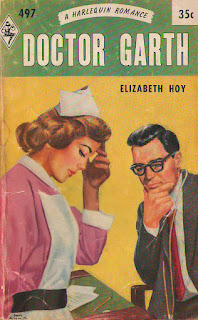
After Elizabeth Hoy’s outstanding Nurse Tennant, I went shopping for more of her books. Young Doctor Kirkdene does not live up to its superlative sister, but it’s certainly better than the other title I found, Doctor Garth. The writing is easy and charming, with occasional pretty phrases like, “Sensibly she reminded herself of these things, while her singing heart went its own wild way.” And few VNRN writers can make you feel so acutely the wretchedness of a young woman pining over an unrequited love—she pulls me back to miseries I haven’t experienced since high school. It must be admitted that the length of this book does get a bit tedious, and I found myself wishing the miserable pair could just have one honest conversation and put a quick end to it—indeed, the end, when that finally does occur, was a bit of a letdown. But all things considered, this is a rarity among VNRNs, a novel that actually hurts, and so I happily suggest you make an appointment at your earliest convenience with Young Doctor Kirkdene.

Saturday, February 22, 2014

Doctor Garth

By Elizabeth Hoy, ©1959

Cover illustration by Paul Anna Soik
 
“What exactly is an honorary?” Joan Langden asked her fellow nurses on her first day at St. Angela’s.
“A visiting consultant—either physician or surgeon,” explained the senior. “Usually they are men with big reputations. They give their services to the hospital free.”
“Oh!” though Joan softly. So Garth at twenty-nine was an “honorary.” An important surgeon with a reputation. She had known only vaguely of his connection with St. Angela’s and hadn’t been sure just what it was. It warmed her heart to hear the quick commendation of him in this girl’s voice. It made her glow with secret happiness that she might see him soon at his work … but although Joan had known Doctor Garth most of her life, she now found there were many things she didn’t understand about him. Why did he make her feel she was something “special” to him and yet keep so distant? And what was his connection with the pretty mother and her son on whom he was to operate? The story of Joan and Doctor Garth is an unusually appealing one.
 
GRADE: B
 
BEST QUOTES:
“There was no use being a nurse if you were going to be squeamish.”
 
“It would be good indeed if a heart could be no more and no less than Miss Don was describing it, a little chalk sketch on a blackboard, a queer, impersonal muscle with complicated vascular and arterial equipment, a bundle of valves and pumps that had nothing to do with aching and grieving, that could not possibly lie like a lump of stone in a person’s breast day after day!”
 
REVIEW:
Joan Langden is a 21-year-old nurse from the English countryside who has been in love with 29-year-old Dr. Garth Perros since she was knee-high to a tea table. She’s just starting her nurse’s training in the hospital where he is a surgeon, and all is going swimmingly between them until the arrival of the adorable seven-year-old Ivan Petrovna, stricken with appendicitis, and his mother, ballet dancer Vera. From the moment he claps eyes on Vera, Garth is “ashen” and walking around like a zombie. Soon enough, Joan learns the horrific truth: Garth knew Vera eight years ago, and the little tyke Ivan is the product of their friendship.
 
Joan is almost literally hysterical with this news, acting as if she has learned that Garth is a serial axe murderer with anal warts. “Garth was lost to her,” Joan wails, and she is incable of even speaking to looking at Garth, much less speaking to him. “She wanted to be done with him now and forever. He had failed her,” she moans. Eventually, however, Garth forces her into a corner, where he offers her an explanation: He is actually married to Vera, though they had only gotten hitched because she needed a green card, and stayed together for just one summer before she took off, and he had been unable to track her down. So after 25 pages of Joan’s frantic heartbreak over Garth’s bastard child, now that the poor boy has been legitimized, we relive the sloppy hysterics anew over his marriage: “Garth was lost to her hopelessly and forever! The dream of her whole girlhood was burned to ashes. Garth! her heart cried in anguish. Garth!” And there’s another 25 pages of pale cheeks, stony looks, sobbing in bed, and sickening jerks of the heart now that we know that he’s not just a father, but a husband as well.
 
Eventually Garth corners Joan again and tells her that Vera will agree to a divorce if he promises never to see Ivan again, so will Joan marry him when it’s all fixed? After thinking it over, though, Joan selflessly decides that she cannot accept Garth’s proposal of marriage—if she turns him down, Garth will stay with Vera, and, more importantly to everyone concerned, with Ivan, who needs a father. And indeed, soon Vera and Ivan have moved into Garth’s flat, and Ivan is the happiest boy ever! But if Garth and Vera couldn’t last more than a summer when it was just the two of them, things aren’t going to last that even long now that there’s the boy to consider as well. Vera, it turns out, is unhealthily obsessed with Ivan, refusing to allow him to go to school or even have friends his own age. She is furious that Garth wants her to give up the stage, and has her Russian friends over for vodka and caviar and loud, brash parties. Take a wild guess as to how we dispose of Garth’s bride.
 
But before she goes, Vera—who until now had been a largely sympathetic character and even a friend of Joan’s—becomes “the poor girl with her mind half crazed at last, hiding her son in that poverty-stricken cottage, changing her name, half-starving herself, driven on by the senseless fears which were a legacy from her terrible, tragic childhood.” It’s as if VNRN authors can’t bring themselves to treat these up-until-now noble characters so shabbily unless they give them a hideous makeover first, a literary insult to injury. Furthermore, even before Vera is dispatched, all the utter impossibility of being with Garth, the pages upon pages of wailing and gnashing teeth, are utterly forgotten. “Her heart was singing suddenly as she slipped on her soft fur coat, thinking that after all it was she who had the most precious part of Garth Perros’ allegiance in spite of all that lay between them. Vera might have his name—his son. But to herself he had given his love.” Which she’d had from chapter one, but it wasn’t much consolation then, so why is it now?
 
For all my carping, this is mostly an agreeable book. True, Joan’s weeping is a bit much, and the wild oscillations of her logic when it comes to Garth are hard to follow. But the writing is pleasant, if not as stellar as that which brought us Nurse Tennant. Elizabeth Hoy knows how to create real emotion in her readers, and this book, if not the best, is a pleasant outing, worth taking.

Sunday, March 20, 2011

Nina Grant, Pediatric Nurse

By Patti Stone, ©1960

The road to becoming a good nurse, Nina Grant discovered, was strewn with many pitfalls. A nurse could not afford even one mistake—because it could prove fatal. Yet she had made one error in judgment, had confessed to a moment of carelessness. One more error would mean dismissal, the end of the work she loved, the end to her strange bitter-sweet relationship with Dr. Halpern. Then an epidemic struck, testing every facet of her skill and courage. Nina Grant and Dr. Halpern found the strength to fight it … and something more …

GRADE: B+

BEST QUOTES:
“I have none of the social graces, she thought wryly. They didn’t teach me those in the orphanage.”

“I want to wear my new bathing suit. The saleslady said it would do things for me, and it certainly did. It emptied my pocketbook.”

“Now the trouble with me is that no man gives me a second look except Bill, and I suspect he needs glasses bad.”

“Did Miss Susan think she actually—well, chased men? Oh, how awful!”

REVIEW:
Nina Grant has just finished her training as a regular old RN, and has signed on for another year at White Shepherd Hospital in Dallas, where she will learn to be a pediatric RN. You just have no idea how hard it is to take care of kids. It’s a wonder they let just any woman at all become a mother. If she makes one teensy, weensy mistake, she’s out on her ear. Well, she starts off with a doozy, stopping before the hospital door to retouch her makeup, when out barges this guy and bumps into her, knocking her bag out of her hands and spilling her beauty secrets all over the steps. She despises him on sight—and then when she sees him a few days later in the caf and tells him to stay away from her. So guess who he turns out to be? It won’t take you long, because in true VNRN fashion, he’s the chief of staff, Dr. Enoc Halpern. (Enoc? Really? Just who thinks up these names?) She’s horrified, of course, as much as with him as at her own blunder. He’s jaunty, joking, and casual. Of course, he’s a fantastic doctor—“If only he could act more dignified, as a great doctor should!”

But soon there’s another blotch on her record: on the night shift, when she is alone on the ward, a child falls out of bed when the side rail is not locked in place. It’s the sort of error that could have killed little Mellie! She can’t believe she didn’t lock the rail, but she’s the only one on the ward—she must have left it down. The fact that she’d just found seven-year-old Andy wandering out of another child’s room never enters her mind—so she confesses to the crime and takes the pink sheet of shame and a week’s suspension.

This is especially hard on her because she fears everyone will think less of her—“I’m no longer the perfect nurse in their eyes, she thought wryly. They know I’m human too.” And what will Dr. Enoc think? Nina still doesn’t really get the good doctor, but he has shown interest in her progress as a trainee. And then, we are told, “there was something—a strange something—that had been sparkling between them from the day they had chased a cheap lipstick down the stairs.” Now, I just absolutely despise having to learn about a burgeoning romance in this way—it’s lazy and insulting. If we haven’t seen it for ourselves in the interactions between the characters, then it isn’t really there, and this is just a backhanded, cheating way of accomplishing the heavy lifting the author should have been doing all along.

So how can we bring our protagonists together? Here’s a novel idea—how about an epidemic? This time it’s diphtheria, which allows the book to go on a little rant about parents who don’t vaccinate their children: “They feel safe, for what they don’t hear about, or know about firsthand, they tend to ignore sometimes.” If the book gets to rant, so do I: Today parents are not ignoring the issue but willfully choosing not to vaccinate, sure their children will have a bad reaction (though the odds of this are 12.1 per 1 million doses, or 0.00121%, in a recent study of the flu vaccine[1]) while paradoxically convinced at the same time they will not contract a vaccine-preventable disease that could possibly kill them (300 children and 42,000 adults die every year of these illnesses[2]).

Anyhoo, there they are, locked on the infectious diseases ward, where the regulations require the nurses get eight hours of sleep nightly, eat nutritious meals, and shampoo their hair every other day. It’s no wonder that after six weeks of eight-hours-on, eight-hours-off shifts, they fall into each others’ arms in the kitchen when she slips in a puddle of water and he catches her. There’s still 25 more pages of book to get through, so we have to wade through Nina’s manufactured insecurities about whether Dr. Halpern’s wealthy family will accept her, and, in a first among the VNRNs I’ve read to date, we actually get to attend the wedding, but not the reception, and certainly not the honeymoon—for that you’ll have to read something a lot more current.

This is another one of those books that debates the nurse vs. human being question, and comes down squarely on the side of caring for the patients: “The best nurses are the human ones,” we are told in the very first chapter. Nina is told by Dr. Halpern after one of her favorite patients dies, that children need “tender loving care … as much as the medicines I prescribe.” Nurses who “love them with all their hearts and souls, as you do,” he says, are the very best. After he leaves, Nina thinks, “You make me feel so human, Dr. Enoc.” Later, after she’s spent a week socializing at her roommate’s wedding, the bookworm realizes she enjoys hanging out with the boys: “I guess I’m human after all, not just a nurse,” she thinks.

For its flaws, this is actually a pretty good book. It hums briskly along, and is a more laid-back cousin of Emergency Ward Nurse. I liked the main characters, though I wish there were a lot fewer peripheral ones: I counted 15 patients with names and stories, not to mention the scores of others we just zip past. In addition to the kids, you also have to manage the more than 40 named characters that inhabit the hospital. There are also countless pediatric illnesses to learn about: pyloric stenosis, leukemia, burns, diabetes, nasopharyngitis, swallowed nickels, tonsillitis, traffic accidents—they’re all there, and much, much more. It’s a nurse novel that also wants to be a medical textbook and a telephone directory. But it’s an entertaining read, even if it’s not very campy, and easily worth your time.

[1] Liang XF, Li L, Liu DW et al, “Safety of Influenza A (H1N1) Vaccine in Postmarketing Surveillance in China,” New England Journal of Medicine, 2011 Feb 17;364(7):638-647.
[2] Centers for Disease Control and Prevention (CDC). Achievements in public health, 1900–1999: Control of infectious diseases. MMWR. 1999 Jul 30;48(29):621-9.

Saturday, January 8, 2011

Nurses Dormitory

By Alice Brennan, ©1962

“Is it wrong to marry for money?” asked Nurse Miller. “Is it wrong to resent your mother because she is a glamorous movie star?” asked Nurse Gray. “Is it wrong to love the boy next door who thinks of you as a kid sister?” asked Nurse Leighton. Nurses Dormitory is an unusually warm story of the lives of three young nurses and the men they fall in love with. Told against the backdrop of the wards, corridors and operating rooms of a big city hospital, there is an authentic insight into the scene behind the scenes and every character is as real as a favorite friend.

GRADE: B+

BEST QUOTES:
“Gosh, Lita, with your looks and figure, why on earth did you ever want to become a nurse?”

“Work may be enough for a man. It isn’t enough for a woman. A woman needs a man to look after her; to hold her hand in the darkness; to be there! Without a man she’s not quite complete!”

“The three of us. We should write a book!”

“Wear kiss-proof lipstick, Veronica. There might be a bit of necking on the evening’s schedule.”

REVIEW:
When I picked up this book, I was concerned that it might not be a real vintage nurse romance novel. This is the first book I’ve read that details the lives of more than one heroine, and with the cover lines advertising that they love “the wrong men,” perhaps the requisite happy endings would escape the grasp of one or more of the ladies. Is Gone with the Wind not a romance because in the end Scarlett doesn’t have Rhett, just a stubborn determination to win him back? Well, I’ll think about that tomorrow.

Today I turn my attention to Lita Gray, whose mother is a movie star; Susie Miller, one of six children raised in a poor family who strives to find herself a wealthy man; and Veronica Leighton, whose crush from the age of 12, now-Dr. John Sernian, still sees her as the gangly pre-teen she once was. The advantage of having three heroines is that their stories are pretty well encapsulated in that one sentence. There are, of course, a few guys to add to the mix: Mark Brandel is a pediatric surgeon who is angry and short with the staff. His wife and three-year-old son were killed in a car accident five years ago, and he continues to beat himself up because he could not save them. He avenges their deaths by pulling out every stop in his attempts to save the lives of every child wheeled in through the doors of St. Jo’s Hospital. He seems charmed by Lita, who has also built a wall around herself as a defense against shallow people who can’t care for her: “She’d been so sick of useless, bored people lapping up excitement the way a cat laps up cream. Of no real importance to anyone except themselves. Concerned only with themselves. She’d craved a reason for being. An importance to her life. To her mind nursing had supplied that reason. It continued to supply it.”

For Susie we have Veronica’s brother, Doug, who comes to town and sweeps Susie off her money-grubbing feet. This is a big blow for her, and she spends a lot of time battling with herself and Doug about how awful it would be to be poor, even if you are happy, versus marrying for love. “If you’re left $100,000 or so, why, ask me to marry you again,” she tells Doug. “But until then, the answer is no … no … no!” And to think that you’re scarcely considered rich these days if you have a million dollars.

The main story centers around the hospital’s chief administrator, Larson Payne, who is intent on boosting hospital profits at the expense of the poor “ward” patients. Naturally, between his gruff manner and his propensity for giving his patients every possible medical treatment, Dr. Brandel quickly runs afoul of him. He has defenders on the hospital staff, including Dr. John Sernian, who go to bat for him, but Larson Payne retaliates by cutting medicine quotas for ward patients in half—which means that at mid-month there is no more oxygen, medicine, or blood products for those patients. Even if Dr. Brandel is gruff, you come to like and pity him, and he clearly has his heart in the right place when it comes to his patients. But you know something bad is going to happen, and all Dr. Brandel’s patients are children, so the build-up to the final gun battle at the corral felt real to me.

The writing is cute, though it does tend toward the mildly self-conscious. Sometimes this works and sometimes it doesn’t. For example, I give you this: “Night is the time of rest, when after a day’s work, you can stretch your weary, aching bones across your own bed, close your eyes and be alone.” Readers more cynical than I am might raise a brow, but for me it worked more than not. And while two of our ladies do come out engaged on the other side, one remains Scarlet-esque, waiting hopefully for her beau to come around. He’s expressed interest, though, so we know it’s just a matter of time. I was pleasantly surprised by this book, and I looked forward to coming back to it when I put it down at bedtime. Don’t be put off by the homely cover; give this book a chance.

Wednesday, December 29, 2010

The Sunshine Nurse

By Sharon Heath
(pseud. Norah Mary Bradley), ©1969

Terry Chisholm made her prime concern the health of the delicate children she took care of at Sunshine House. Young and lovely, she considered no future for herself outside of her career as nurse. Even her best friend’s concern could not make Terry slacken her pace—until romance unexpectedly intervened. For when a youthful doctor and a handicapped sculptor misunderstood each others’ intentions, it was left to Terry to smooth out the emotional tangle. And once she had intervened, it was her own heart that became inextricably involved …

GRADE: B+

BEST QUOTES:
“Perhaps he would discover that a blonde could be every bit as attractive as a redhead!”


“You mean that your pleasure at seeing me was not simply for my sake? Disillusioned and hurt, I maintain my usual exquisite courtesy.”

REVIEW:
Sunshine House, set down in the English countryside, is “a convalescent home for children whose parents can’t afford to take them away after a severe illness or operation.” The idea is, the parents meet Terry at the train station in London and hand over their sick children (including one boy diagnosed with “nervous deviltry and maladjustment”), who will be taken back to Sunshine House for weeks or months until they are deemed well enough to return home again, with apparently not one visit from their parents in the meantime. I cannot believe anyone ever thought this was a good idea.

A large cast of characters populates this book. Linda is a good friend of Terry’s who got sick and requires a place to go while she recuperates, and later while her boss is off honeymooning. Adrian Brooke is the indolent nephew of Lady Eskerton, who is a patron of Sunshine House. Adrian is a sculptor, but he injured his hand and now can’t work, so he spends his days flirting with Verity Gale, who is betrothed to Linda’s boss. Jonathan Hensley is a physician and the son of old Dr. Hensley, who cares for Sunshine House’s prepubescent occupants. Benjy is a four-year-old boy that Terry and her mother are raising after his parents died and his only living relatives didn’t want him. Bessie Hargreaves is a scullery maid with a sordid past—she married a man who she discovered, when she was about to give birth to their first child, was already married to someone else, and she lost the baby. Now she moons over three-year-old Maida, whose wretched, poverty-stricken mother dies while Maida is at Sunshine House, leaving her an orphan. Bessie wants to adopt Maida, but first she needs a husband and a home. Wait, there’s Ted Larkin, the gardener!

The two eligible bachelors (neither Terry nor Linda is a Lady Chatterley type, going for the gardener) are clearly destined for the two ladies. Of course, it’s a circuitous route to get them safely to the altar. Terry wants to help Adrian with his hand, and the two are always getting caught together by Jonathan Hensley, who incomprehensibly turns cold toward Terry. Linda insults Adrian, who incomprehensibly becomes infatuated with her. In the end, we have three engagements to celebrate, what with Bessie and Ted also hooking up. (Yes, this makes them eligible to adopt Maida.) Curiously, however, Jonathan doesn’t put the moves on Terry until after Benjy’s aunt and uncle from Australia turn up to claim him after all, when it turns out they can’t have kids of their own. “As long as you had Benjy to think of and love, I was afraid I wouldn’t stand a chance,” he tells her. “When I heard he was leaving you, I began to hope again.” A tad bit Oedipal to be jealous of a four-year-old boy; what’s he going to do when he and Terry have children of their own?

I suppose the re-telling can be a bit confusing, but the book itself is easy to follow and a decent enough read. You’ll occasionally come across some snappy dialogue, such as when Linda tells Adrian that she suspects that his girlfriends are “legion.” He replies, “Like the wedding presents in the newspaper reports. Both numerous and costly.” If you’re snowed in over Christmas break, it’s a pleasant afternoon on the couch.

Monday, September 6, 2010

Night Nurse

By Rosamund Hunt
(pseud. of Miriam Lynch), ©1962

Cover illustration by Edrien King

Young and lovely Sheila Hayden had been planning to marry Kenny Jamison for as long as she could remember. But when Sheila became a night nurse at Mercer City Hospital, Kenny showed signs of growing resentment, and asked that she resign. Sheila, however, had fallen in love with her work. Moreover, a political campaign to smear the hospital made her presence vital to the pressured staff. Vehemently Sheila insisted that Kenny had no cause to be jealous of her job, or of the brilliant young Dr. Joel Alexander, who was so often at her side. It took a mysterious kidnapping and a new and vicious attack on the hospital’s good name to force the lovely nurse to face some painful truths—about Kenny, about Dr. Alexander, and about her own buffeted heart.

GRADE: C


REVIEW:
Sheila Hayden, recent nursing school graduate, has decided to work on the pediatric ward—you guessed it—on the night shift. Although her friends and family are a bit baffled by her decision, she likes working nights, and she needs the extra money to help support her family. Until now, Sheila’s uncle Dan, who took Sheila’s family in when her father died, has been their sole support. He’s good-hearted, but he’s also a bit of a sap, with “wild enthusiasms for new money-making schemes.” Now Dan has decided to cast his lot with Herbie McVey, who is running for mayor, and so is looking for dirt on the hospital to further McVey’s claim that the current mayor is doing a bad job. Dan tries to pump Sheila for gossip about the hospital, but Sheila refuses to get involved.

Sheila is engaged, of course, to longtime boyfriend Kenny Jamison. This relationship does not bode well, however; on page 11, we are told, “It had always been a one-sided romance, with Sheila doing all the favors and making all the concessions.” Not exactly a marriage of true minds. So who else is there on the horizon? Well, there’s that resident at the hospital, Dr. Joel Alexander, who is “unmarried, unencumbered, and to boot, is the best looking, has the most divine smile,” or so says a nursing buddy of Sheila’s. She and Joel get off on the wrong foot when he snaps that she is not capable on her first night at work of caring for 30 patients, including one motherless boy who is recovering from diabetic shock. “Why, she didn’t even like Dr. Joel Alexander! She would never like him!” Somehow I’m betting she’s going to eat those words.

The book offers several questions to unravel. First, there’s a possible affair between the hospital’s married senior physican and the director of nurses. Then someone breaks into the narcotics cabinet but does not take anything; the newspaper carries a big story about the scandal, which furthers McVey’s campaign. Could dear Uncle Dan be involved? Finally, someone kidnaps the diabetic kid while Sheila is on duty, and the resolution of that situation is the peak of the book, after which everything wraps itself into a tidy little bow.

I once worked as a nurse’s aide at a hospital, one year on the night shift, and the book’s description of the job did have some semblance to reality. “When six o’clock came, Sheila and Mrs. Osborne, the aide, began to make preparations for A.M. care. This was something which those outside the hospital could not understand, that patients had to be awakened at the crack of dawn to have their faces washed and then were left with dragging time until the breakfast trays were served.” In my day it was vital signs, EKGs, blood sugar checks, and rounds by the surgical team that my 30 patients were awakened for. But I did get a little thrill of recognition from the story at this point.

Unfortunately, that was the only excitement Night Nurse brought me. It’s not badly written, and I got through it without the least bit of annoyance. But I didn’t laugh, either. It takes itself too seriously, and the author did not spend much time dreaming up the plot. There’s just no fun to it, so even though I wouldn’t say the book is bad, I still have to call it a failure.