Showing posts with label Colorado. Show all posts

Saturday, January 24, 2015

Mountain Nurse


By Arlene Hale, ©1966
 
Nurse Gwen Douglas loved the small mountain village where she worked alongside of her brother—the only doctor in this isolated community. The only shadow in her life was the empty cabin a hundred yards away—the cabin of Hap Benton, the man she loved. Hap was a restless soul, who wandered through the mountains, only to return to her and Three Rivers in the snowy winter months. But this winter, he was late in returning, and suddenly Gwen found a tall dark stranger showing up in his place …
 
GRADE: B+
 
BEST QUOTES:
“Come on, Baby, let’s get with it. We got some dancing and things to do.”
 
“If you don’t put your arms around me pretty soon, I’m going to have to act like a brazen woman.”
 
REVIEW:
Gwen Douglas works with her brother Bob in Three Rivers, Colorado. She’s in love with the boy next door, Hap Benton, who is apparently a migrant worker, returning to town only after Thanksgiving and blowing back out again when the snow melts in the spring. Naturally, no one, including her brother, can figure out why she pines for the dope. As the book opens, the first flakes of November are starting to swirl from the clouds, so Gwen starts jumping at every slamming car door, thinking it’s her wayward beau come home. It’s not. Unfortunately, though, this leads to a fair amount of inner pining: “Hap! A carefree soul, if ever there was one. Would he ever settle down here in Three Rivers? Would he ever put a ring on her finger and make it official? She could only hope that her love and his need of her would eventually be strong enough to overrule his restless feet.” Uh, good luck with that, sister.
 
When that midnight pound on the door finally comes, it’s a stranger, Cole Fairfax, who tells Gwen that Hap has told him he can stay in his house. Cole is a moody, broody fella with a dark secret that makes him clamp down the minute anyone asks him about himself. But soon we are allowed inside Cole’s head, long enough to find out he’s been sued for every last one of the many dollars he once owned, and now he’s destitute and heartsick over some gal named Dolores; that part of the story unfolds slowly and gracefully, and makes Cole the most interesting character in the book. What is less of a surprise is that Cole is actually a doctor, and since he’s been dropping major hints in that regard all along (“You know quite a lot about blood poisoning, it seems,” Gwen tells him early on), the only person who will be shocked by the eventual revelation is Gwen herself.
 
Meanwhile, this nice young man from the Double S Ranch, Scott Stevens, starts putting the moves on Gwen, who reluctantly dates him despite her undying commitment to Hap. Then, the night Scott finally reveals he has long been in love with Gwen, there’s another midnight knock on the door, and this time it really is Hap! From the word go, he’s not a very likeable character: He’s an hour late for Thanksgiving dinner, he’s possessive and rude to Gwen, too joking to have a serious conversation with her about their relationship, and he immediately leaves town again to take a job at the ski resort, too far away to see Gwen more than once a week or so. For the first time, however, Gwen is starting to see the thorns on the rose, and Scott presses his suit, proposing to her on their second date, wooing her with the VNRN classic: “I think you could love me if you gave yourself a chance.” Well, all right, then! It works, though; now “when she thought of him there was a warm glow inside her.” Complicating matters is the big smooch Cole lays on her, saying, “I figured if I could respond to you, there was still hope for me.” The flatterer!
 
So now there’s just the matter of which of these eligible bachelors will win Gwen in the end, what Cole’s real story is, and whether everyone is going to survive the enormous blizzard that blows up, causing several medical emergencies that Bob and Gwen have to skid all over town to attend to. I was frankly a little surprised about which of the gentlemen triumphed in the end, so that was something, and the final paragraph was cuter than most. Overall this is a good story and well told, which makes me scratch my head a bit at the erratic and usually mediocre product churned out by Arlene Hale; this is the 12th nurse novel written by Arlene Hale that I’ve read, and only the fourth to garner a grade higher than a C. I can’t relegate her to the same category as Peggy Blocklinger (aka Jeanne Bowman), who is a reliably dreadful horror show. But given the fact that Hale churned out about 45 VNRNs, I do wish she’d concentrated on quality—since it is clear she can write a good story when she wants to—instead of quantity.

Sunday, February 9, 2014

Nurse against the Town

By Jane Converse
(pseud. Adele Kay Maritano), ©1966
 
“Murderer” they whispered of the man she loved. Why did the people of Barfield avoid their doctor? Why did they whisper “criminal” about its director, Dr. Jerry Sterling, when they talked of the mysterious death of his beautiful wife, Naomi? And what was driving Naomi’s brother, Henry Barfield, to use his membership on the hospital board to ruin Dr. Sterling? Desperately, pretty Ellen struggled to find the answers. Pitted against her consuming love for Jerry Sterling were the hostility of the neighbors and the terrible suspicious she could not shake free from her own mind. In a story shaken with passion, hiding at its heart a dreadful secret, Ellen Whitaker finds herself all but alone as the nurse against the town.
 
GRADE: D+
 
BEST QUOTES:
“Ellen’s mind had posed the awesome questions about Jerry Sterling’s innocence. Her heart answered them.”
 
REVIEW:
Ellen Whitaker has left her post in Chicago and come back to Barfield, Colorado, her home town, for one simple reason: She is desperately in love with Dr. Jerry Sterling. She knew him when she was just a kid, see—though “the senior class president and undisputed scholastic leader at Barfield High had barely known of a shy, chestnut-haired freshman’s existence”—and was so besotted even then that “his decision to become a doctor had spurred Ellen’s desire to become a nurse.” When he went off to college, she had “lived” for holidays when she might catch “only surreptitious glances” of him—and then she saw nothing at all of him until now, eight years later. Her devotion to Dr. Sterling is held up as an admirable thing, but to me it seems like a very unhealthy obsession.
 
In the interim, Dr. Sterling married beautiful heiress Naomi Barfield, but she was found dead in a ditch a year later, victim of “an illegal operation,” wink, wink. It’s rumored that she ran around with a lot of men and that Dr. Sterling tried to end her pregnancy but botched the job. Never mind that he has an airtight alibi for the time of death, the locals won’t have anything to do with him or the hospital he runs in town, so it’s uninhabited pretty much all the time. Naturally, Ellen feels this is an opportunity that she should jump into: working at an empty hospital hoping to catch glimpses of Dr. Sterling, who, widower for a year as the book opens, might begin to start looking around any minute now. But since he really only passes her in the hall every now and then, it’s not clear why he might opt for her. While she’s waiting for him to notice her, she befriends Dr. Sterling’s best friend, Porter Hubbard, and they even start dating, though she’s made it clear to him that her heart lies elsewhere.
 
All this is set up by page 20, and the rest of the book is an endless back-and-forth between Porter and Ellen about how they can help Dr. Sterling and whether Porter can convince Ellen to marry him. Eventually a Dark Secret is brought to light, but it doesn’t really change anything: We still don’t know who killed Naomi. Or actually, we probably do: We find out about an old doctor who had made a small practice of giving abortions, and who had committed suicide “right after that awful thing with Naomi.” But we’ve been aware of him since about midway through the book, so if he’s the killer, neither we nor the townspeople of Barfield should be at all surprised. We don’t know who the father of Naomi’s baby is, nor are we likely to, since it is common knowledge that she slept with pretty much every man in town. Yet, somehow, Dr. Sterling’s reputation is restored, and somehow manages to fall into Ellen’s arms at the end.
 
After Surf Safari Nurse, brilliant in so many ways, I will cut Jane Converse a lot of slack, but this is a phoned-in job, not worthy of her. Nothing happens throughout the book, the “climax” is actually irrelevant to the plot, and Dr. Sterling is such a complete stranger to both us and to Ellen that her infatuation with him is more than a little creepy. The writing is pleasant, as Jane Converse usually is, but it takes more than good sentences to make for a good story, and Nurse against the Town is anything but that.

Sunday, May 20, 2012

Dude Ranch Nurse


By Arlene Hale, ©1963
Cover illustration by Charles Gehm

Jan Gordon came to Deer River, with its dude ranches deep in the Rockies, in order to thrust aside all the unpleasant memories of the past and rediscover herself. But Jan found that as a nurse and as a woman, she couldn’t turn her back on conflict. There were two young doctors in Deer River; Jan owed loyalty to both. To Dr. Coe, Jan was bound by her conscience, but it was Dr. Lester who held her heart.

GRADE: C-

BEST QUOTES:
“You’re too pretty to be a nurse.”

“You’re more than a nurse. You’re a woman. You know that no matter how important he is, or how old, or even how tough, a man needs the touch of a woman’s hand.”

“There’s some joy in gettin’ sick, if a fellow’s got a pretty nurse like you.”

“I let a few women slip through my fingers. Nice, tasty tidbits, but a man can’t exist on that sort of thing, can he?”

“Wow! Man, you were pretty before, but that uniform really does something for you.”

REVIEW:
The cover of this book, after I posted it on my companion blog, Vintage Romance Covers, earned more comments than any other (so it was just two, but still!). I take it from this (albeit meager) sign that the general public holds some interest in this book, perhaps similar to its feeling for Hootenanny Nurse. These titles epitomize the extremes of the genre and bespeak great possibilities of camp, adventure, and fun. If only what lies inside held half the joy of its promise. Dude Ranch Nurse, I am sorry to say, has one E too many in its title.

Now, some may call this a quibble, but our heroine, Jan Gordon, does not work at a dude ranch. In fact, the only time we actually see one is when spends an evening at Pete’s Dude Ranch on a date, and then it’s a passing reference to singing cowboys and thick steaks. Jan has left her home and a boring, nice guy there to “chase her rainbows and satisfy her dreams and search for that elusive thing called happiness.” Just so you know, this is actually a bad thing – the smarter plan would have been “to fall into a dull, humdrum routine. It would have been safe, secure.” But here she is, in Deer River, Colorado, an hour into the mountains from Denver. She gets off the bus and carries her letter of recommendation straight to Dr. Dan Lester’s clinic, and he hires her on the spot, as his son, Dr. Noel Lester, is expected to return home from a few years in New York doing research, and Noel will need a nurse.

The Lester clinic is a shabby place. The paint on the walls is peeling, the linoleum is badly scuffed, the medical equipment was “only fair and very old.” It’s staffed by Nurse Schmidt, one of those stereotypical battleaxes: “the buxom, hard-eyed, tough kind … that sassed patients, jabbed roughly with the needle and ate spike nails for breakfast.” The only thing it has going for it is that it’s “scrupulously clean.” Needless to say, patients are in short supply at Dr. Dan’s. Across town, though, is the Coe Clinic, run by Dr. Mavis Coe. Her establishment is new, modern, decorated with plush carpeting and the latest in medical technology. She even has a few hospital beds, which saves desperately ill patients from being trucked to Holden General Hospital, 20 miles away, in emergencies. Jan’s first day in Deer River gets her into the Coe Clinic when a young girl is thrown from a horse and Jan accompanies the patient there. The problem is that Dr. Coe and Dr. Dan are bitter enemies, and if Dr. Dan finds out that Jan is stopping by the Coe place to visit with little Debbie, who is paralyzed from the accident, she will lose her job.

After much asking around, Jan learns that Dr. Noel and Dr. Mavis had once been engaged. But Mavis had wanted a bigger and better clinic, and Dr. Dan had refused. She and Dan waged a tug of war over Noel, and neither won: Noel packed up for New York. So Mavis opened her fancy clinic across town, and it’s been a big success. The story is a bit confusing, but it seems that Noel had asked Mavis to wait a few years, for Dr. Dan to retire, before improving the Lester clinic. “All he’d asked for was a few years. All they had to do was wait, but Mavis wouldn’t,” Noel thinks. “She had always been ambitious, going hell bent toward her goals. … If Mavis had really loved him, nothing else would have mattered – neither the clinic nor her fantastic ambition. Mavis didn’t love him, never had and never would.”

There’s a lot wrong with Noel’s assessment, starting with the fact that Noel is mulling this over after he had gone to Mavis’ house before she had arrived home, let himself in with the spare key she keeps under the flowerpot, fought with her, grabbed her and kissed her against her will, and she had bitten him on the lip so hard it bled. Then one could ask why, of the affianced couple, it’s Mavis who ought to have given in. If Dan’s clinic is so clearly shabby and not meeting the needs of the population, why must a new facility that would improve local healthcare hinge solely on Dr. Dan’s whims? We could say that if Noel had loved Mavis, he would have chosen her over his father. This is the point of view taken by Jan: “There was too much respect for this woman doctor in her heart. She had seen how skilled she was, how much she cared about her patients. Perhaps she was ambitious. That was no crime. Perhaps she had wanted a nice building, a decent place to treat her patients. That was no crime either. Dr. Dan was wrong. Worst of all, he knew he was wrong and it ate at him like a burning infection.” But this exculpatory passage doesn’t let Mavis off the hook until the penultimate chapter, so for most of the story Mavis wears a scarlet MD.

Anyway, all that’s just the backstory. In the meantime, Jan has a monster crush on Noel, who is quite the hot tomato. “Noel Lester was one of the most attractive men she had ever seen. … To be involved romantically with a man that looked like this was probably the answer to most girls’ dreams.” So she hankers after Noel, but he mostly just toys with her, as it’s Mavis who owns his heart; Jan “was his ace in the hole,” thinks the lousy cad. For her part, Jan dates Noel, a frisky mountaineer called Buzz, and a reclusive writer next door named Damon. It’s a little peculiar to watch Jan and Noel bounce around, kissing everyone in sight despite their professed love for one person only. By the end of the book, the only person I really respect is Mavis.
This is another cover of the same book.

The story concludes with Noel – once again – displaying his hydrozoan tendencies by decamping for New York, letting his father and Mavis know via a cowardly telegram. The wrench in his plans is the fact that his plane comes to earth a bit prematurely, in the mountains just outside of town. Does he survive? Will this tragedy bring peace at last to all the warring factions? Will Jan find herself a man? All these important questions are answered, of course, but you won’t be surprised by any of it, and you will care even less. And so my quest for a sublimely titled book that is actually worth reading continues.


Saturday, March 10, 2012

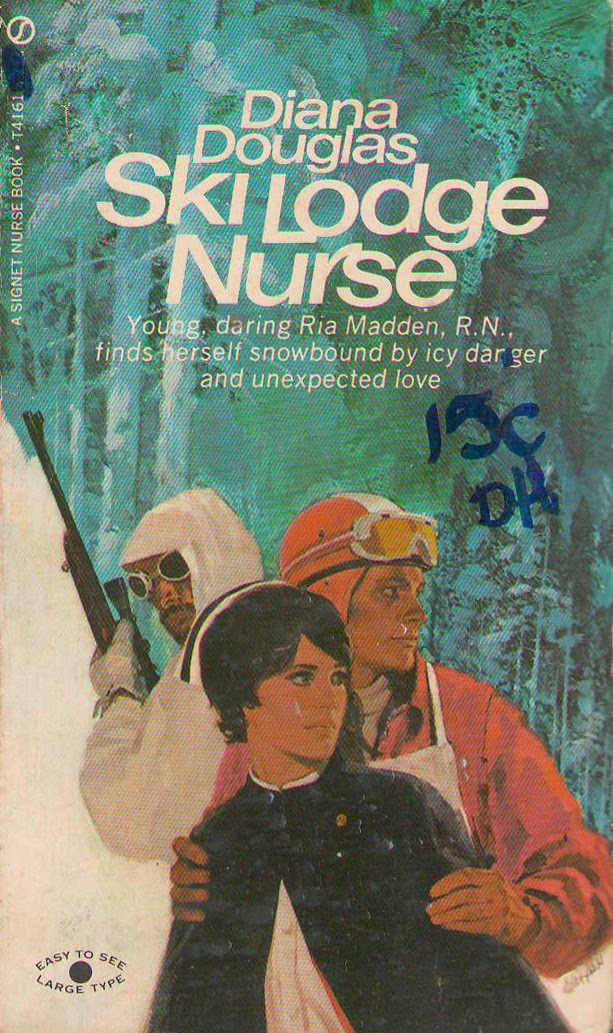
Ski Lodge Nurse

By Diana Douglas
(pseud. Richard Wilkes-Hunter), ©1970
Cover illustration by Allan Kass


For raven-haired, sports-loving Ria Madden, being a nurse at Hurricane Valley Ski Lodge had been, for the past three seasons, the perfect job—glamorous, exciting, fun. But this year was different. This year was trouble, and Ria knew it. It began with the strangely persistent romantic attentions of Thor Carlsen, the handsome Nordic skiing champion. It increased in intensity with Dr. Leon Marshall’s inordinate concern with Ria’s every after-hours activity. And then, without warning, it exploded into an avalanche of danger which forced her to face the ultimate challenge of her nursing career—and to make the most crucial decision of her life…

GRADE: C+

BEST QUOTES:
“Some of the women who come to Hurricane Valley would melt a glacier.”

“Thor appreciated her not only as a woman and a nurse, but as a skier.”

“The hunter on the mountain was insane.”

REVIEWS:
More than any other author I’ve encountered, Richard Wilkes-Hunter’s novels—Casino Nurse, Surfing Nurse, Beauty Contest Nurse, Sea Nurse—read like justifications for writing off that expensive vacation. Ski Lodge Nurse may be one of his better books, but in the end it’s really just more of the same. It has a lot more action than some of his other books, but action doesn’t make up for stupidity.

Ria Madden has worked at the Hurricane Valley (curious name for a ski resort—wouldn’t Blizzard Valley have been more appropriate?) in Colorado for the last three winters with Dr. Leon Marshall. She likes him, and “it was something more than admiration of his six feet of sturdy male strength and his gray eyes that could so easily mask his feelings.” But while they got along great for the first two years, last season she found him possessive, jealous, and “like a bear with a sore head. […] She had almost grown to hate him.” And so far, as this season opens, he’s not much better, snapping at the nurses and stomping off in a huff.

Competing for Ria’s affections is the lead ski instructor, Thor Carlsen, a Norwegian who won some skiing competition long ago. He invites Ria out for the first run of the season, and there’s a blow-by-blow description of every trail and move made by the pair that recalls the surfing passages from Surfing Nurse: too much jargon and an assumption that you care about every bump and turn they make on the way down. The layout of the mountain is also poorly described, so though a lot of action occurs up on the mountain, it’s largely confusing when you can’t picture what is happening.

There’s a lodge up on the mountain for people who get stuck, and while he is out with Ria, Thor notices smoke is coming from the chimney, so he sends up his number two, Niki Casello, to check it out. Niki is engaged to the other nurse, Brigid. Niki is competing in an international ski comptetition, which this year will be held in Hurricane Valley. He is deathly afraid of the ski jump but enters the event anyway because he thinks that if he does well the ensuing fame will earn him a top post at another ski resort and a salary large enough to support him and his bride, who of course he cannot allow to work.

Curiously, Niki loses the first aid pack he takes up the mountain and is as snappish as Dr. Marshall about it when he gets back, saying he did not find anyone in the cabin. The next day, he’s up at 6 a.m., climbing the mountain on foot. No one thinks twice about this until Ria and Dr. Marshall, out skiing that afternoon, hear gunshots. Then Niki falls off a cliff that a ski jumper could have taken easily—he tries to abort the jump at the last minute but his momentum carries him over—and is saved from death by a mysterious skier in white carrying a rifle who digs him out of the snow before Thor, who has seen the accident through his binoculars from a neighboring mountain peak, can get there.

That night, someone breaks into Ria’s room in the hospital. Before she has even clapped eyes on the fellow, Ria has a diagnosis: “The man out there was sick, her training reminded her. Dangerous, but sick. People like that were frightened of light, because their sickness was a thing of darkness and secrecy.” She turns on the light and runs to the window, intending to beat the intruder with her shoe, and discovers it’s the white-garbed hunter. He is muttering in Italian, but guess what! Ria’s mother was Italian, so she’s able to chat the guy up. He’s just looking for food, and he tells her he’s afraid of the men who have been chasing him. She explains they just want to ask him to stop popping off his rifle, because the skiing season has opened and they don’t want any tourists to get shot, which would be bad for business. He doesn’t believe her, though. “They plan to kill me. I have often heard them speak of it. They are clever, often they come upon me at night, unseen, whispering of cruel things …” She rushes off to fill a pack full of food for him, musing that this guy looks a lot like Niki.

The next day, when the men hear about this, they decide to posse up. They chase the poor guy for two days until he jumps off a cliff and is injured, but he gets away. The men are camping on the mountain that night, and at 5 a.m. Ria hears noises outside her window again. The crazy skier is back, passed out in the snow. Ria gets some ski instructors to carry him in, calls a doctor in town for a recipe for a chemical straitjacket, sets his fractured humerus, and arranges for his transport to the nearest hospital. One of the ski instructors heads into the mountains to bring in the posse, and when Dr. Marshall gets back, is he impressed? Heck, no! He snaps at her for giving the man sedatives and because she gave the man food earlier, telling her that her “thoughtless generosity probably contributed to the accident he had.” That pack of guys relentlessly chasing him had nothing to do with it; it most certainly was the pack of food on his back destabilizing his landing, the stupid girl!

Only after the skier—revealed as Lorenzo, Niki’s long-lost older brother—has been safely packed into an ambulance does Thor tells the stupid doctor that he is going back to Norway—alone—and that Ria is in love with the doctor. “All men are jealous of their sweethearts before they marry. But afterward never, for it is an insult to be jealous of your wife,” says deluded Thor. So Dr. Marshall goes back to the hospital and kisses away Ria’s tears, and then it’s all over but for the skiing competition, which Lorenzo attends. He’s now living with his parents in Denver, and “if Lorenzo heard voices now, they had become subdued, part of a familiar pattern that now he understood better and no longer heeded.” Dr. Leon is cured as well—“He wasn’t jealous of [Ria] anymore,” we are told—so that’s two miracle cures in one chapter! All we need now is a top-three finish for Niki in an event that doesn’t give him the willies, the slalom, and we can close the book with a sigh of relief. Check and check.

Sunday, July 24, 2011

Private Duty for Nurse Peggy

By Madeleine Sault, ©1965
Cover illustration by Mort Engel

The dark old house was haunted by the memory of Mrs. Reinley’s lovely granddaughter—and when Peg Merritt went there as the old lady’s private nurse, she could almost feel the dead girl’s presence … But Peg’s real problems came from two handsome doctors—rivals for Mrs. Reinley’s money, and for Peg herself!

GRADE: B

BEST QUOTES:
“She would be smart, ladylike, controlled. She would ignore him. ‘Spoiled brat!’ she found herself shouting at the top of her lungs.”

“They also tried to touch her. A number moved in completely, often pretending to stumble, attempting to press their whole bodies against hers. Many tried to put their big, coarse hands on her hips and thighs. One or two reached openly for her breasts. Peggy, with some experience in such matters, fended them off well enough, stamping on toes (and wishing nurses wore spike heels), and digging her elbows into ribs, stomachs, or perhaps the point of a protruding Adam’s apple. Just once, she had to treat drastically a particularly persistent body-contact expert, lifting her knee sharply between his legs. … This sort of thing seemed to be a regular and inevitable part of ‘public health work,’ so far as she could tell.”

“You actually saw DeBakey perform an endarterectomy?”
“Yes, he did it as a demonstration in our operating theatre at William Trent General. Of course, I don’t pretend to understand it.”

REVIEW:
Peggy Merritt has come home to Ross Park, Colorado, after a stint in a Chicago hospital, to nurse aging millionaire Mrs. Reinley, the mother of her best friend from high school. Peggy had fallen in love with Charles Whittaker when she was young—but he married Sandra Reinley, so Peggy had moved to Chicago for the past four years to escape the heartache. Then Sandra died of multiple sclerosis and Mrs. Reinley had a stroke, so Peggy is back again.

Charles, now a doctor, is caring for Mrs. Reinley, so the two are thrown together again. Peggy also bumps into Henry Reinley, Mrs. Reinley’s son and now himself a doctor as well. The two clash constantly—he calls her “Piggy,” and she calls him “arrogant, juvenile, erratic, obnoxious, demanding, undependable, thoughtless.” Quick, call the preacher! On her first date with Charles, Hank shows up at the country club where Charles is about to kiss Peggy, dragging Charles’ fiancée Nadia with him—a woman whose existence Charles had failed to mention to Peg. Hank then grabs Peggy and drives her out to the family ranch, which he is in the process of converting to a hospital for the indigent. There, she helps him deliver a baby for a Mexican migrant worker. When he’s working, Hank is transformed, soft and gentle, confident, “a pair of gloved hands, skillful and firm.” When the baby has been born, Hank tells Peggy that Charles has a scheme to steal the ranch from Hank and turn it into a hospital for the wealthy, “and he’ll marry you to do it, if he has to.”

Indeed, the next day Charles is furious that Peggy has been up all night working with Hank on “the baby of some scrawny little muchacha who might have God knows what wrong with her!” His concern, of course, is that poor sick Mrs. Reinley was alone all night—and also that Hank is turning the ranch kitchen into an operating room, and starting a nursing school out there, and a clinic for beet-pickers. Charles’ hospital, he tells Peggy, would be “the very latest in hospital design … And the best kind of patients, too. Nice people—who can pay well for their care.”

But Hank is not through with Peggy yet. He gets her a job as a public health nurse for a week, taking her into the poorest part of town and vaccinating every one of the several thousand occupants for a week—that is, until a flood strikes, and then she’s busy helping the victims, until she’s on the brink of a breakdown from complete exhaustion. Home again from this “vacation,” a picnic Peggy is attending is struck by food poisoning and everyone turns green and vomits, and it’s Hank who turns up to help her triage the ill. When a poor little girl with a “gross and unsanitary housewife” for a mother gets sick with botulism from eating her mother’s pickles, Hank saves the girl’s life. His nurses speak of him with awe and reverence, and even if he’s impatient and demanding of Peggy, her opinion of him begins to turn.

Charles, meanwhile, tells Peggy that his engagement to Nadia is just to get her a green card, and really he’s in love with Peggy, because “you speak my language, know my thoughts, answer my needs, and tempt my appetites.” And, oh, yeah, he adds, as he drops her off after their date, “You have to help me stop Hank, before he ruins everything. You’re the only one who can. … We’ll tackle that young barbarian together, Peggy dear. And teach him some manners.” Even if she thinks that’s “a curious way to end a romantic episode,” she’s still swooning over Charles: “He was so big and strong and dominant. … Despite a lifetime of self-reliance and a well-developed taste for doing as she pleased, at heart she was a woman who wanted a man to sustain her, guide her, maybe even rule her.” She rants to Mrs. Reinley about Hank, parroting Charles’ complaints that it’s “unbusinesslike” that Hank is spending his own money to build better housing for the migrant workers. “I don’t suppose he went into medicine as a business,” says the shrewd old lady.

Charles proposes to Peggy and she accepts him, and shortly after that, Mrs. Reinley is abruptly felled by a major stroke. As she lies dying, Hank tells Peggy that his mother is leaving Peggy a third share in the ranch—so it will be her decision as to what happens to it, as Hank and Charles each get a third as well—and he assumes that Peggy will side with Charles now that they are engaged. But Peggy is coming to realize that Charles isn’t quite the hero she thought he was. She is saved from making any difficult decisions, however, when she bizarrely decides to nap in the closet off Mrs. Reinley’s main hall and overhears a telling conversation between Nadia and Charles.

This book has some interesting aspects to it, particularly its devotion to public health. But despite its idealistic speeches about how holy and important this work is, it does depict public health—and its recipients—as dirty, disgusting, demanding, and unrewarding. The poor are worthy human beings too, we are told, but we are shown a beastly population without intelligence, gratitude, manners, or soap; only the Mexicans come across as civilized and honorable. The plot is easily foretold, and we watch Charles manipulate Peggy like a puppet, wishing she wouldn’t have to wait until her nose is almost literally rubbed in Charles’ deceit before she grows a spine. Apart from these flaws, however, it’s a decent enough read, and I liked Hank’s character enough to forgive the author for making Peggy such a dolt.