Sunday, February 9, 2014

Nurse against the Town

By Jane Converse
(pseud. Adele Kay Maritano), ©1966
 
“Murderer” they whispered of the man she loved. Why did the people of Barfield avoid their doctor? Why did they whisper “criminal” about its director, Dr. Jerry Sterling, when they talked of the mysterious death of his beautiful wife, Naomi? And what was driving Naomi’s brother, Henry Barfield, to use his membership on the hospital board to ruin Dr. Sterling? Desperately, pretty Ellen struggled to find the answers. Pitted against her consuming love for Jerry Sterling were the hostility of the neighbors and the terrible suspicious she could not shake free from her own mind. In a story shaken with passion, hiding at its heart a dreadful secret, Ellen Whitaker finds herself all but alone as the nurse against the town.
 
GRADE: D+
 
BEST QUOTES:
“Ellen’s mind had posed the awesome questions about Jerry Sterling’s innocence. Her heart answered them.”
 
REVIEW:
Ellen Whitaker has left her post in Chicago and come back to Barfield, Colorado, her home town, for one simple reason: She is desperately in love with Dr. Jerry Sterling. She knew him when she was just a kid, see—though “the senior class president and undisputed scholastic leader at Barfield High had barely known of a shy, chestnut-haired freshman’s existence”—and was so besotted even then that “his decision to become a doctor had spurred Ellen’s desire to become a nurse.” When he went off to college, she had “lived” for holidays when she might catch “only surreptitious glances” of him—and then she saw nothing at all of him until now, eight years later. Her devotion to Dr. Sterling is held up as an admirable thing, but to me it seems like a very unhealthy obsession.
 
In the interim, Dr. Sterling married beautiful heiress Naomi Barfield, but she was found dead in a ditch a year later, victim of “an illegal operation,” wink, wink. It’s rumored that she ran around with a lot of men and that Dr. Sterling tried to end her pregnancy but botched the job. Never mind that he has an airtight alibi for the time of death, the locals won’t have anything to do with him or the hospital he runs in town, so it’s uninhabited pretty much all the time. Naturally, Ellen feels this is an opportunity that she should jump into: working at an empty hospital hoping to catch glimpses of Dr. Sterling, who, widower for a year as the book opens, might begin to start looking around any minute now. But since he really only passes her in the hall every now and then, it’s not clear why he might opt for her. While she’s waiting for him to notice her, she befriends Dr. Sterling’s best friend, Porter Hubbard, and they even start dating, though she’s made it clear to him that her heart lies elsewhere.
 
All this is set up by page 20, and the rest of the book is an endless back-and-forth between Porter and Ellen about how they can help Dr. Sterling and whether Porter can convince Ellen to marry him. Eventually a Dark Secret is brought to light, but it doesn’t really change anything: We still don’t know who killed Naomi. Or actually, we probably do: We find out about an old doctor who had made a small practice of giving abortions, and who had committed suicide “right after that awful thing with Naomi.” But we’ve been aware of him since about midway through the book, so if he’s the killer, neither we nor the townspeople of Barfield should be at all surprised. We don’t know who the father of Naomi’s baby is, nor are we likely to, since it is common knowledge that she slept with pretty much every man in town. Yet, somehow, Dr. Sterling’s reputation is restored, and somehow manages to fall into Ellen’s arms at the end.
 
After Surf Safari Nurse, brilliant in so many ways, I will cut Jane Converse a lot of slack, but this is a phoned-in job, not worthy of her. Nothing happens throughout the book, the “climax” is actually irrelevant to the plot, and Dr. Sterling is such a complete stranger to both us and to Ellen that her infatuation with him is more than a little creepy. The writing is pleasant, as Jane Converse usually is, but it takes more than good sentences to make for a good story, and Nurse against the Town is anything but that.

Wednesday, February 5, 2014

Disaster Nurse

By Peggy O’More, ©1968

Mina Anne was troubled. She had loved Paul ever since the accident that had brought him to Cutler Hospital. But—one thought turned her days into torment. How could she love a man and still despise his outlook on life? How could she marry a man who so violently disapproved of the job she was doing?

GRADE: C-

BEST QUOTES:
“Put two girls and a can opener in the kitchen, and you have a feast.”
 
“For a physician, you are really very uninformed in a certain field of diagnosis.”
 
REVIEW:
Mina Anne Richards is, in addition to one of the more awkwardly named VNRN heroines I’ve met, a public health nurse. She’s concerned about a population of migrant workers who are living without basic plumbing or running water, and now they’re about to be evicted from their squatting grounds, apparently because “the camp was a veritable breeding ground for communicable diseases.” You could say the same about hospitals and elementary schools, but whatever.
 
Mina Anne’s boyfriend, attorney C. Paul Parker, is pressing her to give up her job and marry him, but she’s not completely convinced. Paul is particularly earnest in his proposal because the president of a large company will give Paul’s firm his business but only if Paul marries Mr. Chalder’s daughter—a very peculiar arrangement in a number of ways—and Paul will be off the hook if he’s already married, he explains to Mina Anne. When she objects, he responds, “Once we’re married, I’ll be able to show you where your perspective is out of focus.” Curiously, Mina Anne neither flings a skillet at his head nor shoves him out the door, but continues to consider, no matter how tepidly, his proposal.
 
The book gives us a lot of back-and-forth between Mina Anne and Paul, and even some mildly interesting if dated debates about welfare—one poor family with only one pair of shoes between the two children refuses to accept welfare, and Mina Anne debates whether this is admirable or “false pride.” A casual dinner or two with Dr. Louis Marquand, her boss, and then, at the book’s halfway point, it begins to snow. When Mina Anne and her roommate Joan, trapped indoors for several days by the blizzard, begin to snap at each other, wise medico Mina Anne chalks it up to dehydration: “The department warned us of the possibility.”
 
But then, even worse, the weather warms, and now it’s raining. And raining. The river is rising, and Mina Anne sets out in her galoshes and mackintosh to rescue, well, pretty much everyone: a man with an infected cut on his arm, a farmer and his family, a cattle rancher and his family, the entire migrant camp, a woman having a baby, a family trapped in a grove of trees, Paul’s parents. Just when you think we’re going to have a minute for a sandwich and a nap, someone is tapping on Mina Anne’s shoulder again and she’s off in the chopper with Dr. Louie. Sixty-plus long pages later, it’s finally over, and suddenly Paul has fallen madly for roommate Joan, whose “love would be an ever-burning searchlight on the roiled waters.” Even worse, a marginal character takes Mina Anne in his arms out of nowhere, and she agrees to allow him “to take care of her, not let her take care of him,” if you think you can take it.
 
Peggy O’More Blocklinger, whose work we have seen before under the pen name Jeanne Bowman, is not my favorite author, which should not surprise the regulars. In Disaster Nurse, she manages to do a little better than usual, which is still, clearly, not all that great. Her condescending psychobabble is slightly less prevalent, but we’re regularly treated to bon mots such as, “Premonitions are usually based on logical deductions distorted by emotions,” “Paul’s poverty was restricted vision,” and “This time I am thinking of our state inventory tax, of merchants buying heavily for the Christmas trade and being stuck with merchandise and having to pay taxes on what the weather kept them from selling.”
 
O’More’s main theme about poor migrant workers could hold some interest, but instead of making her points by showing them through her story, she hectors us with long pedantic lectures. When Joan ponders why the migrant families don’t take more pride in their admittedly temporary homes, instead letting them get so run down, Mina Anne climbs up on her soapbox: “I think it is an inner rebellion at their status. They can’t pinpoint the cause; it’s too ephemeral, ever-changing. So they rebel against their fellow man.” Then Joan jumps on the bandwagon: “They believe not: ‘The world owes me a living’ but rather, ‘The world owes me the right to earn a living.’ And when they can’t earn it, they don’t blame an impersonal escalating automation coinciding with population explosion; they blame those who have managed to maintain at least the appearance of economic stability.” Thanks, Professors, for elucidating these contemporary sociopychological tensions. I feel so much better now.
 
I’ve never met a Peggy O’More book I could recommend—unless it was so catastrophically bad that it could be worth a peek, like slowing down when you drive past a car accident (I’m looking at you, Conflict for Nurse Elsa). This book is neither good nor bad enough to bother with, however, so you’re best leaving this disaster to fend for itself.

Sunday, February 2, 2014

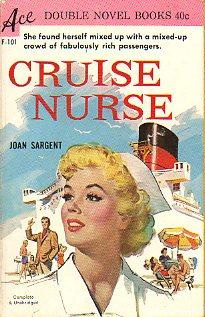
Cruise Nurse

By Joan Sargent
(pseud. Sara Jenkins Cunningham), ©1960
Cover illustration by Robert Maguire
 
Sheila Dorrance was young and lovely, and determined to make the most of her God-given assets. With memories of her impoverished youth always in back of her mind, she set out to use her nurse’s training as a passport to wealth and luxury. And the job as ship’s nurse on the pleasure liner Southwind certainly provided ample opportunity. There were any number of wealthy playboys aboard, and more than one of them was interested in wining and dining—and maybe even marrying—the pretty young nurse. But in spite of her longing for luxury, Sheila found herself falling for the Southwind’s dedicated young medical officer. And she knew that before her job as cruise nurse was over, she would have to decide whether her destiny was to be ruled by her head … or her heart!
 
GRADE: B+
 
BEST QUOTES:
“You couldn’t be sure how an intern might turn out; he might be one of those who could think only of serving humanity and would never bother to collect a bill.”
 
“You never can tell young people anything. They always know everything.”
 
“After we’re back home, I want your job to be me.”
 
REVIEW:
Our heroine, 21-year-old Sheila Dorrance, is admittedly shallow: She decided to be a nurse so she could “meet a doctor or a prosperous patient, marry him, and never again have to worry about being poor.” She is quite candid with her aspirations with Dr. Peter Stowe, the young doctor on board the cruise ship where she is working; he turns out to be one of the noble types who interned at a local charity hospital and so is off her banquet table. But after an initial spat about it, he seems to forgive her, because after all, she’s a very competent nurse.
 
Sheila soon meets Clay Masters, an apparently wealthy young man with pressed white linen pants. Soon he’s beauing her around the Caribbean ports—she’s on the night shift her first week—and she’s dreaming of sparkly diamond rings. But she is also growing to like—take a guess—the good Dr. Peter, who is a sturdy, dependable sort and less inclined toward frivolous parties than Clay. So one evening, when Clay loses his head on a moonlight deck and kisses her a bit too much, Sheila panics and tells him that she isn’t ready to be serious. She soon tells her friend Peter, explaining that though she hasn’t ascertained Clay’s net worth, she hasn’t really thought about it much, only that she has fun with him, and that this isn’t enough to base a marriage on. He laughs, “Sheila Dorrance, you’re a fraud. You’re not honestly looking for a rich man. That’s just the way you talk.”
 
Soon Sheila is encouraging Clay to take out mousy Elise Ferrier, a browbeaten millionairess whose mother all but chains Elise to the radiator to keep her under her thumb. Mrs. Ferrier has been felled by her appendix and is recuperating ever so slowly in sick bay, leaving Elise to her own devices for the first time in her life, and she likes it!
 
The book trots along predictably, but there’s nothing wrong with that if it’s an enjoyable ride. The scenery—Havana, Haiti, Kingstown—is well-drawn, and as the plot progresses we are offered increasing glimpses into people’s characters. Clay, says his sister, enjoys taking Elise out because he can boss her around, and “this one would mean ‘love, honor, and obey’ if she said it.” When Sheila expresses surprise at this characterization, Angela Masters replies, “You didn’t know him very well, did you?” Touché, but to Sheila’s credit, this was one of her own objections to getting too deeply involved with Clay. Though the poor little rich girl does grow a bit of a spine, standing up for herself when her mother tries to insist that Elise stop seeing Clay, she doesn’t make any superhuman recovery. She’s always going to be emotionally fragile, Sheila realizes: “Elise would always need somebody who could make most of her decisions, somebody she thought wise beyond anything human.”  The thought of feeling that way about someone makes Sheila herself snort in disgust, so we are left to feel pleased that Sheila was saved from Clay—who in the end turns out not to be rich, after all, so double phew! And on a tour of the Trinidad countryside, where the children are mostly naked with the swollen bellies of severe protein deficiency, Sheila and Peter’s taxi breaks down, and Sheila spends an afternoon at the hut of a rural woman and her seven children, coming to realize what real poverty is.
 
This is a fun little book, with a pleasant population, interesting armchair travel, and an occasional dose of humor. The writing is quite good as far as VNRNs go, and the plausible evolution of the characters is a welcome surprise. My only disappointment is that the book backing this Ace double novel, Calling Dr. Merryman, is not another nurse novel, and so is wasted on me. But apart from that, this is a cruise worth taking, and though there seems to be just a pitiful handful, I will look forward to more novels from Joan Sargent.

Shop this title, now reprinted 
by Nurse Novels Publishing,
at Amazon!


Thursday, January 23, 2014

Down East Nurse

By Sylvia Lloyd 
(pseud. , ©1965
Cover illustration by Martin Koenig
Also published as Dr. Walker’s People
 
Lovely, city-bred Claudia Snowden came to Maine to nurse her aging aunt—isolated in a remote New England village. Expecting to find an old-fashioned doctor using outmoded methods, Claudia found herself working instead with young, handsome Dr. Adams—who was as dedicated as the top-notch physicians she had worked with in the city… so dedicated that Claudia apparently could not tear his attention away from his work to herself. Should she abandon all hope of ever reaching this aloof doctor and say yes to the man who really needed her?
 
GRADE: B+
 
REVIEW:
When we first meet Claudia Snowden, she’s standing in her rich great-aunt’s over-decorated living room in Reachwood, Maine, evaluating the contents for its monetary value (she doesn’t find it) and wondering, “Where was the Snowden money?” She’s been dispatched to this godforsaken backwoods to care for old Elizabeth Snowden, an aging spinster with pneumonia, by her widowed mother in the hope of securing a prominent position in the old bag’s will. But Claudia is not the best option for a special nurse. Upon graduating, she had decided that “she wanted no more of bedside nursing” and had gone to work for an upscale specialist where patients pass quickly through, and “there was no feeling of involvement of responsibility.” She is full of scorn for the country doctor who has not admitted Elizabeth to the hospital, particularly because “when she met a man for the first time, she took for granted that instantaneous spark of interest and admiration in his eyes”—and the look the good Dr. Adam Walker bestows upon Claudia is rather one of scorn. Indeed, he dresses her down for criticizing his treatment plan, telling her that “Miss Libby” has refused hospitalization.
 
So Claudia is stuck in Maine, caring for Aunt Elizabeth. The only friend she has in an unctuous unsuccessful self-proclaimed artist, Chase Carpenter, though “the challenge of capturing Dr. Walker’s interest still remained.” Chase is entertaining, but Claudia has her doubts about him: He leaves his two boys, ages 7 and 8, at home alone; he refuses to pay Dr. Walker’s bill when one of his sons was ill; he shows no compassion for the poor. But when he finally kisses her, she is “astonished” to find that she enjoyed it. “Had she fallen in love at last?” Uh, no, dear. That’s just your glands talking.
 
She’s certainly not impressed with the townsfolk, who, though they regularly drop by with a bucket of milk or a cold ham for Miss Libby, aren’t warm and embracing. Indeed, Claudia finds them taciturn and coldly aloof, narrow-minded and insular. So when Aunt Elizabeth is clearly on the mend, Claudia is about to blow town when Chase falls out of the loft where he paints and shatters his leg, requiring surgery. He refuses to go to the hospital, however, unless Claudia stays with him morning and night. To get him to go, she agrees, thereby cementing his idea that she is in love with him, loudly proclaiming to every patient and healthcare professional that Claudia is “his girl,” much to her chagrin. Oddly, however, she doesn’t seem able to correct him on that score. But at the short-staffed hospital she helps out when she’s not rubbing Chase’s back, and manages to make herself useful, even coming to feel attached to a few of the patients.
 
Then comes the unfolding of a commonplace plot: Adam is cold to Claudia because he thinks she’s engaged to Chase, and she can’t bring herself to tell him—or Chase—that she’s not. It’s one of the more idiotic turns, because it seems utterly ludicrous that she can’t just open her mouth and start talking. But the book is largely redeemed by the way it presents her gradual unbending into a less grasping and materialistic individual into a caring, conscientious professional and human being. I also appreciated that Adam is always depicted as an admirable person; his initial disdain for Claudia is well-deserved and we know it, so we are spared another VNRN convention that I cannot stand, the complete ass presented as a dreamboat. The ending hits a small rough patch, though, with a dark secret from Adam’s past revealed but never really resolved. If the writing gives us nothing for the Best Quotes category, it goes down easy, and overall this is a pleasant enough book.

Friday, January 3, 2014

Hurricane Nurse


By Peggy Gaddis ©1961
Cover illustration by Harry Bennett
 
Betsy Stockwell had been taught in nurse’s training to maintain an impersonal attitude toward her patient. Only then could a nurse do her job efficiently. But when the patient was your own father, though, how could you be anything but deeply, personally involved? For Betsy’s father, the beloved Dr. Cal, had had a heart attack and after his treatment in the hospital it would be up to Betsy to see that he made a full recovery. Postponing her plans to marry young Doctor Paul Norbert, Betsy accompanies her father to Florida. They are met by a handsome young doctor who practices medicine with a cool competence that both amazes and infuriates Betsy. What is a man like Mark Everett doing in this Florida wilderness? As Betsy begins to learn the answer, she finds that her interest is more than a professional one …
 
GRADE: A-
 
BEST QUOTES:
“Funny thing, how all you fellows beat your brains out and wear yourselves to a nub, trying to heal the human race of ills it’s not a bit anxious to lose. So why? The whole world’s about to go boom any day, so why bother to keep people strong and healthy?”
 
“A really top-notch nurse is half the battle in any operation.”
 
REVIEW:
In the first chapter, Nurse Betsy Stockwell is desperately in love with Dr. Paul Norbert, and they are planning to marry in a few months and move to northern Georgia, where Paul will become a small-town GP in order to pay off a school loan. But then Betsy’s father, surgeon Cal Stockwell, drops of a heart attack after finishing a complex kidney transplant, and has to go somewhere dull for six months to recover, and Betsy insists on going with him. Her separation from Paul is all devotion and sorrow: “I love you very much and couldn’t be untrue to you, ever, not even if I took lessons and tried for years and years,” Paul swears; for her part, Betsy vows, “It’s like that with me, forever and ever and until the day after!”
 
You’ll never guess what happens next. Upon arrival at Blue Heron Cay, Betsy meets Dr. Mark Everett, and the pair takes an instant and deep dislike to each other. This is, of course, a standard VNRN device, but to her credit, Ms. Gaddis meets this head-on. “Love and hate are such terribly strong emotions and only a hair’s breadth separates them,” explains Donna Pruitt, a young hussy who brazenly chases Mark, “and quite often when you think you hate somebody to pieces, you wake up some morning and realize you don’t hate him at all. In fact, you’re nuts about him!” (Betsy responds that it will be a cold day in hell when this happens, and Donna says what we’re all thinking—“Famous last words!”)
 
Betsy attempts to take Donna under her wing and educate the poor misinformed lass about the proper way to win a man: “You can’t win a man by pursuing him that way. Keep him guessing!” she says. Betsy belabors this philosophy through several chapters and repeated sermons: “I think you’re scaring the poor man half to death, going after him as shamelessly as you are. I have a hunch that he’s a man who likes to do the pursuing.” Donna remains blithely unmoved, and it is only Betsy who squirms as Donna links her arm through Mark’s.
 
Then the advertised hurricane strikes, and Betsy and Mark work tirelessly to operate on a four-year-old girl. In their fatigue afterward, Mark holds Betsy’s hand and calls her darling, but surely that’s the lateness of the hour talking! No, Mark insists, they’re in love and must marry, he says the following morning on the beach after the storm has blown itself out. Betsy trots out the specter of Paul, who is no longer described in the adulatory terms we’ve grown accustomed to. Now it’s all obligation: “Paul was counting on her. Depending on her,” she thinks. “She had given Paul her word, and she would live up to it as selflessly and surely as she had lived up to the Florence Nightingale oath.” Again, Ms. Gaddis seizes this metaphoric bull by the horns. “None of which is worth a damn, if you’re not in love with him,” Mark declares. “No man wants a wife who is secretly in love with another man. To go on with your marriage to him would be a wicked, outrageous thing.” But before he has time to carry the point with another smooch, who pulls up to the beach in a battered boat but Donna, and when Mark helps the petrified seadog ashore, Betsy is inanely convinced that Mark will marry Donna.
 
Suddenly Dr. Cal is well enough to leave the island, and Betsy bravely marches back to her job at the hospital, “as though she was walking toward some dreary future.” But she needn’t worry—before too long she catches Paul in the diet kitchen with another woman! She declares herself relieved to be free of Paul, but is still convinced that Mark is going to marry Donna, based on absolutely no evidence apart from Donna’s dogged ambition. Then Donna shows up in Atlanta, shopping for her bridal trousseau: She’s engaged, but—get this—to another man!  Now, however, all Betsy’s lectures to Donna about “chasing” men come back to haunt her, and she tells her father that it would be “too humiliating” to tell Mark that she wants to marry him, after all. Furthermore, “her sense of duty” to a patient she is specialing, a wealthy teenager recovering from a drunk-driving accident, now makes it impossible to visit Mark; why she can’t telephone or write a letter is not explained.
 
But one evening she discovers that the old watchman has allowed her patient’s friends to sneak into the hospital. Totally out of character, Betsy explodes, telling Larry not just that she will have the watchman fired though he is unlikely to ever find another job again, given his advanced age and ignominious behavior, but also that the young father and husband that Larry smashed into was burned to death in the accident, a little fact that Larry’s parents had meant to keep from him. Larry becomes hysterical, and Betsy, with “icy coolness,” “without remorse that she had told him the truth,” shoots him up with a sedative that knocks him out for the rest of her night shift. “She was still blazingly angry at those spoiled brats who broke laws for thrills,” we are told, as if this somehow justifies her brutality. The next morning Larry’s mother lets Betsy go, but for reasons unrelated to her shocking unprofessionalism. This frees Betsy to fly to Blue Heron Cay, where she finds Mark roaming the beach and confesses, “I’m a shameless woman! I’m pursuing you relentlessly!” She tells him that “as soon as I could get myself fired by the patient I was tending, I came straight down here,” as if her scene with Larry was a deliberate, manipulative act meant to free her from her own responsibilities. Now, she decides, “from that moment on she would do whatever was his will.” I wonder what she will do when she decides that obligation is no longer convenient.
 
I was quite pleased with this book up until Betsy’s sudden transformation into a brutal enforcer of punishment to rule-breakers, even more troublesome when juxtaposed with her own “joyous” flouting of a social “rule” that she herself has repeatedly beaten Donna with. Betsy undergoes no reflection on her past attitudes that indicates any growth of character or explains such hypocrisy, and the scene of her unapologetically abusing Larry is actually shocking, offering nothing to the plot but a puzzling glimpse of cruelty in our heroine.
 
Until this point, however, this is a crackerjack book. We get sparkling characters like the quintessential sassy girlfriend, and Mark is a self-assured hero whose initial dislike of Betsy stems from her own snobbery of the island, not from the author’s wish to make him an ass one minute and devilishly attractive the next. The writing offers a self-awareness that is unusual in a VNRN and a welcome change, and we regularly meet enjoyable passages such as, “The boat moved like an elderly lady after a day’s hard shopping, determined to get home but not seeing the necessity of hurrying too much lest she wreck her dignity.” I will even dare to say that I found Mark and Betsy’s crucial scenes to be exciting, which is an extreme rarity in this genre. So though it has a serious flaw in the end, I can still heartily endorse this book as one of Ms. Gaddis’ best.

Wednesday, January 1, 2014

2013 VNRN Awards

I don’t think anyone is more surprised than I am to find that I have actually made it to the fourth annual Vintage Nurse Romance Novel Awards. I’m not sure what it says about me that 220 nurse novel reviews later, I’m still putting along; I just hope it can in some way be construed a good thing.

Rules of the game: Winners are chosen from the VNRNs I have read this year (42 books by 35 different authors). The Best Authors category includes all the VNRNs reviewed for this blog, but only authors with more than one review are included; the One-Hit Wonders category is reserved for the best books by authors with only one review.


BEST BOOKS
1.       Town Nurse, Country Nurse, by Marjorie Lewty
2.       Visiting Nurse, by Jeanne Judson
3.       Nurse Tennant, by Elizabeth Hoy
4.       Nurse Greer, by Joan Garrison
5.       Woman Doctor, by Alice Lent Covert
 
WORST BOOK
     1.       Northwest Nurse
 
BEST COVERS
1.       Northwest Nurse
2.       Eve Cameron, M.D.
3.       Luxury Nurse
5.       Nurse from the Shadows


BEST QUOTES
1.       “Would you like to go down by the river? There are benches, and I promise to behave outrageously.” Jennifer Jones, R.N., by Norman Daniels
2.       “She wished frantically that she were back in some nice safe operating theatre where the worst thing that ever happened at tables was that people died on them.” Nurse Tennant, by Elizabeth Hoy
3.       “Oh, Anne, not you—not you, of all people, wearing trousers!” Leap in the Dark, by Rona Randall
4.       “The marvels of artificial limbs, Lisa, can never be overestimated.” Luxury Nurse, by Peggy Gaddis
5.       “ ‘She pushed me—’ He pointed an accusing finger at Rosemary. I was wholly on Rosemary’s side. We girls must stick together, I thought, and besides, she really did look angelic in that little pink dress.” Town Nurse—Country Nurse, by Marjorie Lewty
6.       “She jerked open the car door and saw the blood gushing from his chest. Instantly she stepped out of her half-slip and started tearing it in strips. I’m glad I wore a cotton one, she thought.” A Nurse Abroad, by Marion Marsh Brown
7.       “ ‘People don’t grow up until they’ve had some banging around,’ he observed.
‘Well, bang me around then,’ she replied. ‘I might like it.’ ” Five O’Clock Surgeon, by Dorothy Pierce Walker
8.       “It’s bad manners to turn down a proposal before the fellow makes it. Gives a sort of impression of overconfidence.” Candy Frost, Emergency Nurse, by Ethel Hamill (pseudonym of Jean Francis WebbIII)
9.       “He’s not a complete Philistine, you know. I told him that I liked French painting, so when I went to see him at St. Agnes’s he talked about impressionism and the romantic movement all through two hernia operations and one gastrectomy.” The Doctors, by Clara Dormandy
10.    “Even at the risk of destroying some beautiful image you might have of us Norberts, I must confess that we still have an ample supply of vermouth.” Island Doctor, by Isabel Cabot (pseudonym of Isabel Capeto)
 

BEST AUTHORS
     1.    Faith Baldwin (3.8 average, based on 4 reviews)
     4.    Marguerite Mooers Marshall (3.7 average, based on 2 reviews)
     4.    Jeanne Judson (3.7 average, based on 2 reviews)
     4.    Patricia Libby (3.7 average, based on 2 reviews)
     7.    Ethel Hamill (3.3 average, based on 3 reviews)
     7.    Helen B. Castle (3.3 average, based on 2 reviews)
     7.    Joyce Dingwell (3.3 average, based on 2 reviews)
     9.    Rosie M. Banks (3.2 average, based on 4 reviews)
     9.    Phyllis Ross (3.2 average, based on 2 reviews)


ONE-HIT WONDERS: Best VNRNs by authors with only one review
1.       “K”, by Mary Roberts Rinehart
2.       A Challenge for Nurse Melanie, by Isabel Moore
3.       Surgical Call, by Margaret Sangster
4.       Nurse Pro Tem, by Glenna Finley
5.       Walk out of Darkness, by Arlene Karson
6.       Nurse at the Fair, by Dorothy Cole
7.       Woman Doctor, Alice Lent Covert
8.       Nurse Greer, by Joan Garrison
9.       Nurse Tennant, by Elizabeth Hoy
10.    Town Nurse—Country Nurse, by Marjorie Lewty